


Budget Car Repair: Save Money Without Cutting Corners
July 2, 2026
TL;DR:
- Budget car maintenance involves spending predictably on essential repairs and routine services. Following manufacturer schedules and performing simple DIY tasks help prevent costly breakdowns and reduce long-term costs. Building a dedicated savings fund and choosing lower-cost, reconstructed vehicles support better financial management over vehicle ownership.
Budget car repair is the practice of maintaining and fixing your vehicle affordably without sacrificing quality or reliability. The average driver spends about 11 cents per mile on routine maintenance and repairs. That adds up to roughly $1,650 a year for someone driving 15,000 miles. The good news? Most of that cost is predictable, manageable, and cuttable with the right habits. This guide gives you a practical, no-nonsense framework for keeping your car running well without watching your wallet cry.
How much should you budget for car repairs?
The 11 cents per mile rule from Experian is your starting point. It translates to about $138 per month for a typical driver. That number covers routine services like oil changes and tire rotations, but it does not account for major failures.
Major repairs get expensive fast. A single average repair costs $838. Transmission replacements run between $5,892 and $6,402. Engine replacements can reach $10,000. Those numbers are not meant to scare you. They are meant to show you exactly why a monthly savings habit beats a panicked credit card swipe.
Treating car maintenance as a fixed monthly expense puts you in control. You stop reacting to surprises and start planning around them. Think of it like a subscription you pay yourself, except the payoff is a car that keeps running.
Here is a quick look at common repair and maintenance costs to help you plan:
| Service | Typical Cost Range |
|---|---|
| Oil change | $35–$75 |
| Tire rotation | $20–$50 |
| Brake pad replacement | $150–$300 per axle |
| Battery replacement | $100–$200 |
| Air filter replacement | $20–$50 |
| Transmission replacement | $5,892–$6,402 |
| Engine replacement | $4,000–$10,000 |
Pro Tip: Set up a dedicated car repair savings account and auto-transfer your monthly estimate into it. Even $100 a month builds a $1,200 cushion in a year, enough to cover most single repairs without stress.
What routine habits most effectively reduce long-term repair costs?
Preventive maintenance is the single most powerful cost-cutting tool available to any car owner. Following manufacturer maintenance schedules avoids costly breakdowns and keeps repair costs manageable over the life of the vehicle. The industry standard is the 30/60/90K schedule, meaning key services happen at 30,000-mile intervals.

Manufacturers designed these intervals for a reason. Skipping them does not save money. It defers costs and multiplies them. A $15 cabin air filter ignored for two years can contribute to HVAC system strain. A $40 coolant flush skipped at 60,000 miles can lead to a $500 radiator repair.
Here are the core habits that protect your wallet most:
- Oil changes every 5,000–7,500 miles. Fresh oil lubricates the engine and prevents wear that leads to expensive internal damage.
- Tire pressure checks monthly. Underinflated tires wear unevenly and reduce fuel economy. A $2 gauge saves you hundreds in premature tire replacement.
- Brake inspection every 12,000 miles. Catching worn pads early prevents rotor damage, which costs three times more to fix.
- Fluid top-offs at every oil change. Coolant, brake fluid, and power steering fluid are cheap. The systems they protect are not.
- Air filter replacement every 15,000–30,000 miles. A clogged filter reduces engine efficiency and can trigger check-engine codes.
- Seasonal checks before winter and summer. Battery health, wiper blades, and tire tread matter most when conditions get extreme.
Learning basic maintenance yourself adds another layer of savings. You cut labor costs and you catch developing issues before they become expensive ones.
Pro Tip: Keep a simple maintenance log in your glove box or a notes app. Record the date, mileage, and service performed. You will never wonder when you last changed your oil, and mechanics will take you more seriously.
How do you find and negotiate with affordable, trustworthy repair shops?
The right mechanic is worth more than any coupon. Independent repair shops consistently offer fairer pricing and more personalized service than dealership service centers or large chains. They also have more flexibility to negotiate, especially on labor.
Here is a practical approach to finding and working with a shop you can trust:
- Ask for recommendations from people you trust. Word of mouth still beats any online review algorithm. A neighbor who has used the same mechanic for five years is a stronger signal than a hundred anonymous stars.
- Always get a written estimate before any work begins. Written estimates and clear communication protect you from surprise charges and give you a paper trail if disputes arise.
- Get at least two or three quotes on non-emergency repairs. Labor rates vary widely between shops. A $200 difference on a brake job is not unusual in the same zip code.
- Ask about coupons, loyalty discounts, and package deals. Many independent shops offer first-time customer discounts or bundled service pricing that is never advertised.
- Negotiate labor costs directly. Labor rates have negotiation potential, particularly at independent shops. Asking politely and paying promptly builds goodwill that pays off on future visits.
- Build a long-term relationship with one shop. Mechanics who know your car’s history catch issues faster and are less likely to oversell services you do not need.
Transparency is the non-negotiable standard. If a shop cannot explain what they are doing and why, that is a signal to walk.
Which maintenance tasks can you safely do yourself?
DIY maintenance is one of the fastest ways to cut low-cost car servicing costs without touching repair quality. Self-performed basic maintenance lowers overall expenses and gives you early warnings of developing issues. Most of these tasks require basic tools and about 30 minutes.
Tasks well within reach for most car owners:
- Engine air filter replacement. Pop the hood, unclip the housing, swap the filter. No tools required for most vehicles. Saves $30–$50 in labor.
- Wiper blade replacement. Takes five minutes. Blades cost $10–$25 each. Shops charge $20–$40 in labor for the same job.
- Tire pressure and tread checks. A $5 gauge and a penny are all you need. Insert the penny into the tread with Lincoln’s head down. If you see all of his head, replace the tires.
- Battery terminal cleaning. A wire brush and a mix of baking soda and water remove corrosion that causes starting problems. Prevents a $150 diagnostic visit.
- Cabin air filter replacement. Usually behind the glove box. Takes 10 minutes and costs $15–$25 for the part alone.
Know your limits. Brake system repairs, suspension work, and anything involving the fuel system belong with a professional. The goal of DIY is to handle what is genuinely simple, not to create new problems. Check your owner’s manual before attempting any task you are unsure about.
What financial strategies help manage unexpected repair costs?
Maintaining a dedicated car repair savings fund based on mileage-driven cost estimates is the most reliable way to handle unexpected repairs without financial disruption. The math is simple. If you drive 15,000 miles a year and budget 11 cents per mile, you set aside $1,650 annually. That fund absorbs most single repairs without touching your emergency savings.
When a repair exceeds your fund, you have options. Many independent shops offer payment plans for larger jobs. Personal loans from credit unions typically carry lower interest rates than credit cards. If you must use a credit card, pay it off within the billing cycle to avoid interest charges that inflate the total cost of the repair.
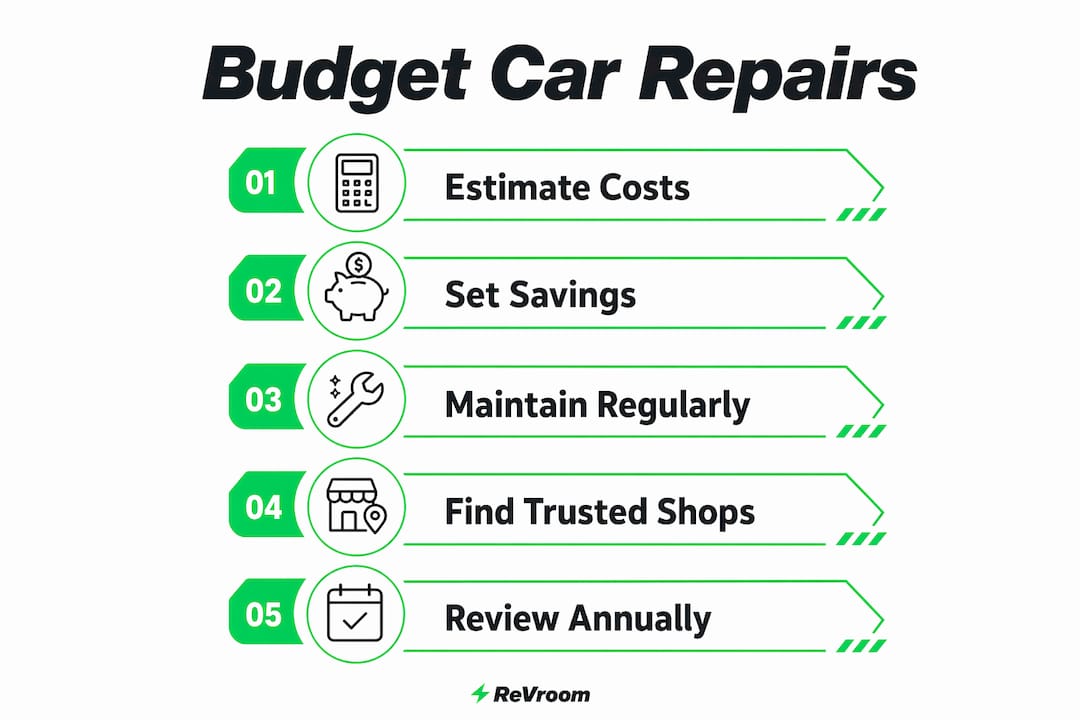
Review your budget annually. If you had three expensive repairs in a year, increase your monthly contribution. If your car ran clean, keep the surplus in the fund. The goal is to make car repairs feel like a planned expense, not a financial crisis. Proactive budgeting, as Experian notes, leads to better control and fewer crises over time.
Key Takeaways
Affordable auto repair is not about finding the cheapest option. It is about spending predictably, maintaining consistently, and choosing shops that respect your time and money.
| Point | Details |
|---|---|
| Budget by the mile | Set aside 11 cents per mile annually to cover routine maintenance and average repairs. |
| Follow the 30/60/90K schedule | Manufacturer service intervals prevent the costly failures that reactive repairs create. |
| Get written estimates | Always request itemized written quotes before authorizing any repair work. |
| DIY the simple stuff | Air filters, wiper blades, and tire checks save real labor costs with minimal effort. |
| Build a repair fund | A dedicated savings account absorbs unexpected repairs without debt or financial stress. |
The real cost of waiting
Here at Revroom, we have watched a lot of car owners make the same expensive mistake: they wait. They skip the $40 oil change and end up with a $2,000 engine repair. They ignore the brake squeal for three months and pay for new rotors on top of new pads. The pattern is so consistent it almost feels like a law of automotive physics.
The owners who spend the least on repairs over time are not the ones who found the cheapest shop. They are the ones who showed up on schedule, kept records, and treated their car like the investment it is. A well-maintained vehicle is also worth more when it is time to sell or trade. That is not a small thing.
We also believe strongly in starting smart. Choosing a vehicle with a lower purchase price and a clean maintenance history gives you a head start on keeping car costs low from day one. The less you owe on a car, the more flexibility you have to maintain it properly. That math works in your favor every single time.
— Revroom Editorial Team
Revroom helps you start with more value
Keeping repair costs low starts before you ever turn a wrench. Choosing the right vehicle at the right price gives you more room to maintain it well.

Revroom is the only online marketplace built specifically for rebuilt title vehicles, where buyers get upfront vehicle history information and photos of what the car looked like before it was repaired. Rebuilt title vehicles are up to 50% cheaper than clean title equivalents. That price difference is real money you can put toward maintenance, a repair fund, or simply keeping in your pocket. Browse Revroom’s rebuilt vehicle listings and see how far your budget actually goes when you start with a smarter purchase.
FAQ
What is a realistic annual car repair budget?
Routine maintenance and repairs average about $1,650 per year for a driver covering 15,000 miles. Setting aside $138 per month covers most routine costs and builds a buffer for unexpected repairs.
How can I reduce my car repair costs without skipping service?
Following the 30/60/90K maintenance schedule prevents the expensive failures that come from deferred service. DIY tasks like air filter and wiper blade replacements also cut labor costs significantly.
Is it worth getting multiple quotes for car repairs?
Getting two or three quotes on non-emergency repairs is one of the most effective ways to save on affordable auto repair. Labor rates vary widely between shops, and independent mechanics often have room to negotiate.
What are the easiest DIY maintenance tasks for beginners?
Engine air filters, cabin air filters, wiper blades, and tire pressure checks are safe and simple for most car owners. These tasks require minimal tools and can save $30–$100 in labor per visit.
How do rebuilt title vehicles help with long-term car budgeting?
Rebuilt title vehicles cost up to 50% less than comparable clean title cars, which means a lower purchase price and more financial room for routine vehicle upkeep. Revroom provides vehicle history information in every listing so buyers can make informed decisions before purchasing.
