


Cars with Frame Damage: Safe Buys or Hard Pass?
August 2, 2026
Yes, you can safely buy a car with frame damage — as long as the repair is documented to OEM standards and the vehicle carries a state-issued rebuilt or branded title. The single most important first step: ask for the state inspection certificate and the frame measurement report before you do anything else.
A solid rebuild comes with a paper trail. Here’s what that looks like:
- State rebuilt title or inspection certificate confirming the vehicle passed a DMV-required safety check
- Full repair invoices listing OEM parts, shop name, dates, and VIN
- Frame rack or laser-measurement printout showing before-and-after readings compared to factory tolerances
- Pre-repair photos showing what the car looked like at the time of the accident
- Alignment printout confirming suspension geometry was restored
If those documents exist, you have something real to evaluate. If they don’t, that’s your answer. A $15 Revroom vehicle analysis can tell you what happened to a specific car, how severe it was, and whether the asking price is fair — before you spend $150 on a full inspection stack.
Table of Contents
- What does “frame damage” actually cover?
- How rebuilt and branded titles work in the U.S.
- What should you check before buying a rebuilt car?
- How a proper structural repair is actually done
- How much can you actually save — and what’s the resale reality?
- Red flags that should make you walk away
- Where to find certified rebuilt cars and how Revroom helps
- Key Takeaways
- The honest truth about buying rebuilt cars
- Revroom makes vetting rebuilt cars fast and affordable
- Useful sources
- FAQ
What does “frame damage” actually cover?
“Frame damage” is a catch-all phrase that covers a wide spectrum. A bent radiator support is routine. Deformation of the main rails or A-pillars is critical structural damage that often requires full component replacement.
The key components that matter for crash protection:
- Front and rear rails (the primary crumple-zone structures)
- A-pillars and B-pillars (the vertical supports flanking your doors)
- Strut towers (the raised mounts supporting front suspension)
- Rocker rails (the structural sills running under the doors)
- Floor pan (the base of the passenger compartment)
Most passenger cars use unibody construction, where the body and frame are one integrated structure. Trucks and large SUVs use a separate ladder frame. The repair philosophy differs: a bent ladder rail on a truck can sometimes be straightened; a crushed unibody rail usually has to be cut out and replaced with a factory-spec section, because the engineered crumple zones can’t be restored by pulling alone.
Boron and ultra-high-strength steel components cannot be straightened at all. Heat destroys their tensile properties, so replacement is the only correct answer. Aluminum structural repairs require dedicated equipment and separate bays — mixing aluminum and steel repair processes causes corrosion that fails silently.
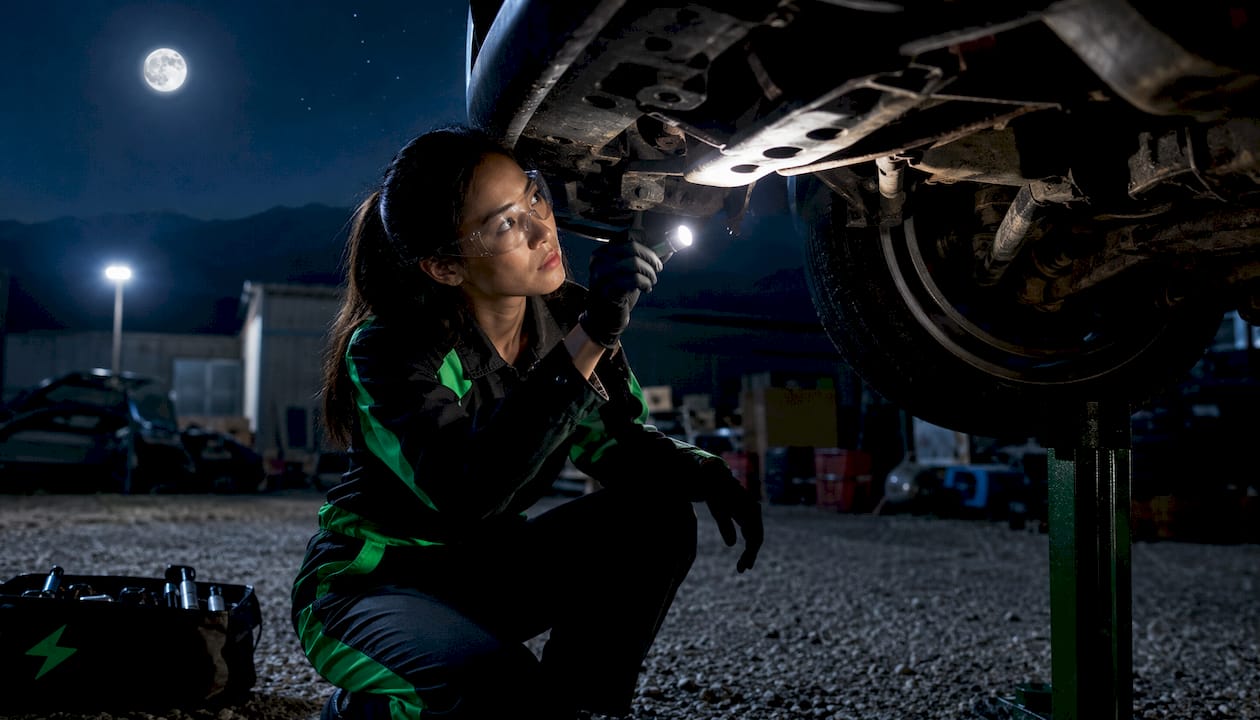
Pro Tip: The components that matter most for occupant protection — A-pillars, B-pillars, rocker rails, and strut towers — are also the ones manufacturers most often require to be replaced rather than straightened. Ask specifically about each one.
How rebuilt and branded titles work in the U.S.
When an insurer decides repair costs exceed a state-defined threshold of the vehicle’s pre-accident value (thresholds vary by state but commonly range from 60% to 100%), it declares a total loss and issues a salvage title. That car cannot be legally driven, registered, or insured in that condition.
A rebuilt or branded title is what happens next. The owner (or a repair shop) fixes the vehicle, submits it for a state safety inspection, and the DMV re-titles it as rebuilt or reconstructed. At that point, the car can be legally registered, insured, and driven as a daily vehicle.
What “certified” means in practice:
- The vehicle passed a state-required physical inspection (rigor varies by state — Georgia requires structural, safety, and emissions checks; others are less thorough)
- The rebuilt title paperwork documents the inspection date and inspector
- Repair invoices and parts documentation were submitted as part of the re-titling process
One important note: frame damage doesn’t automatically mean a salvage title. A vehicle can have significant structural repairs and still carry a clean title if the repair cost stayed below the insurer’s threshold. That’s actually a reason to run a history report on any used car, not just branded-title ones.
Savings reality: Rebuilt and branded title vehicles typically sell for 30%–50% less than equivalent clean-title vehicles. That discount is real and immediate — and it’s permanent on the resale side too.
What should you check before buying a rebuilt car?
Think of this as your on-site checklist. Screenshot it, bring it to the lot, and work through it before you hand over a dollar.
- Request the state rebuilt title and confirm the inspection date and issuing state.
- Ask for full repair invoices — line-item parts with OEM part numbers, shop name, VIN, and dates.
- Get the frame rack or laser-measurement report showing pre- and post-repair readings vs. factory tolerances.
- Review pre-repair photos to understand what the original damage looked like.
- Request the alignment printout confirming thrust angle and suspension geometry were corrected.
- Schedule an independent lift inspection with a certified mechanic who has no relationship with the seller.
- Check for frame-rack clamp dimples on pinch welds — semi-circular indentations that confirm the vehicle was placed on a straightening machine.
- Test drive it. Drive straight on a flat road and check for dog-tracking (rear wheels not following the front path). Note any steering wheel offset, unusual vibrations, or loose cornering feel. A car with properly restored suspension geometry drives straight and corners tightly.
Pro Tip: Insist on seeing the laser-measurement or frame-rack printout — not just the seller’s word that it was measured. A shop that measured the repair will have the numbers. A shop that didn’t will give you vague reassurances instead.
How a proper structural repair is actually done
Good frame repair looks more like precision manufacturing than bodywork. The vehicle goes on a frame rack with laser measurement, reference points are mapped against OEM specs, force is applied in the exact right direction, and the shop measures again before stopping. Eyeballing is not acceptable on a unibody structure.
For critical components, the correct process is OEM sectioning or full replacement — not crude straightening. Manufacturers publish specific cut locations and weld procedures for structural sections. A shop following those procedures will have documentation: stamped OEM part numbers on replacement panels, factory-spec weld patterns, and torque specs on fasteners.
“What were the measurement readings, and how do they compare to OEM tolerance? Which structural components require replacement per OEM procedure, and which are being straightened? If the shop doesn’t have readings, they didn’t measure.” — Crash Lab
One physical red flag worth knowing: heavy, fresh undercoating concentrated around chassis connection points can indicate concealment of structural repairs. A little undercoating is normal maintenance. A thick, sticky layer specifically around frame rails and weld seams on an otherwise clean undercarriage is a reason to look harder.
How much can you actually save — and what’s the resale reality?
The math is straightforward. A clean-title vehicle priced at $20,000 on the open market might sell as a rebuilt or branded title equivalent for $10,000–$14,000. That’s $6,000–$10,000 in immediate savings. The trade-off is that the 30%–50% diminished value is permanent — Carfax and AutoCheck record the history, and future buyers will discount accordingly.
Key financial considerations:
- Financing: some lenders won’t finance rebuilt-title vehicles, or will offer less favorable terms. Ask your lender before you fall in love with a specific car.
- Insurance: liability coverage is usually available at standard rates; collision and comprehensive may be limited or priced higher. Get a quote before purchase.
- Resale: plan to own the vehicle longer to maximize the savings. The discount you got upfront erodes faster if you sell in two years rather than five.
The savings are real. They’re just most valuable when you’re buying a daily driver you intend to keep, not a short-term flip. Learn more about how a rebuilt title affects value before you negotiate.
Red flags that should make you walk away
Some issues are fixable with more documentation. These are not.
Visible red flags:
- Mismatched or jagged weld beads on structural rails — factory welds are consistent and robotic
- Uneven panel gaps, especially doors or hood that look parallelogram-shaped
- New bolts painted body color to blend in with surrounding metal
- Thick, fresh undercoating concentrated specifically around frame connections
Documentation red flags:
- Missing or vague repair invoices with no part numbers or shop name
- No frame-measurement report whatsoever
- No pre-repair photos
- VINs on invoices that don’t match the vehicle
Behavioral red flags:
- Seller refuses to allow a lift inspection — this one alone is enough to walk
- Unwillingness to provide the state inspection certificate
- Pressure for a quick cash deal with no time to verify
If any core structural component — A-pillar, strut tower, rocker rail — was straightened when the manufacturer’s procedure requires replacement, that’s a walk-away situation. The crumple zones have already performed once. They won’t perform the same way again.
For a deeper checklist, Revroom’s guide on red flags when buying rebuilt cars covers physical and handling signs in detail.
Where to find certified rebuilt cars and how Revroom helps
Your main options in the U.S.:
- State-certified rebuilt dealerships: specialize in branded-title vehicles, typically carry full documentation, and can answer detailed repair questions
- Specialty rebuilt-title marketplaces: like Revroom, which require state certification as a listing condition and include pre-repair photos and vehicle history in every listing
- Owner-retained salvage sales: the original owner kept the car after a total-loss payout, repaired it, and re-titled it — documentation quality varies widely, so independent inspection is non-negotiable here
Revroom is built specifically for this market. Every listing on the platform has passed state-required certification confirming it’s repaired and road ready. Pre-repair photos are included in each listing so you can see exactly what the car looked like before it was fixed. And if you’re looking at a rebuilt or branded-title car anywhere — Facebook Marketplace, Craigslist, CarGurus — a Revroom History Report gives you the full picture for $15: what happened, how severe it was, and whether the price is fair compared to clean-title equivalents nearby.
That $15 report replaces the $150 average buyers typically spend piecing together history reports, inspection requests, and price comparisons on their own.
Key Takeaways
A properly documented, state-certified rebuilt vehicle can be a dependable daily driver at 30%–50% less than a clean-title equivalent — if you verify the repair evidence before you buy.
| Point | Details |
|---|---|
| Documentation is everything | Request the state rebuilt title, repair invoices, frame-measurement report, and pre-repair photos before any inspection. |
| 30%–50% savings are real | Rebuilt and branded title vehicles typically sell for 30%–50% less than clean-title equivalents — and that discount is permanent on resale. |
| Measurement proves the repair | Ask for the laser or frame-rack printout; a shop that measured the work will have the numbers on file. |
| Walk-away triggers exist | No measurement report, no pre-repair photos, or a seller who refuses a lift inspection are each sufficient reason to stop the purchase. |
| Revroom cuts verification costs | Revroom listings include state certification, pre-repair photos, and a $15 vehicle analysis report — replacing the $150 average buyers spend vetting rebuilt cars independently. |
The honest truth about buying rebuilt cars
The conventional wisdom says rebuilt-title cars are risky buys for ordinary people. We’d push back on that. The risk isn’t in the title — it’s in the documentation gap. A well-repaired car with a clear paper trail is a genuinely good deal for a budget-conscious buyer who wants a reliable daily driver. The savings are meaningful, the certification process is real, and the verification tools exist to confirm the work was done right. What ordinary buyers actually need isn’t a warning to stay away. They need the same transparency that makes any used car purchase sensible: know what happened, confirm it was fixed properly, and pay a price that reflects the history. That’s exactly what state certification and a thorough inspection deliver. The buyers who get burned on rebuilt cars are almost always the ones who skipped the documentation step, not the ones who asked for it.
Revroom makes vetting rebuilt cars fast and affordable
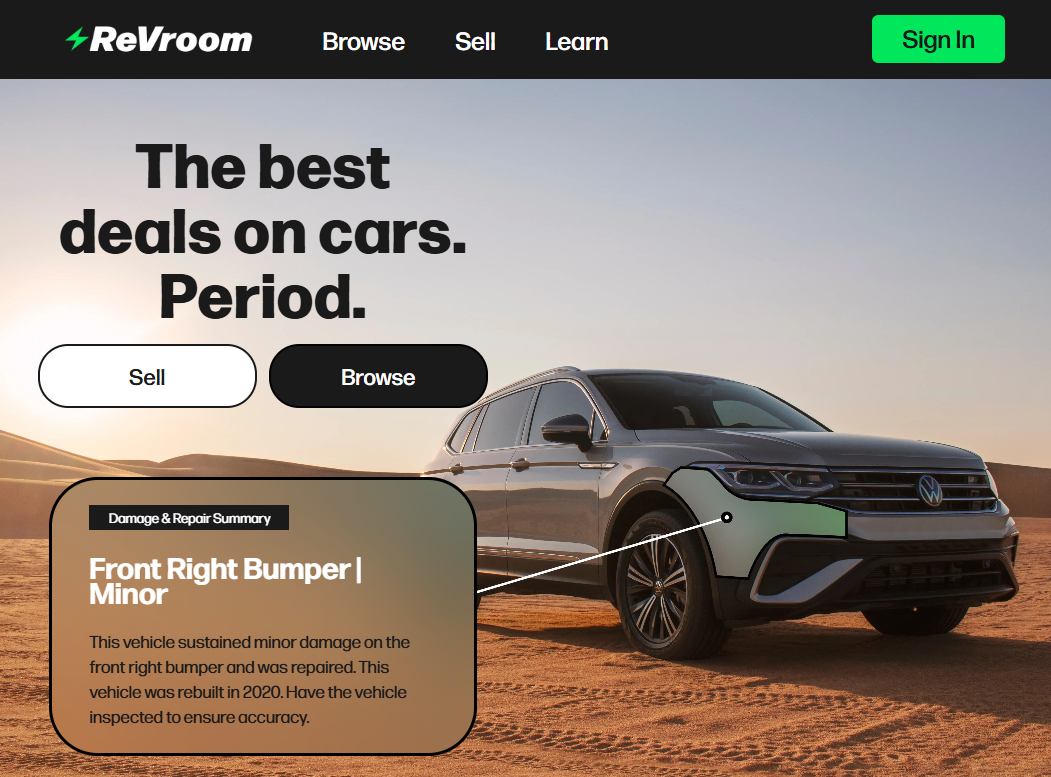
Vetting a rebuilt or branded-title car used to mean spending $150 or more on a stack of reports and inspections before you even knew if the car was worth pursuing. Revroom changes that math. Every listing on Revroom includes state certification, pre-repair photos, and vehicle history upfront — so you can filter for the cars worth your time before you spend a dollar on inspection.
For any rebuilt or branded-title car you find anywhere online, a Revroom History Report gives you the full picture for $15: what the accident was, how severe the damage was, and whether the asking price is fair compared to clean-title vehicles in your area. It’s the fastest way to go from “maybe” to “yes” or “no” with confidence. Browse certified listings or run your first report at revroom.org.
Useful sources
These are the primary references behind this guide. Each one is worth bookmarking for your own verification process.
- TxDMV — Rebuilt Vehicles: Official state guidance on the rebuilt-title process, inspection requirements, and documentation steps. Use this to understand what your state’s DMV expects before re-titling.
- LegalClarity — Frame Damage and Salvage Titles: Explains the relationship between frame damage, total-loss thresholds, and diminished value. Useful for understanding the 30%–50% resale impact and how state thresholds work.
- Crash Lab — Frame Damage Repair vs. Total Loss: The most detailed publicly available explanation of OEM repair procedures, boron steel replacement rules, and laser-measurement standards. Read this before any structural inspection conversation.
- LegalClarity — Pre-Purchase Inspection Checklist: Covers physical inspection cues including pinch-weld clamp dimples and test-drive checks for structural misalignment.
- Kelley Blue Book — Vehicle Frame Damage: Accessible overview of frame damage types, signs to watch for, and the total-loss decision process from an owner’s perspective.
FAQ
Is it safe to buy a car with frame damage?
Yes, if the repair was performed to OEM tolerances and the vehicle carries a state-issued rebuilt or branded title with supporting documentation. Ask for the frame-measurement report and pre-repair photos to confirm the work meets factory specs.
What documents should I request before buying a rebuilt car?
Request the state rebuilt title, full repair invoices with OEM part numbers, a laser or frame-rack measurement printout, pre-repair photos, and an alignment printout. Missing any of these is a red flag worth investigating before proceeding.
How much cheaper are rebuilt title cars than clean-title vehicles?
Rebuilt and branded title vehicles typically sell for 30%–50% less than clean-title equivalents. That discount is immediate and permanent — future buyers will see the history on vehicle reports and price accordingly.
What is a Revroom History Report and how does it help?
A Revroom History Report is a $15 vehicle analysis for any rebuilt or branded-title car. Provide the VIN, price, mileage, and city, and Revroom tells you what happened to the car, how severe it was, and whether the price is fair compared to similar clean-title vehicles in your area.
Does frame damage always result in a salvage title?
No. Insurers declare a total loss only when repair costs exceed a state-defined threshold of the vehicle’s pre-accident value, which varies from roughly 60% to 100% depending on the state. A car with significant structural repairs can still carry a clean title if the repair cost stayed below that threshold.
