


Discounted Cars Buyers Guide: Quality Rebuilt Titles
July 21, 2026
Rebuilt and branded title cars are state-certified, road-ready vehicles that typically cost 20%–40% less than comparable clean-title cars. They’ve been repaired after an insurance company declared them a total loss, then passed a state-required inspection before hitting the road again. That’s the short version. Here’s what every budget-conscious buyer should know before shopping:
- What they are: Vehicles repaired after a total-loss declaration, then re-inspected and re-titled by the state
- What they’re not: Salvage cars. A salvage title means the car hasn’t been repaired yet. A rebuilt or branded title means it has been, and it passed inspection
- The savings: Significantly cheaper than a clean-title equivalent, depending on the vehicle and history
- The trade-off: Resale value is lower down the road—the flip side of the discount you got. Insurance and financing, though, are both readily available
- Where ReVroom fits: ReVroom is the only marketplace built specifically for rebuilt and branded title vehicles, with pre- and post-repair photos, vehicle history, and state certification included in every listing
1. What rebuilt and branded titles actually mean
A rebuilt title is issued after a vehicle previously declared a total loss has been repaired and passed a state-required safety inspection. “Branded title” is a broader term covering rebuilt, flood, hail, theft recovery, and other designations. All of them signal a notable event in the vehicle’s past.
The critical distinction most buyers miss is the difference between salvage and rebuilt. A salvage title means the car is unrepaired and cannot be legally registered or driven. A rebuilt title means it’s been fixed, inspected, and cleared for the road. They are not interchangeable.
State inspection requirements vary. Some states conduct thorough structural and safety checks; others accept documentation review. That variation is exactly why vehicle history transparency matters so much when you’re shopping.
- Rebuilt title: Repaired, inspected, road-legal, and insurable
- Salvage title: Unrepaired, cannot be registered or driven
- Branded title: Umbrella term covering rebuilt, flood, hail, theft recovery, and similar designations
- Clean title: No significant history events; full market value
Pro Tip: Before you buy, pull the vehicle’s history report and confirm the state that issued the rebuilt title. States with stricter inspection standards give you more confidence in what “certified” actually means.
2. Real benefits and honest trade-offs of buying discounted rebuilt cars
The savings are the headline. Rebuilt and branded title vehicles typically cost 20% to 40% less than comparable clean-title cars. For a $30,000 vehicle, you could be looking at $6,000 to $12,000 in savings on the purchase price alone.

The trade-offs are real, too, and you deserve the full picture.
Insurance: You can fully insure a rebuilt title car. Most major insurers offer full comprehensive-and-collision coverage—not just liability—and rates are often comparable to the same car with a clean title. A few carriers ask for a quick photo inspection before writing full coverage, which is why it pays to compare a couple of quotes. Call your insurer before you fall in love with a specific vehicle to confirm your rate.
Financing: Banks and credit unions finance rebuilt title cars, with credit unions often the most flexible. Terms vary by lender—rates depend on your credit and the vehicle, like any loan—so it pays to compare, but the idea that you must pay cash is a myth. For a deeper look at your options, financing a rebuilt car is worth reading before you talk to a lender.
Resale: A rebuilt title reduces starting value and shrinks the buyer pool when you eventually sell. The discount you got as a buyer follows the car. This math works best for people who plan to drive the vehicle for years, not those planning to trade in after two or three—but that’s the same discount you captured buying.
- Significant purchase price savings—typically 20% to 40% less than comparable clean-title cars—depending on the vehicle and its history
- State-certified and road-ready at the time of sale
- Insurance available, including full coverage—just compare a couple of quotes
- Financing available through banks and credit unions; credit unions are often the most flexible
- Resale is lower; long-term ownership is where the value really pays off
3. How to find and evaluate quality rebuilt cars in the United States
The best place to start is a marketplace that does the vetting work upfront. ReVroom lists only rebuilt and branded title vehicles, and every listing includes state certification, vehicle history, and photos of the car before and after repairs. That transparency alone saves you the $150 average cost of independently sourcing that information per vehicle.

If you’re shopping outside a dedicated marketplace, like on Facebook Marketplace or Craigslist, a ReVroom History Report ($15) gives you the vehicle’s full story: what happened, how severe it was, and whether the asking price is fair compared to similar clean-title vehicles nearby.
Your pre-purchase inspection checklist:
- Structural integrity: Check for uneven panel gaps, mismatched paint, and signs of frame repair
- Mechanical systems: Engine, transmission, brakes, and suspension all need a hands-on check
- Safety features: Confirm airbags were replaced, not just reset, and that seatbelts function correctly
- Driver-assistance calibration: Cameras, radar sensors, and lane-keeping systems must be properly recalibrated after structural repairs. A miscalibrated system often won’t throw a warning light
- Documentation: Request repair invoices, before-and-after photos, and the state inspection certificate
- Road test: Drive it on the highway, not just around the block
An independent pre-purchase inspection from a trusted mechanic typically costs $150–$300. Think of it as the cheapest insurance you’ll buy on a rebuilt vehicle.
Pro Tip: After the road test, connect a basic OBD-II scanner (available for as little as $20) and check for pending codes and recently cleared codes. A freshly cleared code history on a rebuilt vehicle is a red flag that the seller may have erased active faults before showing the car.
4. Key questions and negotiation tips for budget-conscious buyers
Walking into a rebuilt title purchase without a checklist is how good deals go sideways. These are the questions worth asking before you hand over any money.
On repair quality and history:
- What caused the total loss, and how severe was the original damage?
- Who performed the repairs, and can you provide invoices and parts receipts?
- Were OEM (original manufacturer) parts used, or aftermarket replacements?
- Do you have before-and-after photos of the repair work?
- Has the vehicle passed a state inspection, and can I see the certificate?
On insurance and financing:
- Have you gotten an insurance quote for this specific vehicle to confirm your rate?
- If you need a loan, have you compared a bank and a credit union for the best terms?
- Does the price still make sense after factoring in insurance and financing?
On negotiating the price: A discount versus clean-title market value is your baseline. If the vehicle has a more complex history (structural repairs, flood, or electrical work), negotiate toward the lower end of that range. If the history is straightforward (hail damage, minor cosmetic repairs), the seller has more ground to hold closer to clean-title pricing. Use the vehicle history report and inspection findings as your leverage.
On warranties and long-term ownership: Most rebuilt title vehicles are sold as-is, with no manufacturer warranty. Some dealers offer limited warranties, but read the terms carefully. Plan your budget for routine maintenance and set aside a small reserve for surprises. The real pros and cons of rebuilt title vehicles are manageable when you go in with clear expectations.
Find your next car on ReVroom
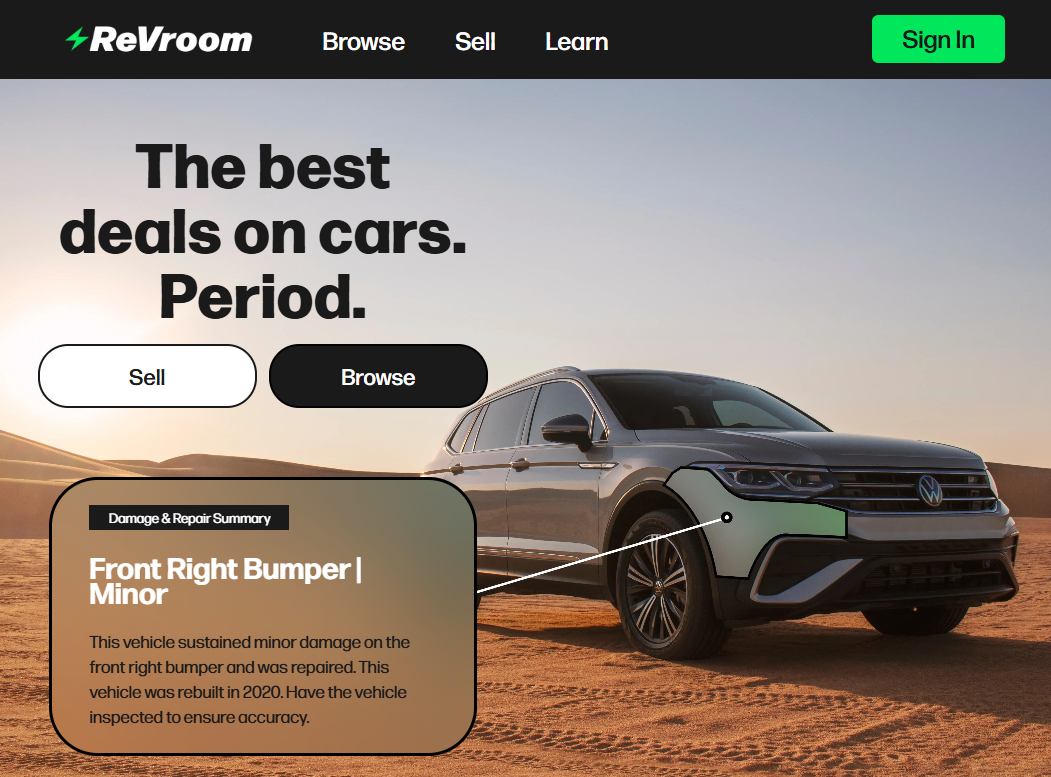
ReVroom is the only marketplace built for rebuilt and branded title vehicles, where every listing includes state certification, vehicle history, and repair photos upfront. No hunting for reports. No guessing about what happened. Just transparent, affordable cars that are ready to drive.
If you’re shopping elsewhere and want to know whether a specific vehicle is worth your time, a ReVroom History Report gives you the full picture for $15. Less than a tank of gas, and it could save you thousands.
Key Takeaways
Rebuilt and branded title cars offer genuine savings for buyers who do their homework, with state certification confirming road readiness and ReVroom’s transparency removing the guesswork.
| Point | Details |
|---|---|
| Savings are real | Rebuilt and branded title vehicles cost less than comparable clean-title cars. |
| Certification matters | A rebuilt title confirms the vehicle passed a state-required inspection and is road-legal. |
| Insurance is available | Full coverage from most major insurers; rates often comparable—compare a couple of quotes. |
| Financing is available | Banks and credit unions lend; credit unions are often the most flexible. Compare lenders. |
| Long-term ownership wins | Resale value is lower, so the math works best for buyers who plan to keep the vehicle for years. |
FAQ
What is the difference between a rebuilt title and a salvage title?
A salvage title means the vehicle has been declared a total loss and has not yet been repaired or inspected. A rebuilt title means it has been repaired and passed a state-required safety inspection, making it legal to register, insure, and drive.
How much cheaper are rebuilt title cars compared to clean-title cars?
Rebuilt and branded title vehicles typically cost 20%–40% less than comparable clean-title vehicles, and in some cases up to 50% less depending on the vehicle’s history.
Can you get full insurance coverage on a rebuilt title car?
Yes. Most major insurers offer full comprehensive-and-collision coverage on rebuilt title vehicles, and rates are often comparable to a clean-title car. A few carriers ask for a photo inspection, so compare a couple of quotes before purchasing.
Is financing available for rebuilt title vehicles?
Yes. Banks and credit unions finance rebuilt title vehicles, with credit unions often the most flexible. Terms vary by lender, so it pays to compare, but the idea that you must pay cash is a myth.
Who should buy a rebuilt or branded title car?
Rebuilt title vehicles work best for buyers who plan to keep the car long-term, confirm insurance and financing upfront, and do a proper pre-purchase inspection. They suit long-term owners more than short-term resellers.
