


Does Carvana Buy Rebuilt Title Cars? Short Answer, Salvage Titles, and Where to Sell Instead (2026)
June 10, 2026
TL;DR:
- Short answer: Carvana's own published requirements do not exclude rebuilt titles. Its help center says it will accept a vehicle that is newer than 1992, has a working odometer, and can be safely driven. What a rebuilt title changes is the offer.
- Carvana's retail standard is no reported accident, fire, frame, or flood history, so a rebuilt car cannot go on its lot. Expect any offer to be priced for the auction exit, not for what the car is worth to someone who wants a rebuilt title.
- Rebuilt-title dealerships and a listing on ReVroom put your car in front of buyers who already know what a rebuilt title means and pay accordingly.
Short answer: Carvana's help center does not say no to rebuilt titles, but do not expect a retail-level number. If you have been told that Carvana flatly refuses rebuilt or branded titles, that is not what Carvana's own pages say, and an older version of this article repeated that myth. We checked Carvana's published requirements directly in September 2026 and corrected it. Here is what Carvana actually says, what that means for your offer, and where a rebuilt title car sells for more.
Does Carvana buy rebuilt title cars?
Short answer: Carvana's published requirements are about age and drivability, not title brands. Its help center says, in its own words, that Carvana "will accept your vehicle if it is newer than 1992, the odometer is in working condition and we are able to safely drive the vehicle," and that all owners listed on the title must be present at the appointment. Nothing on that page excludes a rebuilt, reconstructed, or restored title.

So where does the "Carvana won't touch it" idea come from? From the other side of Carvana's business. Carvana retails cars to everyday buyers with a clean-history promise (more on that below), and a rebuilt title car does not fit that promise. A car Carvana cannot put on its own lot has to leave through a wholesale auction, and the offer reflects that exit. In other words, the answer to "will they buy it" is usually not a hard no. The answer to "will they pay what it is worth" usually is.
Here is how the offer itself works, again per Carvana's own help pages. Your offer is valid for 7 days. If the details and condition you submitted are accurate, the offer does not change at your appointment. Carvana runs automated checks, reviews your photos, and does a final confirmation at pickup, and if it finds a mismatch it generates an updated offer. The VIN you enter pulls the vehicle's history, so a branded title is not something you can leave out and hope for the best.
Pro Tip: Answer the condition and history questions with the rebuilt title disclosed from the start. The number you see after honest answers is the number that survives the pickup appointment. A surprise at pickup only ever moves the offer one direction.
Does Carvana buy salvage title cars?
Short answer: In practice, no. A salvage title means the car was declared a total loss and has not yet been repaired and passed the state inspection that turns it into a rebuilt title. In most states a salvage-titled car cannot be legally driven or registered, and Carvana's stated requirement is a vehicle it is able to safely drive. That combination rules out most salvage cars before any policy question comes up.
You have two real paths with a salvage title. The first is to finish the job: complete the repairs, pass your state's inspection, and get the rebuilt title, which is the point at which the car becomes a normal used car again with a lower price tag. Our guide on how rebuilt cars are retitled walks through that process. The second is to sell the car as-is to a rebuilder or a dealership that buys salvage vehicles and does the work itself. If you are not sure which title you are holding, start with the difference between a salvage title and a rebuilt title.
Does Carvana sell rebuilt or salvage title cars?
Short answer: Not as a rule. Carvana's certified program page says its Carvana Certified vehicles have no reported accidents and no reported fire, frame, or flood history according to CARFAX and AutoCheck, and go through a 150-point inspection. That is a clean-history standard, and it is the reason a rebuilt title car does not fit their retail inventory. If you are shopping for the rebuilt-title discount, Carvana is the wrong aisle.
This matters for buyers as much as sellers. The whole point of a rebuilt title is the price: these cars typically sell for 20 to 50 percent less than comparable clean-title cars, and the savings are real because the history is public and the car had to pass a state inspection to get back on the road. To shop them properly you need a place that treats the history as information instead of a red flag. On ReVroom's marketplace you can filter inventory by history type, from hail and cosmetic paint chips all the way to fire, and by an in-house severity grade, so you can shop for, say, minor-only cars and skip everything else. No other site lets you do that. Each listing shows the history type, the severity grade, and photos of what was repaired, and a ReVroom Report adds the severity graphic, the estimated savings versus clean-title comps, and where and when the car was auctioned.
How much will Carvana offer for a rebuilt title car?
Short answer: Carvana prices each car individually and does not publish a rebuilt-title discount, so nobody can quote you a percentage honestly. What you can predict is the mechanism. A rebuilt title car already trades at 20 to 50 percent under clean-title comps. A buyer who cannot retail the car takes a second cut on top of that, because their exit is an auction, not a customer. Two discounts stacked on one car is why so many sellers walk away from national online buyers feeling shortchanged.
Now compare that with a rebuilt-title dealership. Those dealers retail these cars every day, know what a hail car versus a front-end repair is actually worth, and often pay more than a clean-title lot would, precisely because they are not sending your car to auction. And a private buyer shopping for a rebuilt title on purpose pays closer to the retail number still. Before you accept any offer, put a real number on the car first: our rebuilt title value guide shows how to price against clean-title comps, and where to sell a rebuilt title car ranks every channel by what it typically pays.
What is a rebuilt title and how does it differ from a branded title?
Short answer: "Branded" is the category and "rebuilt" is one brand inside it. A rebuilt title means the car was once declared a total loss, was professionally repaired, and then passed a state inspection to return to the road legally. The wording varies by state: you might see "rebuilt," "reconstructed," "restored," or "prior salvage" on the physical title, but they all describe the same status.

The distinction matters when you sell, because buyers, lenders, and online platforms read the exact wording on your title. Knowing whether yours says "rebuilt" or "reconstructed" is not a minor detail. It is the detail that determines which questions you will be asked and how to answer them. A few other things worth knowing about rebuilt title vehicles:
- Financing is available. Banks and credit unions both finance rebuilt titles, and credit unions are often the most flexible, so shop two or three lenders rather than assuming the first no is final. See can you finance a rebuilt car.
- Insurance is generally available from most providers, despite what you may have read online. Liability is available everywhere; full coverage is offered by most major insurers, so get two or three quotes.
- Resale value is lower than a comparable clean-title car, which is exactly why buyers who know what they are doing seek them out. Rebuilt titles are typically priced 20 to 50 percent below clean-title equivalents.
How Carvana's rebuilt title policy works in practice
Short answer: You get an instant offer based on your VIN and your answers, and that offer is confirmed against the actual car and title at pickup. There is no separate rebuilt-title step; the title brand simply becomes part of the pricing.
Here is how the process plays out, based on Carvana's own description of how it sells and appraises:
- You enter your license plate or VIN, then answer questions about condition, mileage, and features. The VIN pulls the vehicle's details and history.
- Carvana extends an offer that is valid for 7 days. You upload documents to verify you can sell the car and choose how you want to be paid.
- Carvana runs automated checks and reviews your photos.
- At the pickup or drop-off appointment, a final confirmation checks the car and title against what you submitted. If everything matches, Carvana says the offer does not change; if there is a mismatch, it generates an updated offer.
- All owners on the title are present, you sign, and you are paid.
The lesson for a rebuilt title seller is simple: the offer you want to evaluate is the one you get after disclosing the title brand, not the one before. Then compare it with what a rebuilt-title dealership or a private buyer will pay before you commit.
Pro Tip: Run the same car through two or three channels the same week. Offers from national buyers, a local rebuilt-title dealership, and a listing priced against real comps tell you in a few days what the market actually thinks your car is worth.
How selling a rebuilt title car to Carvana compares with other options
Short answer: National online buyers and clean-title dealerships price a rebuilt car for an auction exit. Rebuilt-title dealerships and rebuilt-title buyers price it for what it is. That single difference is most of the gap between offers.
Here is how the channels stack up:
| Selling channel | Speed | Payout potential | Rebuilt title reality |
|---|---|---|---|
| Carvana | Fast | Low | Published requirements do not exclude rebuilt titles; expect an offer priced for a wholesale exit |
| CarMax | Fast | Low | Usually makes an offer, but a rebuilt car goes to its wholesale auction; see does CarMax buy rebuilt title cars |
| Clean-title dealership trade-in | Moderate | Lowest | Cannot retail the car, so the offer prices in an auction exit |
| Rebuilt-title dealership | Moderate | Fair to good | Retails these cars daily and often pays more than a clean-title lot |
| Private sale on ReVroom | Moderate | Highest potential | Built for rebuilt titles; buyers arrive already understanding the history |
Clean-title dealerships are not being unfair when they lowball a rebuilt trade-in. They simply cannot sell it on their own lot, so it is headed to auction the moment you hand over the keys, and the offer prices in that trip. Rebuilt-title dealerships are a different animal: they traffic in these cars, they know the values, and they are often the best trade-in offer you will get. Our guide to whether dealerships take rebuilt title trade-ins covers both kinds.
A private sale gives you the most control over price and the best shot at the full rebuilt-title market value. The tradeoff is finding a buyer who understands what a rebuilt title means, which is exactly the problem a marketplace built for these cars solves.
Practical tips to improve your chances when selling a rebuilt title car
Short answer: Preparation is the single biggest factor in whether your sale goes smoothly or falls apart at the finish line. Documentation of the repairs and the state inspection is the foundation of a credible sale in every channel.
Here is what to have ready before you list or approach any buyer:
- Your physical title with the exact wording. Know whether it says "rebuilt," "reconstructed," or "restored," because that wording is what every buyer's questions are built around.
- State inspection documentation. The certificate or report from your state's rebuilt title inspection proves the car passed and was re-titled. Serious buyers will ask for it.
- Repair records and photos. Invoices, shop documentation, and photos of what was repaired let a buyer see the history for themselves instead of guessing at it.
- Lien release. An unreleased lien is one of the fastest ways to stall a deal. Confirm the title is free and clear before you start.
- A real number. Price against rebuilt-title comps, not clean-title comps, from the start. A car listed at the right number sells; a car anchored to a clean-title price sits.
Pro Tip: Know what a buyer sees when they run your VIN before they run it. Carvana and CarMax both price from vehicle history data, and a private buyer will look too. Presenting the history yourself, with the repair photos next to it, turns the title brand from a surprise into a story.
Where to sell a rebuilt title car instead
Short answer: Go where rebuilt titles are the product, not the exception. In rough order of what they typically pay: a private buyer on ReVroom, a rebuilt-title dealership, a franchise dealership trade-in, then the national online buyers.
- List it on ReVroom. Sell your rebuilt title car on ReVroom and it goes in front of buyers who came looking for a rebuilt title and can filter to exactly your car's history type and severity grade. You are selling the car once, at its rebuilt-title market value.
- Try a rebuilt-title dealership. Dealers who retail rebuilt titles know the values and often beat a clean-title lot's trade-in offer. If you are a rebuilt-title dealer reading this, ReVroom's dealer program puts your inventory in front of the same buyers.
- Trade it in at a franchise dealership if convenience wins. Expect the auction-exit number, and negotiate with that in mind. Franchise stores holding rebuilt trade-ins can move them through ReVroom's franchise program instead of the auction lane.
- Use Carvana or CarMax for speed only. Fast, simple, and priced for the exit. Fine if time matters more than money.
Key takeaways
Short answer: Carvana's own requirements do not exclude rebuilt titles, but its clean-history retail standard means the offer is priced for an auction exit. Sellers who understand that mechanism, and know who actually wants a rebuilt title, get a better number.
| Point | Details |
|---|---|
| Carvana's published requirements | Newer than 1992, working odometer, safely drivable, all owners present. No title-brand exclusion is published. |
| Why the offer is low | Carvana Certified cars have no reported accident, fire, frame, or flood history per Carfax and AutoCheck, so a rebuilt car leaves through auction and the offer reflects that. |
| Salvage titles | Usually cannot be legally driven, so they fail Carvana's drivability requirement. Finish the rebuild or sell to a rebuilder. |
| Who pays more | Rebuilt-title dealerships and buyers shopping for a rebuilt title on purpose. Clean-title lots and national online buyers price for the exit. |
| Documentation | Title wording, state inspection paperwork, repair records and photos, and a lien release are the foundation of a fair sale. |
| Pricing | Rebuilt titles typically sell 20 to 50 percent under clean-title comps. Price against that number, not the clean-title one. |
My honest read on Carvana's rebuilt title policy
I will own something first. An earlier version of this article said Carvana simply does not buy rebuilt title cars. When we went back to Carvana's own help pages this month, that is not what they say. Their published requirements are about the car being newer than 1992, having a working odometer, and being safe to drive. So we fixed it, because a wrong answer on a question this simple is worse than no answer.
Here is the read that survived the fact-check. Carvana is not being unreasonable about rebuilt titles. It built a machine that retails clean-history cars to everyday buyers, and a rebuilt title does not fit that machine, so the car has to go out the back door to an auction. The offer prices that trip. That is a business model decision, not a verdict on your car.
What still frustrates me is watching sellers take that exit number as the car's value. It is not. A rebuilt title car is worth what a buyer who wants a rebuilt title will pay, and those buyers exist, they are informed, and they are shopping. The rebuilt-title dealership down the road often pays more than the clean-title lot. The private buyer on a rebuilt-title marketplace often pays more than both. The sellers who do best are the ones who come prepared, price against the right comps, and go where their buyers actually are.
- Cameron
Where rebuilt title sellers actually find their buyers
If Carvana's number is not the one you want, ReVroom is worth a serious look.
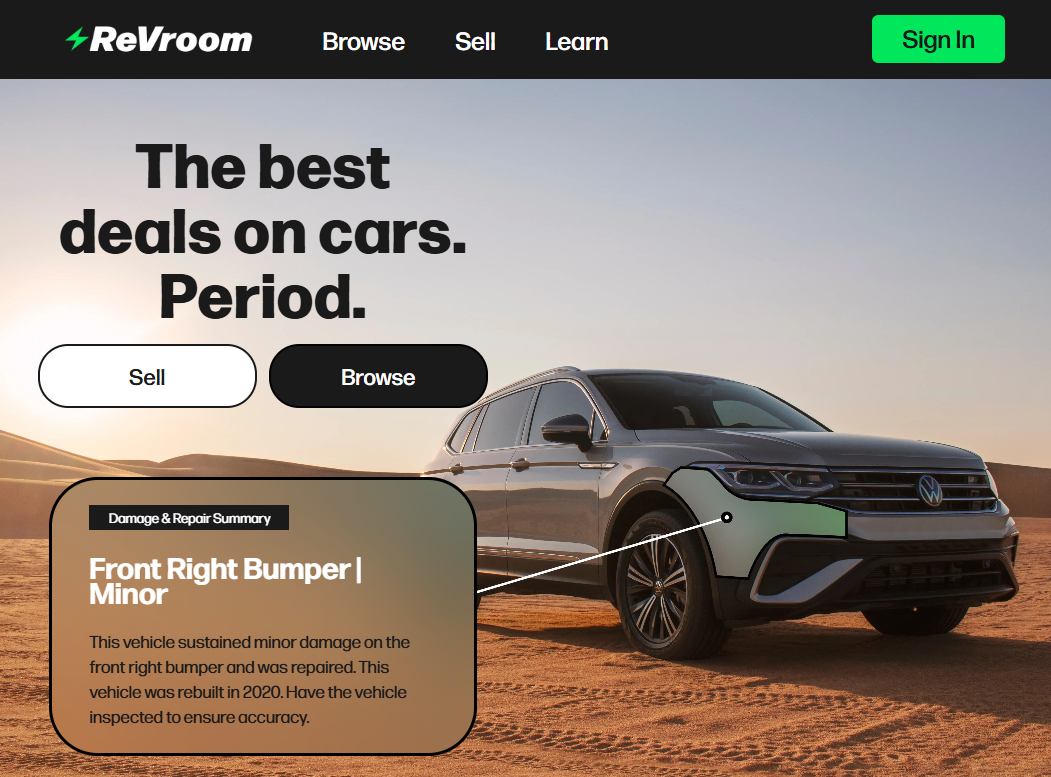
ReVroom is the only online marketplace built specifically for rebuilt and branded title vehicles. Every listing shows the vehicle's history type, an in-house severity grade, and photos of what was repaired, so buyers arrive informed and ready. You are not trying to convince a skeptical general audience. You are reaching people who already know what a rebuilt title means and are actively shopping for the value these cars represent. If you are ready to list your rebuilt title car with buyers who get it, that is where the conversation starts. You can also read how to best sell a rebuilt title car in 2026 to go in with a plan.
FAQ
Does Carvana accept rebuilt title cars?
Carvana's published requirements say it will accept a vehicle newer than 1992 with a working odometer that it can safely drive, and they do not mention title brands. A rebuilt title mainly changes the offer, because Carvana's retail standard is no reported accident, fire, frame, or flood history, so a rebuilt car is priced for the auction exit rather than the retail lot.
Does Carvana buy salvage title cars?
In practice, no. A salvage title means the car has not yet been repaired and re-inspected, and in most states it cannot be legally driven or registered. Carvana's requirement is a vehicle it can safely drive. Finish the rebuild and get the rebuilt title, or sell the car as-is to a rebuilder or dealer who buys salvage.
Does Carvana sell rebuilt or salvage title cars?
Not as a rule. Carvana says its Carvana Certified vehicles have no reported accidents, fire, frame, or flood history according to Carfax and AutoCheck and pass a 150-point inspection. That is a clean-history standard. To shop rebuilt titles and filter by history type and severity, use a marketplace built for them, such as ReVroom.
How much will Carvana offer for a rebuilt title car?
Carvana prices each car individually and does not publish a rebuilt-title discount. Because a rebuilt car does not fit its retail inventory standard, expect an offer priced for a wholesale auction exit, which is usually well below what the car brings from a rebuilt-title dealership or a buyer who is shopping for a rebuilt title on purpose.
Will Carvana's online offer hold if my car has a rebuilt title?
Carvana says an offer is valid for 7 days and will not change if the details and condition you submitted are accurate. It runs automated checks, photo reviews, and a final confirmation at pickup, and generates an updated offer if it finds a mismatch. Disclose the rebuilt title upfront so the number you see is the number you get.
Who buys rebuilt title cars for the most money?
Usually a buyer who wants a rebuilt title on purpose: a private buyer on a rebuilt-title marketplace like ReVroom, or a rebuilt-title dealership that retails these cars every day and knows what they are worth. Clean-title dealerships and national online buyers tend to price the car for an auction exit.
What documentation do I need to sell a rebuilt title car?
Your physical title showing the exact brand wording, the state inspection paperwork from when the car was re-titled, repair records and photos, and proof that any lien has been released. All owners listed on the title should be available to sign.
Can I get a fair price selling a rebuilt title car privately?
Yes. A private sale to a buyer who understands rebuilt titles usually brings the highest number because you are selling the car once, at its rebuilt-title market value, instead of taking a wholesale offer. Rebuilt title cars typically sell for 20 to 50 percent under comparable clean-title cars, and that is the number to price against.
Recommended
- Does CarMax Buy Rebuilt Title Cars? Short Answer, Salvage Titles, and Where to Sell Instead (2026)
- Do Dealerships Take Rebuilt Title Trade-Ins? Yes, But Read This First (2026)
- Where to Sell a Rebuilt Title Car: Every Option Ranked (2026)
- How to Best Sell a Rebuilt Title Car in 2026
- Can You Finance a Rebuilt Car?
- The Difference Between a Salvage Title and a Rebuilt Title
