


Does a Rebuilt Title Mean a Car’s Ready for You?
February 26, 2026
Anyone shopping on a budget knows how quickly car prices add up. The search for reliable wheels at an affordable price often leads to vehicles with a rebuilt title, which offer real savings compared to clean-title options. Understanding what a rebuilt title actually means — and how to read a car’s specific history — lets you find a safe, roadworthy car with a transparent vehicle history and keep more money in your pocket.
Table of Contents
- What Does A Rebuilt Title Really Mean
- Where Rebuilt Titles Come From
- The Inspection And Approval Process
- What Rebuilt Titles Are Not
- Understanding The Value Proposition
- How A Vehicle Earns A Rebuilt Title
- Rebuilt Vs Clean Title: Essential Differences
- State Laws And Inspection Requirements
- Buying A Rebuilt Title Car: What To Know
Key Takeaways
| Point | Details |
|---|---|
| Rebuilt Title Definition | A rebuilt title means a vehicle was previously declared a total loss, then repaired and restored to meet state safety standards. |
| Inspection Process | Rebuilt vehicles must pass a state-mandated inspection confirming safety and repair legitimacy, though standards vary by state. |
| Price Advantage | Rebuilt title cars are typically priced 30–50% lower than clean-title vehicles — substantial savings for budget-conscious buyers. |
| Read the History | The car’s specific history and repair records are what matter most — which is exactly what ReVroom puts up front. |
What Does a Rebuilt Title Really Mean
A rebuilt title is the legal classification given to a vehicle that was previously declared a total loss by an insurance company, then repaired and restored to roadworthy condition. Think of it as a second-chance designation — the car earns a new identity after being brought back and re-certified.
The path to a rebuilt title follows a specific process. A vehicle once declared a total loss goes through repairs and a state inspection before earning its rebuilt status. This isn’t a rubber-stamp approval; it’s a documented recovery.
Where Rebuilt Titles Come From
Rebuilt titles originate from a range of vehicle histories — and they’re not all the same. The event that triggered the total-loss label varies widely:
- Accident damage: Vehicles in collisions that exceeded repair-to-value thresholds
- Weather and water damage: Cars affected by flooding, hail storms, or other environmental events
- Fire damage: Vehicles that survived a fire and were subsequently restored
- Theft recovery: Cars recovered after being stolen, often with minimal actual damage
- Manufacturing issues: Vehicles with factory problems that warranted a total-loss declaration
The category matters because it shapes what you’re actually buying — a theft recovery is a very different story from a flood car, which is exactly why seeing the history up front is so valuable.
Here’s a quick reference to common rebuilt-title sources and where to focus your inspection:
| Rebuilt Title Source | What to look at | Inspection focus |
|---|---|---|
| Accident damage | Structural alignment, repair quality | Frame & chassis integrity |
| Flood damage | Electrical, corrosion | Wiring, undercarriage condition |
| Fire damage | Heat effects, electronics | Interior, electronics functionality |
| Theft recovery | Replaced parts, missing items | Confirm all features present |
| Manufacturing issues | Paint, repair history | Paint quality, records |
The Inspection and Approval Process
Once repairs are complete, a rebuilt title vehicle must pass a state inspection before it’s legally drivable. These inspections verify that critical safety systems work properly and that the repairs meet the state’s standards.
Inspection rigor varies by state, and passing means the car meets the requirements to operate on public roads. Pair that certification with the repair records and your own inspection and you have the full picture.
A rebuilt title means a car has been repaired and inspected — not that it’s brand new. What matters is the specific history and repair quality behind it.
What Rebuilt Titles Are Not
Clarity matters here. A rebuilt title is different from a clean title, and it’s also different from a salvage title. The terms get jumbled online, so let’s be precise:
A rebuilt title means the vehicle has been repaired and inspected. A salvage title means the vehicle has been declared a total loss and has not yet been repaired and re-certified. ReVroom exclusively handles rebuilt title vehicles — not salvage titles.
Getting this distinction right removes a lot of unnecessary worry. You’re not taking on an unvetted risk; you’re choosing a vehicle with a documented history that has passed state inspection.
Understanding the Value Proposition
Rebuilt title vehicles typically cost 30–50% less than comparable clean-title cars. That discount reflects market perception, not inherent inadequacy — many rebuilt vehicles run reliably for years.
Part of the discount comes from outdated myths (like the idea that you can’t insure or finance one), and part reflects the fact that every rebuilt car has a specific history worth reading. With tools like ReVroom’s transparency features, you make that choice with your eyes wide open.
Pro tip: Request detailed photos and repair records from the seller before making an offer. Knowing exactly what was fixed helps you decide whether a specific rebuilt vehicle fits your needs.
How a Vehicle Earns a Rebuilt Title
Earning a rebuilt title isn’t magic — it’s a structured process that turns a totaled car into a legal, drivable vehicle. Understanding it helps you appreciate what you’re actually buying.
The process starts when an insurance company declares a vehicle a total loss. This happens when repair costs exceed a set percentage of the vehicle’s market value — often around 70–80%, though it varies by state. At that point the car becomes salvage property, and the insurer typically takes ownership.
The Repair Phase
Once a vehicle is marked salvage, the real work begins. Thorough repairs to restore roadworthiness include replacing damaged structural components, fixing mechanical systems, and restoring all safety features to working condition.
This isn’t cosmetic touch-up work. It means:
- Structural repairs: Frame straightening, welding, or replacement of damaged sections
- Mechanical restoration: Engine, transmission, and drivetrain repairs or replacements
- Safety system repairs: Airbags, brakes, electrical systems, and steering components
- Parts replacement: New or quality used parts from reputable suppliers
The quality of these repairs depends on the shop doing the work — which is why the repair records matter.

The Inspection Requirement
After repairs are complete, the vehicle must pass a state-mandated inspection. This is the gatekeeper moment — inspectors verify that safety systems work and that parts are legitimate and properly installed.
States differ in inspection rigor. Passing means the car meets the state’s standards to operate on public roads.
Passing inspection confirms a rebuilt vehicle meets safety requirements. Pair it with the repair records and your own inspection for the complete picture.
The Retitling Process
Once inspection passes, the vehicle receives a new title branded “rebuilt.” That document reflects the car’s history and current status. Retitling involves submitting the inspection documentation to your state’s DMV along with proof of ownership.
The rebuilt title then stays with the vehicle permanently, so future buyers always see it in the history report — the transparency that makes these cars easy to shop with confidence.
What This Means for Buyers
A vehicle that completes this process has proven it meets the state’s safety and legal standards. Reading the repair records and getting an independent inspection is how you go from “roadworthy” to “confident.”
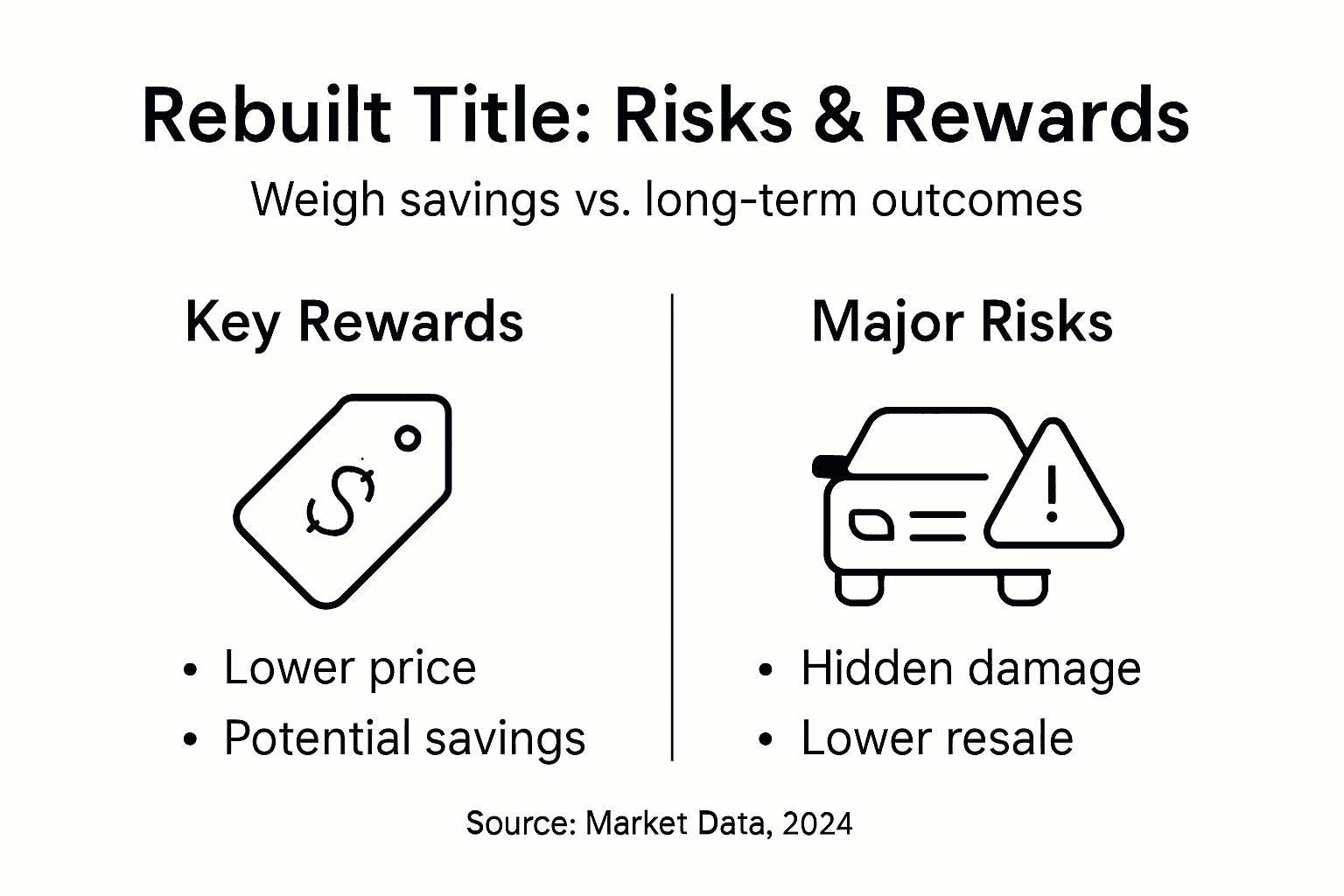
Pro tip: Ask sellers for the repair documentation, photos of the damage before repairs, and records of which parts were replaced versus repaired. That paper trail shows you exactly what you’re buying.
Rebuilt vs Clean Title: Essential Differences
Clean titles and rebuilt titles represent different vehicle histories. The distinction affects your purchase decision, insurance, resale value, and peace of mind.
A clean title means a vehicle has never been declared a total loss. It has an ownership history with no major total-loss claim. That doesn’t mean the car is perfect — it could have minor accidents or wear — just that nothing rose to a total-loss designation.
A rebuilt title tells a different story. A rebuilt title is permanent and cannot revert to clean, even after years of perfect operation. It permanently discloses that the car was once a total loss and has since been repaired and inspected.
Key Differences at a Glance
- Damage history: Clean titles have no total-loss history; rebuilt titles disclose a documented prior total loss
- Insurance: Both are insurable; rebuilt title rates can run somewhat higher, so compare quotes
- Resale value: Clean titles retain value better; rebuilt titles carry a discount (usually 30-50%)
- Permanence: Clean titles can stay clean; rebuilt titles are permanent
- Transparency: A clean title’s minor history may be unknown; a rebuilt title discloses the major event up front
The Truth About Clean Titles
Here’s something counterintuitive: a clean title doesn’t guarantee a damage-free history. A car could have been in multiple accidents or suffered water damage — but if it never reached the total-loss threshold, the title stays clean.
In other words, a clean title can hide more than a rebuilt one discloses. You won’t know about unreported minor accidents without digging into the history.
Why Rebuilt Titles Get a Bad Reputation
Rebuilt titles carry an unfair stigma partly because the designation is visible and permanent. You can’t hide a rebuilt title — it’s right there in the history report. Clean titles benefit from invisibility bias; anything that wasn’t reported stays hidden.
The reality is more nuanced. A rebuilt vehicle that’s been properly repaired and inspected can be a smarter buy than a clean-title car with an undocumented accident history.
A rebuilt title means known, documented, repaired damage. A clean title only means damage never triggered a total loss — not that there was none.
Insurance and Resale Implications
A rebuilt title does affect insurance rates and resale value, but not in the scary way it’s often described. You can insure a rebuilt title car — most major insurers cover them, and full coverage is widely available; rates can run somewhat higher, so it pays to compare quotes. On resale, expect the same discount you enjoyed as a buyer to carry forward.
Clean titles are simpler to quote and hold value closer to market comparables — the trade-off for paying full price up front.
Here’s a summary comparing clean vs rebuilt titles by buyer priority:
| Priority Area | Clean Title Vehicle | Rebuilt Title Vehicle |
|---|---|---|
| Vehicle History | Unreported minor damage possible | Known, documented major repairs |
| Insurance | Standard, easy to quote | Available (full coverage too); compare quotes |
| Resale Value | Higher, easier to sell | Lower — the flip side of the discount you got |
| Transparency | Limited without reports | Full disclosure up front |
| Financing | Most lenders eligible | Banks and credit unions both lend; shop terms |
Making Your Decision
The choice comes down to your priorities. Clean titles offer simplicity and higher resale value. Rebuilt titles offer real savings and a transparent, documented history — an excellent choice when you read that history and buy on purpose.
Pro tip: When comparing a clean-title car to a rebuilt one, request the accident history for both. You may find the “clean” car has undocumented damage while the rebuilt car’s history is fully disclosed and professionally repaired.
State Laws and Inspection Requirements
Rebuilt title regulations vary by state, but they share a goal: protecting consumers and ensuring vehicle safety. Understanding your state’s requirements is helpful before you buy.
Every state has its own approach. Some are strict and thorough; others have lighter requirements. This patchwork means a rebuilt vehicle titled in one state may face different scrutiny in another.
Common Standards Across States
State laws emphasize comprehensive inspections verifying structural soundness and repair legitimacy. Most states require:
- Structural inspection: Verifying the frame and chassis are sound
- Safety system checks: Brakes, steering, lighting, and airbags
- Anti-theft verification: Confirming the VIN matches documentation
- Emissions testing: Where applicable
- Repair documentation: Records of what was fixed and by whom
These requirements exist to keep unsafe vehicles off the road and protect you from fraud.
State-Specific Variations
Individual states set their own thresholds and procedures. Some require inspections at certified facilities only; others allow private mechanics. Damage thresholds vary too — one state might set the total-loss line at 70%, another at 80% — so identical vehicles can carry different title statuses depending on location.
The Inspection Process
Most states require a dedicated rebuilt title inspection by authorized inspectors. Vehicles must pass structural and mechanical safety inspections meeting state codes to qualify. The inspection typically takes 1–2 hours and covers:
- Frame and structural components
- Engine and transmission operation
- Brake system functionality
- Steering and suspension integrity
- Lighting and electrical systems
- Safety features like airbags
If a vehicle doesn’t pass, additional repairs and re-inspection are required before it earns rebuilt status.
Seller Disclosure Requirements
In most states, sellers must disclose the title brand — it’s non-negotiable, and hiding a rebuilt title carries legal penalties. You have the right to know a vehicle’s title status before purchase.
State inspection requirements ensure rebuilt vehicles meet safety standards — and the disclosure rules ensure you always know what you’re buying.
Pro tip: Ask the seller for a copy of the original inspection report so you can confirm the vehicle passed all required safety checks.
Buying a Rebuilt Title Car: What to Know
Buying a rebuilt title vehicle is a smart-money decision when you read the car’s history and match it to your needs. Here’s how to think about it.
The headline benefit is price. Rebuilt title cars typically cost 30-50% less than comparable clean-title vehicles. For budget-conscious buyers, that discount makes a reliable car affordable when clean-title options feel out of reach.
The Rewards
- Real savings: 30-50% discounts create genuine budget flexibility
- Transparent history: Documented repairs beat undocumented, hidden damage
- Quality repairs: Many rebuilt vehicles are thoroughly restored by professional shops
- Insurance and financing available: Most insurers cover rebuilt titles and lenders finance them, despite the old myths
- Second-chance vehicles: Cars that might have been scrapped get a renewed life
What Actually Varies
The one thing that genuinely varies from car to car is the specific history and the quality of the repairs. A theft-recovery vehicle with minimal damage is a different buy from a car with a major structural history. That’s not a reason to fear rebuilt titles — it’s the reason to read the history, which is exactly what a transparent listing lets you do.
Understanding what triggered the total-loss designation is the whole game: hail damage is not the same as structural damage, and the history tells you which you’re looking at.
How to Buy with Confidence
Reading the history turns unknowns into knowns. Inspect in person, request the repair documentation, review the accident report, ask questions, and get a professional pre-purchase inspection from a trusted mechanic. Do that, and a rebuilt title delivers exceptional value.
Rebuilt titles reward buyers who read the history — the transparency is the whole advantage.
Pro tip: Before shopping, list your must-haves: acceptable history types, budget, and financing plan. When you find a rebuilt vehicle that checks those boxes after a solid inspection, you’ll buy with confidence.
Buy Rebuilt Title Cars with Confidence on ReVroom
Shopping for a rebuilt title car is a lot easier when the information you need is already in front of you. ReVroom is the marketplace built specifically for rebuilt and branded title cars, and every listing includes the vehicle’s history along with photos of what the car looked like before repairs — so you can skip the costly investigations and buy smarter.
Every ReVroom listing connects you with vehicles that passed state inspection and come with honest disclosures. And with rebuilt titles typically priced up to 50% below clean titles, your dollar goes much further. Ready to see how a rebuilt title car can fit your needs and budget? Start with ReVroom.

Find your next rebuilt title vehicle today at ReVroom — where every listing tells you the real story behind the car, so “rebuilt” can mean “ready.”
Frequently Asked Questions
What does a rebuilt title mean for a vehicle?
A rebuilt title means a vehicle was previously declared a total loss by an insurance company but has been repaired and passed a state inspection, making it legal to drive again.
How are rebuilt titles different from clean and salvage titles?
A rebuilt title confirms a vehicle was repaired and inspected after major damage. A clean title means no total loss was ever reported. A salvage title means a vehicle was declared a total loss and has not yet been repaired and re-certified.
Can you insure and finance a rebuilt title car?
Yes to both. Most major insurers cover rebuilt titles (full coverage included; rates can run somewhat higher, so compare quotes), and plenty of banks and credit unions finance them — credit unions are often the most flexible.
Are rebuilt title vehicles reliable?
A well-repaired rebuilt title car that passed state inspection can be just as dependable as any used car. Reviewing the repair records and getting a pre-purchase inspection is how you confirm it for the specific car you’re considering.
