


Can You Get a Loan on a Rebuilt Title? How to Finance a Rebuilt Title Car (2026): Quick Answers by Situation, Salvage Title Loans, Who Lends, and the Rates
September 18, 2026
Short answer: yes. Plenty of people finance rebuilt title cars. Some big banks won't touch them, most credit unions look at them case by case, and a lender network can send one application to several lenders that already work with rebuilt titles.
Compared with a clean-title loan, you'll usually see fewer lenders, a rate one to three points higher, and a few more documents to hand over. What stays on your side is the price. A rebuilt car typically costs 20 to 40 percent less, so you borrow less and usually pay less overall.
Below: who lends, the kind of application that tends to get approved, what a higher rate actually costs you each month, and what to bring.
Key takeaways
- You can finance a rebuilt title car. Fewer lenders say yes, but credit unions, some banks and lender networks all do.
- ReVroom's financing page sends one application to several lenders and returns up to 4 offers. In our experience, approvals come more easily with a credit score of 600 or higher, a loan of $8,000 or more, a car 10 years old or newer with under 125,000 miles, and $21,600 or more in income. Each lender sets its own rules, and ReVroom is not a lender.
- Plan on a rate about one to three points above a clean-title loan. The lower price usually more than pays for it.
- Lenders require full coverage on a financed car, so get an insurance quote using the VIN before you apply.
- Have the title, the state inspection certificate, the repair records and the insurance quote ready in one folder.
Can you get a loan on a rebuilt title?
Short answer: yes. Credit unions, some banks and lender networks all lend on rebuilt title cars. One application through ReVroom's financing page returns up to 4 offers from lenders that consider them.
- Most likely to say yes: credit unions (case by case) and lender networks, which send your application only to lenders that accept rebuilt titles.
- Most likely to say no: large national banks, many of which have blanket policies against branded titles.
- What it costs: often a rate one to three points higher, on a car typically priced 20 to 40 percent below clean-title value.
- What lenders ask for: the rebuilt title, proof of inspection, and sometimes photos or a vehicle history report.
Can you get a loan on a rebuilt title in your situation? Quick answers
Short answer: yes in most situations, and the one real exception is a car that still carries a salvage title. Find your row below.
Think of it like a restaurant menu with a few dishes marked "ask your server." Nothing on the list is off the table. Some orders just need a question first.
| Your situation | Can you usually get a loan? | What to do | Go deeper |
|---|---|---|---|
| Buying a rebuilt car from a dealer | Yes, often | Compare a lender network's offers with the dealer's own financing desk | One application, up to 4 offers |
| Buying a rebuilt car from a private seller | Yes, with more paperwork | Ask for a private-party loan and have the title, inspection certificate and bill of sale ready | Private-party offers |
| Buying a salvage car you plan to rebuild | Rarely, while it's still salvage | Pay cash or use a personal loan, then refinance once it's retitled rebuilt | Salvage title loans, below |
| Refinancing a rebuilt car you already own | Yes, often | Shop it like any refinance once you've made a few payments | Refinancing a rebuilt title car |
| Credit under 600 | Harder, not impossible | Bring a bigger down payment and apply to a credit union you belong to as well as a network | Rebuilt title loans with bad credit |
| Your bank already said no | Yes, elsewhere | Big banks are the most likely to decline; credit unions and networks look case by case | Which banks say no in writing |
Every row has the same first step: get an insurance quote on the VIN, because lenders want full coverage on a financed car, then send one application through ReVroom's financing page so several lenders look at the same car at once. ReVroom is not a lender. Still picking the car? Minor-history rebuilt cars are a good place to start, because a car whose history is easy to read is easier for a lender to read too.
What is a rebuilt title, and how is it different from salvage?
Short answer: a salvage car was totaled and hasn't been fixed yet. A rebuilt car was fixed, passed a state inspection and is legal to drive. Lenders finance rebuilt cars, not salvage ones.
When the repair estimate passes a share of the car's value that the state sets, the insurer declares a total loss and the title becomes salvage. After the car is repaired and passes the state's rebuilt inspection, the state issues a rebuilt title. Some states call it reconstructed or branded instead. That inspection is the starting point for any loan. Most rebuilt cars have a collision, hail or vandalism history, and in ReVroom's sales data 87 percent carried only a minor or moderate history grade. For the full comparison, see salvage title vs rebuilt title.

Can you finance a salvage title car?
Short answer: usually not while it's still salvage. Once it's repaired, inspected and retitled as rebuilt, lenders can finance it.
When people search for "salvage title loans," they usually mean one of two different things. One is a loan to buy a salvage car, which most auto lenders won't write until the car is rebuilt. The other is a car title loan, which borrows against a car you already own. Neither is a rebuilt title loan, which is an ordinary auto loan on a car that has already passed its state's rebuilt inspection.
A salvage car hasn't been put back on the road yet, and most states won't register one for driving. Lenders want a car that can be registered and insured, because that's what protects the loan. It's a lot like a mortgage on a house without an occupancy permit: the bank waits until the permit comes through.
| Title on the car | Can you usually get an auto loan? | What to do instead |
|---|---|---|
| Salvage | Rarely | Pay cash or use a personal loan, then repair and pass the rebuilt title inspection |
| Rebuilt, reconstructed or prior salvage | Yes, from credit unions, lender networks and specialty lenders | Compare offers before you shop |
| Clean | Yes | Shop rates as usual |
If a salvage car caught your eye because of the price, you can pay cash for the car and the repairs, or you can buy one that has already been rebuilt and finance that.
Which lenders finance rebuilt title cars?
Short answer: credit unions, some banks, lender networks and personal-loan lenders. Big national banks are the most likely to say no.
| Lender type | Rebuilt titles? | What to expect |
|---|---|---|
| Large national banks | Often no | Many decline branded titles outright under blanket policy. |
| Credit unions and member lenders | Case by case | The most flexible group, especially for existing members with solid credit. Navy Federal (a credit union) and USAA (a bank for military members) generally review rebuilt titles case by case. |
| Lender network (myAutoloan via ReVroom) | Yes, often | One application reaches several lenders that consider rebuilt titles. Up to 4 offers for a purchase, private-party sale or refinance. Free to apply. |
| Specialty and online auto lenders | Often yes | Built for this market; rates run higher to match. |
| Personal (unsecured) loan | Title not evaluated | Approval rests on your credit, not the car; higher rate, shorter term. |
If you belong to a credit union, start there. Then send one network application so you have a few offers to compare, instead of calling branches one by one. Two member lenders get their own guides: Navy Federal rebuilt title loans and will USAA finance a rebuilt title.
Compare lenders in one step
Lenders like Navy Federal and USAA decide case by case. A lender network compares several at once.
One application through myAutoloan, up to 4 offers within minutes. Purchase, private party, or refinance.
Get my offers →Sponsored · myAutoloan
Do you qualify for a rebuilt title loan?
Short answer: there's no single cutoff, because each lender sets its own rules. What we've seen is that buyers whose credit, income, loan size and car fall inside the ranges below get approved more easily.
Use these as a target, not a rulebook. They come from what we've seen work for applications sent through ReVroom's financing page. Missing one doesn't mean a lender will say no, and meeting all of them doesn't guarantee a yes.
| What lenders look at | Range we've seen help (purchase) | Range we've seen help (refinance) |
|---|---|---|
| Credit score | 600 or higher | 600 or higher |
| Loan amount | $8,000 or more | $5,000 or more |
| Vehicle | 10 years old or newer, under 125,000 miles | Same |
| Gross income | $21,600 a year or more | $18,000 a year or more |
| Location and age | 48 states (not Alaska or Hawaii), 18 or older | Same |
Loan size is the one people miss. The median rebuilt car on ReVroom sells for $17,499, well over $8,000. For a $6,000 commuter car, though, a credit union or a personal loan is often the easier route. The age and mileage ranges are about the car rather than you, so keep them in mind while you shop.
Will a typical rebuilt title car fit a lender's limits?
Short answer: usually, yes. The typical rebuilt car sold on ReVroom fits comfortably inside the ranges we've seen lenders approve most easily.
Lenders care about the car as much as the borrower, the way a landlord cares about the apartment and the tenant. So check the car before you check your credit. Here are those ranges next to the median rebuilt car in ReVroom's market snapshot (updated October 1, 2026):
| Range we've seen help approvals | Median rebuilt car sold on ReVroom | Fits? |
|---|---|---|
| Vehicle 10 years old or newer | Model year 2020 | Yes |
| Under 125,000 miles | 55,083 miles | Yes |
| Loan of $8,000 or more | Sold for $17,499 | Yes, unless you put most of it down |
| Credit score of 600 or higher | Depends on you | Check before you apply |
Here's what a higher rate looks like in dollars. This is an illustration, not an offer: a $17,499 car with $2,000 down leaves $15,499 to finance over 60 months.
| Rate (illustration) | Monthly payment | Total interest over 60 months |
|---|---|---|
| 9% | $322 | $3,805 |
| 11% (two points higher) | $337 | $4,720 |
Two extra points add about $15 a month in this example. Meanwhile, the median rebuilt buyer on ReVroom saved $4,590 on the price.
For more detail, see rebuilt title loans in Utah or banks vs. credit unions vs. lender networks. When you're ready, check your offers with one application.
How much will a lender lend on a rebuilt title car?
Short answer: usually the price minus your down payment, as long as the loan fits the lender's rules, including how much it will lend against the car's value. Some lenders lend less against a branded title. Others treat it like any used car.
That limit is called loan-to-value: the loan divided by what the lender thinks the car is worth. The more of your own money you put in, the more comfortable the lender is with the rest. ReVroom's financing page says it plainly: "Some lenders price a branded title higher or cap the loan-to-value; others treat it like any used car."
Here's how that works on the median rebuilt car sold on ReVroom ($17,499), using the financing page's estimator defaults of 6.99% APR over 72 months. This is arithmetic, not an offer:
| Down payment | Amount financed | Over $8,000? | Estimated payment (6.99%, 72 months) |
|---|---|---|---|
| $0 | $17,499 | Yes | About $298 a month |
| 10% ($1,750) | $15,749 | Yes | About $268 a month |
| 20% ($3,500) | $13,999 | Yes | About $239 a month |
A down payment helps twice on a rebuilt title. It lowers your payment, and it gives a cautious lender the cushion it wants.
Is the interest rate higher on a rebuilt title car?
Short answer: often by one to three percentage points. The lower price on the car usually more than makes up for it.
Lenders value a rebuilt car below a clean-title one, so they price the loan for a smaller recovery if it goes bad. But a rebuilt car is typically priced 20 to 40 percent below clean-title value, and across ReVroom's 17,000+ tracked sales the median buyer saved $4,590. A smaller loan at a slightly higher rate usually costs less in total than a bigger loan at the best rate. The payment estimator on the financing page lets you run your own numbers before you apply.
What should you weigh before financing a rebuilt title car?
Short answer: you borrow less, but the car will also be worth less when you sell it. Plan for that.
A lower price means a smaller loan, less interest and a payment that fits your budget. On-time payments build your credit like any car loan, and the title brand never appears on your credit report.
Resale is the part to plan for. The brand stays with the car, so it will sell for less than a clean-title twin later, much like the discount you got when you bought it. Putting 10 to 20 percent down keeps you from owing more than the car is worth, and GAP coverage pays the difference between the insurance payout and the loan balance if the car is totaled. Have an independent shop inspect the car before you buy; our step-by-step buyer's guide walks through it.
Can you get full coverage insurance on a financed rebuilt title car?
Short answer: yes, and you'll need it, because lenders require full coverage on a financed car. Get the quote before you apply.
Progressive publishes that insurers that accept rebuilt titles can typically write liability coverage, and full coverage is commonly reported from the major carriers. A few ask for a photo inspection first or price the car a little differently, so get two or three quotes using the VIN. Claims pay out based on the car's rebuilt-title value, so insure it for what you paid, not the clean-title book price. Our guide to which insurers cover rebuilt title cars names the carriers. Insurers ask for the same papers lenders do (the rebuilt title, the inspection certificate and the repair records), so one folder covers both.
Can you refinance a rebuilt title car loan?
Short answer: yes. The best time is after a year of on-time payments, once your credit score has improved.
Many rebuilt title owners took the first rate they were offered. If your credit is better now, refinancing can lower the payment on the same car. We've seen refinances of $5,000 or more, for borrowers earning $18,000 or more, go through most easily, along with the same credit and vehicle ranges as a purchase. Each lender sets its own rules. ReVroom's financing page handles refinances as well as purchases and private-party sales.
How ReVroom makes buying and financing a rebuilt title car easier
Short answer: you can see the car's history before you call, compare several loan offers from one application, and get a graded report on the history before you buy.
ReVroom is a marketplace built only for rebuilt and branded title cars. Every listing shows what was repaired, with photos where available, and its title status. Private-party listings also show an estimated monthly payment under the price. A ReVroom Report adds an in-house severity grade, a severity graphic, an estimated savings percentage, and where and when the car was auctioned. ReVroom's financing page sends one application to the myAutoloan network and returns up to 4 offers for a dealer purchase, a private-party purchase or a refinance. ReVroom is not a lender; offers come from lenders in the network, and rates and approval depend on your credit and the car.
How do you improve your odds of approval?
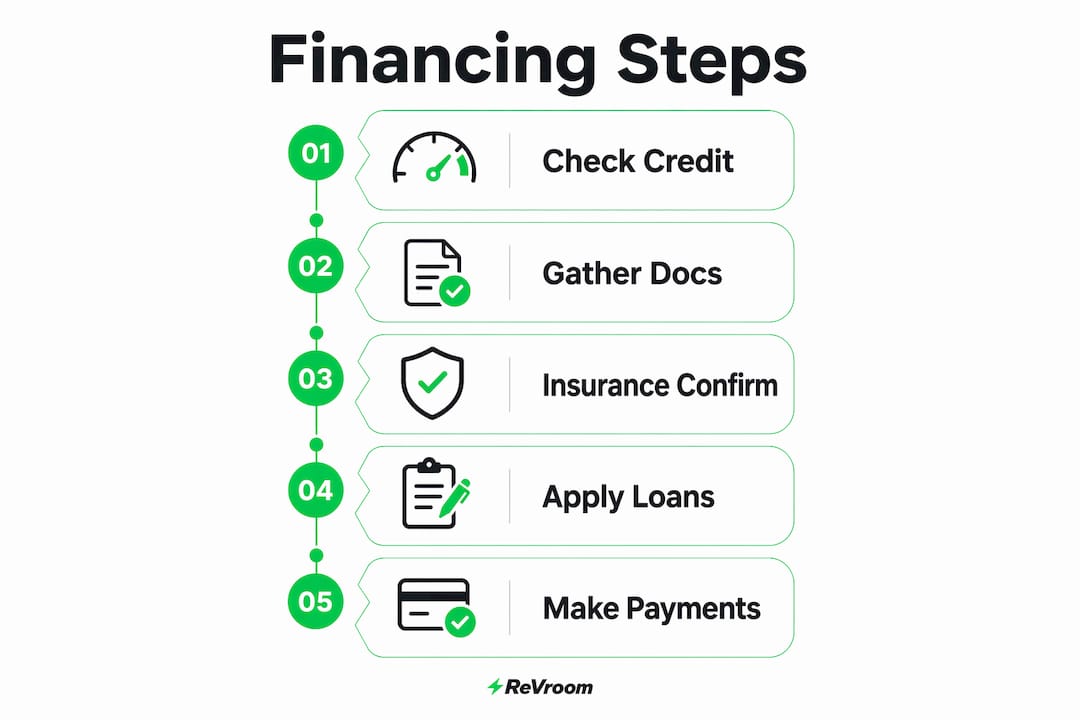
Short answer: know your score, save a down payment, get the insurance quote first, and apply where lenders already say yes.
- Pull your credit report and fix any errors before you apply. In our experience, approvals get easier at 600 and up, and a higher score tends to bring more offers.
- Save 10 to 20 percent down. It eases the lender's worry about the car and keeps you from owing more than it's worth.
- Get insurance quotes using the VIN from two or three carriers so you can show full coverage is lined up.
- Get a pre-purchase inspection from an independent shop and keep the report.
- Apply to your credit union first, then to a lender network, so you're comparing offers instead of waiting on one.
What documents do lenders require for a rebuilt title car loan?
Short answer: the same things as any car loan, plus the car's paperwork.
- Government-issued ID and proof of address
- Proof of income (pay stubs, tax returns, or bank statements)
- The rebuilt title, showing the car's current legal status
- The state inspection certificate
- Repair records showing what was done and by whom
- An insurance quote or binder confirming full coverage
- Often an independent inspection or appraisal, depending on the lender
List the title accurately on the application. The lender checks it with the state anyway. A rebuilt title you mention up front is routine; one the lender discovers later is a problem.
Does a rebuilt title affect your credit score?
Short answer: no. The title is about the car, and your credit report is about you.
The rebuilt brand never shows up on your credit report. It matters only for approval, where it narrows the list of lenders and can raise the rate a little. Once you have the loan, on-time payments build your score like any installment loan. The major scoring models also count several auto-loan applications within a short window (usually 14 to 45 days) as one inquiry, so comparing offers through one application doesn't hurt your score.
Anything legal to know before you sign?
Short answer: the seller should disclose the brand, the lender's lien goes on the rebuilt title like any other, and a salvage car can't be financed until it's rebuilt.
Each state sets its own inspection and disclosure rules, so spend ten minutes on your state's motor vehicle site. We have buyer guides for Texas and Florida. State laws generally require sellers to disclose a rebuilt or branded title (Utah, for example, requires it in writing before the sale), and the lender records its lien with the state until the loan is paid off.
Is a rebuilt title loan the same as a title loan?
Short answer: no. A rebuilt title loan is a regular auto loan for buying a car that has a rebuilt title. A car title loan is a short-term loan where you borrow against a car you already own and hand over its title as collateral.
| Rebuilt title auto loan | Car title loan | |
|---|---|---|
| What it is for | Buying (or refinancing) a rebuilt title car | Borrowing cash against a car you own |
| Who offers it | Credit unions, some banks, lender networks, specialty auto lenders | Title lenders |
| Typical term | Years, like any car loan | Usually short |
| Where to start | Your credit union, then one network application | Not covered here |
Search results mix up the two, so check which one a lender is offering before you share your details. This page is only about the first kind.
Frequently asked questions
Can you finance a car with a rebuilt title?
Yes. Credit unions and lender networks finance rebuilt title cars; some large banks decline them. One application through ReVroom's financing page reaches several lenders at once and returns up to 4 offers. ReVroom is not a lender.
Which banks finance rebuilt titles?
Policies change often. Navy Federal and USAA generally review rebuilt titles case by case, many large national banks decline them, and local credit unions tend to be the most flexible. A lender network routes one application only to lenders that will consider the car.
What credit score do you need for a rebuilt title loan?
There's no universal minimum; each lender sets its own. In our experience, buyers with a score of 600 or higher, a loan of $8,000 or more, a car 10 years old or newer with under 125,000 miles, and income of $21,600 a year or more tend to get approved more easily.
Is the interest rate higher on a rebuilt title car?
Often by one to three percentage points, because lenders value the collateral below a clean-title equivalent. Since the car is typically priced 20 to 40 percent below clean-title value, the total cost of the loan is usually still far lower.
Can I get a loan for a private-party rebuilt title purchase?
Yes. Private-party auto loans pay the seller directly and are available for rebuilt title cars that meet the lender's age and mileage limits, so you can negotiate like a cash buyer.
Can you refinance a rebuilt title car loan?
Yes. Refinancing works the same way as a purchase loan. We've seen refinances of $5,000 or more with incomes of $18,000 or more go through most easily, and a year of on-time payments plus an improved credit score is the best time to apply. Each lender sets its own rules.
Is it hard to get insurance on a rebuilt title car?
Usually not. Insurers that accept rebuilt titles typically write liability coverage, as Progressive publishes, and full coverage is commonly reported from major carriers. A few ask for a photo inspection or price the car a little differently, so compare two or three quotes. Lenders require full coverage on a financed car, so get the quote before you apply.
What documents do I need to finance a rebuilt title car?
ID and proof of income like any auto loan, plus the rebuilt title, the state inspection certificate, the repair records, an insurance quote or binder, and often an independent inspection report. Having them ready is the single biggest thing you can do for approval odds.
Who will finance a rebuilt title car?
Credit unions (case by case), some banks, and lender networks. Many large national banks decline branded titles under blanket policies. One application through ReVroom's financing page reaches lenders in the myAutoloan network that consider rebuilt titles and returns up to 4 offers. ReVroom is not a lender.
Can I get a rebuilt title loan with a 600 credit score?
Often, yes. In our experience, 600 and up is where approvals get noticeably easier, but no score guarantees a yes. Each lender looks at your full credit profile, your income and the car itself.
Can you finance a salvage title car?
Usually not while it is still salvage, because most states will not register it for driving and lenders want collateral that can be registered and insured. Once it is repaired, passes the state inspection and is retitled rebuilt, credit unions, lender networks and specialty lenders can finance it.
Is a rebuilt title loan the same as a title loan?
No. A rebuilt title loan is a normal auto loan to buy a car with a rebuilt title. A title loan is a short-term loan that borrows against a car you already own.
How much can you borrow on a rebuilt title car?
Usually the price minus your down payment, as long as it fits the lender's own rules, including its loan-to-value cap. In our experience, loans of $8,000 or more are the easiest to place. Some lenders cap loan-to-value lower on a branded title; others treat it like any used car.
Do you need a down payment for a rebuilt title loan?
Not always, but it helps. A down payment lowers the payment and gives a lender more cushion on a branded title. On the median $17,499 rebuilt car, 10% down at 6.99% over 72 months works out to about $268 a month, as an illustration, not an offer.
Can you get a salvage title loan?
Not usually from an auto lender while the car is still salvage, because it can't be registered for the road yet. Buyers who want a salvage car to rebuild usually pay cash or use a personal loan, then refinance once the state issues the rebuilt title.
Can you get a loan on a rebuilt title from a private seller?
Yes, often. Ask for a private-party auto loan and have the rebuilt title, the state inspection certificate and a bill of sale ready. One application through ReVroom's financing page can return up to 4 offers, including for private-party purchases. ReVroom is not a lender.
Recommended
- How to Get an Auto Loan on a Rebuilt Title
- Navy Federal Rebuilt Title Loans
- Will USAA Finance a Rebuilt Title?
- Will the Bank Finance a Rebuilt Title?
- Can You Finance a Rebuilt Car?
- How Much Does a Rebuilt Title Affect Value?
- Rebuilt Title Loans in Utah
- Finance a Rebuilt Title Car: Banks, Credit Unions and Lender Networks Compared
