


Flat Tire on a Car: What Every Driver Should Do Now
August 4, 2026
TL;DR:
- Driving on a flat tire risks severe damage to the wheel, suspension, and internal tire structure. It is safest to stop immediately, activate hazard lights, and assess whether to change the tire or call roadside assistance. Damage can escalate within just 200 feet, making prompt, cautious action essential.
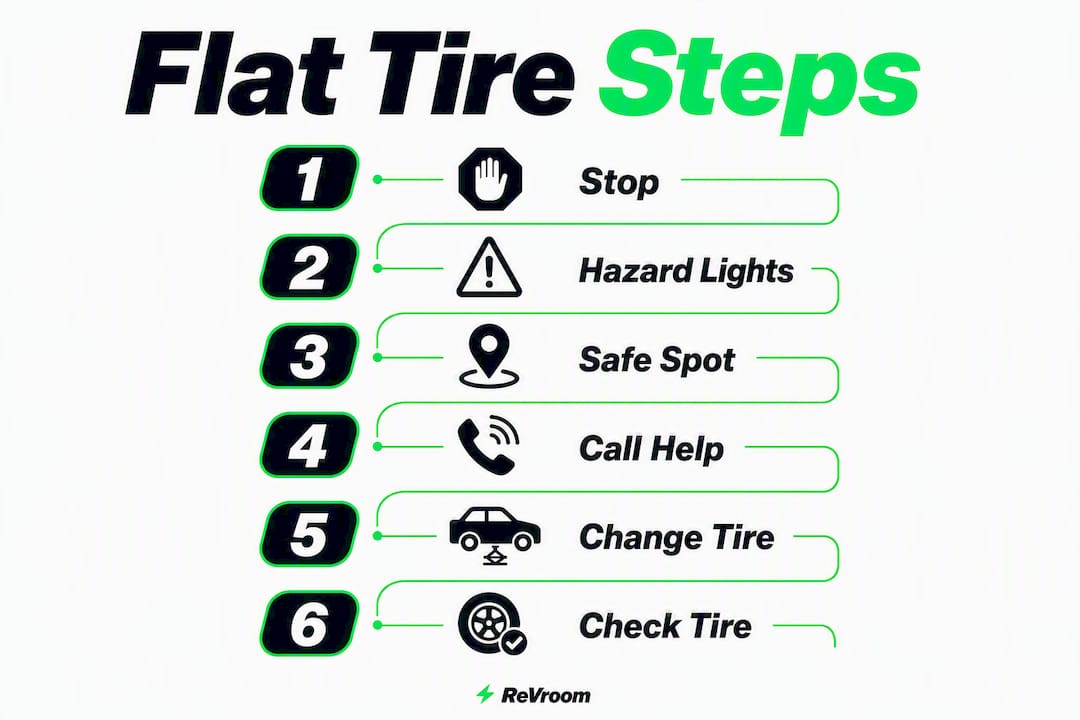
If you get a flat tire on a car, stop safely and do not keep driving. Pull off the road as soon as it is safe to do so, turn on your hazard lights, and either prepare to change the tire or call for help. That is the short version. The longer version matters because the difference between a $35 plug repair and a $1,500 rim replacement often comes down to the next 200 feet you drive.
Here is what to do right now:
- Turn on your hazard lights immediately.
- Ease off the gas gradually and steer toward the nearest safe shoulder or parking lot.
- Once stopped, apply the parking brake and call roadside assistance or prepare to change the tire.
The damage clock starts fast. According to Tire Dose, sidewall folding begins within the first 200 feet of driving on a flat. After 1–2 miles, the tire is often shredded and rim or suspension damage becomes likely.
Table of Contents
- Can you still drive with a flat tire, and what actually happens?
- What to do first when you realize the tire is flat
- Should you change the tire yourself or call for roadside assistance?
- How to change a flat tire safely, step by step
- Temporary fixes: inflators, sealants, and plug kits
- When and how to call roadside assistance, and what to expect
- Simple maintenance habits that prevent most flats
- Key Takeaways
- A note from the Revroom editorial team
- Useful sources and further reading
- FAQ
Can you still drive with a flat tire, and what actually happens?
Almost never. The one real exception is factory run-flat tires, which are designed to support the vehicle’s weight without air pressure for a limited distance. Firestone notes that run-flats are commonly rated for up to about 50 miles at up to 50 mph, but manufacturer limits vary. Check your owner’s manual and look for a TPMS (Tire Pressure Monitoring System) alert that confirms run-flat mode. If your car did not come with run-flats from the factory, that exception does not apply to you.
The “I’ll just drive slowly to the gas station” instinct is the most common mistake drivers make. Automotive professionals at Mavis confirm that slow driving still folds the sidewall on every single rotation, destroying the tire’s internal structure regardless of speed. There is no safe crawl speed on a standard flat.
Here is how the damage escalates:
| Distance driven on flat | What happens |
|---|---|
| 0–200 feet | Sidewall begins folding; inner liner starts to tear |
| 200 feet–1 mile | Significant sidewall damage; tire likely unrepairable |
| 1–2 miles | Tire often shredded; rim damage becomes likely |
| 2+ miles | Rim and suspension damage probable; tow required |
Cost reality check: A repairable tread puncture runs $25–$45. Drive on it and you are looking at a full tire replacement ($120–$350+), possible rim replacement ($150–$800+), or suspension repairs ($500–$2,000+), per TowingWinnipeg’s cost breakdown.
Pro Tip: If you must move the car a short distance to reach a safer spot off live traffic, a few feet onto the shoulder is acceptable. Beyond that, stop and call for help.
One more note on run-flats: even when they work as designed, run-flat tires often cannot be repaired after being driven flat because the structural load compromises the tire internally. Budget for a replacement, not a patch.
What to do first when you realize the tire is flat
Personal safety comes before everything else. A flat tire is fixable. Getting rear-ended on a highway shoulder is a different story.
Secure the scene:
- Activate hazard lights the moment you suspect a flat.
- Grip the wheel firmly, ease off the accelerator, and avoid hard braking.
- Steer toward a stable, flat surface: a parking lot, a wide shoulder, or a side street.
- Apply the parking brake once stopped.
- If you have reflective triangles or road flares, place them 50–100 feet behind the vehicle.
- Keep your seatbelt on until you are fully stopped and away from moving traffic.
Quickly assess the tire:
- Is it completely flat and the rim sitting on the road? That is a full flat.
- Is the sidewall visibly torn or the tread shredded? Do not attempt a DIY fix.
- Is the tire losing pressure slowly with no visible damage? A plug or inflator may work.
- Check your TPMS display and note any unusual thumping or pulling you felt before stopping.
If you are on a narrow shoulder with fast-moving traffic, at night, or in bad weather, stay inside the vehicle with your seatbelt on and call for help. Getting out into traffic is riskier than waiting.
Pro Tip: The U.S. DOT advises checking your spare’s pressure monthly using the vehicle placard on the driver-side doorframe, not the tire sidewall. Knowing your spare is good before an emergency saves a lot of stress at the scene.
Should you change the tire yourself or call for roadside assistance?
Change it yourself only if you are in a safe, well-lit location with a usable spare and the right tools. Otherwise, call for help.
When a DIY change makes sense: You are in a parking lot or wide, stable shoulder with good visibility. Traffic is light or nonexistent. You have a spare, a jack, and a lug wrench. It is daylight and the weather is reasonable.
When to call roadside assistance instead: You are on a narrow highway shoulder with fast traffic. The spare is flat, missing, or you have no jack. It is dark, raining, or icy. You are physically unable to change the tire safely. The tire is shredded and the rim is damaged.
When a tow is the only option: The rim is bent or cracked. The suspension looks visibly damaged. You have no spare and no mobile repair service can reach you quickly.
“For most people, the best response is to contact a roadside assistance service. AAA responds to over 3.5 million calls about flat tires a year.” Consumer Reports
What to expect when you call: Most roadside assistance services (AAA, your auto insurer’s roadside plan, or your car manufacturer’s service) give an estimated arrival window of 30–60 minutes in suburban areas, longer in rural locations. The technician will typically change to your spare, or if no spare is available, arrange a tow to the nearest shop.
Pro Tip: If you have a roadside assistance membership, keep the number saved in your phone before you need it. Searching for it while stressed on a shoulder costs you time.
How to change a flat tire safely, step by step
You can change the tire yourself if conditions are safe and you have a proper spare, whether that is a full-size spare or a compact temporary spare (commonly called a donut).
Tools you need
- Spare tire (inflated and in good condition)
- Scissor or hydraulic jack (from the vehicle’s kit)
- Lug wrench
- Wheel wedges or chocks
- Flashlight
- Gloves
- Reflective vest (optional but smart)
- Vehicle owner’s manual
The procedure
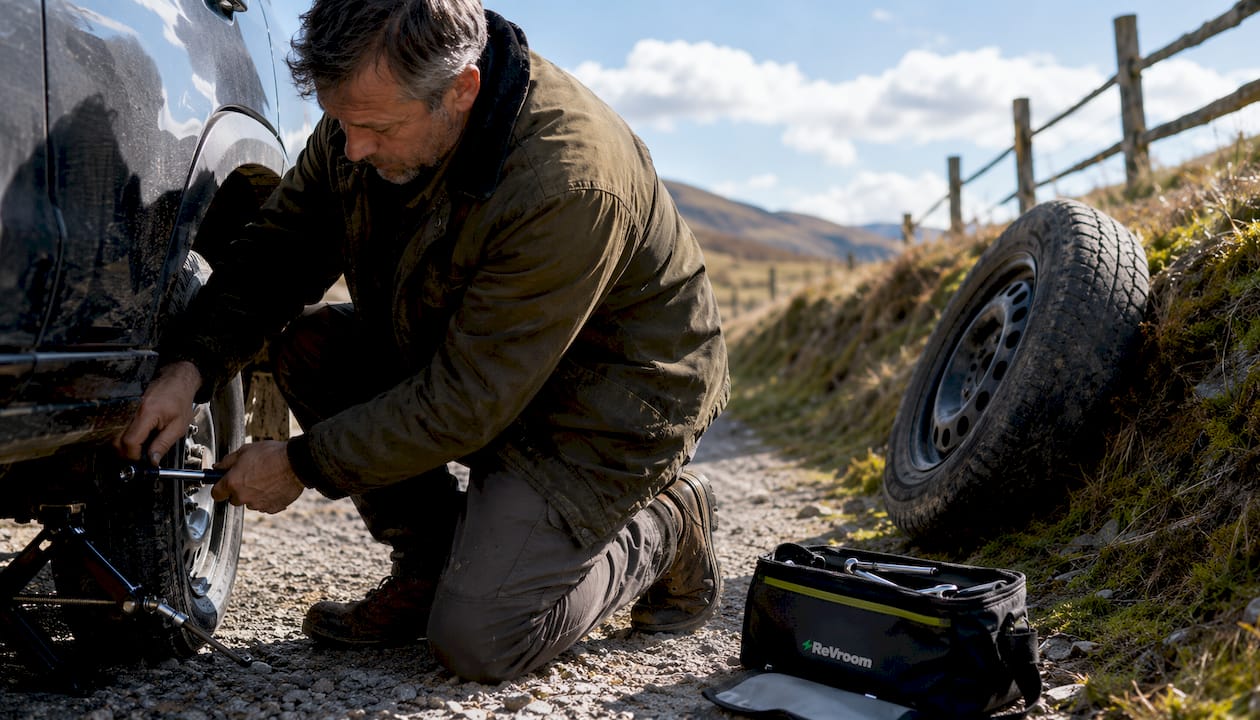
- Park on solid, level ground and apply the parking brake. Place wheel wedges against the tires opposite the flat.
- Loosen the lug nuts before jacking. Turn counterclockwise, one half-turn each. Do not remove them yet. Breaking them loose while the tire is on the ground prevents the wheel from spinning.
- Find the correct jack point. AutoZone’s guide and your owner’s manual both mark the reinforced frame points near each wheel. Placing the jack anywhere else risks bending the frame or dropping the car.
- Jack the vehicle up until the flat tire is about six inches off the ground.
- Remove the lug nuts completely and set them somewhere they cannot roll away. Pull the flat tire straight toward you and set it aside.
- Mount the spare by aligning the holes and pushing it flush against the hub.
- Hand-tighten the lug nuts in a star pattern (not a circle) to seat the wheel evenly.
- Lower the vehicle until the tire touches the ground but the jack still bears some weight. Tighten the lug nuts fully in the same star pattern.
- Lower completely and remove the jack. Give each lug nut a final check.
- Check the spare’s pressure before driving. The correct pressure is on the driver-door placard.
Never place any part of your body under a raised vehicle. After driving 50–100 miles on the spare, have the lug nut torque checked at a shop with a torque wrench.
Compact spare limits: A donut spare is rated for about 50 miles at no more than 50 mph. It is not a long-term solution. Get the flat repaired or replaced promptly.
Pro Tip: Your owner’s manual shows the exact jacking points with diagrams. Spending 60 seconds finding the right spot prevents frame damage that costs far more than the tire.
Temporary fixes: inflators, sealants, and plug kits
Inflators and sealants can work for small tread punctures only. They are not a solution for sidewall cuts, blowouts, or any tire that is visibly shredded.
Common temporary options:
- Portable compressor with pressure gauge: Reinflates a slow leak enough to reach a shop. Works only if the puncture is small and the tire holds air.
- Aerosol sealant (e.g., Slime, Fix-a-Flat): Coats the inside of the tire and seals small tread punctures. Fast to apply, but it contaminates the tire interior and must be disclosed to the shop doing the permanent repair.
- Tubeless plug kit: A small tool kit that inserts a rubber plug directly into the puncture. Takes about 10–15 minutes and holds well enough to drive to a shop. Works only on tread punctures, not sidewalls.
- Mobile tire repair service: A technician comes to your location, patches or plugs the tire on-site, or swaps to your spare. Often the cleanest option when you are not comfortable with DIY.
Basic plug kit steps: Locate the puncture, use the reaming tool to clean the hole, insert the plug strip with the insertion tool, trim the excess, and reinflate to the placard pressure. Drive directly to a shop for a permanent patch.
Know the limits: A plug or sealant is a temporary fix, not a permanent repair. Any tire that has been driven flat, even briefly, should be professionally inspected before you trust it on the highway. Sidewall punctures cannot be safely plugged or patched and require immediate replacement.
Pro Tip: Keep a quality plug kit and a compact 12V inflator in your trunk. Together they cost under $40 and can save you a tow bill for a simple nail puncture.
When and how to call roadside assistance, and what to expect
Call roadside assistance when your location, the weather, or a missing spare makes a DIY change unsafe or impractical. You do not need to be in danger to make that call. It is often the smarter financial move.
What to have ready when you call:
- Your exact location (cross streets, mile marker, or GPS coordinates from your phone)
- Vehicle make, model, year, and color
- A description of the problem: flat tire, which corner, whether you have a spare
- Any hazards nearby (narrow shoulder, active traffic, poor visibility)
- Your roadside assistance membership number or insurance policy number
What typically happens next: The dispatcher will give you an estimated arrival window. In most U.S. suburban areas, expect 30–60 minutes. Rural locations can run longer. The technician will assess the tire, change to your spare if one is available and usable, or arrange a tow to a nearby shop if not. Some services can patch small tread punctures on-site.
Budget-minded drivers: choose a reputable local tire shop over a dealership for straightforward replacements. Independent shops often charge significantly less for the same tire brands and installation.
Simple maintenance habits that prevent most flats
Monthly pressure checks and periodic tread inspections are the two fastest ways to reduce your flat tire risk. Most flats are not random bad luck. They are the result of underinflation, worn tread, or an aging spare that nobody checked.
Monthly maintenance checklist:
- Check cold tire pressure using the driver-door placard (not the tire sidewall). NHTSA notes that proper inflation can save up to about $0.11 per gallon and extend tire life by roughly 4,700 miles.
- Inspect tread depth. Replace tires when tread reaches 2/32 inch or below. The penny test works: insert a penny with Lincoln’s head down; if you see the top of his head, replace the tire. For more detail, Revroom’s tire tread guide walks through exactly what to look for.
- Inspect sidewalls for cracks, bulges, or cuts. A bulge means the internal structure is compromised; replace that tire before your next trip.
- Rotate your tires per your vehicle’s schedule (typically every 5,000–7,500 miles) to even out wear.
- Check the spare’s pressure and condition every time you check the other four. NHTSA advises inspecting the spare for age-related UV cracking; a spare that has never been used can still fail if it is old and dried out.
- Keep your jack, lug wrench, and wheel wedges in the vehicle and confirm they are in working order before long trips.
Pro Tip: Set a phone reminder for the first of every month: two minutes to check all five tires (including the spare) with a $5 pressure gauge. That habit alone prevents most underinflation flats.
Key Takeaways
Stopping immediately and not driving on a flat tire is the single most important decision you can make, because the difference between a $35 repair and a $1,500 wheel replacement often comes down to the first 200 feet.
| Point | Details |
|---|---|
| Stop and secure the scene | Hazard lights on, pull to a stable surface, apply the parking brake before assessing anything. |
| Run-flat exception only | Only factory run-flat tires allow limited driving; run-flats are commonly rated for up to about 50 miles at up to 50 mph, but manufacturer limits vary; consult your owner’s manual for exact limits. |
| Damage escalates fast | Sidewall folding starts within 200 feet; after 1–2 miles, rim and suspension damage become likely. |
| Change only when safe | Attempt a DIY tire change only in a safe, well-lit spot with a usable spare and proper tools. |
| Check monthly, not just in emergencies | Monthly pressure checks and tread inspections, guided by the driver-door placard, prevent most flats before they happen. |
A note from the Revroom editorial team
Here is something worth saying plainly: a flat tire feels like a crisis, but it almost never has to be. The drivers who handle it best are the ones who already know their car, carry the right tools, and have a spare they actually checked. That kind of preparedness is not just about tires. It is the whole mindset behind practical, budget-conscious car ownership.
At Revroom, we think every driver deserves a reliable daily driver without paying a premium they do not have to. Every vehicle listed on Revroom has passed state-required certification confirming it is repaired and road ready, and each listing includes vehicle history and pre-repair photos so you can see exactly what you are buying. Whether you are shopping for your next car or just trying to get more out of the one you have, knowing your vehicle inside and out is what keeps you moving. Start with the spare in your trunk. Check it this week. And if you are in the market for a dependable car at a price that makes sense, browse Revroom’s certified listings to see what is available.
Useful sources and further reading
The claims in this article are drawn from the following sources. Each one is worth bookmarking if you want to go deeper.
- Tire Safety Ratings and Awareness | NHTSA: NHTSA’s primary tire maintenance guidance, including inflation savings data and spare tire inspection advice
- How To Change a Flat Tire | AutoZone: Step-by-step procedure, tools checklist, and jacking point guidance
- How to Change a Car Tire | Consumer Reports: Context on roadside assistance volume and when calling for help is the right call
For Revroom-specific maintenance guides, see the tire tread guide, tire rotation guide, and road trip preparation checklist.
FAQ
Can you still drive a car if it has a flat tire?
Not safely, unless your vehicle has factory run-flat tires. Firestone notes run-flats are commonly rated for up to about 50 miles at up to 50 mph, but manufacturer limits vary; check your owner’s manual for your vehicle’s specific limits.
What should you do if your car gets a flat tire?
Turn on your hazard lights immediately, ease off the gas, and steer to the nearest safe shoulder or parking area. Then assess whether to change the tire yourself or call roadside assistance based on your location, tools, and spare availability.
What happens to your car if you drive on a flat?
Tire Dose documents that sidewall folding begins within 200 feet, significant damage occurs within 1 mile, and rim or suspension damage becomes likely after 1–2 miles. A repairable $35 puncture can escalate to hundreds or thousands of dollars in repairs.
How long can you drive on a flat tire?
Effectively zero distance on a standard tire. The sidewall begins folding immediately, and automotive professionals confirm that even slow driving destroys internal structure with every rotation. Move only far enough to reach a safe stopping point off live traffic.
Is a plugged or sealed tire safe to drive on long-term?
No. A plug or aerosol sealant is a temporary fix to get you to a shop, not a permanent repair. Any tire that has been driven flat, even briefly, needs professional inspection before highway use, and sidewall punctures require immediate replacement regardless of any temporary fix applied.
