


How to Get the Best Car Sell Online Price in 2026
June 3, 2026
TL;DR:
- Online car valuation depends on market conditions, vehicle specifics, and selling method to ensure you receive fair value.
- Private listings generally yield 10-25% more than instant dealer offers, which reflect wholesale pricing.
The car sell online price you can realistically expect is determined by three forces working together: current market conditions, your vehicle’s specific details, and the selling method you choose. Get all three right, and you walk away with money that reflects what your car is actually worth. Miss one, and you leave real dollars on the table. This guide breaks down exactly how online car valuation works, where private listings beat instant offers, and which platforms give you the best shot at a favorable sale in 2026.
How do online car valuation tools determine your car’s price?
Online car appraisal tools are not guessing. They pull from massive pools of real transaction data to give you a number grounded in what buyers are actually paying right now, in your area, for a car like yours.

Kelley Blue Book adjusts car values across more than 100 geographic regions, offering both wholesale and retail activity data to help you set a fair online asking price. KBB provides three distinct outputs: a Typical Listing Price, a Fair Market Range, and a Fair Purchase Price. Each one serves a different purpose. The Typical Listing Price tells you what sellers are asking. The Fair Purchase Price tells you what buyers are actually paying. That gap between the two is where your negotiation room lives.
Spinny’s valuation tool takes a similar approach, analyzing 5 lakh+ market transactions to generate an instant estimate, with an optional free doorstep inspection to sharpen the number. Tools like these are not just convenient. They reflect the market as it exists this week, not six months ago.
| Valuation Output | What It Tells You | Best Used For |
|---|---|---|
| Typical Listing Price | What sellers are currently asking | Setting your initial asking price |
| Fair Market Range | The realistic buyer-seller overlap zone | Anchoring price negotiations |
| Fair Purchase Price | What buyers are actually paying | Validating your final sale price |
| Wholesale Value | Dealer cost basis for instant offers | Understanding instant offer benchmarks |
One factor most sellers overlook: local market and seasonal variations mean the same model can carry meaningfully different values depending on your city and the time of year. A pickup truck in a rural market in January commands a different price than the same truck in a coastal city in spring. Always run your valuation with your specific zip code, not a national average.
Pro Tip: Run your car through KBB’s valuation tool twice: once as “good” condition and once as “very good” condition. The difference shows you exactly how much a detail job, minor repair, or honest condition upgrade is worth in real dollars before you list.

What pricing differences should you expect between private listings and instant dealer offers?
The short answer: private listings typically net you more money, and instant offers give you more convenience. The longer answer is that the gap between the two is bigger than most sellers expect.
Private sales typically yield 10 to 25% more than instant dealer offers, because instant offers are priced at wholesale, not retail. Dealers factor in reconditioning costs, their own profit margin, and market risk before they quote you a number. That math always works in their favor, not yours.
Here is what the trade-off looks like in practice:
- Private listing on Cars.com or a similar platform: Higher net price, but you handle inquiries, negotiations, test drives, and paperwork yourself. Expect the process to take days to several weeks.
- Instant offer from CarMax or Carvana: Faster and simpler, but the offer reflects wholesale pricing dynamics that cover dealer overhead and profit. You trade dollars for convenience.
- EchoPark’s online offers are real-time but require a physical inspection to confirm the final price, and offers are valid for 7 days. If your condition disclosure is accurate, the number holds.
- CarMax honors its online offer if the vehicle condition matches your online claim, but inaccurate condition reports will result in a lower final price at in-person appraisal.
According to carsales.com.au, instant offers commonly beat trade-in values but private sales still yield the highest prices overall. Think of instant offers as your pricing floor, not your ceiling. They tell you the minimum your car is worth in the current market. A well-executed private listing is how you get above that floor.
How to accurately set and optimize your car’s online asking price
Pricing your car correctly from day one is the single biggest factor in how fast it sells and how much you get. Here is a practical process that works.
- Pull your KBB Fair Market Range first. This is your anchor. Set your asking price at or slightly above the top of the range to leave room for negotiation without scaring off serious buyers.
- Search live comparable listings. Look at what similar vehicles (same make, model, year, mileage, and trim) are listed for on Cars.com, AutoNation, or TrueCar right now. If your price is 15% above the nearest comparable, you will get ignored.
- Disclose your vehicle’s condition accurately. This is not just good ethics. It is good strategy. CarMax and similar platforms will adjust their offer downward at inspection if your online description does not match reality. Accurate disclosure protects your price.
- Apply a two-track pricing strategy. Use market data and live listing behavior together. If you get strong inquiry volume in the first week, your price is right. If inquiries are low, the market is telling you something. Adjust by 3 to 5% and reassess.
- Time your listing thoughtfully. Spring and early summer are historically strong periods for used car sales. Listing a convertible in November or a four-wheel-drive truck in July puts you at a seasonal disadvantage. KBB’s local and seasonal pricing data can help you identify the right window.
Pro Tip: Before listing, check whether any recent repairs or upgrades affect your car’s value. A major component replacement can shift your pricing position significantly. Understanding how engine work affects resale is one of those details most sellers skip entirely.
What are the best online platforms to sell your car?
Platform choice directly affects both your final sale price and how much work you put in to get there. No single platform is best for every seller. The right one depends on your priorities.
- Carvana: Fully online process with a firm instant offer. Fast and convenient, but expect wholesale-level pricing. Best for sellers who prioritize speed over maximum return.
- Cars.com: A private listing platform that puts your car in front of a large buyer audience. Higher potential sale price, but you manage the process yourself.
- CarMax: Offers both instant online appraisal and in-person purchase. The 7-day offer window gives you time to compare, but condition verification at pickup can adjust the number.
- AutoNation: Dealer-backed instant offers with physical locations for drop-off. Pricing is competitive within the instant-offer category but still reflects dealer economics.
- TrueCar: Connects sellers with a dealer network for offers. Useful for benchmarking, though the prices reflect dealer acquisition costs rather than private-sale retail.
The platform that gets you the best price to sell your car is almost always a private listing marketplace. The platform that gets you the fastest result is almost always an instant offer service. Many sellers use both: get an instant offer first to establish a pricing floor, then list privately at retail and see if the market delivers a better number within a set timeframe.
Common pitfalls in pricing your car online
Most sellers make the same four mistakes. Knowing them in advance puts you ahead of the majority of listings on any platform.
Overpricing at launch is the most common error. A car priced 20% above market comparables gets skipped in search results and sits unsold for weeks. Buyers in 2026 have access to the same KBB data you do. They know when a listing is inflated, and they move on without contacting you.
Underpricing out of impatience is the opposite problem. Sellers who want a fast result sometimes list below the Fair Market Range and leave hundreds or even thousands of dollars behind. The fastest way to sell a car is not to underprice it. It is to price it correctly from the start.
Ignoring condition disclosure is where sellers lose money they thought they had locked in. If your online description says “excellent condition” but the car has worn tires and a cracked trim piece, any instant offer platform will adjust the price downward at inspection. That adjustment feels like a bait-and-switch, but the seller created it.
Skipping local market research means pricing against national averages that do not reflect your actual buyer pool. A local market analysis combined with active listing data is the most reliable way to price competitively and attract qualified buyers quickly.
Pro Tip: If your listing has been live for more than 10 days with fewer than five serious inquiries, do not drop the price immediately. First, check whether your photos are the problem. Poor lighting and low-resolution images suppress buyer interest just as much as a high price does.
Key takeaways
Pricing your car online correctly requires combining trusted valuation data with live market comparables, honest condition disclosure, and a clear-eyed choice of selling platform.
| Point | Details |
|---|---|
| Use KBB’s full output | Pull the Fair Market Range, Typical Listing Price, and Fair Purchase Price together for a complete picture. |
| Know the private vs. instant offer gap | Private sales net 10 to 25% more than instant offers; use instant offers as your pricing floor. |
| Disclose condition accurately | Inaccurate condition reports lead to price reductions at inspection, reducing your final net. |
| Apply the two-track strategy | Anchor with market data, then validate with live listing inquiry volume and adjust accordingly. |
| Factor in local and seasonal timing | The same car can carry different values by city and season; always use localized pricing data. |
What I’ve learned about pricing cars online that most guides won’t tell you
Here is something I have noticed after watching a lot of sellers go through this process: the biggest pricing mistakes are almost never about math. They are about ego and impatience.
Sellers who anchor to what they paid for the car, or what they need to cover their next purchase, consistently overprice. The market does not care about your financial situation. It cares about what comparable vehicles are selling for right now. The sellers who detach from their emotional number and anchor to KBB’s Fair Market Range tend to sell faster and with fewer painful negotiations.
The other thing most guides skip: the condition disclosure step is where you either protect or destroy your deal. I have seen sellers get a strong instant offer from CarMax or Carvana, feel great about it, and then watch it drop at inspection because they described the car more generously than it deserved. That drop feels personal. It does not have to happen. Honest disclosure up front means the number you see online is the number you get.
If you are selling a rebuilt title vehicle specifically, the transparency piece matters even more. Buyers in that segment are already doing extra due diligence. Giving them accurate, upfront information about vehicle history is not a liability. It is your strongest selling point. Platforms like ReVroom are built around exactly that principle, and it is why they attract buyers who are ready to move rather than buyers who are still building trust.
The best approach is patient and data-driven. Set your price with KBB, validate it against live listings, disclose honestly, and give the market a week to respond before you adjust. That process works. Skipping any part of it costs you money.
— Cameron
List your car where transparency does the selling for you
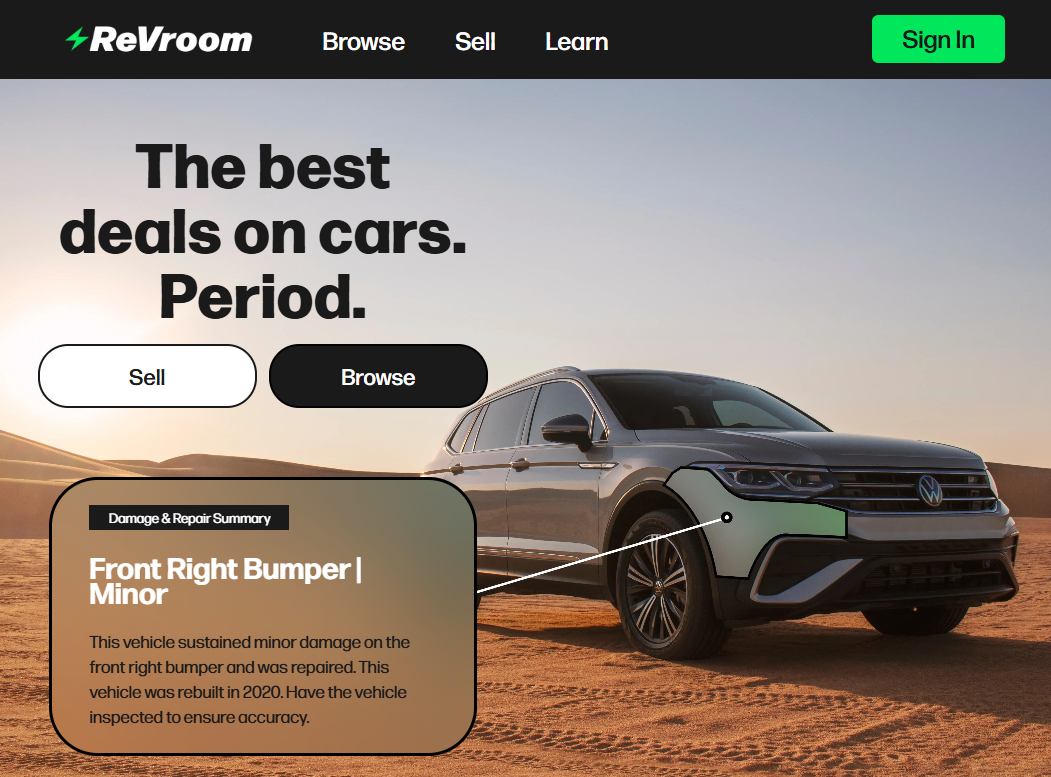
If you are selling a rebuilt title vehicle, the platform you choose matters as much as the price you set. ReVroom is the only online marketplace built specifically for rebuilt title cars, and it is designed to make your listing work harder by giving buyers the vehicle history information and photos they need to feel confident. That transparency is not just good for buyers. It attracts serious, qualified buyers who are ready to purchase rather than tire-kickers who are still on the fence. Browse ReVroom’s marketplace to see how rebuilt title listings are done right, and get your car in front of the buyers who are actively looking for exactly what you have.
FAQ
What is a fair car sell online price?
A fair car sell online price sits within Kelley Blue Book’s Fair Market Range for your vehicle’s make, model, year, mileage, and condition in your local area. Pricing within this range attracts qualified buyers while leaving room for negotiation.
How accurate are online car valuation tools?
Tools like Kelley Blue Book and Spinny are highly accurate when you input precise vehicle details and condition information. Spinny analyzes over 500,000 market transactions for real-time pricing, and KBB draws from more than 100 regional datasets.
Why is my instant offer lower than my asking price?
Instant offers reflect wholesale pricing, which covers dealer reconditioning costs and profit margins. Private sales typically net 10 to 25% more than instant offers because you are selling at retail, not wholesale.
How long are online car offers valid?
Most instant offer platforms hold their price for 7 days, subject to in-person condition verification. EchoPark and CarMax both use this model. If your condition disclosure is accurate, the offer holds at pickup.
Does vehicle history affect my online sale price?
Yes. Accurate vehicle history disclosure directly affects both your asking price and the final offer you receive at inspection. Platforms that provide upfront history information, like ReVroom for rebuilt title vehicles, help sellers reach buyers who are already informed and ready to commit.
