


How to Know Your Car Value Before You Sell
May 23, 2026
TL;DR:
- Your car’s value varies significantly depending on the sale channel, market conditions, and title status. Rebuilt titles typically incur a 20% to 40% discount, but thorough documentation can improve buyer confidence and resale price. Using multiple valuation tools, local market comparisons, and proper preparation helps maximize your car’s true market value.
You already know your car has a number attached to it. What most people don’t realize is that there isn’t one number. There are several, and the gap between them can be thousands of dollars. Your car value shifts depending on who’s buying, how you’re selling, what condition the car is in, and even what time of year it is. That’s especially true for rebuilt title vehicles, where market perception, vehicle history, and buyer confidence all play a role. Understanding how valuation actually works puts you in the driver’s seat, whether you’re selling, trading, or shopping.
Table of Contents
- Key takeaways
- Your car value is not one number
- How vehicle history and title branding affect value
- Factors that shape your car’s current market value
- Deciding whether to sell, trade, or hold
- My honest take on car valuation
- Find the real value with ReVroom
- FAQ
Key takeaways
| Point | Details |
|---|---|
| Multiple values exist | Trade-in, private party, and retail values are each different figures with different purposes. |
| Rebuilt titles carry a discount | Rebuilt title vehicles typically sell at a 20% to 40% discount compared to similar clean-title cars. |
| Tools matter, but context matters more | Car value sites give you a baseline, but local market comparisons tell the real story. |
| Timing affects your number | Depreciation rates, seasonal demand, and market trends all influence what you’ll actually walk away with. |
| Transparency is the great equalizer | With the right vehicle history information, buyers and sellers can negotiate with confidence instead of guessing. |
Your car value is not one number
This is the most important thing to understand before you do anything else. When someone says “just check the blue book value,” they’re describing a starting point, not a finish line. Blue book value varies by sales channel, meaning the number you’d get selling privately is usually higher than what a dealer would offer on a trade-in.
Here’s how the main value types break down:
- Private party value: What a buyer pays you directly, person to person. This is usually the highest number because the buyer isn’t paying a dealer’s markup, and you aren’t getting dealer convenience.
- Trade-in value: What a dealer offers to take your car off your hands toward another purchase. It’s lower because they need room to profit on the resale.
- Retail value: What a dealership charges the next buyer. Always higher than trade-in.
- Wholesale value: The number lenders and dealers use internally. Tools like Black Book’s VIN analytics power many of these behind-the-scenes figures, and they can differ substantially from what consumers see online.
- Actual cash value (ACV): What an insurer would pay in a total loss scenario. This matters a lot for rebuilt title vehicles, and we’ll get to that.
KBB adjusts values weekly based on real transaction data across more than 100 U.S. regions, accounting for local demand and seasonal swings. A truck in a rural area might command a premium that doesn’t show up in a national average. A convertible in Minnesota in February is a tougher sell than the same car in Arizona.
Pro Tip: Always check multiple car value sites and compare the figures. One tool alone won’t capture your local market reality. Use the numbers as a range, not a rulebook.
How vehicle history and title branding affect value
Let’s talk about rebuilt titles, because this is where most people either overreact or under-research.
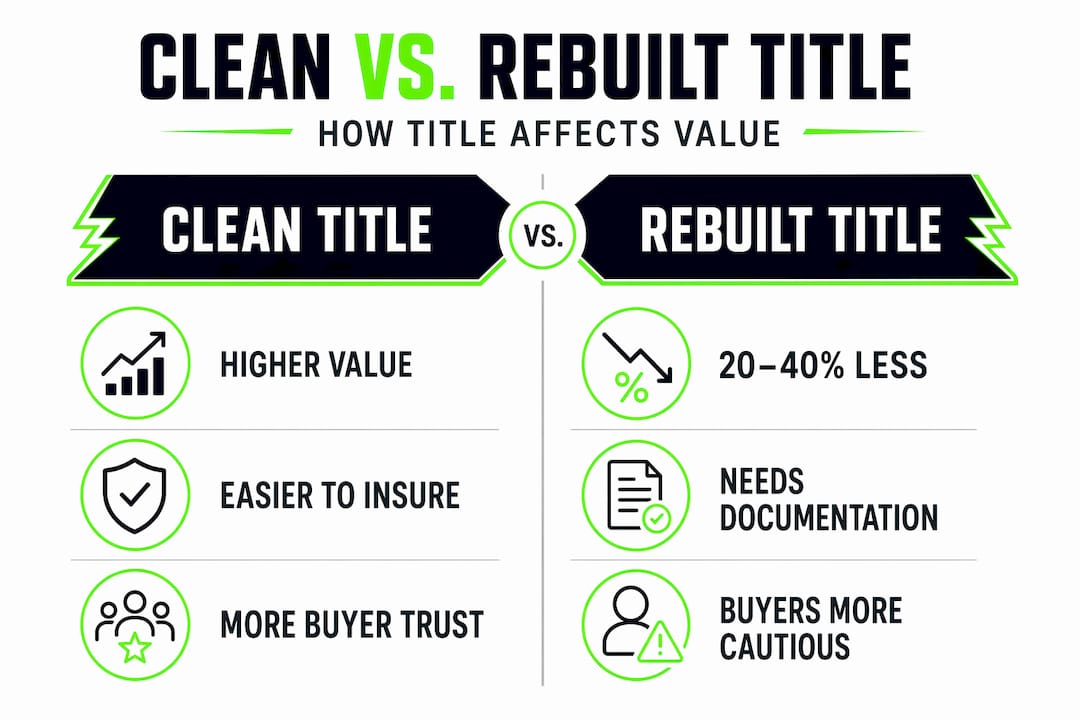
A rebuilt title is issued when a vehicle was once declared a total loss by an insurance company, was subsequently repaired, and then passed a state safety inspection. It is not a scarlet letter. It’s a record. And like any record, what matters is what’s in it.
Here’s a quick comparison to clear up the most common confusion:
| Factor | Rebuilt title | Clean title |
|---|---|---|
| Vehicle history | Disclosed and on record | May or may not have history |
| Market discount | Typically 20% to 40% less | Full market value |
| Financing availability | Varies by lender | Widely available |
| Insurance | Available from most providers | Widely available |
| Resale pool | Smaller but engaged buyers | Broader general market |
| Transparency | High when documented properly | Varies widely |
The rebuilt title discount typically ranges from 20% to 40% depending on the nature of the vehicle’s history and the quality of documentation. That discount doesn’t disappear after repairs. The title brand is permanent, and the diminished value persists because some financing institutions, a smaller number of insurance providers, and a portion of buyers factor it into their risk calculations.

That said, the discount is also the opportunity. A car that retails for $30,000 with a clean title might move for $20,000 with a rebuilt title and the same mechanical condition. For buyers, that’s real money. For sellers, it means pricing strategically rather than hoping someone ignores the title.
Pro Tip: If you’re selling a rebuilt title vehicle, gather every document you have: inspection reports, repair invoices, photos, and any history information available. Buyers who can see what the car looked like before and after repairs are far more likely to feel confident paying closer to market value.
Factors that shape your car’s current market value
Once you understand the value types, you need to know what moves the number up or down. These are the levers, and you have more control over some of them than you might think.
- Mileage. Lower mileage generally means higher value, but condition tells the fuller story. A well-maintained 80,000-mile car can outvalue a neglected 40,000-mile car.
- Condition. Paint, interior, tires, mechanical health. These factors are significant drivers of value and can cause two identical vehicles on paper to differ by thousands.
- Vehicle equity. If you owe more on your car than it’s worth, you’re underwater. That affects your trade-in options significantly.
- Regional demand. What sells in Texas doesn’t always sell the same way in Vermont. Local market comparisons, especially for rebuilt title vehicles where buyer pools vary, are critical.
- Vehicle type and market trends. Used EV sales are growing 16.7% year over year, which is actively reshaping how electric vehicles are valued in the used market. Being aware of this protects you from underselling or overpaying.
- Warranty and remaining coverage. Transferable warranties add real, tangible value. When they expire or don’t transfer, that number drops.
To actually check your car’s value, here’s a practical approach:
- Use two or three car value tools like KBB and Black Book to get a range.
- Enter your VIN directly when the tool allows it. Valuing your car with a VIN gives you specificity that generic make/model searches can’t match.
- Search local listings for similar vehicles to understand what buyers in your area are actually paying.
- For rebuilt title cars specifically, compare local market activity for similar title-branded vehicles before settling on a number. National averages don’t always reflect local buyer sentiment.
Pro Tip: Before listing your car, spend $100 to $200 on a detail and address any minor cosmetic issues. First impressions drive perceived value, and a clean, well-presented car justifies a higher asking price with zero negotiation needed.
Deciding whether to sell, trade, or hold
Getting a number is one thing. Knowing what to do with it is another.
Here are the practical questions worth asking before you decide:
- Are you above or below your loan balance? Vehicle equity, depreciation timing, and remaining warranty are the three variables that most directly affect whether trading in makes financial sense.
- How fast is your car depreciating? Most vehicles lose the sharpest percentage of their value in the first three years. After that, the curve flattens. If you’re past the steepest drop, holding longer often makes more sense than selling now.
- Private sale or trade-in? Selling privately usually nets you more money. Trading in is faster and removes the hassle of listings, calls, and showings. The right answer depends on your timeline and your tolerance for the process.
- What’s the season? Convertibles move in spring. Trucks hold strong year-round. SUVs spike when fuel prices dip. Timing your sale with seasonal demand can quietly add a few hundred to a few thousand dollars.
- If your car has a rebuilt title, who is your likely buyer? The buyer pool is smaller than for a clean-title vehicle, but it’s not thin. Buyers who specifically seek rebuilt titles are often more knowledgeable, more motivated, and less likely to walk away over the title alone, especially when the vehicle history is clearly documented.
Holding onto your car also has merit. The average vehicle age in the U.S. is around 12.8 years, and a well-maintained car that’s past the depreciation cliff might cost you less per year to own than a new car payment would.
My honest take on car valuation
I’ve spent a lot of time watching people leave money on the table, and I’ve seen it go both ways. Sellers who accept the first trade-in offer without checking a single car value site. Buyers who skip rebuilt title cars entirely because the number sounds too good and assume something must be wrong.
Here’s what I’ve actually learned: the “blue book value” framing sets people up to think too simply. Treating any single tool as the answer misses the point. Your real number lives at the intersection of the tool’s estimate, your local market, and how well you’ve documented the car’s condition and history.
For rebuilt title vehicles specifically, I’ve seen experienced appraisers weight documentation quality heavily when determining value. A car with thorough records and clear repair history often commands meaningfully more than an identical car with nothing on paper. That gap is entirely within your control as a seller.
The risk perception built into rebuilt title discounts is real, but it’s also partially a knowledge gap. Buyers who understand what they’re looking at, who can see the vehicle’s history clearly, negotiate from confidence rather than anxiety. That changes the entire dynamic of the transaction. Dealers and lenders often rely on wholesale tools and risk adjustments when evaluating rebuilt title trade-ins, which means private sales with well-documented vehicles frequently yield better outcomes for sellers.
My advice: do the research, gather the paperwork, and don’t accept the first number that lands in front of you.
— Cameron
Find the real value with ReVroom

If you’re dealing with a rebuilt title vehicle, either buying or selling, the biggest challenge has always been the same: figuring out what’s fair when information is scarce. ReVroom was built specifically to fix that. Every listing on ReVroom includes vehicle history information and photos of what the car looked like before it was repaired, so you’re never guessing. That transparency is exactly what makes smart negotiation possible and what helps buyers understand rebuilt title pricing without relying on gut instinct alone.
Whether you want to see your car’s value in context, explore what comparable rebuilt title vehicles are selling for, or list your own vehicle where the right buyers are already looking, ReVroom gives you the clearest picture in the market. Browse current listings and see what going further actually looks like.
FAQ
What is the difference between trade-in and private party value?
Trade-in value is what a dealer offers you toward another vehicle, while private party value is what an individual buyer pays you directly. Private party value is typically higher because it doesn’t account for dealer overhead or resale profit margin.
How do I check my car’s value using my VIN?
Enter your VIN into a car value tool like KBB or Black Book to get a vehicle-specific estimate. VIN-based lookups account for your car’s exact options, trim level, and history rather than relying on general model averages.
How much less is a rebuilt title car worth compared to a clean title?
Rebuilt title vehicles typically sell for 20% to 40% less than comparable clean-title cars. The exact discount depends on the vehicle’s history, the quality of repairs, and the documentation available.
Do rebuilt title cars affect insurance?
Most insurance providers cover rebuilt title vehicles without major issues. Payout amounts may reflect the rebuilt title market value rather than a clean-title equivalent, which is why buying at a fair price matters. ReVroom’s transparency tools help buyers make informed decisions and avoid overpaying.
When is the best time to sell my car?
Spring and early summer generally produce the strongest demand and prices for most vehicle types. Trucks hold value year-round, while specialty vehicles like convertibles peak seasonally. Selling when local demand aligns with your vehicle type puts you in the strongest negotiating position.
