


Rebuilt title car inspection guide: how to buy safely & save
April 16, 2026
TL;DR:
- Rebuilt title cars were previously declared a total loss but are legally restored and roadworthy.
- Inspection and thorough documentation are essential to assess repair quality and avoid hidden risks.
- Cosmetic damage rebuilds, like hail, can be good value with proper verification, while flood and structural histories carry higher risks.
Buying a rebuilt title car can feel like finding a great deal in the clearance section. The price is right, the car looks good, and you’re wondering why everyone else passed on it. But just like that clearance rack, some items are there for a reason. A rebuilt title inspection verifies that a vehicle has been repaired to roadworthy standards, covering VIN matching, safety systems, and repair documentation. Done right, the inspection process is your best tool for separating genuine value from a costly mistake. This guide walks you through everything you need to know to inspect smartly, buy confidently, and keep more money in your pocket.
Table of Contents
- What is a rebuilt title car and why inspection matters
- Essential tools, documents, and requirements for inspection
- Step-by-step rebuilt title car inspection checklist
- Edge cases, common mistakes, and safety warnings
- Why budget buyers should be both cautious and opportunistic
- Ready to shop with confidence?
- Frequently asked questions
Key Takeaways
| Point | Details |
|---|---|
| Thorough inspection is key | Careful rebuilt title car examinations help you spot hidden safety and value issues before you buy. |
| Documentation matters most | Detailed repair and inspection paperwork is your protection against fraud and future problems. |
| Cosmetic damage equals savings | Budget buyers can find real deals with rebuilt titles from hail or minor cosmetic damage with complete records. |
| Know which histories need more homework | Flood and structural histories call for the most homework, and an NMVTIS check catches title washing. |
What is a rebuilt title car and why inspection matters
Let’s clear the air on something a lot of people get wrong. A rebuilt title is not a bad word. It’s a designation given to vehicles that were once deemed a total loss by an insurance company, then professionally repaired and restored to a drivable condition. The car passed a state inspection. It’s back on the road legally. That’s the whole story.
A clean title, by comparison, simply means no insurance company has ever totaled the vehicle. It does not mean the car is damage-free or has never had issues. Many clean title cars carry undisclosed vehicle history that never shows up anywhere. Rebuilt titles, on the other hand, wear their history openly.
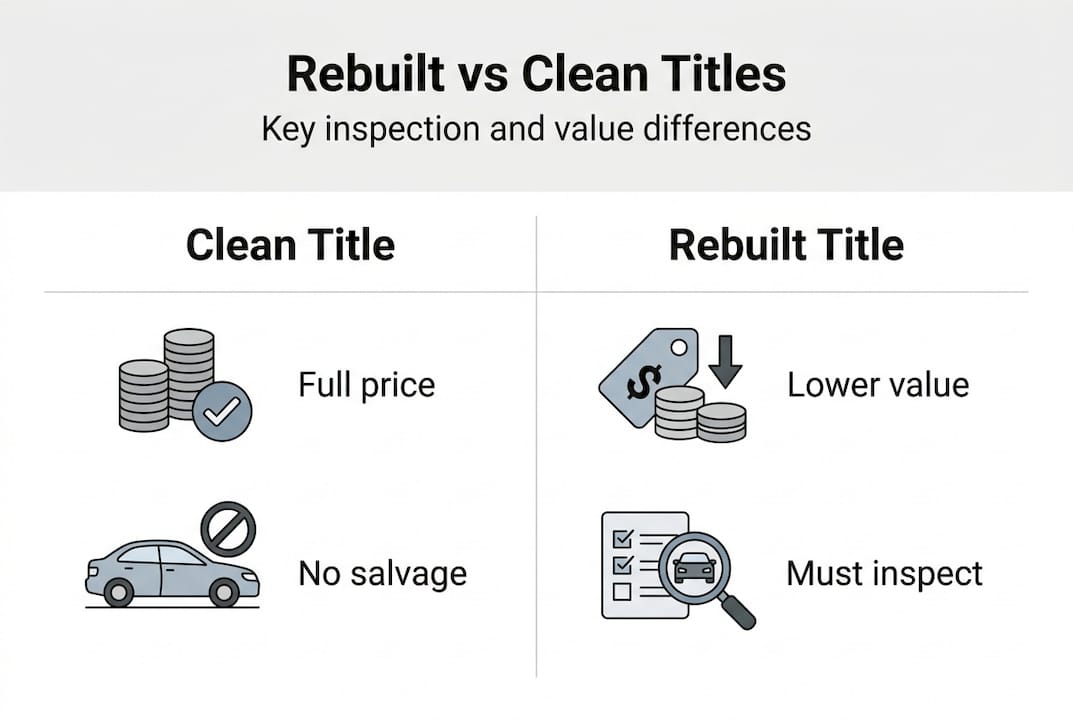
Here’s a quick look at how these title types compare:
| Title type | Price range | History transparency | Inspection required |
|---|---|---|---|
| Clean title | Full market value | Variable, often limited | No state requirement |
| Rebuilt title | 20-40% below market | Disclosed by law | Yes, required by state |
Rebuilt cars typically sell 20-40% below clean title value, which is a significant savings for budget-conscious buyers. That gap is real money. On a $25,000 vehicle, you could be looking at $5,000 to $10,000 in savings.
So why does inspection matter so much? Because not every rebuilt title vehicle was repaired with the same care. Some repairs are thorough and professional. Others cut corners. The inspection process, both the state-required check and your own due diligence, is what separates a smart buy from a regrettable one.
A few common misconceptions worth addressing:
- Rebuilt titles are always risky. Not true. Many rebuilt titles stem from minor incidents like hail, paint defects, or theft recovery with no structural involvement at all.
- Clean titles are always safer. Also not true. A clean title only tells you what insurance companies know, not what actually happened to the car.
- Rebuilt title cars are hard to insure or finance. One of the most persistent myths out there. Most major insurers offer full coverage, and banks and credit unions finance rebuilt titles.
Understanding rebuilt title values and the real pros and cons of rebuilt titles gives you the foundation to shop with your eyes open. Knowledge is your best negotiating tool.
Essential tools, documents, and requirements for inspection
Knowing what to look for starts with having the right tools and documents ready at inspection. Think of this as your pre-game checklist. Show up prepared and you’ll catch things that less prepared buyers miss entirely.
Documents you need to gather:
- Repair receipts from the shop that performed the work
- Before-and-after photos of the vehicle
- VIN documentation matching the title
- State inspection forms and certificates
- Any prior vehicle history reports available
Tools that give you an edge:
- A flashlight for inspecting panel gaps, undercarriage welds, and interior corners
- An OBD-II scanner to check for stored fault codes in the vehicle’s computer
- A VIN decoder to cross-reference the vehicle identification number across panels
- Gloves and protective eyewear if you’re getting hands-on under the hood
Here’s a quick reference table for what inspectors typically focus on:
| Inspection area | What’s being checked | Why it matters |
|---|---|---|
| VIN matching | All panels and dashboard match | Confirms vehicle identity |
| Safety systems | Airbags, seatbelts, brakes | Core safety functionality |
| Repair documentation | Receipts, photos, parts records | Validates quality of repairs |
| Electrical systems | Lights, sensors, ADAS features | Modern cars are very wiring-dependent |
Official rebuilt title inspections focus on VIN matching, safety systems, and repair documentation. That’s a solid baseline, but it’s not everything.
Pro Tip: Build your own structural and mechanical checklist before your inspection appointment. It should cover checkpoints that go beyond what most buyers think to look for—frame welds, undercarriage corrosion, and airbag modules included.
Also familiarize yourself with the retitling process for your state. Requirements vary, and knowing what paperwork was required to get the rebuilt designation in the first place tells you a lot about what the seller had to prove before the title was issued.
Step-by-step rebuilt title car inspection checklist
Once you’ve gathered everything you need, it’s time to follow a step-by-step approach for your inspection. This is where preparation pays off.
-
Verify the VIN on every panel. The VIN should match on the dashboard, door jambs, engine bay, and title. Any mismatch is a serious red flag that warrants walking away.
-
Review all repair documentation. Go through receipts line by line. Look for parts replaced, labor performed, and shop credentials. A well-documented repair is a confident repair.
-
Inspect safety systems personally. Check that airbags are present and properly seated (not just covered). Test seatbelt retractors. Press the brakes firmly and listen for anything unusual.
-
Run the OBD-II scanner. Plug it in and check for active or stored fault codes. Pay special attention to codes related to airbag systems, ABS, and advanced driver assistance systems (ADAS). These are expensive to fix.
-
Check panel alignment and welds. Uneven panel gaps, mismatched paint texture, or rough welds under the car can indicate structural repairs that weren’t done to a high standard.
-
Book an independent pre-purchase inspection (PPI). This is the step most buyers skip and the one they most often regret skipping.
State inspections are not full safety checks. A buyer’s PPI uncovers hidden issues like poor welds or electrical faults that the official process can miss.
Pro Tip: An independent mechanic’s PPI typically costs $100 to $200. On a vehicle that could save you thousands, that investment is a no-brainer. Ask the mechanic specifically to inspect the frame, welds, airbag modules, and any ADAS calibration.

The hidden risks in rebuilt title cars are rarely obvious to the untrained eye. A professional second opinion is the closest thing to a guarantee you can get in this process.
Edge cases, common mistakes, and safety warnings
Even if you follow every step, some rebuilt titles are safer investments than others. Let’s cover the edge cases and major pitfalls so you know exactly what to watch for.
Vehicle histories that deserve extra caution:
- Flood history: Water intrusion causes long-term electrical problems that can take months or years to surface. Corrosion hides in places no inspector can easily reach.
- Structural repairs: Frame damage that has been welded or straightened can affect crash safety in ways that aren’t visible during a standard inspection.
- Odometer irregularities: Any sign of odometer tampering should end the conversation immediately.
Title washing is a fraud tactic where a vehicle’s title history is obscured by re-registering it across multiple states to make a problematic history harder to trace. It affects roughly 1 in 325 vehicles, which sounds small until you’re the one holding the keys to that car.
Here’s a comparison of vehicle history types by risk level:
| History type | Risk level | Key concern |
|---|---|---|
| Hail or cosmetic | Low | Mostly surface-level, structural intact |
| Theft recovery | Low to medium | Check electrical and ignition systems |
| Flood | High | Electrical corrosion, mold, long-term issues |
| Structural repair | High | Frame integrity and crash safety |
How to spot potential fraud:
- VINs that don’t match across all panels
- Titles issued in multiple states in a short time period
- Sellers who are reluctant to provide full repair documentation
- Prices that seem too good even for a rebuilt title vehicle
Hail and cosmetic damage rebuilt titles are generally safer investments when backed by solid documentation. Flood and structural histories require significantly more scrutiny.
If you want to explore the lower-risk end of the rebuilt title spectrum, our hail damage rebuilt title guide is a great place to start. And if you’re trying to understand pricing context, our guide to what rebuilt titles are worth breaks down how different vehicle histories affect market value.
Why budget buyers should be both cautious and opportunistic
Here’s a perspective that most articles on this topic won’t give you. The risks in rebuilt title buying are real, but they’re often not where people think they are.
Most buyers worry about the title itself. The smarter concern is the documentation behind it. A rebuilt title with thorough repair records, before-and-after photos, and a clean PPI is often a more transparent purchase than a clean title car with unknown history sitting quietly on a dealer lot.
Cosmetic-damage rebuilt titles, particularly hail, are genuinely undervalued in today’s market. The value gap persists and good deals exist on cosmetic damage vehicles, though buyers benefit from being mechanically informed. The cars are structurally sound. The repairs are surface-level. And the savings are real.
The buyers who get burned are usually the ones who skip the PPI, ignore documentation gaps, or chase the lowest price without asking why it’s that low. Caution and opportunity aren’t opposites here. They work together. Go in informed, verify everything, and the hail damage deals you’ll find can be genuinely excellent value for long-term ownership.
Transparency in documentation is your best friend in this market. Always.
Ready to shop with confidence?
You’ve done the homework. You know what to look for, what to ask, and which red flags to take seriously. Now it’s time to put that knowledge to work.

ReVroom is the only online marketplace built specifically for rebuilt title vehicles. Every listing shows the title status, the history type and in-house severity grade, and what was repaired, with photos where they are available, so you can evaluate each vehicle before you ever schedule a showing. If you’re ready to find rebuilt title cars with the transparency you deserve, ReVroom is where your search starts, and you can keep learning in our guides along the way.
Frequently asked questions
What paperwork is required for a rebuilt title car inspection?
Most states require repair receipts, photos, and VIN documentation along with completed state inspection forms. Requirements vary by state, so check your local DMV guidelines before your appointment.
How much does a pre-purchase inspection (PPI) cost for a rebuilt title car?
An independent mechanic’s PPI typically costs $100-$200 and is one of the best investments you can make before committing to a purchase.
Are rebuilt title cars always a bad investment?
Not at all. Vehicles with documented cosmetic vehicle history, like hail, can offer major savings with lower risk, especially when paired with a thorough inspection and complete repair documentation.
What are the biggest risks with rebuilt title cars?
Flood and structural vehicle histories carry the highest risk, and title washing fraud affects roughly 1 in 325 vehicles. Complete documentation and an independent inspection are your strongest defenses against both.
