


Rebuilt Title Value Impact – What Buyers Need To Know
February 6, 2026
Anyone shopping for an affordable, reliable car has probably run into rebuilt title vehicles — and the big savings they offer. Understanding what a rebuilt title actually means matters because it opens up access to real savings, with market value often 20% to 40% lower than a clean title car. This guide separates myth from fact and shows how a rebuilt title vehicle can be a smart, safe choice when you know what to look for.
Table of Contents
- What Does A Rebuilt Title Mean?
- Key Differences: Rebuilt Versus Clean Titles
- How Much Does A Rebuilt Title Affect Value?
- Factors That Influence Rebuilt Title Pricing
- Insurance, Resale, And Buying Tips
Key Takeaways
| Point | Details |
|---|---|
| Rebuilt Title Definition | A rebuilt title means a vehicle was professionally repaired and restored to roadworthy condition after being declared a total loss. |
| Title Comparison | Rebuilt titles sell for less than clean titles — but they’re both insurable and financeable, with rates that vary by carrier and lender. |
| Value and Pricing | Rebuilt title vehicles are typically priced 20-40% (up to 50%) below clean-title equivalents — real opportunity for buyers who read the history. |
| How to Buy Well | Request the full repair documentation and get an independent inspection to confirm the car’s quality before you buy. |
What Does a Rebuilt Title Mean?
A rebuilt title marks a vehicle that has been legally restored to roadworthy condition after significant damage. When an insurance company originally declares a vehicle a total loss, it can later earn this designation — a story of repair and a second chance on the road.
A rebuilt title has a few defining characteristics:
- The vehicle was previously declared a total loss by an insurer
- Professional mechanics repaired the car
- State safety inspectors verified it meets roadworthy standards
- The title serves as a permanent record of the car’s history
A rebuilt title doesn’t mean an unreliable vehicle. Many rebuilt title cars are smart value buys — they clear a state safety inspection and meet specific state requirements before earning rebuilt status.
The path to a rebuilt title:
- Damage assessment by the insurance company
- Professional repair work
- State safety inspection
- Official redesignation from salvage to rebuilt
A rebuilt title means a vehicle has been professionally repaired and cleared for road use — not a permanently damaged car.
Pro tip: Request a detailed vehicle history report and get an independent inspection before buying any rebuilt title vehicle.
Key Differences: Rebuilt Versus Clean Titles
Understanding the difference between rebuilt titles and clean titles helps you buy well. A clean title means a vehicle has no total-loss event on record.
The key differences show up in:
- Damage and repair history
- Price and valuation
- Resale potential
- Insurance and financing terms
A clean title means the car never reached a total-loss threshold. A rebuilt title means the car was declared a total loss, then professionally repaired and re-certified through a state inspection. That difference shapes price and resale — mostly in the buyer’s favor up front.
Here’s how they compare at a glance:
| Aspect | Rebuilt Title | Clean Title |
|---|---|---|
| Damage History | Prior total loss, repaired & inspected | No total-loss event reported |
| Insurance | Available, full coverage too; compare quotes | Broad, easy to quote |
| Resale Value | Lower — up to 50% below market up front | Higher, market value retained |
| Buyer Perception | Discounted — but a well-repaired car is a smart buy | Seen as more reliable |
| Financing | Banks & credit unions lend; shop terms | Wide range of options |
- Clean title vehicles command higher resale prices
- Rebuilt title cars are often priced 30-50% below clean-title equivalents
- Insurance rates can differ, so compare quotes
- Financing is available from banks and credit unions; terms vary
A rebuilt title doesn’t mean an unreliable car — it means a documented history and a real discount.
Pro tip: Always pull a vehicle history report and schedule a professional inspection before buying a rebuilt title car.
How Much Does a Rebuilt Title Affect Value?
Understanding the value impact is key for budget-conscious buyers. Branded titles typically reduce market value by 20% to 40% compared to similar clean title vehicles — which is exactly the savings you capture as the buyer.
Several factors shape how much a rebuilt title car is worth:
- Extent and type of the original damage
- Quality and completeness of the repairs
- State regulations and inspection standards
- Detailed vehicle history documentation
- Make, model, age, and mileage
The picture is nuanced: these cars carry a discount, and that discount is the opportunity. A well-inspected, professionally repaired rebuilt title car can be an exceptional value.
The financial upside breaks down as:
- Immediate purchase-price savings of 30-50%
- A resale discount later — the flip side of the up-front saving
- Financing available from banks and credit unions
- Insurance available, including full coverage; rates vary, so compare
A rebuilt title doesn’t define a car’s whole worth — reading the history reveals value beyond first impressions.
Pro tip: Get a professional inspection and a full history report to accurately assess a rebuilt title vehicle’s true value.
Factors That Influence Rebuilt Title Pricing
Rebuilt title pricing depends on several variables beyond simple damage assessment. Pricing for rebuilt vehicles depends on multiple factors:
- Original damage extent and type
- Quality and completeness of the repairs
- Documentation and inspection history
- Make, model, and overall condition
- Age and mileage
- State regulatory requirements
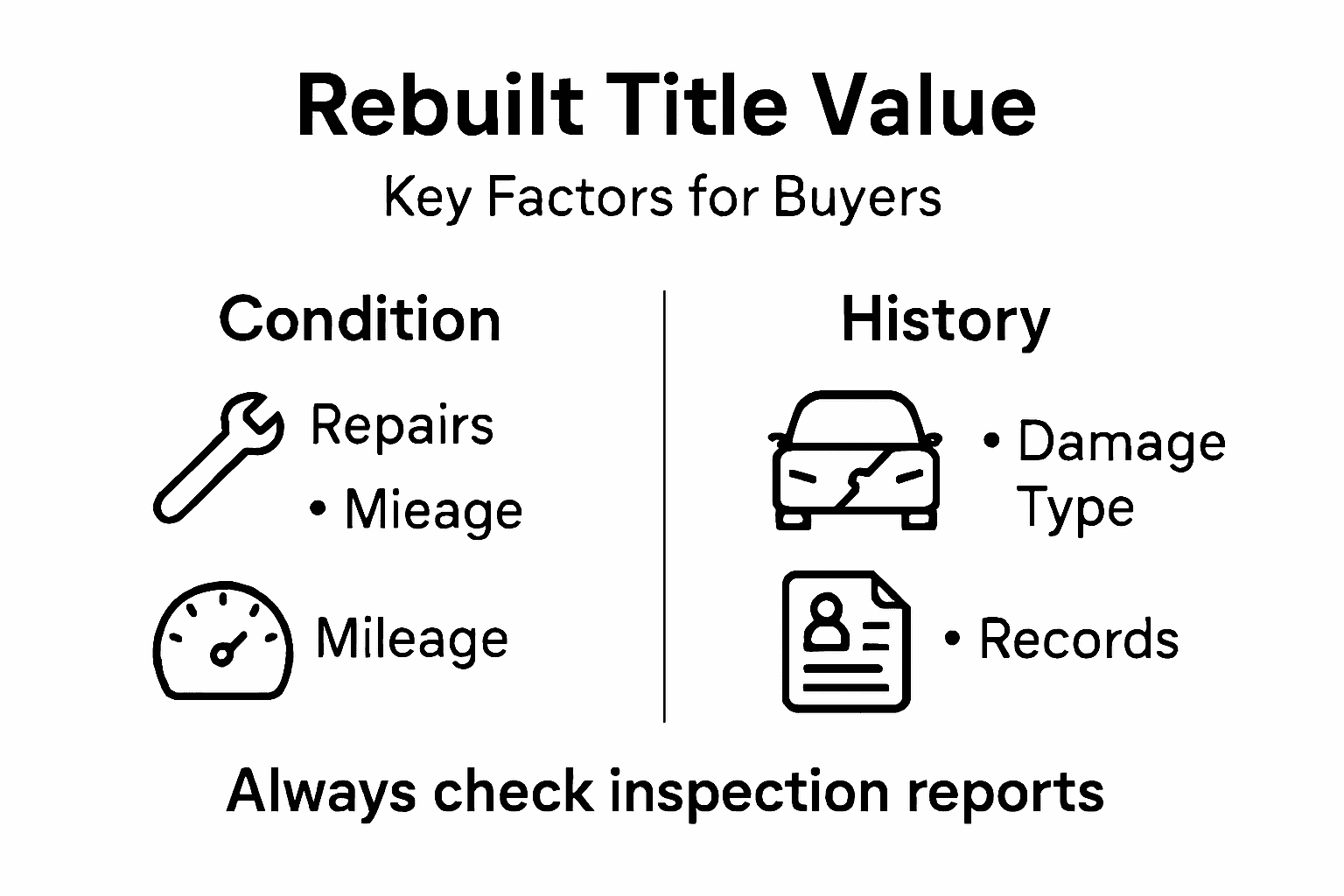
Repair quality is the biggest single determinant of value. A car meticulously restored by professionals can hold value well, turning a former total loss into an attractive buy.
Value tends to track with:
- Complete repair documentation
- The state inspection certificate
- A transparent vehicle history report
- An independent third-party inspection
Not all rebuilt titles are equal — the difference between a good and a great value is documentation and repair quality.
Pro tip: Request complete repair records and get an independent inspection to accurately assess a rebuilt title car’s market value.
Insurance, Resale, and Buying Tips
A little know-how goes a long way here. You can insure a rebuilt title car — most major insurers offer liability everywhere and full coverage too; a few ask for a photo inspection, so comparing a couple of quotes gets you the best rate. Financing is available from banks and credit unions, with credit unions often the most flexible.
Key points for a rebuilt title purchase:
- Insurance is available, full coverage included — compare quotes
- Financing is available from banks and credit unions — shop terms
- Resale is lower than a clean title — the flip side of the discount
- Keep the repair and history documentation handy
A few things to double-check so your great price stays a great deal:
| Check | Why | What to do |
|---|---|---|
| Repair records | Complete documentation confirms quality | Ask for the full repair paperwork |
| Independent inspection | Confirms the repairs first-hand | Hire a trusted mechanic |
| Insurance rate | Rates vary by carrier | Compare a couple of quotes in advance |
| State rules | Laws differ by state | Check the rules where you’ll register it |
- Get complete repair and history documentation
- Schedule an independent professional inspection
- Confirm your state’s rebuilt title rules
- Compare insurance and financing quotes
A rebuilt title vehicle is an opportunity — read the history and it’s a genuinely smart buy.
Pro tip: Compare a couple of insurance quotes and line up financing before you finalize — both are readily available for rebuilt titles.
Buy Rebuilt Title Vehicles with Confidence
Shopping rebuilt title cars is far easier when the history is in front of you. ReVroom is the marketplace built specifically for rebuilt and branded title vehicles — bringing clarity, honest history, and pre-repair photos up front so you know what you’re getting before you buy.

With prices up to 50% below clean titles and transparent listings featuring accident history and pre-repair photos, ReVroom helps you save time, skip surprises, and find the best deals. Ready to explore the difference? Visit ReVroom and take the next step toward a smarter, fairer rebuilt car purchase.
Frequently Asked Questions
What is a rebuilt title?
A rebuilt title means a vehicle was previously declared a total loss by an insurance company but has been professionally repaired and passed a state safety inspection to be roadworthy again.
How does a rebuilt title affect the value of a vehicle?
A rebuilt title typically means a vehicle sells for 20% to 50% less than a comparable clean title car — a saving up front and a factor to plan for at resale.
Can you insure and finance a rebuilt title car?
Yes to both. Most major insurers cover rebuilt titles (full coverage included; rates vary, so compare quotes), and banks and credit unions finance them — credit unions are often the most flexible.
What should buyers consider when purchasing a rebuilt title vehicle?
Get the complete repair records, schedule an independent inspection, understand your state’s rules, and compare insurance and financing quotes to buy with confidence.
