


Buying a Car With a Rebuilt Title (2026): Should You, What to Pay, eBay Motors vs. a Rebuilt Marketplace, and the Step-by-Step Buyer's Guide
September 18, 2026
Short answer: buying a rebuilt title car is a smart move for a budget buyer when three things are true: the repair is documented, the car passes an independent inspection, and the price sits roughly 20-40% below what the same car would cost with a clean title. Get those three right and you drive home the same car your neighbor paid thousands more for. This guide walks you through the whole process in order, from the first document you ask for to the day the title lands in your name.
Key takeaways
- A rebuilt title means the car was once a total loss, was professionally repaired, and passed a state inspection before going back on the road. It describes the car's past, not its current condition.
- The rule of thumb is roughly 20-40% below clean-title value. Across 17,000+ rebuilt title cars tracked by ReVroom, buyers saved a median of $4,590 per vehicle, and one in three bought at 25% or more below market.
- Ask for five documents before you visit: the inspection certificate, itemized repair invoices, pre-repair photos where they exist, the branded title, and a VIN-based history record.
- Always pay for an independent pre-purchase inspection. The state inspection is the floor every rebuilt car clears; the mechanic tells you about the repair quality.
- Rebuilt title cars can be insured and financed. Line up both before you negotiate.
Table of contents
- Should you buy a car with a rebuilt title?
- Is buying a rebuilt title car a good idea?
- What is a rebuilt title and how does the buying process start?
- How much should you pay for a rebuilt title car?
- Preparation checklist: the five documents to ask for
- Step-by-step buying process
- What to look for on the car itself
- Where to buy a rebuilt title car
- Can you insure and finance a rebuilt title car?
- After the purchase
- Why transparency beats stigma
- eBay Motors vs. a rebuilt-only marketplace
- How to buy a rebuilt title car online
- Which rebuilt title cars buyers choose
- Frequently asked questions
Is buying a rebuilt title car a good idea?
Short answer: yes, for the right buyer and the right car. If you want a dependable daily driver and you care more about the monthly payment than the badge on the trunk, a rebuilt title car is one of the few places left in the used market where the discount is real and repeatable. The car has to pass a state inspection that a clean-title car never faces after its own repairs, so a well-documented rebuilt car can be one of the most transparent used cars you will ever look at.
It is not for everyone. If you plan to sell the car in two years and want top dollar back, the rebuilt brand follows the car for life and your buyer will want a discount just like you did. If you cannot spare an hour for paperwork and an inspection, skip it. Everyone else: keep reading. Our editor bought one for 53% off and has never gone back to clean titles.
Should you buy a car with a rebuilt title? A one-minute checklist
Short answer: yes, if you want a dependable daily driver for less money and you are willing to spend an hour on paperwork and an independent inspection. The checklist below sorts it out in about a minute.
Think of it like buying a house with a new roof after a storm. The question is not whether there was a storm. It is whether the roof was done right and whether the price reflects it.
| If this sounds like you | A rebuilt title car fits? | Why |
|---|---|---|
| You want the most car for your budget | Yes | Median savings of $4,590 against clean-title value in ReVroom's October 2026 snapshot |
| You plan to drive it for years | Yes | The discount you got up front is the one your next buyer expects, so long ownership keeps the math simple |
| You will read the paperwork and book an inspection | Yes | That hour is what turns a good price into a good car |
| You want to choose the kind of history | Yes | You can shop minor-graded cars or hail-history cars only |
| You plan to sell in a year or two for top dollar | Maybe not | The rebuilt brand stays on the title, and resale buyers expect the same discount you got |
| You need financing or full coverage | Yes, with a little shopping | Rebuilt cars are financeable and insurable; compare a few lenders and insurers |
If most of your answers landed on "yes," you are the buyer rebuilt title cars were made for. Start with the rebuilt inventory and filter by the history you are comfortable with.
What is a rebuilt title and how does the buying process start?
Short answer: a rebuilt title is the brand a state puts on a car that was declared a total loss, professionally repaired, and then inspected and cleared to drive again. Some states call it reconstructed or restored. As Consumer Reports explains, a car with a rebuilt title once had a salvage title and has since been rebuilt and should be road-ready.
The word "total loss" scares people more than it should. An insurer totals a car when the repair estimate crosses its own threshold, and that threshold has nothing to do with whether the car can be fixed well. Some of the most common histories behind a rebuilt title:
- Hail that dents every panel on paper but leaves the engine, frame and interior untouched
- Theft recovery where the car came back with cosmetic or minor issues after the insurer had already paid out
- Collision ranging from a bumper and a headlight to a full front-end repair
- Vandalism, which is usually glass and paint
- Water or fire, the smallest share and the one where documentation matters most
Across rebuilt title vehicles with documented history analysis on ReVroom, 81.9% is collision history, 10.4% hail and 3.4% vandalism, and 87% of the cars sold carried only minor or moderate history (ReVroom Rebuilt Title Market Snapshot, October 2026). In other words, the typical rebuilt car is a hail car or a moderate collision repair, not a rebuilt wreck.
So the buying process starts with one question, before price, before mileage, before color: what happened to this car, and can the seller prove how it was fixed? Everything below flows from that. If you want the longer definition first, read what a rebuilt title is and how salvage and rebuilt titles differ.
How much should you pay for a rebuilt title car?
Short answer: start from the clean-title market value and take off roughly 20-40%, then adjust for what actually happened to the car. That range is the rule of thumb Kelley Blue Book publishes for branded titles ("the industry rule of thumb is to deduct 20% to 40% of the Blue Book Value"), and it lines up with what we see across thousands of real sales.
A rule of thumb is a starting point. A sold price is a fact. Here is what 17,000+ rebuilt title sales tracked by ReVroom show, from the live October 2026 market snapshot:
| What the data shows | Figure |
|---|---|
| Rebuilt title vehicles analyzed | 17,000+ |
| Median saved per vehicle vs. clean-title market value | $4,590 |
| Median sold price | $17,499 |
| Median model year / mileage | 2020 / 55,083 mi |
| Total documented savings | $60,146,801 |
| Share sold with only minor or moderate documented history | 87% |
| Median saved on a 2023 model year | $6,537 (more than three times a 2015) |
Two practical takeaways. First, the discount is bigger in dollars on newer cars, so a two- or three-year-old rebuilt car is often where the savings are largest. Second, the history should move the price: a hail car with a clean mechanical record deserves a smaller discount than a car that needed structural work, and a seller asking for a clean-title price on a rebuilt car has not earned it. For the full math, including a worked example, read how a rebuilt title affects a car's value.
Preparation checklist: the five documents to ask for before you visit
Short answer: ask for the inspection certificate, the repair invoices, pre-repair photos, the branded title and a VIN history record, and ask for all five by email before you drive anywhere. Think of it like packing before a road trip: you do not want to discover what is missing once you are on the highway.
- State inspection certificate proving the car passed the rebuilt (or salvage-to-rebuilt) inspection after the repair. It is the document that turned salvage into rebuilt, and it is table stakes for every rebuilt car, everywhere.
- Itemized repair invoices and parts receipts that show what was fixed, by whom, and with what parts. Dates should line up with the total-loss event and the inspection.
- Photos of the car before the repair, where they exist. Auction photos are the usual source. They tell you in ten seconds what the invoices take ten minutes to say.
- The title itself, showing the rebuilt brand in your state's format, with a VIN that matches the dash and the door jamb.
- A VIN-based history record showing the original total-loss event and its date, so the seller's story and the record agree.
| Document | What it tells you | What should make you pause |
|---|---|---|
| Inspection certificate | Passed the state's rebuilt inspection | Missing, expired, or from a different state than the title |
| Repair invoices and receipts | What was fixed and with what parts | Vague line items, no shop name, dates that do not match |
| Pre-repair photos | Where the car was hit and how hard | "No photos exist" on a car that came through an auction |
| Branded title | Legal status and VIN | VIN mismatch, a lien still listed, or a seller who is not the owner on the title |
| VIN history record | The original event and timeline | More than one total-loss event, or an event the seller did not mention |
Pro tip: a seller who will not send the invoices and the certificate before a showing is a seller worth skipping. There are more cars. On ReVroom, every listing shows what was repaired, with photos where they are available, so you can do this step from your couch; for a specific car anywhere, a ReVroom Report gives you an in-house severity grade, a detailed severity graphic, an estimated savings percentage, and where and when the car was auctioned.
Step-by-step buying process for rebuilt title vehicles
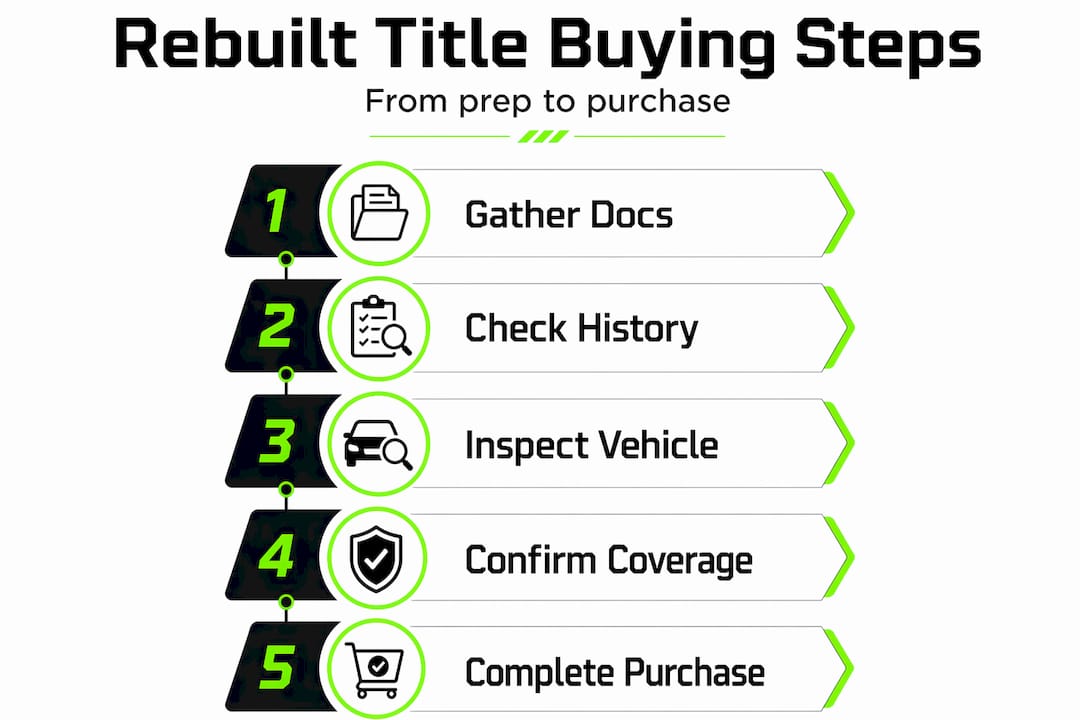
Short answer: documents first, history check second, independent inspection third, price fourth, paperwork last. Buyers get into trouble by doing these out of order, usually by falling for the car before they have read a single invoice.
-
Request the inspection certificate and the repair documentation. Before you visit. If the seller cannot produce them, stop here.
-
Verify the title and history yourself. Run the VIN through your state's DMV or a history service and confirm the rebuilt brand is recorded and matches the seller's paperwork. Check that the person selling is the person on the title.
-
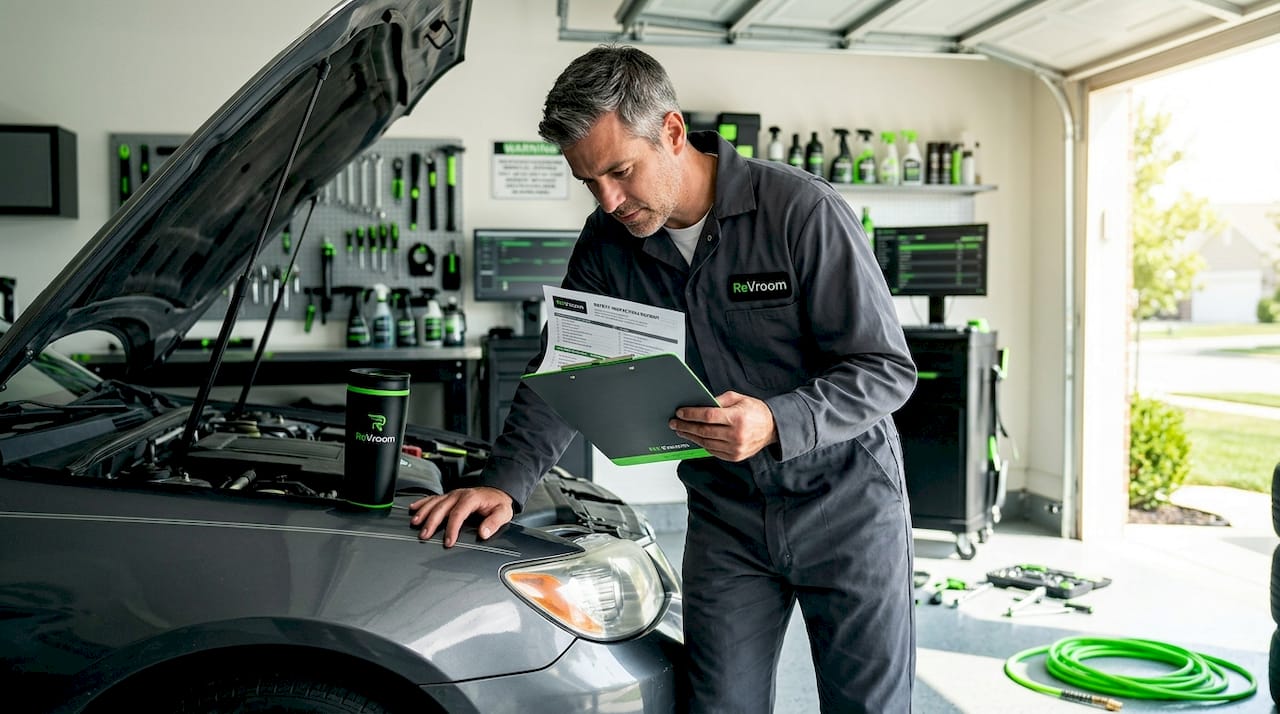
Book an independent pre-purchase inspection. Not the seller's mechanic. Yours. Ask for the car on a lift, a frame and underbody check, an airbag system scan, and a full electrical walk-through. It costs about what a good oil change and a tank of gas cost together, and it is the best money in the whole process.
-
Go to the inspection if you can. Ask the mechanic to walk you through what they see in plain language. You are listening for one thing: does the repair match the invoices and the photos?
-
Line up insurance and financing quotes. Do this before you negotiate, not after. Most major insurers and most banks and credit unions handle rebuilt titles; knowing your numbers keeps the finish line boring. Details in which insurers cover rebuilt titles and getting an auto loan on a rebuilt title.
-
Price it from the clean-title value down. Use the 20-40% rule of thumb as your anchor, move within it based on the history and the mechanic's findings, and use anything the inspection turned up as a number, not a feeling. If the findings are serious, walk. There are always more cars.
-
Finish the paperwork carefully. Bill of sale, title signed over with the rebuilt brand intact, registration, and proof of insurance in hand before you drive off. Keep every document from steps one through six in one folder; you will want it when you sell.
What to look for when buying a rebuilt title car
Short answer: look for a repair that matches its paperwork. Even gaps, matching paint, a straight underbody, working airbag lights, dry carpet and honest electrics tell you the shop did the job right. Here is the walk-around, in the order a mechanic would do it:
- Panel gaps and paint. Run your eye down each side. Gaps between hood, fenders and doors should be even; paint should match panel to panel in daylight. Overspray on trim or rubber means a fast paint job.
- Underbody and frame rails. On the lift, look for kinked or freshly welded rails, new undercoating in one spot only, or bolts with tool marks on suspension parts. A hail car should have none of this.
- Airbags. At key-on, the airbag light should come on and go off. A light that never comes on has been disabled; one that stays on has a fault. Ask the mechanic to scan the module for deployment history.
- Water signs. Lift the carpet at the sills and in the trunk, sniff for must, check for silt in the seat tracks and corrosion on unpainted bolt heads under the dash.
- Glass and lights. Every piece of glass should carry the same maker's mark; a single odd windshield or headlight is fine, several is a story.
- Tires and alignment. Uneven wear across the front tires on a car that has been "fully repaired" says the alignment was never done.
- Electrics. Every window, seat, light, camera and sensor. Collision repairs that skipped a harness show up here first.
- The test drive. Straight steering wheel on a straight road, no pull under braking, no new noises over bumps, and a transmission that shifts the same cold and warm.
If the invoices, the photos and the lift all tell the same story, you are looking at a good rebuilt car. If any one of the three disagrees with the other two, that is your answer. For a printable version of this list, see how to buy a rebuilt car safely and the red flags to watch for.
Where to buy a rebuilt title car
Short answer: buy wherever the history is disclosed up front, and prefer sellers who deal in rebuilt titles every day. You have three good options and one that takes more work:
- Rebuilt title dealerships. These dealers retail rebuilt cars for a living, know exactly what they are worth, and usually have the inspection and repair paperwork on the desk. Many also offer their own warranty. ReVroom lists verified rebuilt title dealers by state, each with live inventory.
- Private sellers. Often the lowest price, because there is no lot overhead. The documents matter even more here, since there is no dealer disclosure form behind the sale.
- A rebuilt-title marketplace. ReVroom is the only site where you can filter inventory by history type, from hail and cosmetic paint chips all the way to fire recoveries, and by in-house severity grade. If you only want the gentlest histories, start with hail-history cars or minor-severity listings. No other site lets you shop that way.
- Salvage auctions. Cheapest on paper, but you are buying the car before the repair, then paying for the repair and the inspection yourself. That is a different job, and it is not the one this guide is about. If you are a rebuilder, our guide to buying at Copart without a dealer license covers that side.
More on the options, including national chains and what they will and will not sell, in where to buy rebuilt cars.
Buying a rebuilt title car on eBay Motors vs. a rebuilt-only marketplace
Short answer: you can buy rebuilt title cars on eBay Motors, but eBay's own buyer protection leaves out condition claims on any car not listed with a clean title. On a rebuilt title car, the listing, the paperwork and your own inspection are what protect you, wherever you buy.
eBay is a big, useful marketplace, and plenty of rebuilt cars sell there. Here is what eBay publishes on its own pages, read October 14, 2026, and how it compares with shopping on ReVroom:
| What you want to know | eBay Motors (as eBay publishes it) | ReVroom |
|---|---|---|
| Must the seller disclose a rebuilt title? | Yes: "The title brand history of a vehicle must be disclosed in the description if it has had a brand issued in the past" | Every listing is a rebuilt or branded title, so it's disclosed by definition |
| Buyer protection on condition | Vehicle Purchase Protection (up to $500,000 on eligible Secure Purchase deals) excludes "Any damage on a vehicle listed with anything but a 'clean' title" | The history type and severity grade are on the listing, with repair photos where available, before you buy |
| Protection on the title brand itself | Covers an undisclosed brand "like salvage, bonded, rebuilt" on a car listed as clean, but excludes "Misstatements about the type of title brand" on a car listed with a brand | The title status is shown on the listing |
| Can you filter by history type and severity? | Title-type labels group "Rebuilt, Rebuildable & Reconstructed" together | Yes: by history type and by in-house severity grade; no other site lets you shop that way |
| Where and when the car was auctioned | Up to the seller to share | Shown in a ReVroom Report, alongside the severity grade |
That middle row matters most. It's like buying a renovated house "as is": the seller's disclosures and your inspector are the protection, not a warranty. So on any site, rebuilt or not, do the same three things: get the rebuilt inspection certificate, check where and when the car was auctioned, and pay for a pre-purchase inspection. On ReVroom, the history type and severity are on the page before you ever message a seller.
How do you buy a rebuilt title car online, start to finish?
Short answer: filter for the history you are comfortable with, read the listing's repair notes, check the brand by VIN, get a report and an inspection, then line up insurance and financing before you pay. Shopping online works for rebuilt title cars the same way it works for groceries: the store does the sorting, so you only walk the aisles you care about.
- Pick your comfort zone first. ReVroom is the only site that lets you filter the whole market by history type and by in-house severity grade. Start with minor-graded cars, or narrow to hail history if cosmetic dents are the only story you want to hear. You can combine them: hail history, minor grade.
- Read what was repaired. Every ReVroom listing shows what was repaired, with photos where they are available, and the title status. If a listing elsewhere will not tell you what happened, keep scrolling.
- Confirm the brand by VIN. A free salvage title check through NICB VINCheck and an NMVTIS report confirms the title history across states.
- Get the grade and the savings estimate. A ReVroom Report gives you the in-house severity grade, a detailed severity graphic, the estimated savings percentage, and where and when the car was auctioned. It is not a vehicle history report; it answers the question a history report does not: how severe was it, and is the price fair?
- Book a pre-purchase inspection. A mechanic you hire, with the car on a lift. This is the step that turns a good listing into a good purchase.
- Line up insurance and financing before you pay. Get two or three insurance quotes on the VIN. If you are financing, ReVroom Financing sends one application to the myAutoloan lender network for up to 4 offers, as published. ReVroom is not a lender.
- Contact the seller and close. Ask for the repair file, sign a bill of sale that names the brand, and handle the title transfer the same day.
Which rebuilt title cars do buyers actually buy?
Short answer: mostly nearly new, mostly lightly repaired, and mostly collision history. The typical rebuilt car that sells is a 2020 with about 55,000 miles, and 87% of the cars sold carried only a minor or moderate grade. In other words, the market looks a lot like a regular used-car lot, just with the price tag moved down.
Here is the mix from ReVroom's live market snapshot by history (updated October 1, 2026):
| What sold | Share | What it means for you | Shop it |
|---|---|---|---|
| Minor grade | 34.3% (4,229 cars) | The easiest decisions; cosmetic or bolt-on repairs | Minor-graded cars |
| Moderate grade | 53.1% (6,556 cars) | The heart of the market; read the repair notes and inspect | Moderate-graded cars |
| Severe grade | 12.6% (1,555 cars) | The deepest discounts, for buyers who want the most car per dollar and will inspect closely | Severe-graded cars |
| Collision history | 81.9% | The most common story; ask which panels and whether airbags were involved | Collision history |
| Hail history | 10.4% | Cosmetic by nature and among the biggest savers, typically $4,090 or more below market | Hail history cars |
| Vandalism history | 3.4% | Often glass, paint, and trim | Vandalism history |
The grade is a choice, not a warning. A minor-graded car is the easy yes. A severe-graded car is the bigger discount for the buyer who wants it and does the homework. What matters is that you pick on purpose, with the grade in front of you, instead of finding out after you have signed.
And the newer the car, the bigger the dollar saving: the snapshot's median saving is $4,870 on a 2020 model year, $5,966 on a 2022, and $7,023 on a 2024. If your budget can stretch to a two- or three-year-old car, that is where a rebuilt title does the most work for you.
Can you insure and finance a rebuilt title car?
Short answer: yes to both. Most major insurers cover rebuilt title cars; liability is available everywhere and full coverage from most carriers, though a few ask for photos first or price the policy a little differently, so get two or three quotes. Banks and credit unions finance rebuilt title cars every day, and credit unions are often the most flexible on terms. The upfront savings usually outweigh the extra phone calls.
Getting a quote is easier than most people expect when you bring the rebuilt title, the inspection certificate and the repair receipts. For one carrier's published position, see does Progressive insure rebuilt title cars, and compare a few quotes side by side; that is usually where the savings show up.
One thing to understand before you buy: if the car is ever totaled again, the insurer pays market value for a rebuilt title car, which reflects what you paid, not the clean-title price. That is fair when you bought at a fair price, and it is one more reason not to overpay.
After the purchase: verification and the follow-through
Short answer: confirm the title transferred, keep every document, and pay attention to the car for the first month. Buying the car is the beginning of the ownership, not the end of the homework.
- Confirm the title is in your name with the rebuilt brand recorded correctly. Check your state's DMV record once the paperwork is filed.
- Keep the whole folder. Inspection certificate, invoices, photos, the pre-purchase inspection report. Your next buyer will want to see exactly what you wanted to see, and a complete folder is worth real money when you sell.
- Listen to the car in the first weeks. A new noise over bumps, a warning light, a pull under braking: get it looked at early. Most rebuilt cars are as reliable as their clean-title twins; the ones that are not tend to say so quickly.
- Future inspections are not usually required. Once the car is retitled and registered, the rebuilt brand stays on the title, but you are not re-inspected every year because of it. The diligence you did up front is the diligence that carries the car.
Warranties are worth a look too: factory coverage varies by manufacturer once a car has been totaled, and some extended-warranty providers cover rebuilt titles. The details are in our guide to rebuilt title warranties.
Why transparency and homework beat stigma in rebuilt title buying
Here is an opinion you will not hear from every corner of the internet: the stigma around rebuilt titles costs buyers more than the titles do.
Most of the fear comes from incomplete information. A buyer sees the word "rebuilt" and imagines the worst. But a rebuilt title on a hail car with zero mechanical impact tells you almost nothing alarming. What matters is the story behind the title and whether that story is documented. Even Consumer Reports, which generally steers shoppers away from rebuilt titles, allows that it can come down to a case-by-case basis and that a hail car "might be mechanically sound."
What we have seen consistently is this: the buyers who struggle with rebuilt titles are the ones who bought on price alone. The buyers who do well treated the documentation and the inspection as the actual product they were evaluating. The car is almost secondary to the paper trail. When a seller can hand you a complete inspection certificate, invoices that match every line item, and photos of the car before the repair, you are no longer hoping the car is what it appears to be. You know what it is. That is a better position than most clean-title buyers ever get to stand in.
Find transparent rebuilt title vehicles with confidence at ReVroom
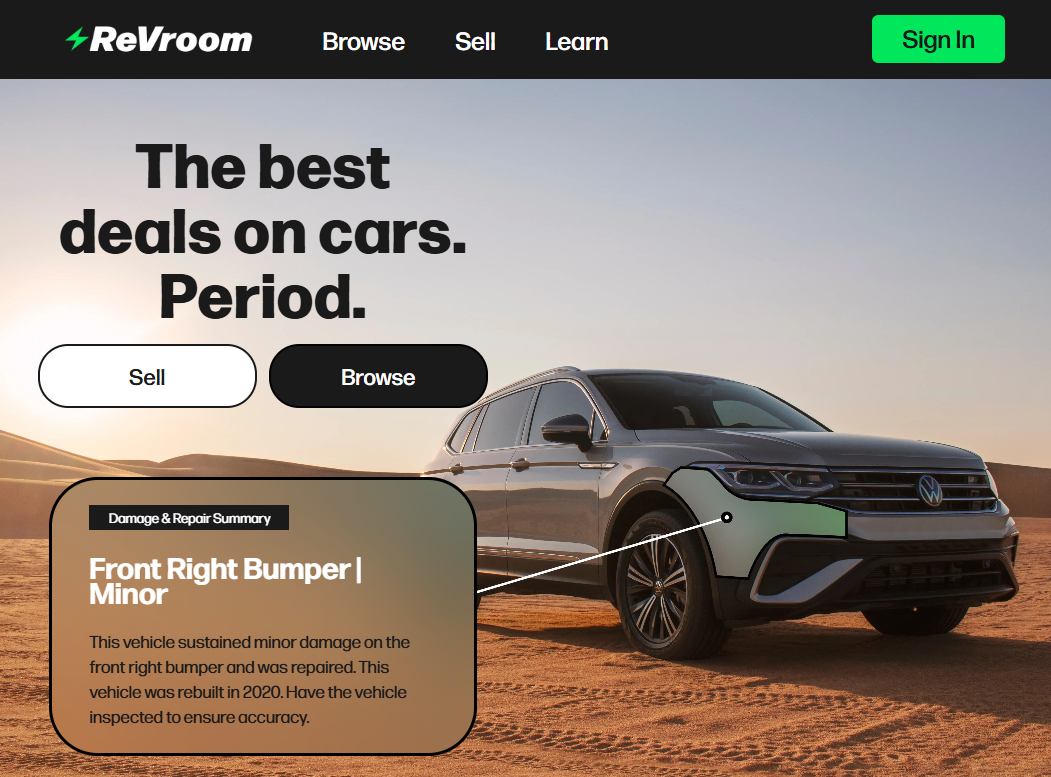
ReVroom is the only marketplace built exclusively for rebuilt and branded title vehicles. Every listing shows what was repaired, with photos where they are available, and its title status, so the "ask for the documents" step is already done before you send a message. You can filter by history type and by severity grade, which no other site offers, and every car is priced against clean-title comparables so you can see the discount instead of guessing at it. Browse rebuilt title cars, or pull a ReVroom Report on a car you found somewhere else.
Frequently asked questions
Is buying a rebuilt title car a good idea?
Yes, for a budget-conscious daily-driver buyer it can be one of the best deals in used cars, as long as the repair is documented and you check it. A rebuilt title car passed a state inspection after being professionally repaired, usually sells for roughly 20-40% below clean-title price, and can be insured and financed. What separates a great buy from a poor one is repair quality, so buy the paperwork and the inspection, not just the price.
What documents should I get from the seller when buying a rebuilt title vehicle?
Ask for five things: the state rebuilt or salvage inspection certificate, itemized repair invoices and parts receipts, photos of the car before the repair where they exist, the title itself showing the rebuilt brand, and a VIN-based history record showing the original total-loss event. Ask for them digitally before you drive out to see the car.
What should I look for when buying a rebuilt title car?
Look for even panel gaps and matching paint, a straight underbody with no kinked or freshly welded rails, airbag warning lights that come on and then go off at startup, dry carpet and no musty smell, matching tire wear, and clean electrical behavior on every switch. Then have an independent mechanic put it on a lift. If the repair records, the photos and what the mechanic sees all tell the same story, you are looking at a good rebuilt car.
How much should I pay for a rebuilt title car?
Start from the clean-title market value and take off roughly 20-40%, the rule of thumb Kelley Blue Book publishes for branded titles. Then adjust for the car in front of you: a hail or cosmetic history deserves a smaller discount than a major collision repair. Across 17,000+ rebuilt title cars tracked by ReVroom, buyers saved a median of $4,590 per vehicle, and 87% of sold cars carried only minor or moderate documented history.
Can I insure and finance a rebuilt title car?
Yes. Most major insurers cover rebuilt title cars, with liability available everywhere and full coverage from most carriers; a few ask for photos or price the policy differently, so compare two or three quotes. Banks and credit unions finance rebuilt title cars every day, and credit unions are often the most flexible. Line both up before you agree on a price.
Should I skip the pre-purchase mechanic inspection if the car passed the state inspection?
No. The state inspection confirms the car is road-legal and the repair is documented; it is table stakes for every rebuilt title car in every state. An independent pre-purchase inspection looks at repair quality, frame alignment, airbag systems and electrical condition in a depth the state check does not, and it is the best money you will spend in the whole process.
Where is the best place to buy a rebuilt title car?
The best place is wherever the repair history is disclosed up front and you can compare cars by what happened to them. Rebuilt title dealerships retail these cars daily and know them well; private sellers can offer the lowest prices; ReVroom is the only marketplace where you can filter listings by history type, from hail and cosmetic paint chips through collision, and by in-house severity grade, and see what was repaired on every listing.
Can you buy a rebuilt title car online?
Yes. Filter for the history type and severity grade you are comfortable with, read the listing's repair notes, confirm the brand with a VIN check, get a ReVroom Report for the grade and estimated savings, book a pre-purchase inspection, and line up insurance and financing before you pay. ReVroom is the only site where you can filter by severity grade and history type.
What is the typical rebuilt title car that sells?
In ReVroom's October 2026 market snapshot, the median rebuilt title car sold was a 2020 model year with 55,083 miles at a median price of $17,499, and 87% carried only a minor or moderate grade. Buyers saved a median of $4,590 against clean-title market value.
Should I buy a car with a rebuilt title?
Yes, if you want a dependable daily driver for less money and you will spend an hour on the paperwork and an independent inspection. In ReVroom's October 2026 snapshot, buyers saved a median of $4,590 against clean-title value, and 87% of sold cars carried only minor or moderate history. If you plan to resell within a year or two for top dollar, a clean title may suit you better.
Is buying a vehicle with a rebuilt title worth it?
For most budget-conscious daily drivers, yes. The car has been repaired and passed a state inspection, it can be insured and financed, and it typically sells well below its clean-title twin. Choose the history type and severity grade you are comfortable with, read the repair file, and have it inspected.
Can you buy a rebuilt title car on eBay Motors?
Yes. eBay Motors lists rebuilt, rebuildable and reconstructed title vehicles, and its seller rules say title brand history must be disclosed in the description. Note that eBay's Vehicle Purchase Protection excludes condition claims on any vehicle listed with anything but a clean title, so get the inspection paperwork and a pre-purchase inspection before you buy.
Does eBay Vehicle Purchase Protection cover rebuilt title cars?
Only partly. As published on October 14, 2026, it covers a car listed as clean that turns out to have an undisclosed brand such as salvage or rebuilt, but it excludes "any damage on a vehicle listed with anything but a clean title" and "misstatements about the type of title brand" on a branded listing.
