


Does a Rebuilt Title Void the Warranty? Factory vs. Extended Warranty on Rebuilt and Salvage Titles (2026)
December 29, 2025
Short answer: yes, a rebuilt title voids the factory warranty. Toyota, Honda, Ford and Hyundai all say so in their own warranty booklets, and the exclusion does not come back once the car is repaired and retitled. But that is not the end of the story. Safety recalls are still honored, some extended warranty companies will still cover a rebuilt car, and the money you save on the purchase usually dwarfs what a warranty would have been worth. Here is how rebuilt title car warranties actually work in 2026, with the manufacturers' own words instead of guesses.
Table of Contents
- Does a Rebuilt Title Void the Factory Warranty?
- What Is a Rebuilt Title Car Warranty
- Can You Get an Extended Warranty on a Rebuilt Title?
- Does a Salvage Title Void the Warranty Too?
- Which Rebuilt Cars Are Easiest to Cover?
- Types of Warranty Coverage Offered
- Key Differences From Clean Title Warranties
- How Much Does an Extended Warranty Cost on a Rebuilt Title?
- Do Dealerships Offer Warranties on Rebuilt Title Cars?
- Utah Laws and Warranty Restrictions
- Is a Rebuilt Title Car Worth It Without a Warranty?
- Tips for Choosing Warranty Protection
Key Takeaways
- The factory warranty is gone. Every major manufacturer we checked excludes vehicles that were declared a total loss or issued a salvage title, and repairing the car does not reinstate it.
- A salvage title ends it first. The exclusion starts at the salvage brand, so shop for extended coverage only once the car is rebuilt, inspected and retitled.
- Recalls are not. Safety recall work is still free on a rebuilt title car. Honda also keeps its emissions and seat belt warranties in force.
- Extended coverage exists, but ask first. Some vehicle service contract companies cover rebuilt titles and some do not. Get the answer in writing before you buy the car, not after.
- The math still favors the buyer. ReVroom buyers save a median of $4,590 per vehicle versus clean title value. Most used cars have little or no factory warranty left anyway.
- Repair quality is what matters. A warranty is a backstop. Knowing what was repaired, and how badly the car was affected, is the real protection, which is why ReVroom grades every car's history in-house and lets you filter by it.
Does a Rebuilt Title Void the Factory Warranty?
Short answer: yes. The moment an insurer declares a car a total loss and the state brands the title as salvage, the manufacturer's new vehicle limited warranty is excluded, and it stays excluded after the car is rebuilt. This is not a rumor from a forum. It is written into the warranty booklet that came with the car. Here is what four of the biggest brands say, quoted from their own 2026 warranty guides:
| Manufacturer | What the warranty booklet says | What is still covered |
|---|---|---|
| Toyota | Excludes "any vehicle that has ever been branded as salvage, total loss, true mileage unknown or similar title under any state's law or has ever been declared a 'total loss' or equivalent by a financial institution or insurer." | Open safety recalls |
| Honda | Excludes "any vehicle that has ever been declared a total loss or sold for salvage by a financial institution or insurer, or that has been issued a 'salvage' or similar title under any state's law." | Emissions warranties, seat belt warranty, safety recalls |
| Ford | Vehicles "currently or previously titled as 'dismantled', 'fire', 'flood', 'junk', 'reconstructed', 'totaled', or 'salvaged'" and vehicles "determined to be a 'total loss' by an insurance company" void the New Vehicle Limited Warranty. | Safety recalls (required by federal recall law) |
| Hyundai | Excludes "any vehicle that has ever been declared a total loss, scrapped, or issued a 'salvage' or similar title," including vehicles "currently or were previously titled as 'scrap,' 'rebuilt,' or 'dismantled'." | Safety recalls (required by federal recall law) |
Notice the phrase "has ever been." The exclusion is tied to the car's history, not its current condition. A perfectly repaired car with a rebuilt title is still a car that was once declared a total loss, and that is the box the manufacturer checks. Think of it like a store's return policy: once the item leaves under a "final sale" tag, the tag follows it no matter how good it looks later.
Does a rebuilt title void recalls? No. Recall repairs are a separate obligation under federal recall law, which requires the manufacturer to fix a safety defect at no charge regardless of what the title says. Toyota's guide spells it out: its salvage exclusion "does not apply to any open Safety Recalls." Any franchised dealer for the brand will still do recall work on a rebuilt title car. Check the VIN on the manufacturer's recall page before you buy so you know what is open.
What Is a Rebuilt Title Car Warranty
Short answer: it is almost always a third-party vehicle service contract, not a manufacturer warranty. A vehicle service contract (most people just call it an extended warranty) is a repair plan you buy from an independent company or through a dealership. It pays for covered mechanical breakdowns after you take delivery, in exchange for a monthly or lump-sum price and a deductible per claim.
Because manufacturer coverage is excluded on a rebuilt title vehicle, a service contract is the only warranty path left for most rebuilt cars. The good news is that this is the same product clean title used-car buyers purchase once their factory coverage runs out, so you are not shopping in a strange corner of the market. The difference is that some providers will not write a contract on a rebuilt title, and the ones that do may ask for an inspection or limit which plans you can pick.
Pro tip: Before you buy a service contract for a rebuilt title car, read the car's history and repair documentation first. A provider will exclude anything that was already wrong with the car, so knowing exactly what was repaired tells you what a plan can and cannot do for you.
Can You Get an Extended Warranty on a Rebuilt Title?
Short answer: sometimes. Some providers say yes, some say no, and the only way to know is to ask before you buy the car. We checked two of the most searched names in the category, on their own websites, and they landed on opposite sides:
- Endurance says yes. Its learning center states that you can get an extended auto warranty on a salvage or rebuilt title through its Advantage plan, with a footnote that the plan "excludes vehicles that have been declared True Mileage Unknown (TMU) or have ever been branded for flood, fire, or saltwater damage."
- CarShield says no. American Auto Shield, the company that administers CarShield contracts, states in its support center that "Salvage Title cars are not eligible for vehicle service contract coverage," and it treats rebuilt titles the same way.
Two big names, two different answers. That is the whole lesson: rebuilt title warranty eligibility is a provider-by-provider question. When you call, say the words "rebuilt title" up front, ask which plans you qualify for, and ask whether an inspection is required. Then get the eligibility answer in writing before money changes hands. Policies also change, so confirm the current rule with the provider rather than relying on a screenshot from last year.
One more place to look: the rebuilt title dealership selling the car. Dealers who specialize in rebuilt titles often have a service contract provider they work with regularly, which saves you the phone tree.
Does a Salvage Title Void the Warranty Too?
Short answer: yes, and it happens first. Read the booklet language above one more time. Toyota's exclusion covers any vehicle that has "ever been branded as salvage," and Honda's covers any vehicle "issued a 'salvage' or similar title." So the factory coverage ends the day the car is declared a total loss and titled salvage, long before anyone picks up a wrench. The rebuilt title doesn't void the warranty. It inherits a warranty that was already gone.
Can you get an extended warranty on a salvage title car? Not in any useful way while it is still salvage. A salvage-titled car generally can't be registered for highway use until it is repaired, passes the state inspection and is retitled, and a service contract is built to pay for breakdowns on a car you are driving. So the order is simple: rebuild, inspect, retitle, then shop for coverage. When you do, say "rebuilt title" in the first sentence and get the eligibility answer in writing, exactly as above.
Which Rebuilt Cars Are Easiest to Cover? Start With the History Grade
Short answer: the lighter and better documented the history, the shorter the conversation with a warranty provider. Every service contract excludes pre-existing conditions, and on a rebuilt car the provider reads the history to decide what those are. A hail car with a replaced roof leaves the engine and transmission out of the story. A car with a heavier history gives the provider more to ask about. It's a bit like buying a home warranty on a house you've already had inspected: the report tells you what the conversation will be about before you pick up the phone.
That makes the history grade the best place to start your shopping, not the last thing you check. Here is how the rebuilt cars sold on ReVroom break down by in-house severity grade, from our history snapshot (updated October 1, 2026; vehicles with documented history analysis):
| In-house severity grade | Share of rebuilt cars sold | What it means for your warranty questions | Shop it |
|---|---|---|---|
| Minor | 34.3% (4,229 cars) | The shortest list of repaired areas to explain to a provider | Minor-history cars |
| Moderate | 53.1% (6,556 cars) | A bigger repair file to hand over; bring every invoice | Moderate-history cars |
| Severe | 12.6% (1,555 cars) | Often the deepest discount; get the provider's eligibility answer in writing before you buy | Severe-history cars |
History type matters too. Hail made up 10.4% of the documented rebuilt sales in the same snapshot, and hail-history cars are cosmetic by nature, which is about as easy a story as a rebuilt car can tell. You can shop hail-history cars directly, or combine filters, like minor hail only. ReVroom is the only site where you can filter inventory by history type and in-house severity grade, so you can line up the cars that are easiest to cover before you ever call a provider.
Found a car you like? A ReVroom Report shows its in-house severity grade, a detailed severity graphic with the highlights called out, the estimated savings percentage, and where and when it was auctioned. That is the file a warranty provider is going to ask about. Then browse rebuilt title cars by history grade and send the seller a message from the listing.
Types of Warranty Coverage Offered
Short answer: the same tiers any used-car service contract offers, from powertrain-only up to near bumper-to-bumper. Providers that accept rebuilt titles usually let you choose from a menu like this:
- Powertrain: engine, transmission and drive axle. The cheapest tier and the one that covers the most expensive failures.
- Stated component: powertrain plus a named list of systems such as air conditioning, steering, electrical and fuel.
- Exclusionary (near bumper-to-bumper): everything except a short list of exclusions like wear items, cosmetics and pre-existing conditions. The most complete and the most expensive.

The one clause that matters more on a rebuilt car than on a clean one is pre-existing conditions. Every service contract excludes problems that existed before the contract started, and on a rebuilt car the provider will read the car's history to decide what that covers. If the car had hail on the roof and the roof was replaced, the roof is a pre-existing item. The engine and transmission usually are not, unless the history says they were involved. This is exactly why a car with a clear, documented history is easier to cover than one with a vague one.
Key Differences From Clean Title Warranties
Rebuilt title car warranties diverge significantly from clean title warranties, primarily because manufacturers void their original coverage once a vehicle receives a rebuilt designation. Beyond that one big difference, the gap is smaller than most people expect. Here is how the two compare side by side:
| Characteristic | Rebuilt Title Warranty | Clean Title Warranty |
|---|---|---|
| Factory warranty | Excluded by the manufacturer | Applies until it expires by time or miles |
| Safety recalls | Still honored at no charge | Still honored at no charge |
| Provider type | Third-party service contract or dealer warranty | Manufacturer, third-party or dealer |
| Eligibility | Provider by provider; some say yes, some say no | Widely available |
| Inspection before coverage | Sometimes required | Rarely required |
| Pre-existing condition clause | Read against the car's documented history | Read against the car's current condition |
| Price of the contract | Usually higher, or fewer plan choices | Standard pricing |
| Price of the car | Median $4,590 below clean title value | Full market value |
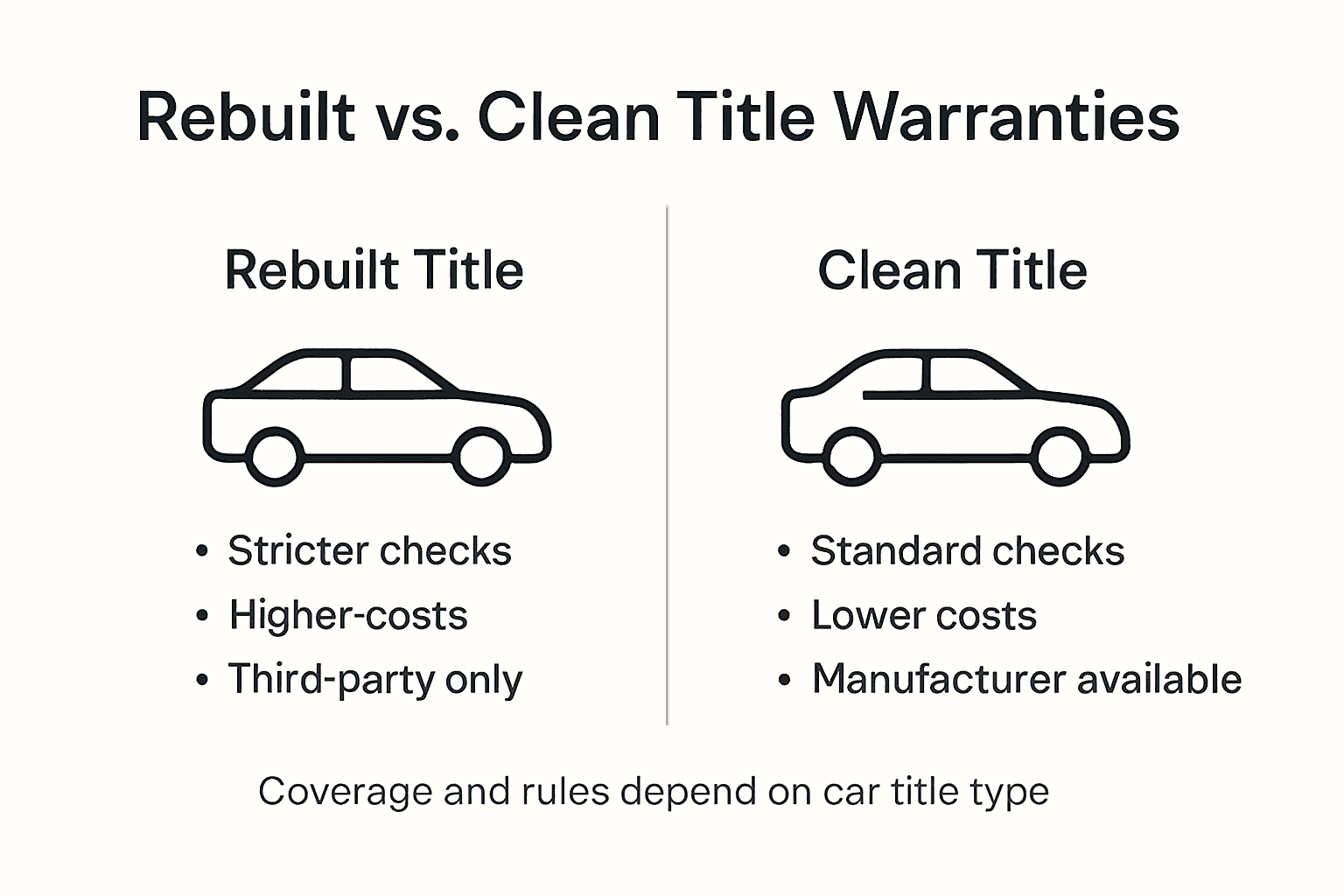
That last row is the one to keep in mind. A clean title buyer pays full price and gets whatever factory coverage is left. A rebuilt title buyer pays thousands less and shops for a service contract if they want one. On most used cars past the three-year mark, the factory bumper-to-bumper warranty has already expired, so the clean title buyer is shopping for the same service contract you are, just without the discount.
How Much Does an Extended Warranty Cost on a Rebuilt Title?
Short answer: more than it would on the same car with a clean title, priced on age, mileage and coverage level, and the only real number is the quote in front of you. Service contract prices are not published like sticker prices. Providers quote each car individually, and a rebuilt title typically does one of two things to that quote: it narrows you to fewer plans, or it adds to the price of the plan you want.
The useful way to judge a quote is against what you saved on the car. As of October 2026, buyers on ReVroom save a median of $4,590 per vehicle versus clean title value, and about 1 in 3 rebuilt cars sold for 25% or more below market. Newer cars save the most: a 2023 model year saved a median of $6,537. If a three-year powertrain contract costs a fraction of that, you are still well ahead of the clean title buyer, and you have coverage they may not have bothered to buy.
A few things that move the price in your favor: a lower-mileage car, a history graded minor rather than severe, complete repair documentation, and choosing a powertrain plan instead of exclusionary coverage. And always compare at least two quotes. Prices for the same car can differ by hundreds of dollars between providers.
Do Dealerships Offer Warranties on Rebuilt Title Cars?
Short answer: some do, and the window sticker tells you which. Under the FTC Used Car Rule, every used car on a dealer lot carries a Buyers Guide that says whether the car is sold "as is" with no dealer warranty, or with a dealer warranty and what it covers. That guide is the first thing to read on any lot, rebuilt title or not.
Rebuilt title dealerships are a good place to ask. They retail these cars every day, know what a properly repaired one looks like, and some back their cars with a short limited dealer warranty or sell a third-party service contract at the desk. Clean title lots that occasionally take a rebuilt car on trade are less likely to offer either, because it is not the business they are in. Either way, a verbal promise is worth exactly what it costs. If a dealer says the car comes with a warranty, it goes on the Buyers Guide and in the paperwork, or it does not exist.
Private sellers generally sell as is, which is one reason a private-party rebuilt car is often priced lower still. You can see both kinds of seller on ReVroom's marketplace, and you can visit the dealers hub to find rebuilt title dealerships that list with us.
Utah Laws and Warranty Restrictions
Short answer: Utah does not require a warranty on any used car, rebuilt or clean. Like nearly every state, Utah lets dealers sell used cars "as is" as long as the FTC Buyers Guide says so, and private sales carry no warranty at all. There is no Utah law that forces a manufacturer to keep covering a car after a total loss, and no Utah law that adds warranty protection to a rebuilt title specifically.
What Utah does require, like every other state, is that a salvage vehicle be repaired and pass a state inspection before it can be retitled and driven again. That inspection is table stakes for every rebuilt car in the country, not a special Utah feature, and it is not a warranty. If you want the details on how the Utah salvage and rebuilt process works, our Utah salvage title guide walks through it. For insurance, which is a separate question from warranty, most carriers will write a policy on a rebuilt title, and our guide to which insurance companies cover rebuilt title cars lists who does what.
Is a Rebuilt Title Car Worth It Without a Warranty?
Short answer: usually, yes, and the reason is that you were probably never going to have a factory warranty on a used car anyway. Most new-car bumper-to-bumper warranties run three years or 36,000 miles. The median rebuilt car sold on ReVroom is a 2020 model year with about 55,000 miles on it. A clean title version of that same car is already out of its basic warranty. So the real comparison is not "warranty versus no warranty." It is "full price with no warranty" versus "thousands less with no warranty, plus the option to buy a service contract."
On that comparison the rebuilt car wins by a wide margin. Across 17,000+ rebuilt title vehicles ReVroom has tracked, buyers saved a documented $60.1 million, a median of $4,590 each, with discounts observed up to 69% below market. Set aside a slice of that as your own repair fund, or spend part of it on a powertrain contract, and you have covered the same risk the warranty would have, with money left over.
What actually protects you is knowing the car. ReVroom is the only site where you can filter inventory by history type, from hail and cosmetic paint chips all the way to fire, and by in-house severity grade, so you can shop minor-history cars only if that is your comfort level. Every listing discloses what was repaired, with photos where available. And if you want the full picture on one specific car, a ReVroom Report shows its in-house severity grade, a detailed severity graphic with the affected areas highlighted, the estimated savings, and where and when the vehicle was auctioned. That is the information a warranty provider will ask about, too.
Tips for Choosing Warranty Protection
Short answer: know the car's history first, ask about eligibility second, and buy the plan that covers the expensive parts. Here is the checklist we would use:
- Read the history before you shop for a plan. Know the history type and severity grade, and what was repaired. This tells you what any provider will treat as pre-existing.
- Say "rebuilt title" in the first sentence of every call. It saves everyone time and gets you a straight answer on eligibility.
- Ask about an inspection requirement. Some providers want one. If so, you can often use the same independent mechanic you had look at the car before buying it.
- Get at least two quotes. Same car, same coverage, different providers. The spread is often hundreds of dollars.
- Start with powertrain. It is the cheapest tier and covers the failures that actually cost thousands. Step up to a stated component plan if the price gap is small.
- Read the exclusions and the claims process. Know the deductible, whether you can use your own shop, and how a claim gets approved before you need one.
- Check open recalls on the VIN. Those are free at any franchised dealer regardless of title, so they should never be part of what you pay a plan to cover.
- Keep the paperwork. The car's repair documentation, the inspection certificate and the contract itself. That folder is what turns a claim into a yes.
How do you shop for a rebuilt car you can actually cover?
Short answer: pick the history first, then the car, then the plan. Most people do it backwards. They fall for a car, then find out the warranty company wants nothing to do with its repair file.
Think of it like adopting a dog with paperwork. The vet bill is easier to plan when you already know what the dog has been through. A rebuilt car works the same way: the lighter and better documented the history, the shorter your call with a provider. Here is the order I would shop in on ReVroom:
| Step | What to do | Why it helps with a warranty provider |
|---|---|---|
| 1. Filter by severity | Start with minor-history rebuilt cars, then widen to minor and moderate if you want more choice | Fewer repaired areas means fewer pre-existing-condition exclusions to argue about |
| 2. Filter by history type | Try hail-history cars or vandalism-history cars | Cosmetic histories rarely touch the engine, transmission or electrical parts a plan covers |
| 3. Pick a newer model year | Newer cars usually carry lower mileage, which is the biggest single factor in a service contract price | Lower mileage often means more plan choices and a cheaper quote |
| 4. Pull the Report, then call | A ReVroom Report gives you the severity grade, a severity graphic, the estimated savings and where and when the car was auctioned | You open the call with facts, and the provider can give you a straight yes or no |
Then put the quote next to the savings. Newer rebuilt cars save the most, so they leave the most room for a plan. Here is the median a buyer saved by model year in ReVroom's market snapshot (updated October 1, 2026):
| Model year | Median saved vs clean title | Rebuilt cars sold |
|---|---|---|
| 2018 | $3,283 | 931 |
| 2020 | $4,870 | 1,097 |
| 2022 | $5,966 | 1,328 |
| 2024 | $7,023 | 1,330 |
If a powertrain contract on a 2022 costs a fraction of the $5,966 you saved, you are still well ahead of the clean title buyer, and you have coverage most of them never bought. Ready to look? Browse rebuilt title cars on ReVroom and start with the history filters.
Shop Rebuilt Title Cars With the History Up Front
A warranty is a backstop. Transparency is the actual protection, and it is what ReVroom was built for. We are the only marketplace dedicated exclusively to rebuilt and branded title vehicles, and the only site where you can filter by history type and in-house severity grade before you ever click into a car. Every listing shows what was repaired, with photos where available, so the conversation with a warranty provider, an insurer or a lender starts from facts instead of guesses.
Why guess when you can know
- Filter to the history types and severity grades you are comfortable with, from hail and cosmetic all the way to fire.
- Compare cars with the repair details disclosed on every listing.
- Pull a ReVroom Report on any car for its severity grade, severity graphic, estimated savings and auction history.

Ready to see what the discount looks like on a real car? Browse rebuilt title cars on ReVroom, priced thousands below market, with the history where you can see it. Then shop for a warranty knowing exactly what you are covering.
Frequently Asked Questions
Does a rebuilt title void the factory warranty?
Yes. Toyota, Honda, Ford and Hyundai all exclude vehicles that have been declared a total loss or issued a salvage or similar title from their new vehicle limited warranties, and the exclusion sticks after the car is repaired and retitled as rebuilt. Safety recalls are still honored, and Honda also keeps its emissions and seat belt warranties in force.
Does a salvage title void the factory warranty?
Yes, and it happens first. The manufacturer exclusions are written around the salvage brand itself, so factory coverage ends when the car is declared a total loss and titled salvage, before anyone rebuilds it. Safety recalls are still honored.
Can you get an extended warranty on a salvage title car?
Not while it is still salvage. A salvage-titled car generally cannot be registered for highway use until it is repaired, inspected and retitled, so shop for a service contract once it carries a rebuilt title, and get each provider's eligibility answer in writing.
Does a rebuilt title void recalls?
No. Safety recall repairs are handled separately from the warranty. Toyota's warranty guide states its salvage exclusion does not apply to open safety recalls, and federal recall law requires the remedy at no charge regardless of title. A franchised dealer will still perform recall work on a rebuilt title car.
Can you get an extended warranty on a rebuilt title car?
Sometimes. Many vehicle service contract companies do not cover rebuilt or salvage titles, but some do. Endurance says it offers a plan for salvage and rebuilt vehicles, while CarShield's contract administrator says salvage title cars are not eligible. Ask the provider in writing before you buy the car.
Which rebuilt title cars are easiest to get an extended warranty on?
Cars with a light, well-documented history. A service contract excludes pre-existing conditions, and on a rebuilt car the provider reads the history to decide what those are, so a minor-graded car with a complete repair file gives the provider the least to exclude. On ReVroom you can filter inventory by in-house severity grade and history type before you shop for coverage.
Does CarShield cover salvage or rebuilt titles?
According to American Auto Shield, the company that administers CarShield contracts, salvage title cars, which it also refers to as rebuilt titles, are not eligible for vehicle service contract coverage.
How much does an extended warranty cost on a rebuilt title?
Providers price on the car's age, mileage and the coverage level you choose, and a rebuilt title usually either narrows which plans you qualify for or adds to the price. Get two or three quotes and compare them to what you saved on the car: ReVroom buyers save a median of $4,590 per vehicle versus clean title value.
Do dealerships offer warranties on rebuilt title cars?
Some do. Under the FTC Used Car Rule, the Buyers Guide on the window tells you whether the car is sold as is or with a dealer warranty. Rebuilt title dealerships that retail these cars every day sometimes include a limited dealer warranty or sell a third-party service contract; get any promise in writing.
Does Utah require a warranty on a rebuilt title car?
No. Utah does not require a warranty on any used car, rebuilt or clean. What Utah does require is that a salvage vehicle pass a state inspection before it can be retitled as rebuilt, which is standard in every state.
Is a rebuilt title car worth buying without a factory warranty?
Usually, yes. Most used cars have no factory warranty left anyway, and the rebuilt discount is real: a median $4,590 saved per vehicle, one in three sold 25% or more below market, on cars with a median model year of 2020. Put part of the savings toward a service contract or a repair fund and you are still ahead.
Does a rebuilt title void the powertrain warranty?
Yes. In the warranty booklets we checked, the salvage and total loss exclusion applies to the vehicle as a whole, so the factory powertrain coverage ends with the rest of the new vehicle warranty. Recall repairs are still free. If powertrain protection is what you want, a third-party powertrain service contract is the usual route, and it is often the cheapest tier.
Is an extended warranty worth it on a rebuilt title car?
Often, if the price is small next to what you saved. ReVroom buyers saved a median of $4,590 per rebuilt car, and newer model years saved more ($5,966 on 2022 models). Shop by history first: a minor or hail history makes the provider conversation shorter, and a powertrain plan covers the repairs that cost the most.
Recommended
- Are Rebuilt Titles Bad? Here's What They Really Mean
- What Insurance Companies Cover Rebuilt Title Cars?
- Rebuilt Title vs. Clean Title
- Hail Rebuilt Title Cars: A 2026 Buyer's Guide
- Rebuilt Title Insurance Explained: What Utah Buyers Need
- Rebuilt Title Eligibility: What Utah Buyers Should Know
- Rebuilt Title Car Registration in Utah
