


How to Evaluate a Cheap Car Listing the Right Way
July 22, 2026
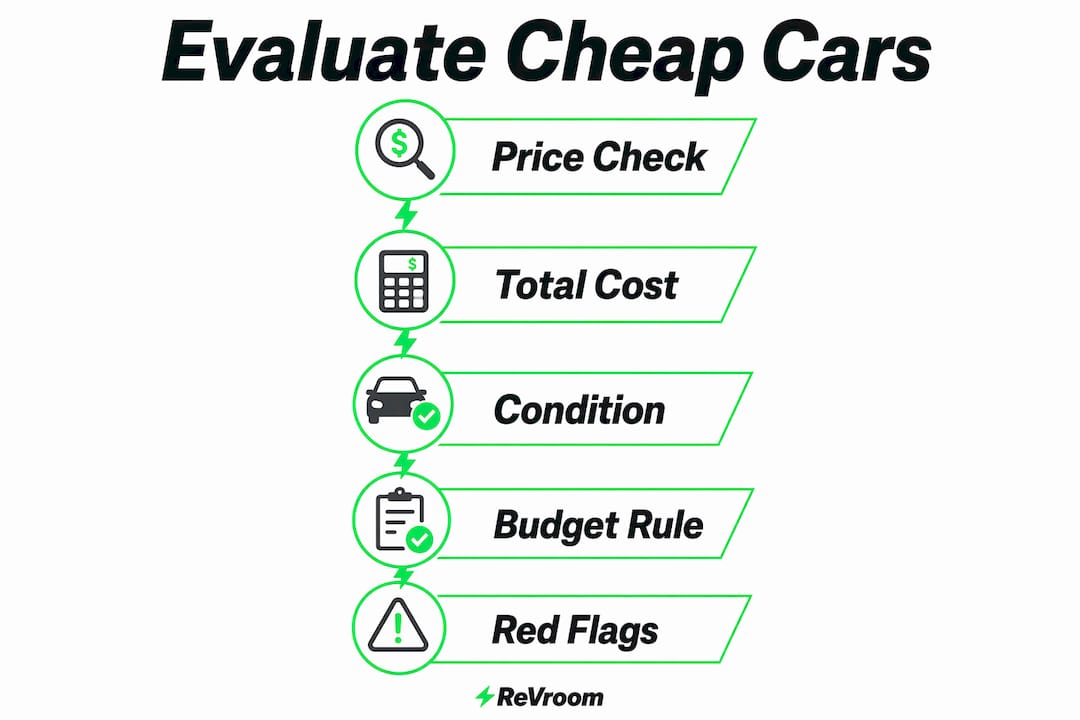
Evaluating a cheap car listing comes down to five things: confirming the price is fair, calculating what you’ll actually pay out the door, verifying the vehicle’s history, inspecting it properly, and applying a smart budget rule before you commit. Skip any one of these and a “great deal” can turn into a money pit fast. Here’s the quick checklist to keep you grounded:
- Check the listing price against Kelley Blue Book and Edmunds for your zip code
- Add sales tax, title, registration, and first-month insurance to get your real cost
- Pull a vehicle history report and look for rebuilt or branded title status
- Apply the $3,000 rule to confirm you have enough financial cushion
- Ask targeted questions, test drive it, and get an independent inspection before signing anything
## 1. How to evaluate cheap car listings using trusted pricing tools
The fastest way to spot whether a cheap listing is actually cheap is to run the year, make, model, mileage, and condition through Kelley Blue Book and Edmunds. Both tools generate localized fair market values, so you’re comparing apples to apples for your specific region, not some national average that may not reflect your city’s market.
Pull both numbers and treat them as a range. If the listing sits below both estimates, that’s worth investigating further. If it’s above both, you have immediate negotiating leverage.
- Enter the exact trim level, not just the model name
- Select the correct condition tier (good, fair, poor) honestly
- Compare private party value AND dealer retail to understand the full range
- Cross-reference with active listings in your area to see real asking prices
Pro Tip: Comparing prices across multiple dealerships and online listings is one of the most effective ways to recognize a fair deal. Dealers count on buyers not shopping around.
2. What does a cheap car actually cost you out the door?

The sticker price is just the starting point. A hard budget must include purchase price, sales tax, title, registration, dealer fees, and first-month insurance before you can call a listing affordable.
Sales tax alone runs 4–10% depending on your state. On a $6,000 car, that’s up to $600 you didn’t see coming. Add title and registration, documentation fees at a dealership, and your insurance down payment, and the real number can be $1,000–$1,500 higher than what’s listed.
- Sales tax: 4–10% of purchase price, varies by state
- Title and registration: typically $50–$300 depending on state
- Dealer documentation fees: often $100–$500
- First-month insurance premium: get a quote before you commit
- Immediate maintenance: budget for an oil change, wiper blades, or tires
One thing buyers consistently overlook: some cheap cars carry higher insurance premiums than slightly pricier alternatives. Run an insurance quote on the exact year, make, model, and trim before you fall in love with the price.
3. How to assess a cheap car’s condition and history realistically
A vehicle history report is non-negotiable. It reveals accident history, title brands, fleet or rental use, mileage inconsistencies, and prior ownership patterns that the seller may not volunteer. Carfax and AutoCheck are the two main options in the US market.
Mileage deserves a closer look too. High mileage on a highway commute often means less wear than lower mileage accumulated through short city trips. A car averaging more than 20,000 miles per year or fewer than 5,000 miles per year both warrant extra questions.
- Review title status: clean, rebuilt, branded, or flood
- Check for mileage discrepancies across the history report
- Ask for maintenance records and verify service intervals
- Look up open recalls using the VIN at the NHTSA website
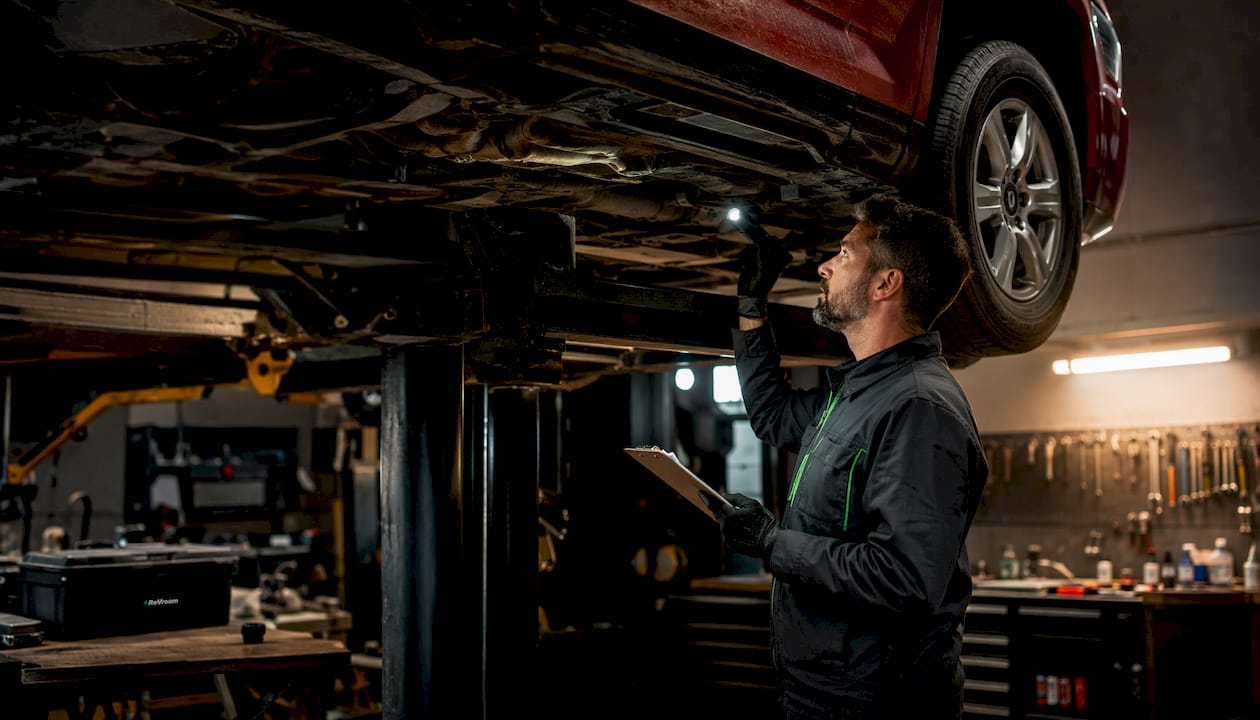
- Schedule a pre-purchase inspection at an independent shop
Pro Tip: Verify the VIN in three places: the dashboard plate, the driver’s door jamb sticker, and the title document. If any of the three don’t match, walk away immediately.
The pre-purchase inspection (PPI) typically costs $100–$150 at an independent mechanic and catches roughly 90% of major hidden issues. Skipping it to save that money is consistently the most expensive mistake in used car buying.
4. How the $3,000 rule helps you budget for a cheap car purchase
The $3,000 rule is actually three separate guidelines that share the same number, and confusing them is how buyers end up in financial trouble.
For cash buyers, $3,000 is roughly the floor for a reliable used vehicle worth owning. For buyers financing a purchase, $3,000 is the recommended minimum down payment. And for anyone who just bought a used car, $3,000 is the repair buffer you should keep in reserve after the purchase closes.
- Cash purchase floor: at $3,000 total, prioritize mechanical reliability over features
- Down payment minimum: $3,000 only meets the 20% threshold on vehicles priced at or below $15,000
- Repair reserve: keep $3,000 accessible after purchase for unexpected repairs in the first year
- Strategic move: a $2,200 car with $800 in reserve often beats a $3,000 car that leaves you with nothing
The repair reserve interpretation has the most practical value for everyday buyers. Used cars, even solid ones, can surprise you with a water pump, alternator, or brake job in the first few months. Having that cushion turns a stressful repair into a manageable errand.
5. Questions to ask and red flags that should make you walk
Asking the right questions before you visit saves you a wasted trip. Ask about mileage history, number of prior owners, accident history, open recalls, and whether service records are available. A seller who can’t produce maintenance receipts but claims the car was “well cared for” is a yellow flag.
Red flags that should end the conversation:
- Mismatched VINs across the dashboard, door jamb, or title
- Open recalls the seller ignored and hasn’t had fixed
- Seller refuses an independent PPI — this is almost always hiding something
- Title is not in the seller’s name or has a lienholder listed
- Price dropped dramatically and recently with no explanation
Private sellers typically price below dealer retail, but you lose warranty options and handle the title transfer yourself. Dealers offer more paperwork protection but add documentation fees. Neither is automatically better; the vehicle’s condition and your comfort with the process determine which route fits.
When the PPI comes back with findings, use them. Negotiating based on PPI results reduces the purchase price by $400–$1,200 on average, with worn brakes, suspension parts, or AC issues each serving as a concrete price lever.
6. Why checking for liens matters before you hand over any money
A lien on a vehicle means a lender has a legal claim to it. If the seller still owes money on the car, the title will show a lienholder, and you cannot legally take clear ownership until that loan is paid off. Buying a car with an undisclosed lien can leave you holding a vehicle you don’t actually own.
The fix is simple. Ask to see the title before you agree to anything. If a lienholder is listed, the seller must pay off the loan and get a clear title before the transaction closes. Never accept a promise that the title will arrive later in the mail.
7. How depreciation and model year affect cheap car pricing
Cars lose value fastest in their first three years, which is actually good news for budget buyers. A three-to-five-year-old vehicle has already absorbed the steepest depreciation, giving you more car per dollar than buying new. Beyond that window, depreciation slows considerably.
Model year matters more than most buyers realize. A one-year difference can shift the price by several hundred dollars even when the mechanical differences are minimal. Older model years of reliable platforms like the Toyota Corolla or Honda Civic hold value well precisely because the repair ecosystem is deep and parts are affordable. That predictability is worth factoring into your evaluation alongside the sticker price.
Evaluating a cheap car listing well means using Kelley Blue Book and Edmunds for pricing, calculating true out-the-door costs, verifying vehicle history, applying the $3,000 rule, and getting an independent inspection before you commit.
| Point | Details |
|---|---|
| Use pricing tools | Check Kelley Blue Book and Edmunds for localized fair market value before any negotiation. |
| Calculate full costs | Add sales tax (4–10%), title, registration, fees, and insurance to find your real out-the-door number. |
| Get a PPI | An independent inspection costs $100–$150 and catches roughly 90% of major hidden issues. |
| Apply the $3,000 rule | Always keep at least $3,000 available as your price floor, minimum down payment, and repair reserve to protect against unexpected costs. |
| Check for liens | Confirm the title is clear and in the seller’s name before handing over any money. |
FAQ
What is the $3,000 rule for cars?
The $3,000 rule is a widely endorsed budgeting guideline: many experts recommend always having at least $3,000 available to serve as the minimum price floor for a reliable used car, the minimum down payment if financing, and an emergency repair fund after buying. This protects you against the most common sources of repair debt and budget overruns.
What is the best site to evaluate car value?
Kelley Blue Book and Edmunds are the two most trusted tools for assessing fair market value on used cars in the US. Both generate localized estimates based on year, make, model, mileage, condition, and your zip code.
How much does a car salesman make on a $30,000 car?
Car salespeople typically earn a percentage of the dealership’s gross profit on a vehicle, not a percentage of the sale price. Commission amounts vary widely depending on the car’s price and profit margin.
Should I always get a pre-purchase inspection on a cheap car?
Yes. A PPI at an independent mechanic costs $100–$150 and catches roughly 90% of major hidden issues that a test drive won’t reveal. If a seller refuses to allow one, treat that refusal as a reason to walk.
Is a rebuilt title car worth considering for a budget buyer?
Rebuilt and branded title vehicles can be up to 50% cheaper than comparable clean-title cars and are state-certified as repaired and road ready. Revroom’s car buying checklist walks you through exactly what to verify when evaluating one, so you can decide with full information rather than guesswork.
