


How to finance a rebuilt vehicle safely and affordably
March 21, 2026
You’ve found an affordable rebuilt vehicle that fits your budget perfectly, but now you’re wondering if getting financing will be impossible. Many buyers assume lenders won’t touch rebuilt titles, but that’s not entirely true. While financing these vehicles requires extra preparation and transparency, it’s absolutely achievable when you understand what lenders need and how to present your case effectively. This guide walks you through the requirements, steps, and strategies to secure financing safely while maximizing your savings on a quality rebuilt vehicle.
Table of Contents
- Key takeaways
- Understanding rebuilt vehicle financing requirements
- Step-by-step guide to securing financing for rebuilt vehicles
- Common challenges and how to overcome them when financing rebuilt vehicles
- Verifying and protecting your investment after financing a rebuilt vehicle
- Explore financing options and learn more at ReVroom
- Frequently asked questions about financing rebuilt vehicles
Key Takeaways
| Point | Details |
|---|---|
| Documentation readiness | Gather complete repair invoices, inspection certificates, photos before and after repairs, valuation reports, and proof of insurability to speed approval. |
| Right lender selection | Identify lenders experienced with rebuilt titles and prioritize credit unions or specialty online lenders. |
| Higher interest risk | Expect interest rates one to three percentage points higher than clean title loans and compare offers to save money. |
| Prepare paperwork early | Start gathering all documentation before you apply to demonstrate responsibility and shorten the approval process. |
Understanding rebuilt vehicle financing requirements
Before you start shopping for loans, you need to understand what sets rebuilt vehicle financing apart from traditional auto loans. A rebuilt title indicates a vehicle was previously declared a total loss by an insurance company but has since been repaired and inspected to meet safety standards. This history makes lenders more cautious, but it doesn’t make financing impossible.
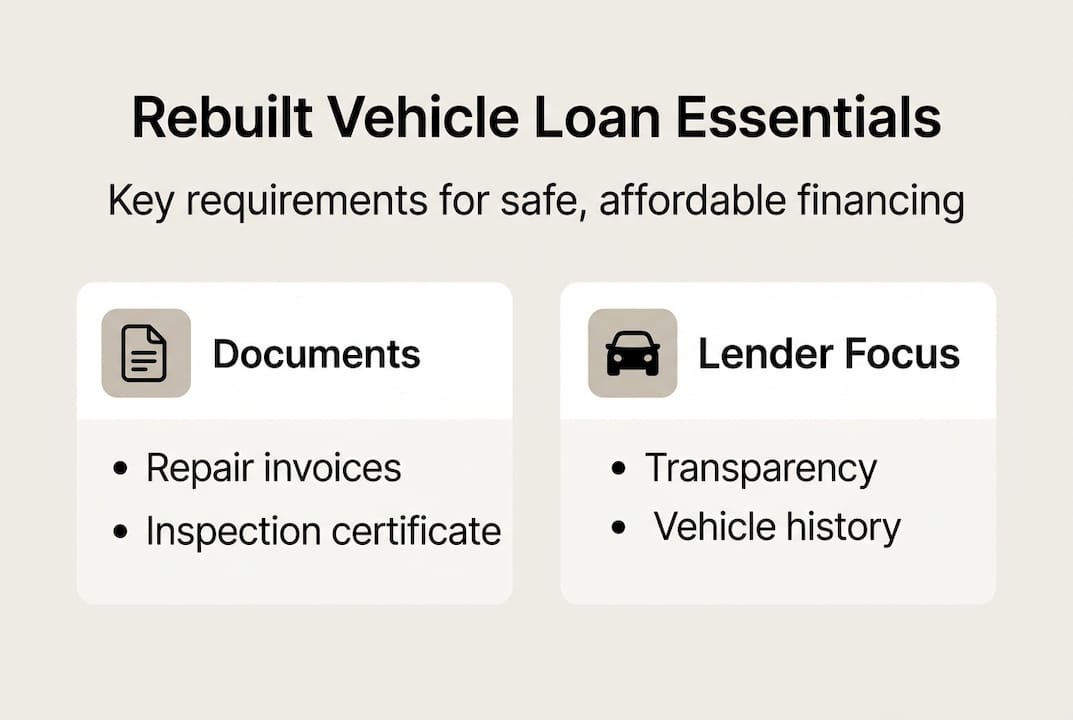
Lenders require proof of vehicle repairs and inspections before approving rebuilt vehicle loans. You’ll typically need to provide detailed documentation that demonstrates the vehicle’s current condition and roadworthiness. Think of it as building a case that proves your vehicle is a sound investment despite its past.
Here’s what most lenders expect when you apply for financing a rebuilt car:
- Complete repair documentation showing what work was performed and by whom
- Official inspection certificates from state-authorized facilities confirming the vehicle meets safety standards
- Photos of the vehicle before and after repairs to verify the extent of restoration
- Current market valuation reports that reflect the rebuilt title status
- Proof of insurability showing carriers will cover the vehicle
Transparency becomes your strongest asset in this process. Lenders want to see you’ve done your homework and aren’t hiding anything about the vehicle’s condition or history. The more complete your documentation, the more confident they’ll feel extending credit. Some lenders may also restrict loan amounts to a percentage of the vehicle’s current value rather than its original worth, or they might offer shorter loan terms to minimize their risk exposure.
Pro Tip: Start gathering documentation before you even apply for financing. Having everything organized upfront demonstrates responsibility and speeds up approval times significantly.
Step-by-step guide to securing financing for rebuilt vehicles
Now that you understand what lenders need, let’s walk through the practical steps to actually secure that financing. This process requires more legwork than financing a clean title vehicle, but following these steps systematically will dramatically improve your approval odds.
First, gather and organize all relevant vehicle repair and inspection documents. Create a complete file that includes repair invoices, parts receipts, inspection certificates, and any warranty information. This paper trail proves the vehicle’s legitimacy and quality. Don’t skip this step, even if it feels tedious. Lenders view incomplete documentation as a red flag.
Next, research and identify lenders experienced with rebuilt titles. Not all financial institutions handle these loans, so you’ll waste time applying to banks that automatically reject them. Credit unions often show more flexibility than large national banks because they evaluate applications individually rather than using rigid algorithms. Online lenders specializing in alternative auto financing also represent good options.

Third, compare financing offers carefully, focusing on terms and interest rates. Don’t just accept the first approval you receive. Financing options vary, but preparation and lender selection are key to getting approved. Interest rates for rebuilt vehicles typically run 1-3 percentage points higher than clean title loans, but shopping around can save you thousands over the loan term.
Fourth, submit a thorough loan application with transparency about the vehicle’s condition. Include all your documentation upfront rather than waiting for the lender to request it. Write a brief cover letter explaining why you chose this vehicle and how you verified its quality. This proactive approach builds trust and demonstrates you’re a responsible borrower.
Finally, follow up proactively and provide any additional information promptly. Lenders may request supplementary details or clarification on repair work. Respond quickly and completely to keep your application moving forward. Delays signal disorganization or uncertainty, which can sink your approval chances.
Pro Tip: Apply to 2-3 lenders simultaneously so you can compare actual offers rather than hypothetical rates. Just keep applications within a 14-day window to minimize credit score impact.
Following this financing for rebuilt title step guide systematically transforms what seems like an overwhelming process into manageable chunks. Each step builds on the previous one, creating momentum toward approval.
Common challenges and how to overcome them when financing rebuilt vehicles
Even with perfect preparation, you’ll likely encounter some hurdles specific to rebuilt vehicle financing. Understanding these challenges ahead of time lets you develop strategies to address them before they derail your plans.
Lenders’ cautious stance leads to tougher conditions across the board. Buyers often encounter higher interest rates and limited lender options due to rebuilt titles. This isn’t personal; it’s pure risk assessment. Lenders calculate that rebuilt vehicles carry more uncertainty than clean title cars, so they price that risk into their terms. You can’t eliminate this challenge entirely, but you can minimize its impact.
Maintaining excellent credit becomes even more critical when financing a rebuilt vehicle. A credit score above 700 gives you significantly more negotiating power and access to better rates. If your score needs work, consider delaying your purchase by a few months to improve it. Paying down existing debt and correcting any credit report errors can boost your score quickly.
Finding specialized lenders or credit unions represents your best strategy for reasonable terms. Large banks often have blanket policies against rebuilt titles, but smaller institutions evaluate each application individually. Credit unions, in particular, tend to prioritize member relationships over rigid underwriting rules. Regional banks with community ties also show more flexibility.
Here are practical tactics to overcome common financing obstacles:
- Offer a larger down payment (20-30%) to reduce lender risk and improve approval odds
- Consider a co-signer with strong credit if your own score is borderline
- Get pre-approved before shopping so you know your budget and can negotiate from strength
- Demonstrate stable income and employment history to offset vehicle-related concerns
- Show proof of an emergency fund that could cover several months of payments
Insurance and warranties play a surprisingly important role in satisfying lenders. Most require proof of comprehensive coverage before finalizing any loan. Some buyers wrongly assume rebuilt vehicles are difficult to insure, but that’s largely a myth. Most major carriers offer policies, though you’ll want to shop around for the best rates and coverage levels.
Pro Tip: Get insurance quotes before applying for financing. Having coverage lined up demonstrates preparedness and removes a potential approval barrier.
The key to avoiding scams and ensuring vehicle legitimacy lies in thorough verification. Never rely solely on seller claims. Hire an independent mechanic to inspect the vehicle before purchase. Review all history reports and cross-reference repair documentation. Legitimate sellers welcome scrutiny because they have nothing to hide.
“Success in financing rebuilt title cars comes down to preparation, persistence, and partnering with the right lender. Don’t let the first rejection discourage you; each application teaches you what lenders need to see.”
Remember that challenges are normal in this process. Every buyer faces them. What separates successful applicants from unsuccessful ones is simply refusing to give up and continuously refining their approach based on feedback.
Verifying and protecting your investment after financing a rebuilt vehicle
Securing financing is only half the battle. Once you’ve got the loan approved and the keys in hand, you need to verify the vehicle’s condition and protect your investment long term. This final phase ensures you’re not stuck with unexpected problems or financial exposure down the road.
Insurance options for rebuilt vehicles differ from standard policies in important ways. While coverage is readily available, some carriers limit payout amounts or exclude certain types of claims. Insurance and warranty options significantly affect ongoing costs and lender confidence throughout your loan term. Understanding these differences helps you choose the right policy and avoid surprises if you ever need to file a claim.
| Insurance Type | Coverage Level | Typical Cost | Best For |
|---|---|---|---|
| Liability Only | Minimum legal requirements | Lowest premiums | Older vehicles with low value |
| Collision & Comprehensive | Full protection minus deductible | Moderate premiums | Financed vehicles (usually required) |
| Agreed Value | Fixed payout amount set upfront | Higher premiums | Well-documented, quality rebuilds |
| Stated Value | Declared value subject to adjustment | Moderate premiums | Average rebuilt vehicles |
Warranty options tailored to rebuilt cars provide additional peace of mind and can actually improve resale value later. Extended warranties from reputable providers demonstrate confidence in the vehicle’s condition. Some lenders view warranties favorably because they reduce the risk of the vehicle becoming undrivable before the loan is repaid. Shop for warranties that specifically cover rebuilt titles, as standard warranties often exclude them.
Insurance coverage directly impacts loan terms and resale value in ways many buyers overlook. Lenders require collision and comprehensive coverage on financed vehicles to protect their collateral. If you can only secure liability coverage, you won’t get approved for most loans. Additionally, buyers considering your vehicle later will ask about insurance history and coverage levels as quality indicators.
Here’s a practical checklist for verifying vehicle safety and condition post-purchase:
- Schedule a comprehensive inspection with an independent mechanic within the first week
- Test all safety systems including airbags, ABS, traction control, and stability systems
- Verify all lights, signals, and electrical components function properly
- Check for any fluid leaks or unusual noises during test drives
- Confirm all documentation matches the actual vehicle identification number
- Review state inspection requirements and ensure compliance
Regular maintenance and reinspection become even more important with rebuilt vehicles. Create a maintenance schedule that exceeds manufacturer recommendations slightly. Keep meticulous records of all service work, as this documentation proves you’ve maintained the vehicle properly if you ever need warranty coverage or want to sell later. Consider having a mechanic inspect the vehicle every six months during the first year to catch any developing issues early.
Protecting your investment also means understanding your insurance and warranties for rebuilt cars thoroughly. Read policy documents carefully and ask questions about anything unclear. Know exactly what’s covered, what’s excluded, and what documentation you need to file claims successfully. This knowledge prevents unpleasant surprises and ensures you get the protection you’re paying for.
The vehicles that maintain their value best are those with complete documentation trails showing consistent care and maintenance. Every oil change receipt, every inspection report, and every repair invoice adds credibility and value. Think of this documentation as an investment in your vehicle’s future worth, not just paperwork.
Explore financing options and learn more at ReVroom
Now that you understand the complete financing process, you’re ready to take the next step toward affordable, reliable transportation. ReVroom offers the transparency and resources you need to make confident decisions about rebuilt vehicles.
Unlike traditional marketplaces, ReVroom includes detailed history information and pre-repair photos in every listing, giving you the documentation lenders require before you even start the financing process. This upfront transparency eliminates the guesswork and $150+ investigation costs buyers typically face when vetting rebuilt vehicles elsewhere. You’ll see exactly what happened to each vehicle and how it was restored, making it easier to build your financing case.

Explore comprehensive articles and step-by-step guides that walk you through every aspect of buying, financing, and owning rebuilt vehicles safely. Our resources help you understand what lenders need, how to prepare your application, and which red flags to watch for. When you’re ready to start shopping, browse listings with complete confidence knowing every vehicle comes with the transparency you need to secure financing and protect your investment.
Frequently asked questions about financing rebuilt vehicles
Is it harder to finance a rebuilt vehicle than a clean title?
Yes, financing a rebuilt vehicle typically requires more documentation and preparation than a clean title car. Lenders view them as higher risk, so you’ll need thorough repair records and inspection certificates. However, with proper preparation and the right lender, approval is absolutely achievable.
Can I get regular insurance on a rebuilt title car?
Yes, most major insurance carriers offer policies for rebuilt title vehicles, contrary to common myths. Coverage availability and rates vary by carrier and vehicle condition, so shop around for the best options. Comprehensive coverage is usually required if you’re financing the vehicle.
Do banks generally finance rebuilt title cars?
Some banks do, but policies vary widely by institution. Credit unions and specialized online lenders typically show more flexibility than large national banks. Research lenders specifically experienced with rebuilt titles to improve your approval odds and secure better terms.
What paperwork do I need for financing a rebuilt vehicle?
You’ll need complete repair documentation, state inspection certificates, current photos, market valuation reports, and proof of insurability. Having organized, comprehensive paperwork demonstrates responsibility and significantly speeds up the approval process. For detailed guidance, check out this auto loan on rebuilt title guide.
Are interest rates higher for rebuilt title loans?
Yes, interest rates typically run 1-3 percentage points higher than clean title loans due to perceived risk. However, rates vary significantly between lenders, so comparing multiple offers can save you thousands over the loan term. Strong credit and a larger down payment help secure better rates.
How much should I put down when financing a rebuilt vehicle?
Aiming for 20-30% down improves approval odds and reduces monthly payments significantly. A larger down payment demonstrates financial stability and reduces lender risk, often resulting in better interest rates. If possible, save more than the minimum to strengthen your application.
