


How Much Is Insurance on Rebuilt Title
November 8, 2025
Let’s clear up the biggest myth right away: you can fully insure a rebuilt title car. Liability coverage is available everywhere, and full comprehensive-and-collision coverage is offered by most major insurers. Rates are often comparable to a clean-title version of the same car; a few carriers price a rebuilt title a little differently or ask for a quick photo inspection, which is exactly why it pays to compare two or three quotes. This guide walks through what actually affects your premium, the documentation to have ready, and how to save.
Table of Contents
- What Rebuilt Title Means For Insurance
- Coverage Options, Including Full Coverage
- What Actually Affects Your Premium
- Documents Insurers Like To See
- How To Shop And Save On Coverage
- Resale Value And Claim Payout Impact
Key Takeaways
| Point | Details |
|---|---|
| Full Coverage Is Available | You can get liability and full comprehensive-and-collision coverage on a rebuilt title from most major insurers. |
| Rates Are Often Comparable | Premiums are frequently similar to a clean-title version of the same car; a few carriers price it a little differently, so compare quotes. |
| Documentation Helps | Having repair invoices and an inspection report on hand makes the whole process smooth and can help at claim time. |
| Claim Payouts Reflect Value | On a total-loss claim, payout reflects the car’s market value—the flip side of the discount you got buying. Good records help. |
What Rebuilt Title Means For Insurance
A rebuilt title indicates a vehicle that was previously declared a total loss, then repaired and passed a state inspection to return to the road. For insurance, the practical takeaway is simple: rebuilt title cars are insurable, and most major carriers will write full coverage on them.
A few insurers take a closer look at a rebuilt title before quoting—some ask for a quick photo inspection to confirm condition—but that’s the exception, not a wall. It just means a little preparation and comparing a couple of quotes goes a long way, the same smart-shopper move you’d make with any car.
Here are the key things to know about insuring a rebuilt title vehicle:
- Liability is universal: Every state’s required coverage is available on a rebuilt title
- Full coverage is common: Most major insurers offer comprehensive and collision, too
- A photo inspection is sometimes requested: A few carriers confirm condition before writing full coverage
- Documentation smooths the path: Repair and inspection records make quoting and claims easier
The bottom line: preparation and a couple of quotes are all it takes. For the full walkthrough, see our guide on getting insurance on a rebuilt title car.
 The key is preparation, documentation, and comparing a few insurers.
Coverage Options, Including Full Coverage
When it comes to insuring a rebuilt title vehicle, the good news is that the full range of coverage is on the table. You can get liability, comprehensive, and collision coverage on a rebuilt title from most major insurers—not just the bare minimum.
A handful of carriers are choosier about writing full coverage on a rebuilt title, and a few ask for a photo inspection first, but plenty of mainstream insurers will cover the car normally. That’s exactly why comparing a few quotes is worthwhile: you’re looking for the carrier that treats your car fairly, and they’re out there.
Typical insurance coverage available for rebuilt titles includes:
- Liability Insurance: Available everywhere, meets state requirements
- Comprehensive Coverage: Widely available from major insurers
- Collision Coverage: Also widely available; pairs with comprehensive for full coverage
- Full Coverage: Comp + collision together, offered by most mainstream carriers
To make quoting as smooth as possible, consider these steps:
- Have a professional inspection report ready
- Keep your repair and maintenance documentation organized
- Get quotes from several carriers, including the big national names
- Ask each carrier whether they need a photo inspection to write full coverage
For a deeper look at coverage strategies, see our guide on insurance, financing, and warranties for rebuilt cars.
What Actually Affects Your Premium
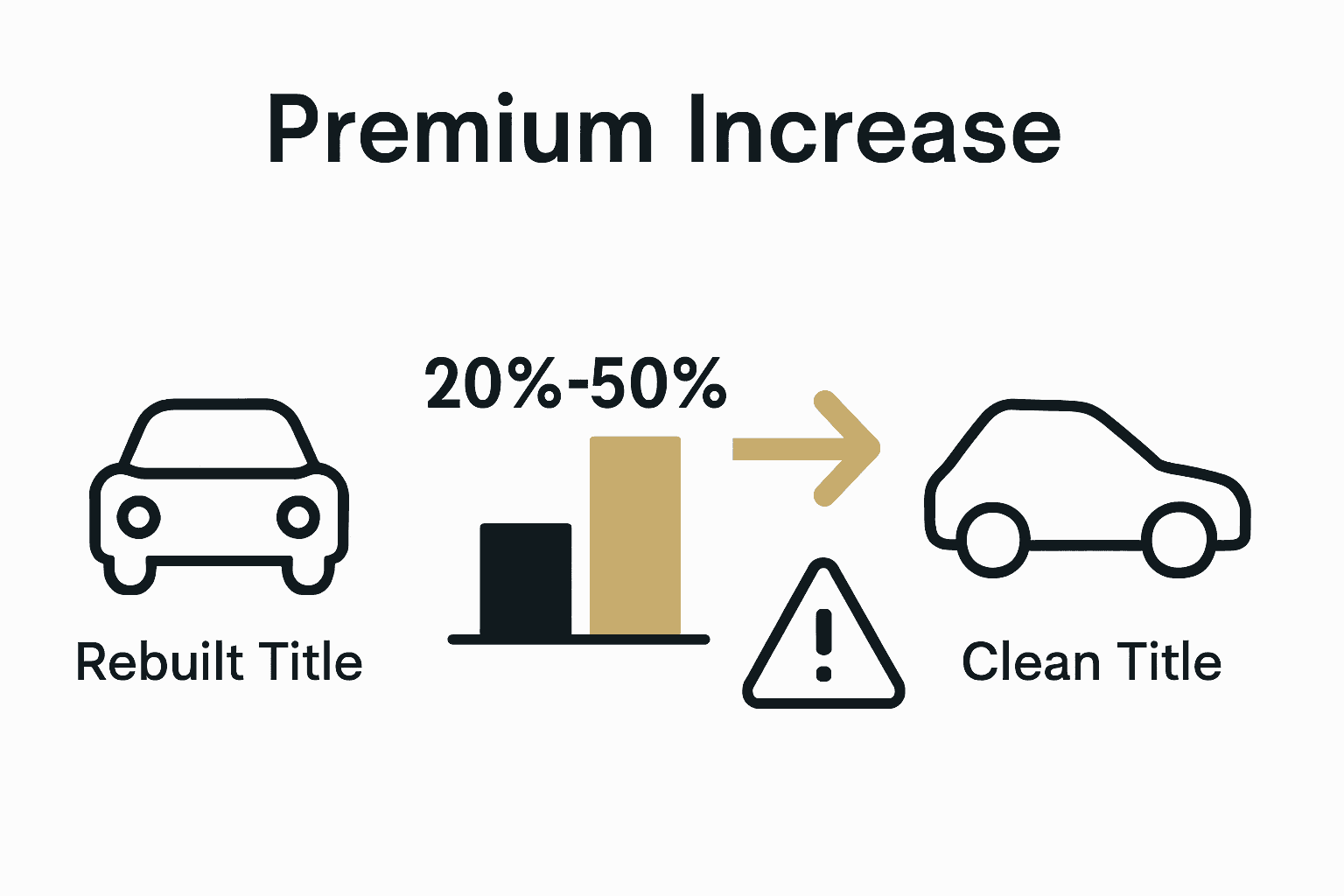
Here’s the honest picture on cost: a rebuilt title, by itself, is often close to a wash on premium. Rates are frequently comparable to a clean-title version of the same car. What really drives your premium is the same set of factors that drives it on any vehicle.
The biggest levers on your rate are your driving record, your location, the make and model, your coverage level and deductible, and your credit in states where that’s allowed. A rebuilt title might nudge things at a few carriers, but it isn’t the dominant factor—and comparing quotes usually surfaces a carrier that prices it fairly.
Factors that actually shape your premium:
- Your Driving Record: The single biggest lever on any auto premium
- The Car Itself: Make, model, age, and repair cost of the specific vehicle
- Coverage & Deductible: Higher deductibles lower your premium
- The Carrier: Different insurers price a rebuilt title differently—so compare
To keep your premium low:
- Compare quotes from several carriers, including major national insurers
- Have your inspection and repair records ready
- Consider a higher deductible to lower the monthly cost
- Keep a clean driving record and bundle policies where you can
For budget-conscious buyers, the takeaway is reassuring: insurance rarely erases the savings from buying a rebuilt title. Shop a few quotes and you’ll usually land a fair rate.
Documents Insurers Like To See
Having the right paperwork on hand makes insuring a rebuilt title vehicle quick and painless. When a carrier can see the vehicle was properly restored and inspected, quoting is straightforward—and good records help you at claim time, too.
Documents worth having ready:
- Rebuilt Title Certificate: The official document confirming the vehicle’s status
- Comprehensive Repair Invoices: Records of the repairs and parts replaced
- Professional Inspection Reports: A third-party assessment of the vehicle’s condition
- Photographic Evidence: Before-and-after photos of the restoration
- Vehicle History Report: The VIN history showing prior damage and repairs
A little organization goes a long way:
- Arrange your repair documents chronologically
- Keep the professional inspection report with them
- Have a single folder with the full vehicle history ready to share
- Be ready to provide a photo inspection if a carrier asks
For budget-conscious buyers, thorough documentation isn’t just about insurance—it protects your investment and demonstrates the vehicle’s true value.
How To Shop And Save On Coverage
Shopping for insurance on a rebuilt title vehicle rewards a little legwork. Full coverage is available from most major insurers; the goal is simply to find the carrier that prices your car fairly, and comparing quotes is how you do it.
Have your documentation ready and get several quotes—you’ll typically see a range, and the best rate is often much closer to a clean-title price than the myths suggest.
Key strategies for saving on rebuilt title insurance:
- Get Multiple Quotes: Compare several providers, including major national insurers
- Show Your Repairs: Provide documentation of high-quality restoration
- Consider Higher Deductibles: Lower your premium by taking on a bit more risk
- Bundle Policies: Combine auto with home or renters for a discount
- Add Safety Features: Anti-theft and safety devices can reduce your rate
To maximize your savings:
- Request quotes from a mix of national and regional carriers
- Have a professional, comprehensive vehicle inspection ready
- Maintain a clean driving record
- Take a defensive driving course if your insurer offers a discount for it
- Consider usage-based insurance if you drive less than average
A methodical approach gets you reasonable coverage on a rebuilt title. For more on managing car-buying costs, see our guide to what rebuilt titles are worth.
Resale Value And Claim Payout Impact
There is one honest nuance worth understanding. A rebuilt title car is valued lower than a clean-title equivalent, so on a total-loss claim, your payout reflects that lower market value. This is the flip side of the discount you got when you bought—not a hidden penalty, just the same value math working in the other direction.
The same is true at resale: a rebuilt title generally sells for less down the road. Drive the car for years and it barely registers; resell soon and you simply factor it in. Good documentation helps you get the most in both cases.
Factors that affect resale value and claim payouts:
- Market Value: A rebuilt title prices below a clean-title equivalent
- Repair Quality: Quality repairs support both value and buyer confidence
- Documentation: Complete records help at resale and at claim time
- Transparency: A clear history reassures buyers and adjusters alike
Strategies to maximize your rebuilt title’s value:
- Maintain meticulous repair and maintenance records
- Invest in professional, high-quality repairs
- Get regular professional inspections
- Provide detailed vehicle history documentation
- Be transparent about the vehicle’s reconstruction
Informed buyers find real value in rebuilt titles. Understanding this value math sets realistic expectations and helps you buy well. For more, see our guide to what rebuilt titles are worth.
Discover Smart Insurance Choices with ReVroom for Your Rebuilt Title Vehicle
Insuring a rebuilt title vehicle is more straightforward than the myths suggest—full coverage is available, and a couple of quotes usually lands a fair rate. The one thing that makes it all easier is transparency about the car’s history, and that’s exactly what ReVroom is built for.
With every listing on ReVroom, you get the documented repair history and title status up front, plus pre-repair photos. That upfront transparency helps insurers assess your vehicle quickly, and it empowers you to shop smarter—knowing exactly what you’re buying and how to approach carriers with confidence.

Take control of your rebuilt title car journey by exploring vehicles vetted for safety and reliability at ReVroom, or keep learning in our guides. Go further with a platform that removes the guesswork and lets your dollars stretch.
Frequently Asked Questions
Can I get full coverage on a rebuilt title car?
Yes. Liability is available everywhere, and full comprehensive-and-collision coverage is offered by most major insurers. A few carriers ask for a photo inspection first, so it’s worth comparing two or three quotes.
How much does insurance cost on a rebuilt title vehicle?
Rates are often comparable to a clean-title version of the same car. Your premium is driven mostly by your driving record, location, the vehicle, and your deductible—the same factors as any car. Comparing quotes helps you find the carrier that prices a rebuilt title fairly.
What documents help when insuring a rebuilt title vehicle?
Helpful documents include the rebuilt title certificate, repair invoices, a professional inspection report, before-and-after photos, and a vehicle history report. Having these ready makes quoting quick and helps at claim time.
How can I lower my insurance costs for a rebuilt title vehicle?
Compare several quotes, share your repair documentation, consider a higher deductible, keep a clean driving record, and bundle policies. These are the same levers that lower any auto premium.
