


Kelley Blue Book Value on a Rebuilt Title: How to Adjust KBB for a Rebuilt Car (the 20% to 40% Rule, Checked Against 16,000+ Real Sales)
September 22, 2026
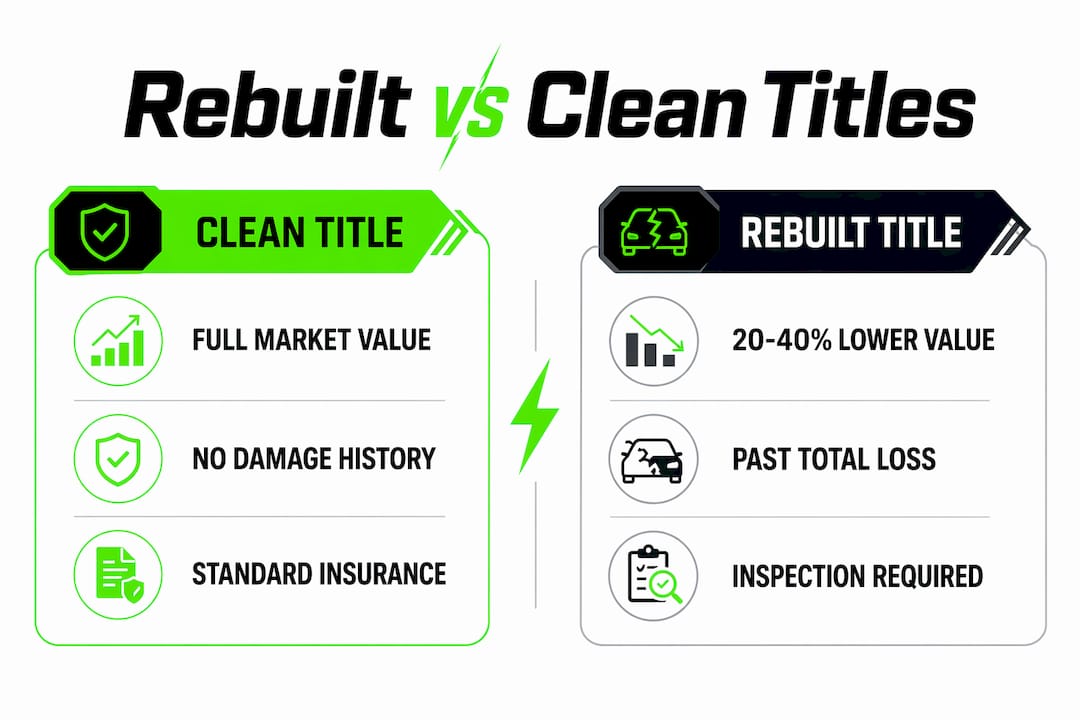
Short answer: Kelley Blue Book does not publish a separate value for rebuilt title cars. Its own values FAQ says the industry rule of thumb is to deduct 20% to 40% of the Blue Book value, and that a branded-title car really should be appraised case by case. So you start with the clean-title KBB number, take 20% to 40% off, then figure out where inside that range this particular car belongs.
That last step is the whole game. A 20-point range on a $25,000 car is a $5,000 question. I want you to walk into the deal knowing which end of it you are on.
Key takeaways
- KBB's rule of thumb for a branded title: deduct 20% to 40% of the Blue Book value (KBB values FAQ, read September 22, 2026).
- Real sales lean toward the small end of that range: across 16,000+ rebuilt title sales, the median saving was $4,607 and the median sale price $17,471.
- Where a car lands depends mostly on the type and severity of its history and how well the repair is documented.
- A ReVroom Report gives you an in-house severity grade and an estimated savings percentage for the specific car. It is not a history report.
- Rebuilt title cars are insurable and financeable.
Does Kelley Blue Book give values for rebuilt title cars?
Short answer: not directly. KBB's values assume an ordinary title, and its FAQ handles branded titles with a rule of thumb instead of a number.
KBB's wording, from its values FAQ: a salvaged, reconstructed or otherwise "clouded" title has a permanent negative effect on value, and "the industry rule of thumb is to deduct 20% to 40% of the Blue Book Value." It adds that these vehicles should be privately appraised on a case-by-case basis.
Think of the KBB number like the list price on a menu. It is the right starting point, but the rebuilt title is a known substitution, and you adjust for it.
How do you calculate a rebuilt title car's value from KBB?
Short answer: clean-title KBB value times 0.60 to 0.80.
- Look up the clean-title KBB value for the exact year, trim, mileage and ZIP code. Use private party value if you are buying from a person, dealer retail if from a lot.
- Multiply by 0.80 for the top of the rebuilt range and 0.60 for the bottom.
- Place the car inside that range using the factors in the next section.
| Clean-title KBB value | 20% off (top of range) | 40% off (bottom of range) |
|---|---|---|
| $12,000 | $9,600 | $7,200 |
| $20,000 | $16,000 | $12,000 |
| $28,000 | $22,400 | $16,800 |
| $35,000 | $28,000 | $21,000 |
This is plain arithmetic on KBB's rule of thumb, not a quote for any specific car.
What moves a rebuilt car to the top or bottom of the 20% to 40% range?
Short answer: how severe the history was and how well the repair is documented. Everything else is fine-tuning.
| Factor | Usually closer to 20% off | Usually closer to 40% off |
|---|---|---|
| History type and severity | Minor, cosmetic history such as hail | Severe history, or history that is unclear |
| Repair documentation | Receipts, parts list, inspection paperwork | Little or no paperwork |
| Model demand | Popular commuter models with steady demand | Niche models with a thin buyer pool |
| Mileage and age | Newer, lower-mileage cars | Older, high-mileage cars |
For context, 83% of the rebuilt title cars sold in ReVroom's data had collision history, 9.3% hail and 3.6% vandalism, and 88% carried only minor or moderate history (ReVroom market snapshot, updated September 9, 2026). If you only want to see the cosmetic end, you can shop minor-severity cars or hail-history cars directly.
What do real rebuilt title sales show against the KBB rule?
Short answer: real sales lean toward the small end of the 20% to 40% range.
Across 16,000+ rebuilt title vehicles on ReVroom's snapshot, the median sale price was $17,471 and the median saving was $4,607. Those are two separate medians, so they do not combine into an exact percentage, but side by side they point to a typical discount nearer 20% than 40%. Here is the median saved by make:
| Make | Median saved |
|---|---|
| GMC | $6,168 |
| Ram | $5,483 |
| Chevrolet | $5,267 |
| Honda | $5,181 |
| Acura | $5,005 |
| Subaru | $4,900 |
| Toyota | $4,717 |
| Ford | $4,487 |
| Kia | $4,475 |
| Nissan | $3,896 |
| Mazda | $3,844 |
| Hyundai | $3,236 |
| Jeep | $2,963 |
Source: ReVroom savings by make, updated September 9, 2026.
KBB or a ReVroom Report: which one tells you where a specific car lands?
Short answer: KBB gives you the clean-title starting point. A ReVroom Report tells you how severe this car's history was and what it should save you.
| Question | Kelley Blue Book | ReVroom Report |
|---|---|---|
| What is a clean-title version worth? | Yes, by year, trim, mileage and ZIP | Measured against clean-title comparables |
| How much should the rebuilt title take off? | A 20% to 40% rule of thumb | An estimated savings percentage for this car |
| How severe was the history? | No | In-house severity grade plus a detailed severity graphic |
| Where and when was it auctioned? | No | Yes |
| Is it a vehicle history report? | No | No. Run a free VIN check or a history report separately. |
Use them together. KBB sets the ceiling, and the ReVroom Report tells you how far below it this car should sit. If you are also weighing Carfax, here is what a Carfax VIN check covers and what it does not.
Does a rebuilt title affect insurance, financing and resale?
Short answer: you can insure it and finance it. Resale is where the rebuilt title follows you.
- Insurance: rebuilt title cars are insurable. Get a quote on the specific car before you buy, including comprehensive and collision if you want them.
- Financing: rebuilt title cars are financeable. Lenders value the collateral below a clean-title car, so shop a few offers.
- Resale: the title brand is permanent, so the same 20% to 40% logic applies when you sell. That is why a rebuilt title suits buyers who plan to keep the car.
Frequently asked questions
Does Kelley Blue Book give values for rebuilt title cars?
Not directly. KBB's values FAQ says the industry rule of thumb is to deduct 20% to 40% of the Blue Book value and that these cars should be appraised case by case.
How much does a rebuilt title reduce KBB value?
KBB cites 20% to 40%. Across 16,000+ rebuilt title sales tracked by ReVroom, the median saving was $4,607 and the median sale price $17,471, which points to typical discounts near the low end of that range.
How do I calculate a rebuilt title car's value?
Take the clean-title KBB value for the exact car and multiply by 0.60 and 0.80. Then place the car inside that range by the severity of its history and its repair documentation.
What makes a rebuilt car worth more or less?
History type and severity, repair documentation, model demand, mileage and local prices. A minor cosmetic history usually lands nearer the small end of the discount.
Is a ReVroom Report the same as a vehicle history report?
No. It gives an in-house severity grade, a severity graphic, an estimated savings percentage, and where and when the car was auctioned.
Can you insure and finance a rebuilt title car?
Yes. Rebuilt title cars are insurable and financeable.
Related reading
- How much is a rebuilt title car worth? What 16,000 sales show
- Rebuilt title car value calculator
- Carfax VIN check vs a free VIN check
- Carfax alternatives
- Is it worth buying a rebuilt title car?
Pricing a specific car? Get a ReVroom Report for its severity grade and estimated savings, or browse rebuilt title cars with the savings shown up front.
