


Rebuilt vs clean title price differences explained in 2026
March 26, 2026
You’ve probably heard that rebuilt title cars offer huge savings, but you’re wondering if they’re actually a good deal or just cheap for a reason. Many budget buyers assume rebuilt titles are risky bargains while clean titles guarantee quality, but the truth is far more nuanced. Understanding the real pricing differences between rebuilt and clean title vehicles, along with the factors that drive those gaps, empowers you to make confident buying decisions. This guide breaks down exactly what affects pricing, how much you can expect to save, and what trade-offs you need to weigh when choosing between these two options.
Table of Contents
- Key takeaways
- What is a rebuilt title and how does it affect price?
- Comparison of rebuilt and clean title prices: key factors and data
- How to evaluate pricing when considering rebuilt vs clean title vehicles
- Benefits and risks of choosing rebuilt title cars over clean titles
- Explore rebuilt title cars and pricing insights on ReVroom
- FAQ
Key Takeaways
| Point | Details |
|---|---|
| Rebuilt title discount | Rebuilt title cars typically sell for 20 to 40 percent less than comparable clean title cars due to buyer perception and lower resale down the road. |
| Insurance and financing are available | You can insure a rebuilt title car (liability and full coverage) and finance it through banks and credit unions. Compare a few quotes and lenders. |
| Clean title premium | Clean title vehicles generally carry higher market value and easier resale, reflecting lower perceived risk. |
| Due diligence benefit | Always request repair records and photos to verify workmanship and negotiate a fair price for a rebuilt title car. |
What is a rebuilt title and how does it affect price?
A rebuilt title is a designation given to vehicles that were previously declared a total loss by an insurance company but have since been repaired and inspected to meet roadworthiness standards. These vehicles receive this branding after passing state inspections that verify they’re safe to drive again. The history behind a rebuilt title varies widely, from minor incidents like hail or paint defects to theft recovery or more significant repairs.
The rebuilt designation immediately impacts market perception and pricing. Buyers often hesitate because they’re unsure about repair quality or worried about hidden issues. This stigma creates downward pressure on prices, even when repairs are excellent. Rebuilt title vehicles typically sell for 20-40% less than comparable clean title cars due to prior vehicle history, making them attractive to budget-conscious shoppers.
Several factors drive these price reductions:
- Buyer perception and concerns about repair quality create lower demand
- Reduced resale value when owners eventually sell
- A smaller buyer pool than mainstream clean-title cars
- State-by-state title branding laws that vary in strictness
- Repair transparency, which lets an informed buyer capture the discount with confidence
Pro Tip: Always request detailed repair records and photos of the vehicle before repairs when evaluating a rebuilt title car. This transparency helps you assess repair quality accurately and negotiate a fair price based on the actual work completed.
The key is understanding that a rebuilt title reflects vehicle history, not necessarily current condition. Many rebuilt title vehicles are mechanically sound and offer excellent value when properly vetted. The pricing discount compensates buyers for doing extra due diligence and accepting a lower resale down the road compared to clean title alternatives. Insurance and financing, worth noting up front, are both readily available.
Comparison of rebuilt and clean title prices: key factors and data
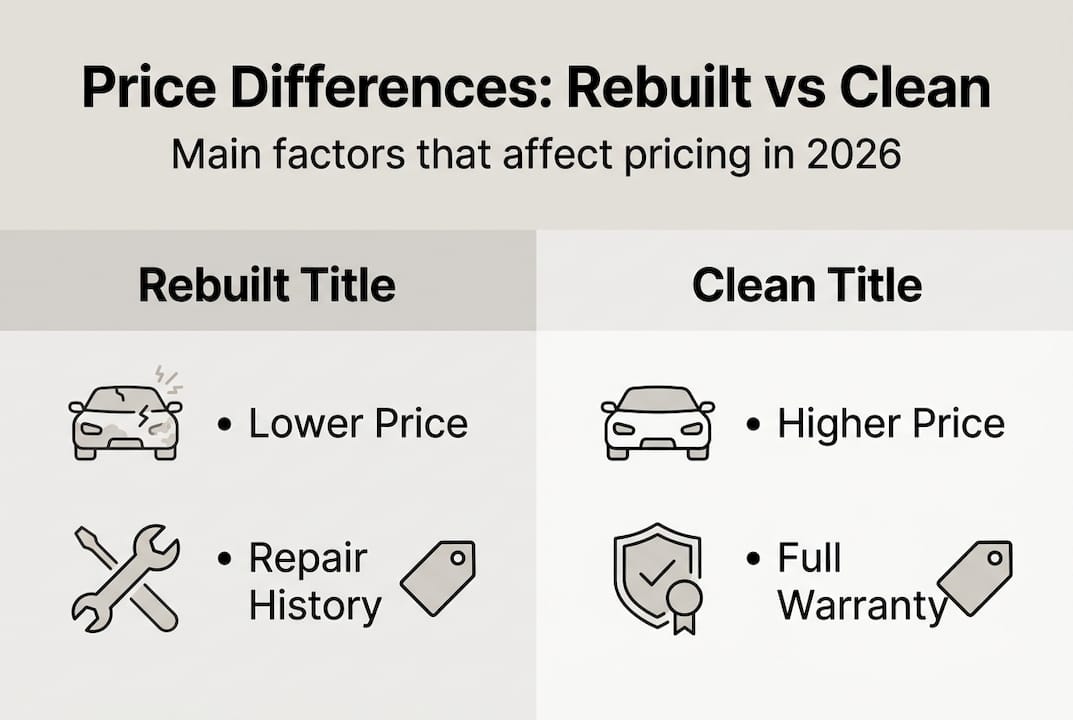
When comparing rebuilt versus clean title vehicles, the price gap is substantial but varies based on multiple factors. The average rebuilt title car sells for roughly 25-35% less than a comparable clean title vehicle, though this range shifts depending on vehicle specifics and market conditions.

Here’s how rebuilt and clean title vehicles compare across critical ownership factors:
| Factor | Rebuilt Title | Clean Title |
|---|---|---|
| Average price discount | 20-40% below clean title market value | Full market value |
| Financing availability | Available; banks and credit unions lend, credit unions often the most flexible | Widely available with competitive rates |
| Insurance access | Full coverage from most major insurers; compare a couple of quotes | Standard coverage with all carriers |
| Resale value | Lower than clean title, offset by the lower buy-in | Higher; standard depreciation curves apply |
| Buyer pool | Smaller; appeals to budget-conscious, informed buyers | Larger; mainstream market appeal |
| Inspection needs | Essential; professional mechanic review strongly recommended | Recommended but less critical |
Several key determinants influence exactly where a rebuilt title vehicle falls within the 20-40% discount range:
- Extent and nature of the prior incident that led to the total loss declaration
- Quality and documentation of repairs performed
- Vehicle age, mileage, and overall condition at time of sale
- Make, model, and market demand for that specific vehicle
- Regional market dynamics and state title branding regulations
- Availability of before-repair photos and detailed repair records
Price differences also vary significantly by region and vehicle type. Luxury vehicles with rebuilt titles often see steeper discounts because buyers in that segment prioritize pristine history. Conversely, trucks and SUVs with rebuilt titles from minor incidents like hail may command prices closer to clean title values due to high demand and obvious, cosmetic-only history.
Understanding these variables helps you set realistic price expectations. A well-documented rebuilt title vehicle with minor prior history and quality repairs should command the higher end of the discount range, while vehicles with unclear repair history or more extensive prior incidents warrant deeper discounts. Smart buyers use this knowledge to identify genuine value and avoid overpriced listings that don’t reflect appropriate market adjustments.
How to evaluate pricing when considering rebuilt vs clean title vehicles
Assessing fair pricing requires a systematic approach that accounts for both market data and vehicle-specific factors. Follow these steps to determine whether a rebuilt or clean title vehicle offers the best value:
- Research comparable clean title prices for the same make, model, year, and mileage in your market to establish a baseline value.
- Review the vehicle history report thoroughly, focusing on the incident that triggered the total loss and subsequent repairs completed.
- Inspect repair quality in person or hire a trusted mechanic to perform a comprehensive pre-purchase inspection.
- Calculate the appropriate discount by applying a 20-40% reduction to the clean title baseline, adjusted for repair quality and history transparency.
- Verify insurance costs by getting quotes from a couple of carriers before committing to purchase.
- Line up financing early; banks and credit unions lend on rebuilt titles—get pre-qualified to compare terms.
- Factor in a lower future resale value when determining your maximum acceptable price.
Pricing a rebuilt title car means factoring in repair history, vehicle condition, and the market discount compared to clean title prices. Use clean title listings as your anchor, then adjust downward based on the specific vehicle’s history and documentation quality. A rebuilt title vehicle with complete repair records, before-repair photos, and a minor prior incident justifies a smaller discount than one with vague history or significant prior issues.
Pro Tip: Create a simple spreadsheet comparing three to five similar vehicles across both title types. Include purchase price, an insurance quote, potential resale value, and total cost of ownership over your planned ownership period. This side-by-side view reveals which option truly delivers better value for your specific situation.
Balancing potential savings against trade-offs requires an honest assessment of your comfort level and budget flexibility. If you’re mechanically inclined or have access to trusted inspection resources, rebuilt titles offer genuine savings. If you prefer simplicity and plan to resell within a few years, clean titles might justify their higher upfront cost through easier resale and broader buyer appeal. Neither choice is universally better; the right answer depends on your priorities, resources, and willingness to do extra homework.
Benefits and risks of choosing rebuilt title cars over clean titles
Rebuilt title vehicles deliver tangible benefits that make them attractive to informed, budget-conscious buyers. Understanding both advantages and trade-offs helps you decide whether the savings justify them.
Key benefits of choosing rebuilt title vehicles include:
- Significant purchase price savings of 20-40% compared to clean title alternatives
- Access to newer models, better features, or more desirable vehicles within your budget
- Opportunity to own quality vehicles that underwent professional repairs and passed state inspections
- Availability of specific makes and models that might be unaffordable with clean titles
- Potential for excellent value when repair history is transparent and quality is verified
The honest trade-offs to weigh:
- Possible unknown issues if repair quality was substandard or incomplete—which a pre-purchase inspection surfaces
- Lower resale value and a smaller buyer pool when you eventually sell (offset by the lower price you paid)
- Stigma and perception challenges even when the vehicle is mechanically excellent
- The need for extra due diligence, including a professional inspection and history verification
Insurance and financing, by the way, aren’t on that list: you can fully insure a rebuilt title car and finance it through banks and credit unions. The savings come with real value math, and the trade-offs are manageable with good information.
The key to maximizing benefits while minimizing trade-offs is transparency and verification. Vehicles with complete documentation, before-repair photos, detailed repair records, and clear history offer the best value proposition. Avoid rebuilt title vehicles with vague history, missing documentation, or sellers unwilling to provide inspection access. The savings only make sense when you can confidently verify repair quality and understand exactly what prior incident the vehicle experienced. For a fuller look, see our guide to whether rebuilt titles are bad.
Balancing these factors requires honest self-assessment. Are you comfortable doing extra research? Do you have access to trusted mechanics for inspections? If yes, rebuilt titles can stretch your budget dramatically. If you prefer simplicity and plan short-term ownership, clean titles might better serve your needs despite higher upfront costs. Neither option is wrong; the right choice aligns with your priorities and circumstances.
Explore rebuilt title cars and pricing insights on ReVroom
Now that you understand pricing differences and evaluation strategies, finding the right vehicle becomes your next step. ReVroom specializes in rebuilt title vehicles, offering a marketplace built specifically for buyers who want transparency and value. Unlike traditional platforms where rebuilt titles hide among thousands of listings, ReVroom focuses exclusively on this market segment, providing the tools and information you need to buy confidently.

Every listing on ReVroom includes comprehensive vehicle history information and photos showing what the car looked like before repairs. This upfront transparency eliminates the guesswork and $150+ investigation costs typical buyers face when vetting rebuilt title vehicles elsewhere. You can quickly compare options, assess repair quality, and identify genuine value without paying for multiple reports or wondering what sellers might be hiding. Whether you’re comparing rebuilt versus clean title options or ready to explore specific vehicles, ReVroom gives you the transparency and confidence to find quality cars at prices that fit your budget, and you can keep learning in our guides along the way.
FAQ
Is a rebuilt title car always a bad deal?
No, rebuilt title cars are not inherently bad deals when properly vetted. Many offer excellent value for buyers willing to do thorough research and inspections. The key is transparency about vehicle history and verification of repair quality. Smart buyers who understand what they’re purchasing can find reliable vehicles at significant savings compared to clean title alternatives.
How much cheaper are rebuilt title cars compared to clean title vehicles?
Rebuilt title cars typically sell for 20-40% less than comparable clean title vehicles, though the exact discount varies. Factors like repair quality, documentation completeness, vehicle age, and market demand influence where specific vehicles fall within this range. Luxury vehicles often see steeper discounts, while high-demand trucks or SUVs with minor prior incidents may command smaller reductions from clean title prices.
Can I finance or insure a rebuilt title car easily?
Yes to both. Full coverage is widely available from most major insurers, and banks and credit unions finance rebuilt titles—credit unions are often the most flexible. Rates are often comparable to a clean-title car, and terms vary by lender, so getting quotes from multiple insurers and comparing lenders before purchase is the smart move.
What should I look for when inspecting a rebuilt title vehicle?
Focus on repair quality verification, complete vehicle history review, and a professional mechanic inspection before buying. Check that repairs meet manufacturer standards, verify the rebuilt title documentation is accurate and complete, and confirm the vehicle passes a comprehensive mechanical inspection. Request before-repair photos and detailed repair records to understand exactly what work was performed. Thorough inspection and transparency are essential for avoiding costly surprises and ensuring you’re getting genuine value.
