


Hail Damage Cars for Sale (2026): Is a Rebuilt Title From Hail Worth It, What Hail-History Cars Cost Today, and How to Check the Repairs
September 18, 2026
Short answer: yes, a hail damage rebuilt title car is usually worth buying, and it is often the best deal in the whole rebuilt market. Hail dents sheet metal and cracks glass. It does not touch the engine, the frame, or the airbags. That is why so many of these cars were totaled on paper, fixed in a body shop, passed a state inspection, and now sit on a lot priced thousands under a clean-title twin. This guide covers how much cheaper they really are, what the history grade on a listing means, how a rebuilt title from hail compares to a clean-title car with a few dings, what to look at on the car, and where to find them.
Key takeaways
- Hail history is cosmetic by nature. On ReVroom, hail-history vehicles sell roughly $4,090 or more below market value, and almost every one carries a minor history grade.
- Hail is about 10.4% of documented rebuilt title history; collision is 81.9%. If you want the lightest history at the deepest discount, hail is where to look.
- A rebuilt title from hail means the insurer totaled the car on cost, a shop fixed it, and the state inspected it. A clean-title car with hail dings was never totaled and usually still has the dents.
- Every rebuilt title car passed a state inspection before it could be retitled. What you are checking is the quality of the body and glass work, not whether the car is legal.
- Insurance and financing are both available. Shop two or three quotes, same as any car.
- ReVroom is the only marketplace that lets you filter inventory by history type, so you can see every hail-history car on one page.
Why does hail give a car a rebuilt title?
Short answer: the insurer totals the car because fixing hundreds of dents costs more than the policy is willing to pay, not because the car is broken.
A single storm can put a thousand dings across a hood, roof, and trunk lid and crack the windshield. When the repair estimate approaches a set share of the car's pre-storm value (the threshold varies by state, often around 70 to 75 percent), the insurance company declares a total loss and the title becomes salvage. From there the path is the same as any other rebuilt title:
- The insurer sells the car at auction with a salvage title.
- A rebuilder buys it and repairs the panels and glass.
- The state inspects the car and issues a rebuilt title.
- The car is legal to register, insure, drive, and sell.
The difference between a salvage title and a rebuilt title is the whole ballgame. Salvage means not yet repaired or inspected. Rebuilt means repaired, inspected, and cleared. You want the second one.

How much cheaper are hail-history rebuilt title cars?
Short answer: typically 20 to 40 percent below clean-title market value, and the live inventory says the top end of that range is common.
These are not estimates. They are the numbers on ReVroom's own history and severity snapshot, updated October 1, 2026, and the live hail-history inventory page on October 5, 2026.
| What the market shows | Number |
|---|---|
| Share of documented rebuilt title history that is hail | 10.4% (1,287 vehicles) |
| Typical savings on a hail-history vehicle | $4,090 or more below market |
| Median savings across all 17,000+ rebuilt title sales tracked | $4,590 |
| Rebuilt title vehicles with only minor or moderate history | 87% |
| Cheapest hail-history car listed October 5, 2026 | $6,795 |
And the cars leading the hail page that day, so you can see what the percentages mean in dollars:
| Vehicle | Miles | Price | Below market |
|---|---|---|---|
| 2025 Jeep Compass Latitude | 5,542 | $16,971 | 39% ($10,850 off) |
| 2022 Ford Explorer XLT | 66,086 | $16,971 | 35% ($9,138 off) |
| 2021 Kia Telluride SX | 74,000 | $17,250 | 34% ($8,886 off) |
| 2024 Ford Edge SEL | 38,850 | $16,471 | 33% ($8,113 off) |
| 2022 Ford Escape SE | 48,895 | $12,971 | 31% ($5,828 off) |
| 2025 Ford Bronco Sport Big Bend | 11,122 | $19,471 | 28% ($7,572 off) |
Every one of those cars is graded minor. That is the pattern with hail: big discount, small story. Listings change daily, so treat the table as a snapshot and check the hail page for today's cars. For the full picture of what a rebuilt title does to price, read how much a rebuilt title affects a car's value.
What does a "minor" hail history grade mean?
Short answer: the repair was cosmetic, and ReVroom graded it that way in-house before the car went on the site.
ReVroom grades every car's history on a minor, moderate, or severe scale. Minor means panels, paint, glass, and trim. Moderate means something under the skin needed work. Severe means structural or drivetrain repairs. Across the whole market, 34.3% of graded vehicles are minor and 53.1% are moderate. Hail-history cars sit almost entirely in the minor bucket, which is exactly what you would expect from a storm that dents metal and breaks nothing underneath.
You can shop by that grade. The minor-only filter shows every car in the market with a cosmetic history, and combining it with the hail filter gets you the shortest list of the easiest decisions. If you want the grade, the severity graphic, the estimated savings, and where and when the car was auctioned in one place, a ReVroom Report puts that on one page.
Minor hail on a clean title vs. a rebuilt title from hail: which is the better buy?
Short answer: if you want the dents gone and the biggest documented discount, the rebuilt title from hail. If you need a clean title above all else, the dinged clean-title car, priced down by haggling.
These are two different cars that both went through a storm. One got a claim check and stayed on the road with its dings. The other got totaled, repaired, inspected, and retitled. Think of it like two sofas from the same warehouse flood sale: one is sold as-is with the water ring on the cushion, the other was reupholstered and tagged "refurbished." Same storm, different paperwork, different price tag.
| Clean title with hail dings | Rebuilt title from hail | Rebuilt title from collision | |
|---|---|---|---|
| What happened on paper | Not totaled. The owner may have taken the claim money and skipped the repair | Insurer totaled it on repair cost, a shop fixed it, the state inspected it | Same path, different cause |
| Are the dents fixed? | Often not. Ask | Yes, before the inspection | Repairs depend on the impact |
| Title | Clean | Rebuilt brand, permanent | Rebuilt brand, permanent |
| Typical price | Negotiated case by case; there is no market-wide number | About $4,090 or more below market in ReVroom's sold data | Varies with severity; $4,590 median across all rebuilt sales |
| Typical history grade | Not graded | Almost always minor | Spread across minor, moderate, and severe |
| Insurance and financing | Normal | Available; compare two or three quotes | Available; compare two or three quotes |
| Best for | Buyers who must have a clean title and don't mind dings | Budget buyers who want a fixed car at the deepest discount | Buyers who shop by grade and price |
One more thing to know about the clean-title side: an unrepaired hail car can still pick up a salvage brand later if a second claim pushes it past the total-loss line. A rebuilt title from hail has already been through that process, so what you see on the title is the whole paperwork story. To shop the rebuilt side by grade, stack the hail filter with the minor-only grade.
How do shops fix hail dents, and does the method matter?
Short answer: paintless dent repair is the method you hope for, conventional bodywork is fine when done right, and the difference is visible from three feet away in daylight.
Paintless dent repair, usually called PDR, works the dents out from behind the panel with the factory paint left untouched. It is the standard fix for most hail because it keeps the original finish and does not add filler. Conventional bodywork comes into play when the dents are sharp enough to crack the paint or the panel is easier to replace than to massage back. Roofs, hoods, and trunk lids are the panels most often replaced or repainted.
Neither method is a problem on its own. What you are looking for is evidence the work was finished: paint that matches from panel to panel, reflections that run straight along the body line, and a roof that does not show a faint dimple pattern when the light hits it sideways. That is the entire inspection for most hail cars, and it takes ten minutes.
What should you check on a hail-history car before you buy?
Short answer: the glass, the seals, the paint match, and the sensors. Everything else on a hail car is the same used-car homework you would do anyway.
- Sight down every panel. Stand at the front corner and look along the hood, then the roof, then each side, with the sun or a shop light behind you. Waves and dimples show up at a low angle that you will never see head-on.
- Compare the roof and hood paint to the doors. Those are the panels most likely to have been repainted or replaced. A slight color or texture difference is cosmetic; you are just confirming it was done cleanly.
- Check the windshield and rear glass. Replaced glass is normal on a hail car. If the windshield carries a camera for lane-keeping or automatic braking, ask whether it was recalibrated after the swap.
- Open every door and the trunk. Look at the rubber seals and the headliner for water stains. A roof that was worked hard can leak if the seals were not reset.
- Read the listing's repair disclosure. On ReVroom, every listing shows what was repaired, with photos where they are available, and its title status. Match what the seller says to what you see.
- Get a pre-purchase inspection. An independent shop will confirm the body and glass work and catch anything unrelated to the hail. It is a small fee against a five-figure purchase.
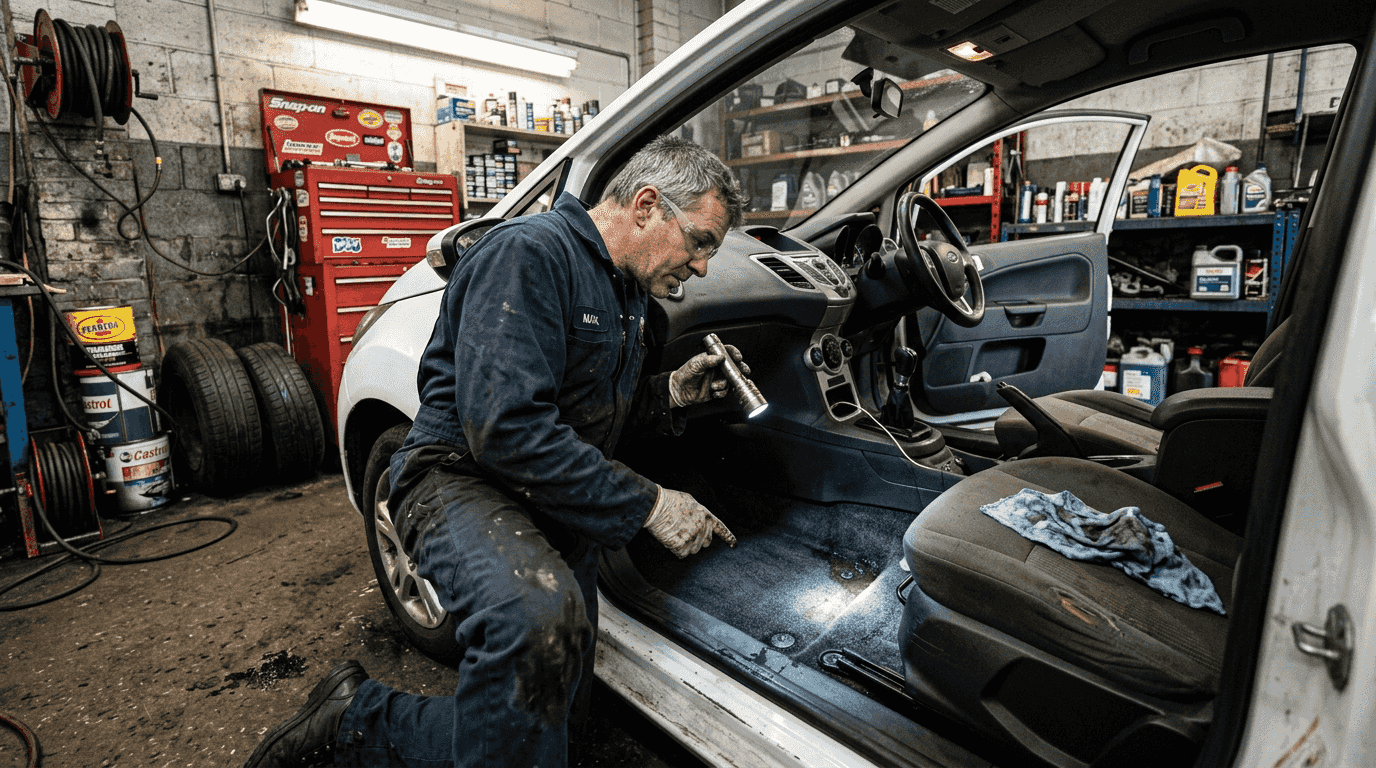
Our guide to buying a rebuilt car safely walks through the full inspection for any history type, and what leads to a salvage or rebuilt title explains how hail compares to collision, water, and the rest.
Can you insure, finance, and resell a hail-history rebuilt title car?
Short answer: yes, yes, and yes, with a little extra shopping on the first two and a smaller resale number on the third.
Insurance. Liability coverage is available everywhere. Most major insurers write full coverage on rebuilt titles; a few ask for a quick photo inspection or price the car a little differently. Two or three quotes settle it. Our guide to which insurers cover rebuilt title cars names names.
Financing. Banks and credit unions both finance rebuilt titles, and credit unions are often the most flexible. If you would rather not call branches one at a time, one application through ReVroom's financing page reaches several lenders at once and returns the offers to you. ReVroom is not a lender.
Resale. A rebuilt title follows the car for life, so your buyer will get a discount too. That is the flip side of the discount you got walking in, and on a hail car the story you hand the next owner is the easiest one in the market to explain: dents, fixed, inspected, done. When that day comes, a ReVroom listing costs a flat $5.
What do hail damage cars for sale cost right now?
Short answer: ReVroom's hail-history inventory page listed cars from $6,795 on October 12, 2026, and hail-history cars in ReVroom's sold data typically went for $4,090 or more below market.
Think of it like buying the floor model at an appliance store. It works exactly like the one in the box, it has a scuff you can point to, and the price tag knows it. Hail cars are the floor models of the rebuilt market. Here is what the numbers say, straight from ReVroom's own market pages:
| What you are looking at | The number, as published | Where it comes from |
|---|---|---|
| Cheapest hail-history car listed October 12, 2026 | From $6,795, updated daily | Hail-history inventory page |
| Typical hail-history saving | $4,090 or more below market | History snapshot, updated October 1, 2026 |
| Hail share of documented rebuilt history | 10.4% (1,287 vehicles); collision is 81.9% | History snapshot |
| Median saving, every rebuilt car tracked | $4,590 across 17,000+ vehicles | Market snapshot |
| Cars sold 25% or more below clean-title value | About 1 in 3 | Market snapshot |
Model year matters more than most shoppers expect. Across all rebuilt title cars ReVroom tracked, the median saving climbs with the year, so a newer hail car usually carries the bigger dollar discount:
| Model year | Median saving (all rebuilt history types) | Cars sold |
|---|---|---|
| 2018 | $3,283 | 931 |
| 2020 | $4,870 | 1,097 |
| 2022 | $5,966 | 1,328 |
| 2024 | $7,023 | 1,330 |
Those savings are for every history type, not hail alone. Use them as the floor, then look at the hail cars on the hail filter to see the live gap on each card.
Which hail-history cars are for sale today, and how do you read the listing?
Short answer: on October 12, 2026 the first page of ReVroom's hail inventory held 36 cars from $12,971 to $32,000, 20 to 39 percent below market, and every one was graded minor.
A listing card works a lot like a nutrition label. The price is the calorie count, but the useful part is the small print underneath it: how far below market, what kind of history, how serious it was, and where the car sits. Here is the top of the hail-history inventory page as it read that morning:
| Vehicle | Miles | Price | Below market | Grade |
|---|---|---|---|---|
| 2025 Jeep Compass Latitude | 5,542 | $16,971 | 39% ($10,850 off) | Minor |
| 2022 Ford Explorer XLT | 66,086 | $16,971 | 35% ($9,138 off) | Minor |
| 2024 Ford Edge SEL | 38,850 | $16,471 | 33% ($8,113 off) | Minor |
| 2022 Dodge Charger GT | 62,408 | $16,971 | 31% ($7,625 off) | Minor |
| 2022 Ford Escape SE | 48,895 | $12,971 | 31% ($5,828 off) | Minor |
| 2023 Buick Envision Avenir | 76,496 | $19,495 | 29% ($7,963 off) | Minor |
| 2025 Ford Bronco Sport Big Bend | 11,122 | $19,471 | 28% ($7,572 off) | Minor |
| 2021 Ford Explorer XLT | 76,397 | $16,471 | 28% ($6,405 off) | Minor |
| 2025 Chevrolet Trax RS | 46,597 | $15,871 | 27% ($5,870 off) | Minor |
| 2023 Chevrolet TrailBlazer LT | 34,670 | $13,971 | 27% ($5,167 off) | Minor |
| 2023 Volkswagen Tiguan SE 4Motion | 75,513 | $15,471 | 26% ($5,436 off) | Minor |
| 2022 Jeep Compass Limited | 41,599 | $14,271 | 26% ($5,014 off) | Minor |
Three things jump out. Every card is graded minor, which is the hail pattern. Newer cars carry the bigger dollar gap: the 2025 Compass is $10,850 under market, the 2022 Escape $5,828. And the cheapest hail car on the site, from $6,795, sits further down the list, because the page leads with the biggest savings, not the lowest price. Listings sell and change daily, so treat this as one morning's snapshot.
Here is how to read each line on a card:
| What the card says | What it tells you | What to do with it |
|---|---|---|
| "39% below market ($10,850 off)" | The estimated gap against comparable clean-title listings | Compare it across cards. A ReVroom Report puts the estimate, the grade, and the auction details on one page |
| "Hail" | The history type that led to the rebuilt title | Keep the hail filter on |
| "Minor" | ReVroom's in-house grade of how serious the history was | Stack it: hail, graded minor |
| "Rebuilt & branded title" | The title brand, which stays with the car | Price your insurance and loan the same week; both are available |
| "291 mi since repair" (on some cards) | Miles driven since the repair was finished | Ask the seller for the repair receipts and inspection paperwork |
And the shortcuts, depending on what you are shopping for:
| You want | Start here |
|---|---|
| Every hail-history car, biggest savings first | Hail-history inventory |
| Hail cars graded minor only | Hail + minor filter |
| Anything under $15,000 | Rebuilt cars under $15k |
| An SUV | Rebuilt title SUVs |
| A truck | Rebuilt title trucks |
| A dealer's lot near you | Rebuilt title dealers by state |
When I bought my own rebuilt car at 53 percent off, the part that sold me was not the price. It was being able to see exactly what I was paying less for. The card is where that starts.
Does hail damage show on a vehicle history report?
Short answer: the title brand shows up, the word "hail" often does not.
When an insurer totals a car after a storm, the state brands the title salvage, and once it is repaired and inspected, rebuilt. That brand lands in the federal NMVTIS record, and a free NICB VINCheck will flag a salvage or flood record reported by a participating insurer. What those tools usually skip is the why. A brand is a stamp, not a story. Our salvage title check guide walks through both free lookups step by step.
To learn how serious the history was, a ReVroom Report grades it minor, moderate, or severe, shows where and when the car was auctioned, and estimates how much you should be saving. It is not a vehicle history report, and it does not need to be: the brand is already on the title. The listing itself shows what was repaired, with photos where they are available.
Where can you find hail damage cars for sale?
Short answer: on the one marketplace that lets you filter by history type, which is ReVroom.
Most sites bury the history inside the listing text, if they mention it at all. ReVroom sorts inventory by it. The hail-history inventory page shows every hail car in the market with its price, miles, savings, and history grade on the card, updated daily. The browse filter does the same thing inside the full search, so you can stack it with a make, a budget, or the minor-only grade. If you would rather buy from a lot, rebuilt title dealers by state lists verified dealerships with their live inventory. And if you are wondering why lots run hail sales after a big storm, our guide to how dealership hail sales work explains the timing.
Find your hail-history car on ReVroom
You now know why hail cars are the quiet bargain of the rebuilt market, how they compare to a dinged clean-title car, what the grade on the card means, and the ten-minute walk-around that confirms the work. The rest is picking one. Every ReVroom listing shows what was repaired, with photos where they are available, and its title status, so you can compare cars before you ever leave the couch.

Browse hail-history rebuilt title cars, or keep learning in our guides. Your dollar goes further. Your car does too.
FAQ
Is a hail damage rebuilt title car worth buying?
Usually yes. Hail leaves dents in sheet metal and glass, not in the engine, frame, or airbags, so a hail-history rebuilt title car is typically the least eventful history you can buy at a rebuilt-title price. On ReVroom, hail-history vehicles sell roughly $4,090 or more below market value and almost every one carries a minor history grade.
Is buying a car with hail damage a good idea?
It is one of the better ideas in the used market if the hail repairs are finished. A rebuilt title car from hail has already been repaired and passed a state inspection, and on October 12, 2026 the first page of ReVroom's hail-history inventory ran 20 to 39 percent below market. A clean-title car with unrepaired dings is a different purchase: you are buying the dents along with the car, so price it that way.
Why would hail give a car a rebuilt title?
Because the insurer totaled it. When the cost of fixing hundreds of dents and the glass gets close to the car's pre-storm value, the insurer declares a total loss and the title becomes salvage. After a shop repairs it and the state inspects it, the title becomes rebuilt. The car was expensive to fix, not broken.
Is a car with minor hail dents and a clean title a better deal than a hail rebuilt title?
It depends on whether you want the dents fixed. A clean-title car with hail dents was never totaled, keeps a clean title, and is priced by negotiation, often with the dents still on it. A rebuilt title from hail has already been repaired and inspected and sells at a documented discount, roughly $4,090 or more below market in ReVroom's sold data, but the rebuilt brand stays on the title for life.
How much cheaper are hail damage rebuilt title cars?
Typically 20 to 40 percent below clean-title market value, sometimes more. The first page of ReVroom's hail-history inventory on October 12, 2026 ran from 20 to 39 percent below market, led by a 2025 Jeep Compass listed at $16,971, which is $10,850 under market.
Can I shop hail-history cars by grade and budget?
Yes. ReVroom is the only marketplace that filters rebuilt title inventory by history type and by in-house severity grade, and the two filters stack, so you can see only hail-history cars graded minor in one list. Separate pages cover cars under $15,000, SUVs, and trucks.
Is a hail damage rebuilt title car safe to drive?
Every rebuilt title car passed a state safety inspection before it was retitled, and hail does not touch the systems that keep you safe. The things to confirm are the repairs to the glass, the roof seals, and any sensors mounted in the windshield or mirrors.
Can I insure a rebuilt title car with hail history?
Yes. Liability coverage is available everywhere, and most major insurers write full coverage on rebuilt titles. A few ask for a quick photo inspection or price the car a little differently, so compare two or three quotes.
Can I finance a hail damage rebuilt title car?
Yes. Banks and credit unions finance rebuilt titles, credit unions are often the most flexible, and one application through ReVroom's financing page reaches several lenders at once. ReVroom is not a lender.
How do I know the hail dents were fixed properly?
Look down each panel at a low angle in daylight for waves or dimples, check that the roof, hood, and trunk paint match the doors, open the doors and check the seals and headliner for water marks, and confirm any windshield-mounted cameras were recalibrated if the glass was replaced. A pre-purchase inspection by an independent shop settles the rest.
Where can I find hail damage cars for sale?
ReVroom is the only marketplace where you can filter rebuilt title inventory by history type, so you can see hail-history cars on one page, sorted by savings, with the repairs disclosed on every listing.
Does hail damage show on a vehicle history report?
The title brand does. An insurer total loss becomes a salvage brand, and later a rebuilt brand, in the federal NMVTIS record, and NICB VINCheck flags salvage or flood records from participating insurers. The cause is often missing. A ReVroom Report grades how serious the documented history was and shows where and when the car was auctioned.
What is the cheapest hail damage car for sale on ReVroom?
On October 12, 2026 the hail-history inventory page listed cars from $6,795, and the page updates daily. Hail-history cars typically sell $4,090 or more below market in ReVroom's sold data.
Can I sell a car with a hail rebuilt title?
Yes. A rebuilt title car can be sold like any other car, as long as the title brand is disclosed. ReVroom lists rebuilt and branded title cars for a flat $5 listing fee on its sell page, and hail is the easiest history in the market to explain to the next buyer.
Recommended
- What Leads to Salvage and Rebuilt Titles? | ReVroom
- How to Buy a Rebuilt Car Safely | ReVroom
- How Much Does a Rebuilt Title Affect Value? | ReVroom
- Salvage Title vs. Rebuilt Title | ReVroom
- What Insurance Companies Cover Rebuilt Title Cars? | ReVroom
- Are Rebuilt Titles Bad? | ReVroom
- Salvage Title Check: How to Tell If a Car Has a Salvage or Rebuilt Title | ReVroom
- Rebuilt Title SUVs: Which SUVs Buyers Choose and What They Save | ReVroom
- Hail Sale Cars: How Dealership Hail Sales Work | ReVroom
