


Will State Farm Insure a Rebuilt Title? Yes — Here's How (2026)
January 17, 2026
Every parent wants safety and value when helping a teen or college student buy a first car. Shopping for rebuilt title vehicles in Utah often looks affordable, but finding clear answers about insurance options can be confusing. Understanding what documentation you need and how providers like State Farm review your case matters for securing reliable coverage. This guide highlights the essential steps and explains State Farm’s requirements, so you can confidently protect your student’s ride within budget.
Short answer: Yes, usually. State Farm is widely reported to insure rebuilt title vehicles once you show the repairs were done properly and the car passed its state inspection, though every policy is underwritten case by case, so your agent has the final say. The full step-by-step is below. And if you're still shopping, you can browse certified rebuilt & branded title cars on ReVroom — each listing shows its documented repair history and title status up front — or pull a ReVroom Report on any car you found elsewhere: in-house severity grading, a detailed severity graphic, and how the price compares with clean-title cars.
Table of Contents
- Step 1: Gather Required Rebuilt Title Documentation
- Step 2: Contact State Farm for Eligibility Verification
- Step 3: Submit Vehicle Information and Photos
- Step 4: Review Preliminary Insurance Quote Options
- Step 5: Confirm and Finalize State Farm Coverage
- Does State Farm Offer Full Coverage on a Rebuilt Title?
- How Much Does State Farm Insurance Cost on a Rebuilt Title?
- Will State Farm Insure a Salvage Title?
Quick Summary
| Key Insight | Explanation |
|---|---|
| 1. Gather Comprehensive Documentation | Assemble repair history, inspection reports, and certifications to prove roadworthiness. |
| 2. Contact State Farm for Coverage Options | Speak with an agent about specific requirements for insuring a rebuilt title vehicle. |
| 3. Submit Detailed Vehicle Information | Include comprehensive details and high-quality photos to assist in the insurance assessment. |
| 4. Review Insurance Quote Options | Compare liability and full coverage options, focusing on terms that may affect your premium. |
| 5. Finalize Your Coverage Policy | Carefully read and confirm all policy details, ensuring you understand all terms before signing. |
Step 1: Gather Required Rebuilt Title Documentation
Collecting the right documentation is your roadmap to successfully insuring a rebuilt title vehicle. You will need comprehensive records that prove the vehicle has been professionally repaired and meets safety standards.
Start by assembling a complete repair history portfolio. This includes detailed vehicle repair documentation from the shop that performed the reconstruction. Gather every repair receipt, itemized parts list, and photographic evidence of the restoration process. Insurance companies want transparency about the vehicle’s past and current condition. Your documentation package should include professional inspection reports showing the car passed all required safety examinations. Pay special attention to collecting official statements from the mechanic or repair shop certifying that all structural and mechanical components have been restored to roadworthy condition.
Most insurance providers will request additional verification beyond repair records. This might involve obtaining a formal vehicle inspection report from your state Department of Motor Vehicles or an authorized inspection station. Some insurers may require an independent assessment to confirm the vehicle meets their specific standards.
Pro Tip: Always create digital and physical copies of your documentation to ensure you have backup records in case any paperwork gets misplaced.
Step 2: Contact State Farm for Eligibility Verification
Reaching out to State Farm is a crucial step in determining whether your rebuilt title vehicle can be insured. Your goal is to understand their specific requirements and confirm potential coverage options for your unique vehicle.
Initiate contact by calling a local State Farm agent or visiting their nearest branch. Be prepared to provide detailed information about your rebuilt title vehicle, including specific vehicle inspection details. The agent will want to know the vehicle’s age, repair history, and current condition. During this conversation, ask about their specific criteria for insuring rebuilt title vehicles. Some agents might require additional documentation or an independent safety inspection before offering coverage. Expect questions about the extent of repairs, the repair shop’s credentials, and the vehicle’s current mechanical condition.
Understand that each State Farm office may have slightly different protocols for rebuilt title vehicles. Some might offer liability coverage while being more cautious about comprehensive insurance. Take detailed notes during your conversation and request written confirmation of their specific requirements to ensure you have a clear understanding of the next steps.
Pro Tip: Schedule an in person appointment with a State Farm agent and bring all your vehicle documentation to streamline the verification process.
Step 3: Submit Vehicle Information and Photos
With your documentation prepared, the next crucial step is compiling and submitting comprehensive vehicle information to State Farm. This step requires detailed and transparent reporting about your rebuilt title vehicle to help the insurance company assess its insurability.
Prepare a comprehensive package that includes detailed vehicle documentation covering every aspect of the vehicle. Gather high quality photographs from multiple angles that showcase the vehicle’s current condition including front, rear, sides, interior, and any areas of previous repair. Include clear shots of the odometer, VIN number, and repair work. Alongside photos, compile a complete information packet including the vehicle’s make, model, year, engine type, mileage, and complete repair history. Be prepared to provide additional documentation such as repair invoices, professional inspection reports, and any state certification of roadworthiness.
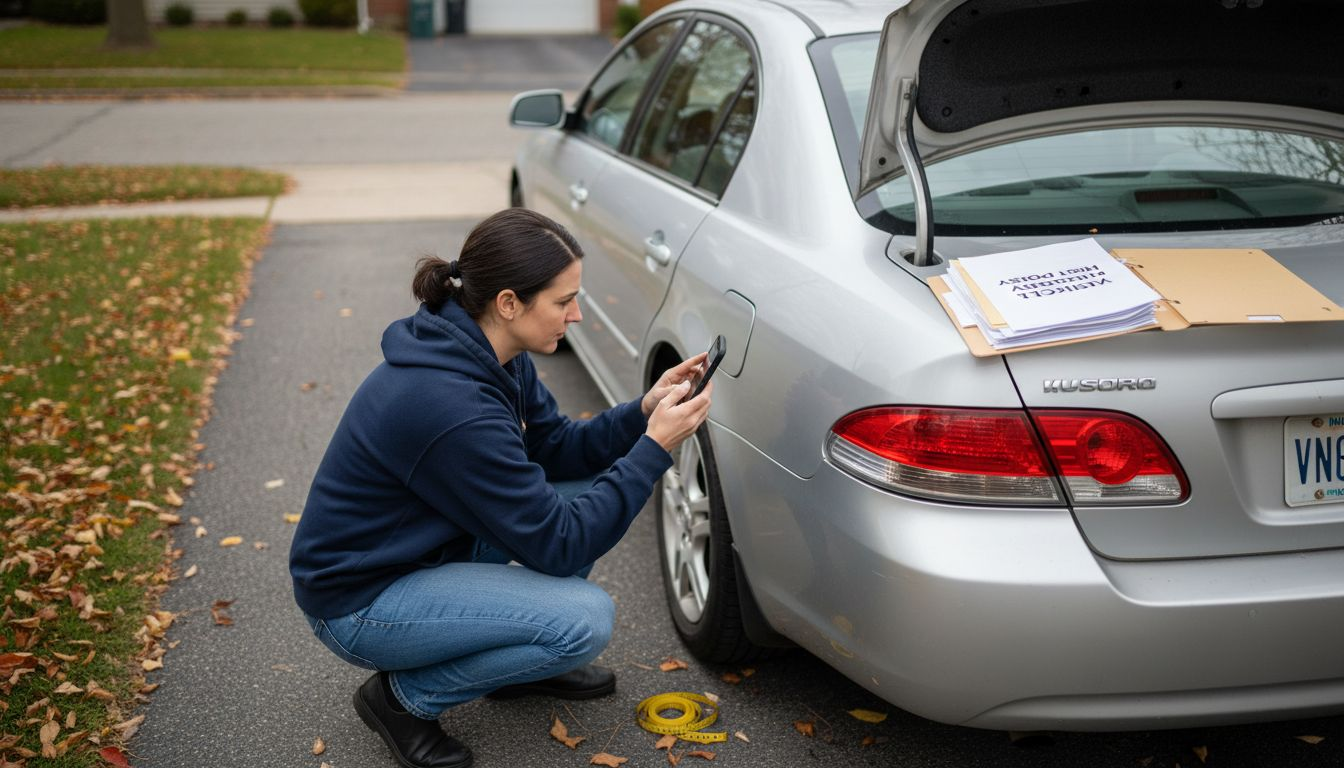
Your submission should demonstrate the vehicle’s safety and reliability. Include a comprehensive vehicle history report that outlines all past incidents and repairs. Be transparent about the vehicle’s background and prepared to answer follow up questions from the insurance agent. Remember that thorough documentation increases your chances of securing insurance coverage for your rebuilt title vehicle.
This table summarizes State Farm’s key rebuilt title insurance requirements and potential hurdles:
| Requirement | Why It Matters | Possible Hurdle |
|---|---|---|
| Detailed Repair Records | Proves professional repair | Missing receipts |
| Professional Inspection | Confirms roadworthiness | Failed safety checks |
| State Certification | Validates legal status | Incomplete paperwork |
| Photographic Evidence | Shows repair quality | Poor image quality |
Pro Tip: Organize your vehicle photos and documents in a digital folder with clear file names to make submission and potential follow up requests smoother.
Step 4: Review Preliminary Insurance Quote Options
Understanding your insurance quote options is a critical step in insuring your rebuilt title vehicle with State Farm. Your objective is to compare coverage types, understand pricing differences, and select the most appropriate protection for your specific situation.

Carefully review the rebuilt title insurance options State Farm presents. Typically, they offer two primary coverage categories: liability-only and full coverage. Liability-only policies will be less expensive but provide minimal protection, while full coverage offers more comprehensive protection at a higher premium. Pay close attention to the specific terms each quote includes. Some quotes might have additional stipulations related to your vehicle’s rebuilt status, such as requiring additional safety inspections or implementing specific coverage limitations. Examine the deductibles, coverage limits, and any potential exclusions that might affect your specific vehicle.
Here is a comparison of common insurance coverage options for rebuilt title vehicles:
| Coverage Type | Typical Features | Cost Impact |
|---|---|---|
| Liability Only | Covers damage to others | Lower premiums |
| Comprehensive | Covers damage to your car | Higher premiums |
| Collision | Pays for accident repairs | Moderate premiums |
| Full Coverage | Combines all major types | Highest premiums |
Do not rush your decision. Take time to compare multiple quote variations and ask detailed questions about each option. Request a breakdown of how the rebuilt title status impacts your premium and what specific risk factors the insurance company is considering. Remember that while premiums for rebuilt titles are generally higher, thorough documentation and a clean repair history can help negotiate more favorable rates.
Pro Tip: Request quotes from multiple State Farm agents to ensure you receive the most competitive pricing for your rebuilt title vehicle.
Step 5: Confirm and Finalize State Farm Coverage
With all your documentation prepared and preliminary quotes reviewed, you are now ready to finalize your insurance coverage for your rebuilt title vehicle. This critical step transforms your insurance exploration into an actual protective policy.
Review and complete the rebuilt title policy documentation carefully. State Farm will require you to sign official policy documents that outline the specific terms of coverage for your rebuilt title vehicle. Carefully read through each section, paying special attention to any clauses specific to rebuilt titles. Understand your coverage limits, deductibles, and any unique conditions that might apply to your vehicle. Be prepared to provide final proof of inspection and repair documentation to validate the vehicle’s roadworthiness. Some agents might request an additional in person review or supplemental documentation before finalizing the policy.
Before completing the transaction, confirm all details with your State Farm agent. Double check that the coverage matches what was discussed in previous quotes and that you fully understand any potential limitations. Remember that insurance for rebuilt titles often comes with more nuanced terms, so ask clarifying questions about anything that seems unclear. Your goal is to walk away with a comprehensive policy that provides adequate protection for your vehicle.
Pro Tip: Request a digital copy of your complete policy documents and store them in a secure cloud storage location for easy future access.
Does State Farm Offer Full Coverage on a Rebuilt Title?
Short answer: Often, yes. Full coverage, meaning comprehensive and collision rather than just liability, is commonly reported as available through State Farm in many states. Approval happens case by case. Your agent will typically want the repair records and inspection paperwork from Step 1, and some offices ask for a mechanic's inspection before adding comprehensive and collision.
No carrier is a sure thing here, though. Reported availability varies by state and by agent, so treat any single yes or no as one data point and get a second quote. If full coverage is the goal, having your documentation organized before you call is the single best thing you can do to speed up a yes. Curious how other companies stack up? See which insurance companies cover rebuilt title cars.
How Much Does State Farm Insurance Cost on a Rebuilt Title?
Short answer: Expect a modest premium bump. Industry sources commonly report rebuilt-title premiums running roughly 20 to 40 percent above a comparable clean-title policy. If a clean-title policy would run you $100 a month, plan for something in the neighborhood of $120 to $140. Your exact number depends on the car, your state, your driving record, and the coverage you pick.
Here is the part that makes the math work in your favor: the car itself typically sells for roughly 20 to 40 percent less than its clean-title twin. On most vehicles, the purchase savings dwarf the extra premium many times over. A few dollars more per month on insurance against thousands saved on the car is a trade most budget-minded buyers will take all day.
One more wrinkle worth knowing: because rebuilt cars are valued lower, a comprehensive or collision payout is usually based on that lower rebuilt-title value, not the clean-title price. It is not a dealbreaker, just good to know before you pick your deductibles. It is also why paying a fair rebuilt-market price for the car matters so much: buy at that value and a claim check stays in line with what you actually spent.
Will State Farm Insure a Salvage Title?
Short answer: No, and neither will anyone else, because a salvage-titled car is not road-legal yet. A salvage title means the car has not been repaired and inspected. Once the repairs are done and the car passes your state's inspection, the title converts to rebuilt, and that is the moment State Farm can insure it.
Think of salvage as the before photo and rebuilt as the after. Everything in this guide applies to the after. If you are looking at a car that is still salvage-titled, the path to coverage runs through the state inspection first.
Unlock the Full Potential of Your Rebuilt Title Vehicle with ReVroom
Navigating the insurance maze for a rebuilt title vehicle can feel overwhelming. You need meticulous repair records, state certifications, and transparent vehicle history to secure coverage like State Farm’s. This challenge is exactly why ReVroom was built—to remove the guesswork and upfront costs involved in vetting rebuilt title cars. With each listing, you get the documented repair history and title status up front, so you can see what was actually repaired before you ever reach out. This transparency helps smart buyers find cars that meet insurance requirements confidently and save significantly on price compared to clean title vehicles.
Buying or selling a rebuilt vehicle is no small feat but it shouldn’t be a leap into the unknown. Whether you are gathering documents for your insurance appointment or reviewing your coverage options, ReVroom’s marketplace levels the playing field by connecting you with trustworthy sellers and transparent listings. Stop spending hundreds on inspections blindly and start using your time and money smartly where it counts—every ReVroom listing already includes its documented repair history and title status, and a ReVroom Report adds in-house severity grading, a detailed severity graphic, and a clean-title price comparison for any car you found elsewhere.
Ready to find rebuilt title vehicles with the verification details you need?

Explore why thousands trust ReVroom to make rebuilt title buying and selling simple, safe, and fair. Visit ReVroom now to browse certified rebuilt & branded title cars and start your smarter rebuilt vehicle journey today.
Frequently Asked Questions
Will State Farm insure a rebuilt title vehicle?
Yes, State Farm can insure rebuilt title vehicles, but specific requirements must be met and each policy is underwritten case by case. Start by collecting comprehensive repair documentation and ensuring the vehicle has passed necessary inspections.
What documentation do I need to submit to insure a rebuilt title?
To insure a rebuilt title, you need detailed repair records, professional inspection reports, and high-quality photographs of the vehicle. Prepare a complete submission package that includes all relevant documentation to streamline the process.
How can I confirm if my rebuilt title vehicle qualifies for insurance?
You can confirm eligibility by contacting a State Farm agent directly. Provide detailed information about your vehicle, including its repair history and current condition, and ask about specific coverage requirements.
What factors influence the insurance quote for a rebuilt title vehicle?
Factors that influence your insurance quote include the extent of repairs, the vehicle’s age, and the type of coverage you choose. Review preliminary quotes carefully and compare them to find the best option that meets your needs.
What should I do after receiving my insurance quotes?
After receiving your quotes, carefully compare the coverage options and terms provided by State Farm. Take your time to evaluate each option and ask detailed questions to ensure you understand how each could impact your premiums and coverage.
How can I finalize my insurance coverage for a rebuilt title?
To finalize your insurance coverage, review and sign the policy documentation from State Farm. Ensure you understand all terms and conditions, and provide any final required proof of inspection or repair to complete the process.
Can you get full coverage on a rebuilt title with State Farm?
Often, yes. Comprehensive and collision are commonly reported as available through State Farm once the car passes a state inspection and, in some cases, a mechanic's review, with the final call made case by case. Bring your repair records to the quote and ask the agent to confirm what your state allows.
Does State Farm cover salvage titles?
No. A salvage-titled car cannot be legally driven, so standard auto policies are not available for it. Once the car is repaired, passes inspection, and is retitled as rebuilt, State Farm can cover it.
Does a rebuilt title make State Farm insurance more expensive?
Somewhat. Industry sources commonly report rebuilt-title premiums running roughly 20 to 40 percent above clean-title policies. The purchase savings on the car itself are usually far larger than the added premium.
