


What makes a car eligible for a rebuilt title? Criteria explained
March 28, 2026
Imagine finding a reliable car you love, only to discover it’s priced 20–40% below what you’d pay at a dealership. No catch, no missing parts, no mystery. Just a rebuilt title and a whole lot of savings. A lot of buyers walk away from these deals out of fear, assuming something must be wrong. But here’s the thing: rebuilt title cars go through a strict, state-regulated process before they’re ever allowed back on the road. Understanding what makes a car eligible for that designation is the key to shopping smarter, not harder.
Table of Contents
- What does a rebuilt title mean?
- Eligibility criteria for a rebuilt title: The full checklist
- Special cases, state-by-state rules, and common exceptions
- Practical risks and rewards: What buyers should know before purchase
- Find rebuilt title cars with confidence
- Frequently asked questions
Key Takeaways
| Point | Details |
|---|---|
| Rebuilt title process | A car must first be a total loss, then fully repaired, inspected, and documented before getting a rebuilt title. |
| State-specific rules | Eligibility requirements and exceptions differ between states, so check local DMV guidelines before purchase. |
| Risks and rewards | Rebuilt title cars offer big savings but often come with limited insurance, resale, and financing options. |
| Essential paperwork | Receipts, repair photos, and a successful inspection are critical for retitling. |
| Buyer protection | A pre-purchase inspection and VIN history check are musts for peace of mind when considering a rebuilt car. |
What does a rebuilt title mean?
Let’s clear the air on terminology, because this is where a lot of confusion starts. A rebuilt title (sometimes called a reconstructed or branded title) is issued to a vehicle that was previously declared a total loss by an insurance company, then professionally repaired and inspected to confirm it’s safe and roadworthy again. Think of it as a car’s second act.
A clean title means the vehicle has never been declared a total loss. It says nothing about whether the car has ever been in an incident or had repairs done. Clean title does not automatically mean damage-free history.
The path to a rebuilt title always starts with what’s called a prior designation. Before a car can be rebuilt, it must first be declared a total loss and issued a prior branded title. That’s the mandatory first step. No exceptions. You can read more about the difference between these two title types to get a fuller picture.
| Title type | What it means | Can you drive it? |
|---|---|---|
| Clean title | No total loss history | Yes |
| Prior branded (total loss) | Declared a total loss, not yet repaired | No |
| Rebuilt title | Repaired, inspected, and roadworthy | Yes |
Common events that can lead to a total loss designation include:
- Major collision damage
- Flood or water intrusion
- Fire damage
- Hail or weather events
- Theft recovery with significant issues
- Vandalism or structural concerns
“A rebuilt title is not a red flag. It’s a record. It tells you the car went through something, got fixed properly, and passed inspection. That’s more transparency than most clean title cars ever offer.”
For a deeper look at how these designations compare, the rebuilt vs. branded title guide breaks it all down clearly.
Eligibility criteria for a rebuilt title: The full checklist
So what actually has to happen before a car earns a rebuilt title? It’s not just a repair and a handshake. There’s a structured, state-regulated process, and every step matters.
Here’s how it works from start to finish:
- Total loss declaration. An insurance company determines the repair cost exceeds a set percentage of the car’s value. Most states set this threshold between 70 and 80% of the vehicle’s pre-incident market value.
- Prior branded title issued. The state DMV issues a branded title, pulling the car from normal road use.
- Professional repairs completed. The vehicle is repaired to meet safety and structural standards. This includes restoring safety systems like airbags, seatbelts, and brakes to proper working order.
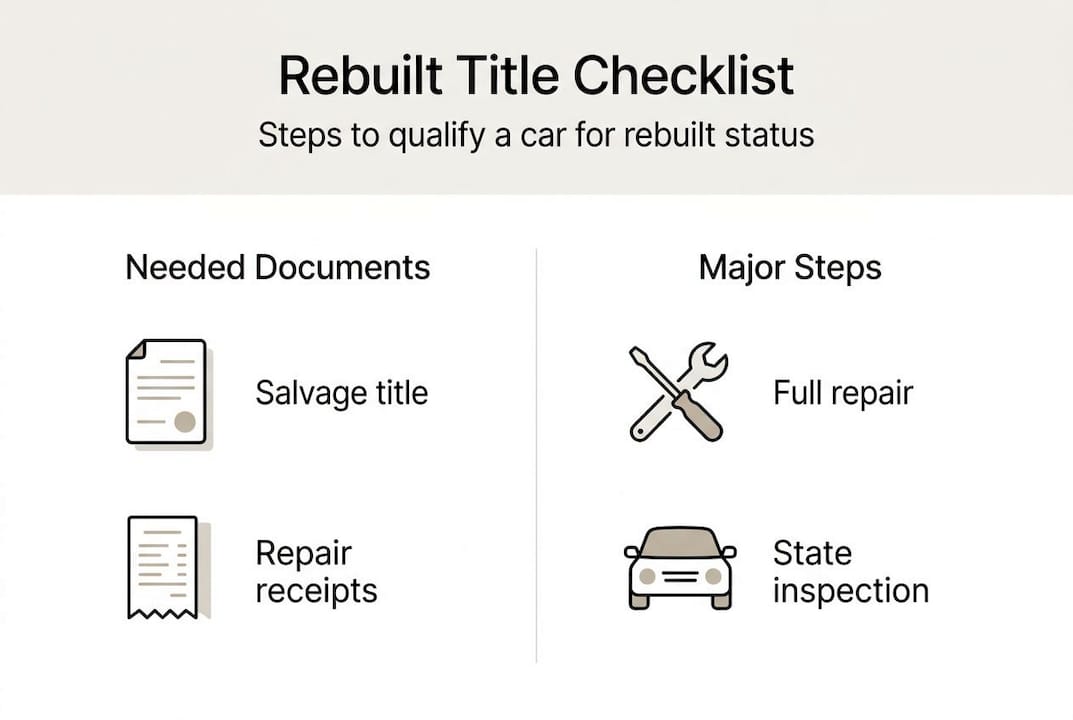
- Documentation gathered. The owner or rebuilder collects all repair receipts, parts invoices, photos of the vehicle before and after repairs, and proof of parts origin.
- State safety inspection passed. A licensed inspector examines the vehicle for structural integrity, confirms no stolen parts are present, and verifies that safety systems function correctly.
- Rebuilt title issued. Once repairs, inspection, and documentation are complete and approved, the DMV issues the rebuilt title.
Here’s a look at how total loss thresholds vary by state:
| State | Total loss threshold |
|---|---|
| Virginia | 75% of market value |
| Texas | 100% of market value (actual cash value) |
| Florida | 80% of market value |
| California | Determined by insurer |
| Most states | 70–80% of market value |
Pro Tip: You cannot legally drive a vehicle with a prior branded title to its inspection appointment. It must be transported by tow or trailer. Plan for that cost upfront.
The inspection is thorough, but it’s worth noting that no inspection can guarantee every underlying issue has been resolved. That’s why documentation matters so much. Repair photos, receipts, and parts records give you a paper trail that tells the real story. Learn more about how rebuilt cars are retitled if you want the full procedural breakdown.

Special cases, state-by-state rules, and common exceptions
The general checklist above covers most situations, but the world of rebuilt titles has its share of gray areas. Here’s what you need to know before assuming every repaired vehicle qualifies.
Out-of-state titles follow you. If a car was branded in another state, that designation travels with the vehicle. You cannot remove or reset a title brand by crossing state lines. The history stays on record.
Flood and fire vehicles face stricter scrutiny. Many states apply additional restrictions to vehicles with flood or fire history, and some may be ineligible entirely depending on the extent of the damage and local rules. Always verify with your state DMV.
Nonrepairable and junk designations are permanent. Some vehicles are issued a nonrepairable or junk title instead of a standard branded title. These cars cannot be retitled as rebuilt under any circumstances. They’re end-of-road vehicles, full stop.
Dealer exceptions exist in some states. Certain states allow licensed rebuilders or dealers to retitle older or lower-value vehicles under slightly different rules. In Virginia, for example, a licensed rebuilder with 10 or more years of experience may qualify for exceptions on vehicles over 10 years old with a value under $10,000. These are narrow carve-outs, not loopholes.
Common exceptions and what they mean for buyers:
- Flood or fire history: May face additional state inspections or be ineligible for rebuilt status
- Nonrepairable title: Permanently off the road, no rebuilt title possible
- Out-of-state branding: Brand follows the car regardless of where it’s registered
- Dealer-only retitling: Some older or low-value vehicles can only be retitled by licensed rebuilders
- Theft recovery: Eligible in most states if repairs meet standards, but documentation requirements are strict
Pro Tip: Always check your specific state’s DMV website before purchasing or retitling a vehicle. Rules change, thresholds shift, and exceptions vary widely. The Utah DMV’s salvage vehicle rules are a solid example of how detailed these regulations can get. You can also explore how rebuilt cars are retitled for a broader look at the process.
Practical risks and rewards: What buyers should know before purchase
Now that you understand the eligibility process, let’s talk about what it actually means for your wallet and your peace of mind. Rebuilt title cars are not for everyone, but for the right buyer, they represent real, meaningful value.
The upside:
- Rebuilt cars typically sell 20–40% below clean title value, which translates to thousands of dollars in savings
- Repair receipts and documentation give you more insight into a car’s history than most clean title vehicles ever provide
- Lower entry cost means you can access a higher trim level or newer model year for the same budget
- The price difference between rebuilt and clean title cars is one of the most compelling arguments for considering this market
The tradeoffs to plan for:
- Resale value will be lower than a comparable clean title vehicle
- Some lenders are cautious about financing a rebuilt car, so financing options may be more limited
- Insurance payouts are based on the rebuilt title market value, which is lower than clean title equivalents
- Possible undiscovered issues that weren’t caught during inspection, which is why a pre-purchase inspection matters
“Transparency via repair receipts and photos is a buyer’s best friend. The more documentation a seller provides, the more confidence you can have in the vehicle’s condition.”
The smartest move you can make before buying any rebuilt title car is to get a pre-purchase inspection (PPI) from a trusted, independent mechanic. Pair that with a full VIN history report and a thorough review of all available repair documentation. Ask the seller for everything: receipts, photos, inspection forms, and parts records. If they can’t provide it, that tells you something important.
Understanding what a rebuilt title is worth and knowing your insurance options going in will help you make a decision you feel good about. The savings are real. The process is real. And with the right due diligence, the value is absolutely real.
Find rebuilt title cars with confidence
You’ve done the reading. You know what makes a car eligible for a rebuilt title, what the checklist looks like, and what to watch out for. Now comes the fun part: actually finding a great vehicle. That’s exactly what ReVroom was built for.

ReVroom is the only online marketplace built specifically for rebuilt title vehicles. Every listing includes vehicle history information and photos of what the car looked like before it was repaired, so you can see the full picture before you ever reach out to a seller. No guessing. No digging. No $150 investigation fees. Just upfront transparency that puts you in the driver’s seat. Explore rebuilt title cars on ReVroom and see what your budget can really get you.
Frequently asked questions
What is the main difference between a prior branded title and a rebuilt title?
A prior branded title means a car was declared a total loss and is not roadworthy, while a rebuilt title is issued after required repairs and a state inspection confirm the car is safe to drive. A car must receive a branded title first before it can ever become eligible for rebuilt status.
Are there cars that can never get a rebuilt title?
Yes. Vehicles issued a nonrepairable or junk title are permanently ineligible for rebuilt status and cannot return to the road under any circumstances.
Does a rebuilt title affect the car’s resale value or insurability?
Rebuilt cars typically sell for 20–40% less than clean title equivalents, and insurance payouts reflect that lower market value. Most major insurers do cover rebuilt title vehicles, though coverage options can vary.
Do all states have the same rebuilt title rules?
No. Each state sets its own total loss thresholds, documentation requirements, and exceptions. State rules and thresholds vary significantly, so always check your local DMV before buying or retitling.
What documents do I need to retitle a car as rebuilt?
You’ll need repair receipts, before-and-after photos, proof of parts origin, a passed state safety inspection form, and any additional documentation required by your specific state DMV.
