


Carfax Used Vehicles: Is It Enough for Rebuilt Titles?
July 30, 2026
TL;DR:
- Running multiple checks, including NMVTIS and your state DMV, is essential when buying a rebuilt or branded-title used car. A Carfax report offers useful context but does not provide authoritative legal status, which is confirmed by official sources; a certified mechanic’s inspection is crucial for assessing repair quality. Proper verification typically costs less than $200 and helps ensure you purchase a vehicle that is truly road-ready and accurately represented.
No, Carfax alone is not enough when you’re buying a rebuilt or branded-title used car. It’s a useful starting point, but it’s one layer of a multi-step process. Here’s what to do right now, before you go any further:
Run these checks immediately:
- Pull an NMVTIS report at vehiclehistory.gov — this is the federally backed system that surfaces insurance total-loss flags and title brands.
- Look up the VIN on your state DMV’s title inquiry tool — the DMV is the only legal authority on the current title brand.
- Schedule a same-day pre-purchase inspection (PPI) with a certified independent mechanic.
Trust signals to demand from any seller:
- State-issued rebuilt or reconstructed certificate
- Repair invoices and parts receipts
- Pre-repair photos showing the vehicle’s condition before work was done
- A same-day vehicle history report (not a printout from three months ago)
Rebuilt and branded-title cars can be significantly cheaper than comparable clean-title vehicles. That’s real money. But the savings only make sense when you verify what you’re actually buying.
Table of Contents
- What do Carfax and similar vehicle history reports actually show?
- Why NMVTIS and your state DMV are the authoritative checks
- A step-by-step verification checklist before you buy
- What to look for during an inspection and what to ask the seller
- What to expect on price and ownership costs
- How Revroom makes this process faster and less expensive
- Key Takeaways
- The real value of doing this right
- Transparent rebuilt-title cars, without the $150 research bill
- Useful sources for your next VIN check
- FAQ
What do Carfax and similar vehicle history reports actually show?
A Carfax vehicle history report pulls from over 150,000 sources, including state DMVs, insurance companies, auction houses, repair shops, and law enforcement. That sounds thorough, and for many routine used-car purchases, it is. But there are structural gaps that matter a lot for rebuilt and branded-title vehicles.
What private history reports typically cover:
- Reported title events, registration history, and state-to-state transfers
- Insurance claims and auction records that were submitted to the aggregator
- Odometer readings from title work, inspections, and dealer service visits
- Ownership count and usage type (personal, fleet, rental)
- Open recall notices (though you should still verify these at NHTSA’s safercar.gov)
What they commonly miss:
- Repairs paid out-of-pocket that were never reported to an insurer
- Events that happened before the DMV posted a title brand
- Shops that don’t report service data to private aggregators
- Structural repairs that were completed but not documented through official channels
The most important gap is timing. Reporting lags of 30 days or more are common between an insurer’s total-loss decision and the DMV’s application of a brand. A car can be resold in that window with a clean commercial report, and the branded title surfaces only when the next buyer goes to register it. That’s not a hypothetical — it happens.
History reports also cannot verify repair quality. A report might show that damage was repaired, but it has no way to confirm whether the work met safety standards or whether structural components are still compromised. That’s what a PPI is for.
Pro Tip: Treat a clean Carfax report the way you’d treat a clean credit score — useful context, but not the whole picture. It tells you what was reported, not everything that happened.
Why NMVTIS and your state DMV are the authoritative checks
Private history reports are secondary aggregators. NMVTIS and your state DMV are the primary sources, and that hierarchy matters when you’re buying a rebuilt or branded-title car.
Here’s how to use them together:
- Run an NMVTIS-approved report first. The FTC recommends NMVTIS as a primary check for title, odometer, insurance total-loss determinations, and transfers to salvage or junk yards. NMVTIS-approved providers can surface an “Insurance Total Loss” flag before the DMV has even posted a brand, giving you an early warning that a private report might miss entirely. You can find the full list of approved providers at vehiclehistory.gov.
- Check your state DMV’s VIN/title lookup tool. The state DMV holds the definitive legal record of a vehicle’s current title brand. NMVTIS is a federal aggregator and can lag; the issuing state DMV is where the brand actually lives. Many states offer free or low-cost VIN inquiry tools online.
- Cross-reference both. NMVTIS gives you early signals. The state DMV confirms the current legal status. If they tell different stories, that’s a red flag worth pausing on before you spend another dollar.
Note that Carfax is not an approved NMVTIS provider for direct consumer reports — it provides data only to dealerships. For your own NMVTIS check, you’ll need to use one of the approved providers listed on vehiclehistory.gov.
Pro Tip: Some states let you look up title brands by VIN for free. Search “[your state] DMV VIN lookup” and go straight to the .gov page.
A step-by-step verification checklist before you buy
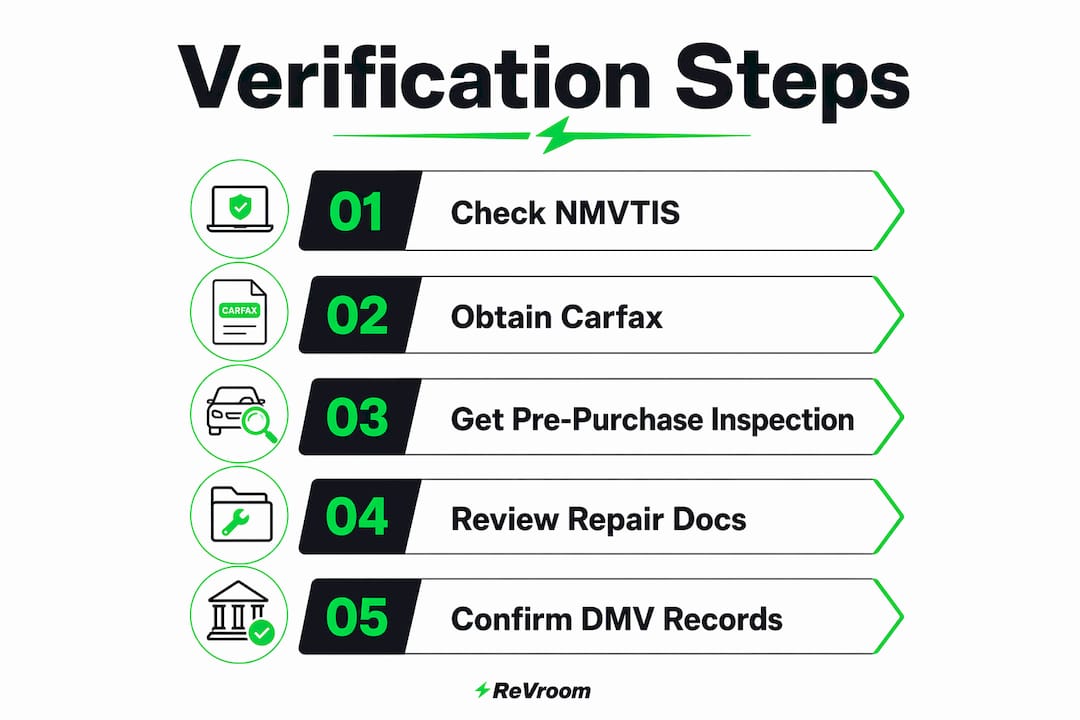
Follow these steps in order. Each one builds on the last.
- Get the VIN. It’s on the dashboard (visible through the windshield), the door jamb sticker, and the title paperwork. Verify all three match.
- Run an NMVTIS-approved report. This is your early-warning check for insurance total-loss flags and title brands.
- Pull a Carfax or AutoCheck report for supplemental context. Useful for service records, ownership history, and auction notes — but treat it as supporting evidence, not authority.
- Check your state DMV’s title lookup. Confirm the current legal brand and any required certifications.
- Request repair invoices, parts receipts, and pre-repair photos from the seller. A legitimate seller of a rebuilt or branded-title car should have these ready.
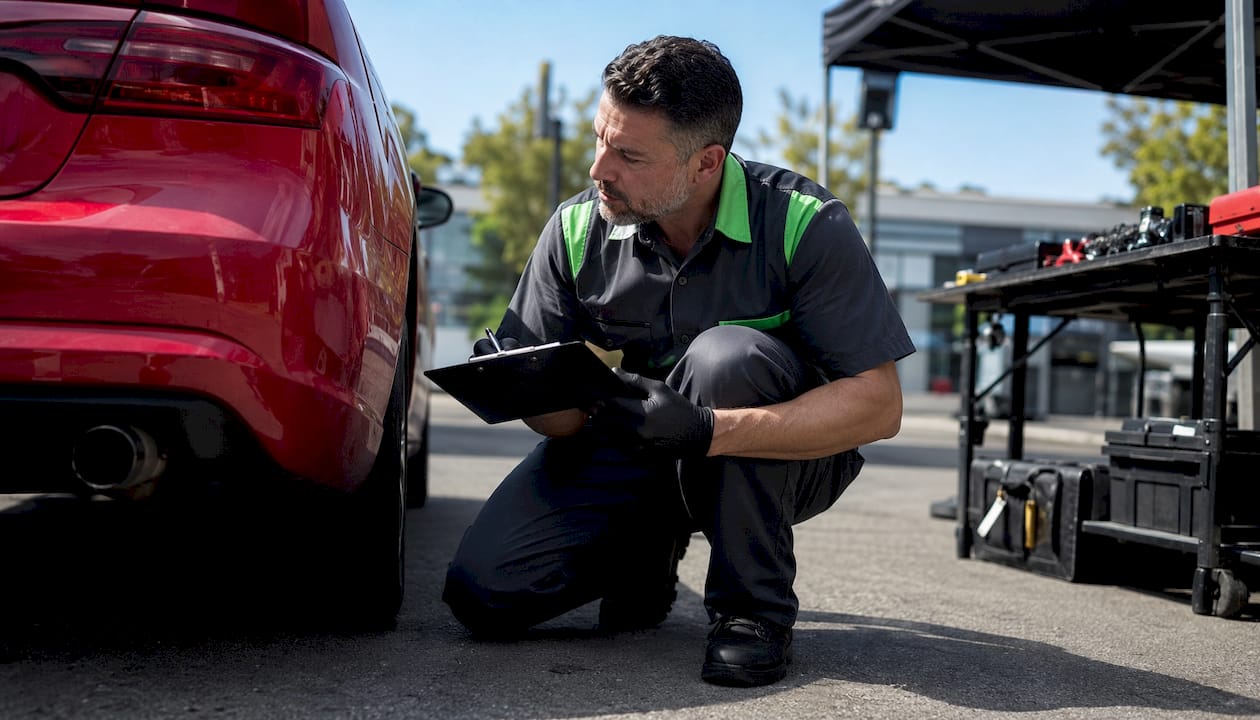
- Order a same-day PPI from a certified independent mechanic. This is the only step that can confirm repair quality and catch structural issues no report will show.
- Verify the state-issued rebuilt or reconstructed certificate. This document confirms the vehicle passed a state-required inspection after repairs.
Estimated costs and timing:
| Verification Step | Typical Cost | Typical Turnaround |
|---|---|---|
| NMVTIS-approved report | $2 | Instant |
| Carfax or AutoCheck report | $15 (single report) | Instant |
| State DMV VIN/title lookup | Free–$15 | Instant to 1 business day |
| Pre-purchase inspection (PPI) | $100–$200 | Same day with scheduling |
Sellers typically provide history reports. You’ll usually pay for the PPI yourself, and that’s fine — think of it as your negotiation tool. A PPI that turns up a repair issue either gets you a lower price or saves you from a bad buy.
Pro Tip: Always insist on a same-day generated report, not a printout from weeks ago. Stale reports are one of the most common ways buyers get misled.
What to look for during an inspection and what to ask the seller
A PPI is only as good as the questions you bring to it. Walk in with a checklist.
Inspection checklist:
- Panel gaps and paint match across adjacent body panels
- Weld quality and seam finishing at structural joints
- Evidence of airbag deployment (steering wheel, dash, seat side panels)
- Suspension behavior and alignment pull during a test drive
- Signs of structural repair: misaligned frame rails, fresh undercoating over welds
- Fluid leaks under the vehicle after it’s been sitting
- Electronics: all warning lights, sensors, and safety systems functioning
Seller Q&A script — ask these directly:
- “Can you show me the pre-repair photos?”
- “Do you have the repair invoices and parts receipts?”
- “What’s the state certification number, and can I verify it?”
- “Were there any auction or salvage lot notes on this vehicle?”
- “Does any warranty or limited guarantee apply to the repairs?”
Red flags to watch for: A seller who can’t produce same-day reports, won’t share repair documentation, or gives vague answers about where the work was done is worth walking away from. Dealers sometimes use older or selectively framed reports as a sales shield. If the story keeps shifting, trust that signal.
Pro Tip: Screenshot and save every report and document you receive. In any future dispute, the exact report given at the time of sale is critical evidence.
What to expect on price and ownership costs
Rebuilt and branded-title vehicles are significantly cheaper than comparable clean-title cars. That gap is real and it’s the main reason budget-conscious buyers seek them out. But total cost of ownership involves a few more variables.
| Cost Category | What to Expect |
|---|---|
| Purchase price | Significantly below comparable clean-title vehicles |
| Insurance premiums | May be higher or limited to liability-only with some insurers |
| Financing | Some lenders won’t finance branded titles; cash or specialty lenders are common |
| Resale value | Lower than clean-title equivalents; factor this into your exit plan |
| Trade-in value | Perception-driven; expect lower offers at traditional dealerships |
The insurance picture varies by insurer and state. Some carriers offer full coverage on rebuilt titles; others limit you to liability. Get quotes before you buy, not after.
How Revroom makes this process faster and less expensive
Revroom is the only marketplace built specifically for rebuilt and branded-title vehicles, and it’s designed to cut the friction out of exactly the process described above.
What every Revroom listing includes:
- State-required certification confirming the vehicle is repaired and road ready
- Pre-repair photos showing the vehicle’s condition before work was done
- Repair invoices and documentation built into the listing
That means several steps from the verification checklist above are already done for you. You’re not chasing a seller for photos or hoping they kept the paperwork.
Revroom also offers ReVroom History Reports for $15 — a vehicle analysis report for any rebuilt or branded-title car, anywhere. Give Revroom a VIN, a price, a mileage, and a city, and you’ll get a clear picture of what happened to the car, how significant it was, and whether the asking price is fair compared to similar clean-title vehicles in your area. That’s less than the cost of lunch, and it works for cars you find on Facebook Marketplace, Craigslist, or anywhere else.
Pro Tip: Even with a Revroom listing, still run your NMVTIS check and book a PPI. The documentation Revroom provides gives you a strong starting point and real negotiating leverage — the independent inspection closes the loop.
Key Takeaways
A Carfax vehicle history report is useful context, but NMVTIS plus your state DMV are the authoritative sources for title brands, and a same-day PPI is the only way to verify repair quality.
| Point | Details |
|---|---|
| Carfax = context, not authority | Private reports miss timing gaps and unverified repairs; use them as one layer, not the final word. |
| NMVTIS + state DMV = legal truth | Run an NMVTIS-approved report for early signals, then confirm the current brand at your state DMV. |
| PPI is non-negotiable | A certified mechanic’s same-day inspection is the only check that catches structural or quality issues. |
| Demand documentation | Request state certification, repair invoices, pre-repair photos, and a same-day report from every seller. |
| Revroom speeds the process | Every Revroom listing includes state certification and repair docs, plus $15 history reports for any branded-title car. |
The real value of doing this right
Here’s the honest take from the Revroom editorial team: the verification process for a rebuilt or branded-title car looks like a lot of steps on paper, but most of it takes under an hour and costs less than $200 total. Compare that to the up to 50% you save on the purchase price, and the math is obvious.
What we see buyers get wrong most often is treating a clean Carfax as a green light. It’s not. It’s a starting point. The title brand lives at your state DMV. The repair quality lives in the mechanic’s report. The documentation lives with the seller. A transparent rebuilt-title purchase is genuinely achievable — you just have to ask for the right things from the right sources.
Rebuilt and branded-title cars aren’t second-rate vehicles. They’re state-certified, road-ready cars that happen to cost a lot less. The buyers who do well with them are the ones who verify thoroughly and negotiate from a position of knowledge, not hope.
Transparent rebuilt-title cars, without the $150 research bill
Properly vetting a rebuilt or branded-title vehicle on your own typically costs less than $200 total for all reports and inspections. Revroom cuts that down significantly by including pre-repair photos, repair invoices, and state certification in every listing from the start.
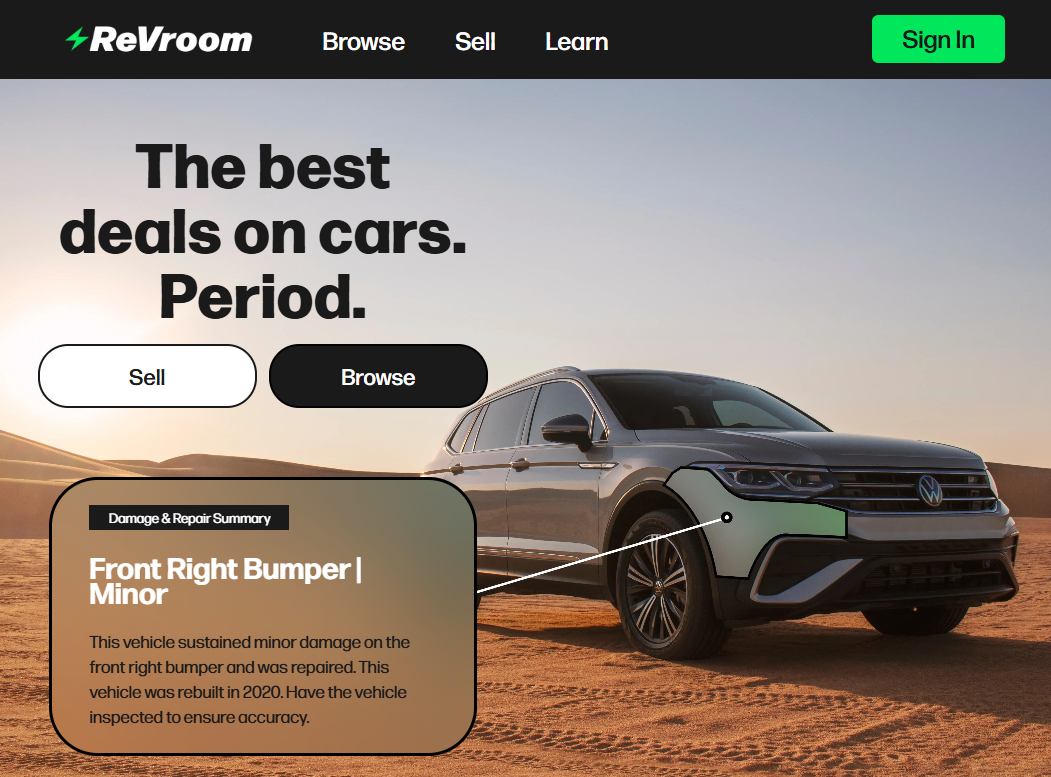
For any rebuilt or branded-title car you find anywhere online, a $15 Revroom History Report gives you a clear picture of what happened, how significant it was, and whether the price is fair. No guessing, no chasing sellers for paperwork. Browse state-certified listings and get your history report at revroom.org.
Useful sources for your next VIN check
Use these official resources as your first clicks when checking vehicle history:
- NMVTIS / vehiclehistory.gov — The federal system for title brands, insurance total-loss records, and salvage/junk transfers. Start here for any branded-title vehicle.
- NMVTIS approved providers list — The official directory of businesses authorized to provide NMVTIS consumer reports. Carfax is not on this list for direct consumer access.
- FTC used-car guidance — The FTC recommends NMVTIS checks and vehicle history reports as critical steps, and points buyers to NHTSA for recall lookups.
- Your state DMV VIN/title lookup — Search “[your state] DMV VIN lookup” and go to the official .gov page. This is the definitive legal record of the current title brand.
- NHTSA safercar.gov — Free VIN-based recall lookup. Run this alongside your title checks to catch any open safety recalls.
- NICB VINCheck — The National Insurance Crime Bureau’s free tool for checking whether a vehicle has been reported stolen or as a total loss.
FAQ
Is Carfax enough when buying a rebuilt-title used car?
No. Carfax is useful for service records and ownership history, but it’s a private aggregator with reporting gaps. For title brands, you need an NMVTIS-approved report and a state DMV title lookup, which are the authoritative sources.
What does NMVTIS show that Carfax doesn’t?
NMVTIS surfaces insurance total-loss flags and title brands, sometimes before the DMV has even posted the brand. It also captures transfers to salvage and junk yards. Carfax is not an approved NMVTIS provider for direct consumer reports.
How much does a pre-purchase inspection cost?
A PPI from a certified independent mechanic typically runs $100–$200 and can usually be scheduled same-day. It’s the only check that can confirm repair quality and catch structural issues that no history report will show.
What is a Revroom History Report?
A Revroom History Report is a $15 vehicle analysis for any rebuilt or branded-title car. Provide a VIN, price, mileage, and city, and Revroom tells you what happened to the car, how significant it was, and whether the price is fair relative to comparable clean-title vehicles in your area.
Can rebuilt-title cars be insured?
Yes, though coverage options vary by insurer and state. Some carriers offer full coverage on rebuilt titles; others limit policies to liability only. Get insurance quotes before you finalize a purchase, not after.
