


Used car transparency: a guide to rebuilt title vehicles
April 13, 2026
TL;DR:
- Rebuilt titles indicate a vehicle was previously declared a total loss and has been repaired and inspected.
- Rebuilt title vehicles typically cost 20-40% less but face lower resale value and limited insurance options.
- Thorough verification, discipline, and understanding the vehicle history are essential before purchasing a rebuilt title car.
You’ve spotted a car listed at 35% below market price. It looks great in the photos, the mileage is reasonable, and the seller seems legit. Then you notice two words in the listing: rebuilt title. Suddenly, questions flood in. Is this a deal or a trap? The truth is, rebuilt title vehicles can represent real value for budget-conscious buyers, but only when you know exactly what you’re looking at. This guide walks you through everything: what rebuilt titles actually mean, where the savings come from, what the real trade-offs are, and how to check a vehicle thoroughly before you hand over a single dollar.
Table of Contents
- What is a rebuilt title—and why does it matter?
- How much can you actually save—and what do you give up?
- Insurance, financing, and registration: What are the limitations?
- How to evaluate and verify rebuilt vehicles safely
- When is a rebuilt title car actually a smart buy?
- The uncomfortable truth: Transparency isn’t enough—discipline is key
- Get clear on your next used car decision with ReVroom
- Frequently asked questions
Key Takeaways
| Point | Details |
|---|---|
| Understand rebuilt titles | A rebuilt title car was previously declared a total loss, then repaired and inspected for road use. |
| Weigh savings vs. risks | Rebuilt title cars cost less up front but come with insurance, repair, and resale drawbacks. |
| Do thorough checks | Always verify records and get independent inspections to avoid hidden damage or title scams. |
| Choose cautiously | Rebuilt titles work best for buyers who accept risks and only when documentation is rock-solid. |
What is a rebuilt title—and why does it matter?
Let’s clear up the terminology first, because a lot of confusion starts right here. A rebuilt title (sometimes called a reconstructed or branded title depending on your state) is given to a vehicle that was previously declared a total loss by an insurance company, then repaired and passed a state safety inspection to be legally roadworthy again. As Consumer Reports explains, a rebuilt title indicates a vehicle was previously declared a total loss due to its vehicle history, but has since been repaired and passed state inspection.
This is fundamentally different from a clean title, which means the car has never been declared a total loss. It is also very different from a pre-repair status, which means the vehicle has not yet been fixed or inspected. Rebuilt means the work is done and the state signed off on it.
So what kind of history leads to a rebuilt title? The range is wider than most people expect.
| History type | Typical severity | Notes |
|---|---|---|
| Hail damage | Low to moderate | Often cosmetic only |
| Theft recovery | Low to moderate | May have minor wear |
| Collision | Moderate to high | Depends on impact area |
| Flood | High | Corrosion risk is real |
| Fire | High | Structural integrity concerns |
Here’s something worth knowing: not every rebuilt title vehicle has been in a serious collision. Many carry this designation because of hail storms, paint defects, or theft recovery situations where the car was recovered with minimal issues. The title reflects the insurance decision, not always the severity of what happened.
That said, the rebuilt title does affect how the world treats the car going forward. Insurers look at it differently. Lenders are cautious. Some mechanics charge more to work on them simply because the history is uncertain. And resale value takes a hit that never fully recovers.
“A rebuilt title follows a car forever. Even after a perfect repair, the designation stays on the vehicle’s record and affects every future transaction.”
Understanding the risks of rebuilt titles before you shop puts you miles ahead of buyers who find out after the fact. Knowledge is the whole game here.
How much can you actually save—and what do you give up?
Here is where things get interesting. Rebuilt title vehicles typically sell at a 20 to 40% discount compared to clean title equivalents, with flood or fire history vehicles sometimes discounted even more steeply. On a $30,000 car, that could mean paying $18,000 to $24,000. That is real money.

But the sticker price is only part of the story. The savings you see upfront can shrink when you factor in what comes next.
What you gain:
- Lower purchase price, sometimes significantly
- Access to vehicles you might not otherwise afford
- Opportunity to own a well-repaired car at a fraction of market value
What you give up:
- Resale value stays low permanently, even after years of good ownership
- Insurance options may be more limited or cost more
- Financing through traditional lenders is harder to secure
- Some buyers will not touch a rebuilt title when you go to sell
Let’s compare the real numbers side by side.
| Cost factor | Clean title | Rebuilt title |
|---|---|---|
| Purchase price | $28,000 | $18,000 |
| Insurance (annual) | $1,400 | $1,600 to $1,700 |
| Resale value (3 years) | $18,000 | $9,000 to $11,000 |
| Total cost of ownership | Higher upfront, better resale | Lower upfront, slower depreciation recovery |
The effect on long-term car value is one of the most overlooked parts of this decision. Buyers focus on the purchase price and forget that the rebuilt title reduces resale value in ways that compound over time.
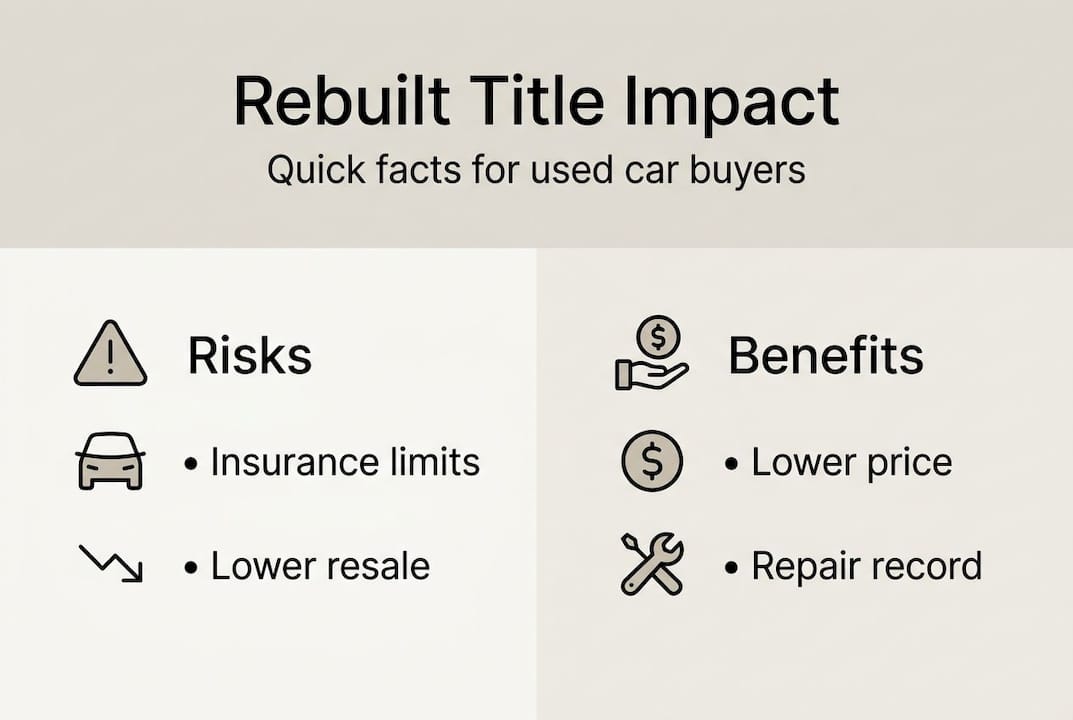
Pro Tip: Before you fall in love with a price, calculate your total estimated ownership cost over three to five years. Include insurance, expected maintenance, and a realistic resale estimate. Sometimes the math still works in your favor. Sometimes it does not.
The bottom line is that rebuilt title vehicles can absolutely be smart financial choices, but only when you go in with clear eyes and a full picture.
Insurance, financing, and registration: What are the limitations?
This is where a lot of buyers get blindsided. The purchase goes smoothly, then reality hits when they try to insure or finance the car.
Here is what you need to know before you sign anything:
-
Insurance coverage can be limited. Many insurers will offer liability coverage on rebuilt title vehicles, but comprehensive or full coverage is often harder to obtain or comes at a premium. Consumer Reports notes that rates can run up to 20% higher even when full coverage is available, with providers like Progressive and Geico applying stricter underwriting to these vehicles.
-
Financing is a real hurdle. Most traditional banks and credit unions are reluctant to finance rebuilt title vehicles. They see the title as a risk factor for collateral value. You may need to look at credit unions with more flexible policies, personal loans, or seller financing.
-
Registration rules vary by state. Some states require additional inspections before they will register a rebuilt title vehicle. Others have straightforward processes. Know your state’s rules before you buy, especially if you are purchasing across state lines.
-
Payout risk on claims. If you do get into an incident after buying, your insurer will pay based on the market value of a rebuilt title vehicle, which is lower than a clean title equivalent. This matters if the car gets totaled.
Important: The idea that rebuilt title cars are nearly impossible to insure is a myth. Most major insurers do cover them. The real issue is that coverage options and costs vary, so shopping around for the right policy matters more with a rebuilt title than with a clean one.
Understanding financing a rebuilt car and the full list of cons before you commit saves you from expensive surprises. Also worth noting: if you are in a state with comparative fault rules, like Georgia’s auto accident liability framework, having the right coverage level matters even more.
How to evaluate and verify rebuilt vehicles safely
Okay, you’ve found a rebuilt title vehicle you like and the price looks right. Now comes the most important part: verification. This is where you separate the well-repaired gems from the ones best left on the lot.
Here is a step-by-step approach:
-
Pull a vehicle history report. Use NMVTIS, CarFax, or AutoCheck to get the full picture. Consumer Reports recommends combining these reports with pre and post-repair photos, repair receipts, frame alignment checks, and ADAS (advanced driver assistance system) calibration proof.
-
Request repair documentation. A reputable seller should have receipts, photos of the vehicle before and after repairs, and records of what work was done. No paperwork is a red flag.
-
Book an independent pre-purchase inspection (PPI). A trusted mechanic who has no connection to the seller should inspect the vehicle in person. This is non-negotiable.
-
Check for frame or structural issues. Ask specifically about frame straightening, unibody repairs, and whether any airbags were deployed and replaced.
-
Watch for title washing. This is when a vehicle’s title history is obscured by transferring it through states with looser title laws. A cross-referenced NMVTIS report usually catches this.
Pro Tip: Cosmetic rebuilds, think hail damage or theft recovery with solid documentation, tend to carry the lowest risk. Flood history and frame repairs are where things get complicated fast. When in doubt, prioritize vehicle histories that are easy to verify and fully documented.
Our smart buyer’s guide and tips on buying rebuilt title vehicles wisely go even deeper on each of these steps.
When is a rebuilt title car actually a smart buy?
Not every rebuilt title vehicle is right for every buyer. Here is the honest breakdown.
It may be a smart buy if:
- The vehicle history is cosmetic only, fully documented, and independently verified
- You are mechanically knowledgeable or have a trusted mechanic who can assess the car thoroughly
- You plan to keep the car long-term and are not counting on strong resale value
- The savings are significant enough to offset the insurance and financing friction
- You have done the math on total ownership cost and it still makes sense
It is probably not the right fit if:
- You want easy resale in a few years
- You need straightforward financing through a traditional bank
- You want the simplest possible insurance experience
- You are not prepared to invest time in verification
Consumer Reports advises that most buyers are better served by clean titles unless the savings are substantial and the risks are clearly understood. That is fair, honest advice. The keyword is understood.
“The buyers who do best with rebuilt titles are not risk-takers. They are researchers. They ask hard questions, get independent opinions, and walk away when something feels off.”
As one industry analysis notes, cosmetic and theft recovery histories are often low-risk when well-documented, while flood and structural histories carry compounding concerns. Explore whether rebuilt title cars are safe for your situation, and check out the best rebuilt title cars for budget buyers to see what strong candidates look like.
The uncomfortable truth: Transparency isn’t enough—discipline is key
Here is something most buying guides will not tell you: having all the right information does not protect you if your emotions are running the show. We have seen it happen. A buyer finds a beautiful car at a jaw-dropping price, gets the reports, skims them, and signs anyway because they really want the car. That is not due diligence. That is wishful thinking with paperwork.
The buyers who come out ahead with rebuilt title vehicles share one trait: discipline. They set a clear checklist before they start shopping. They decide in advance what vehicle histories are acceptable and which are not. And when a car does not meet their criteria, they walk away, even if the price is tempting.
Transparency tools are powerful. But they only work when you actually use them and act on what they tell you. The courage to walk away from a good-looking deal is worth more than any discount. Read more on buying rebuilt title vehicles wisely to build that discipline into your process before you start browsing.
Get clear on your next used car decision with ReVroom
If this guide has shown you anything, it is that buying a rebuilt title vehicle rewards preparation. The good news is you do not have to do all the legwork alone.

ReVroom is the only marketplace built specifically for rebuilt title vehicles, and every listing includes vehicle history information and photos of what the car looked like before it was repaired. No extra reports to buy. No guesswork. Just the transparency you need to make a confident call. Check out the smart budget buyer’s guide to put everything you have learned into action and start browsing vehicles that have already done the hard work of being honest with you.
Frequently asked questions
Can you insure a rebuilt title car with full coverage?
Many insurers offer liability coverage on rebuilt title vehicles, but comprehensive or full coverage is sometimes limited or priced higher. Shopping multiple providers is the best way to find competitive options, as coverage availability varies significantly by insurer.
How do I check if a rebuilt title car has hidden flood or frame damage?
Start with NMVTIS, CarFax, or AutoCheck reports, then request repair documentation and have an independent mechanic inspect for corrosion, frame misalignment, and ADAS calibration records.
Do rebuilt title cars really save you money overall?
Rebuilt title vehicles are typically 20 to 40% cheaper at purchase, but insurance costs, potential repairs, and permanently reduced resale value can narrow or eliminate those savings depending on how long you own the car.
Are there any types of rebuilt title cars that are safer to buy?
Vehicles with cosmetic histories like hail or theft recovery tend to carry lower risk when well-documented and inspected, while flood history and structural repairs require extra scrutiny from a qualified mechanic before purchase.
