


How to find safe rebuilt title vehicles in 2026
April 5, 2026
TL;DR:
- Rebuilt title vehicles can be safe if professionally repaired and properly inspected.
- Vehicle history, repair quality, and type of damage greatly influence safety risks.
- Buyers should conduct thorough documentation checks and inspections to ensure reliability.
Rebuilt title vehicles have a reputation that walks in the door before they do. Most people hear “rebuilt title” and picture something barely holding together, a rolling question mark. But that picture is incomplete. The reality is that many rebuilt title cars have been professionally repaired, passed state inspections, and are back on the road doing exactly what cars are supposed to do. The gap between perception and reality is where smart buyers find real value. Up to 50% cheaper than comparable clean title vehicles, these cars deserve a closer look. This guide will help you understand what rebuilt titles actually mean for safety, which types of vehicles are worth considering, and how to vet one the right way.
Table of Contents
- What is a rebuilt title and how does it affect safety?
- Types of rebuilt title vehicles: Which are safest to consider?
- How to assess the safety of a rebuilt title car: Key steps for buyers
- Insurance, financing, and resale for rebuilt title cars
- Our take: Who should (and shouldn’t) buy a rebuilt title car for safety?
- Ready to shop rebuilt? Start your search with confidence
- Frequently asked questions
Key Takeaways
| Point | Details |
|---|---|
| Know the title type | Not all rebuilt titles carry the same risk—understand the car’s history and damage type before buying. |
| Prioritize documentation | Only consider vehicles with full repair records, certified shop work, and thorough pre-purchase inspections. |
| Insurance & financing are available | You can insure (full coverage) and finance a rebuilt title through banks and credit unions. The real trade-off is a lower resale value. |
| Safe deals exist | With careful homework, budget-minded buyers can safely benefit from rebuilt title discounts. |
What is a rebuilt title and how does it affect safety?
A rebuilt title is a designation given to a vehicle that was previously declared a total loss by an insurance company, then repaired and restored to a drivable condition. Once the repairs are complete, the car goes through a state inspection to confirm it meets basic roadworthiness standards. Pass that inspection, and the title changes from a total loss designation to “rebuilt” or “reconstructed,” depending on the state.
Here is where the safety conversation gets nuanced. That state inspection is not the same as a crash test. No empirical crash-test benchmarks exist for rebuilt vehicles from organizations like NHTSA or IIHS, and there is no re-certification of federal safety standards after repairs are made. What that means practically is that a rebuilt car can legally return to the road without anyone confirming that its airbags are properly calibrated or that its frame geometry is exactly where it should be. That is precisely why an independent inspection matters so much.
That said, not every rebuilt title carries the same level of risk. The real pros and cons of rebuilt title vehicles vary enormously depending on what happened to the car and how thoroughly it was repaired. A vehicle that received a rebuilt title after a hail storm looks very different from one that was in a serious structural collision.
Some of the risks worth knowing about include:
- Frame distortion that affects handling and crash protection
- Uncalibrated airbag systems that may not deploy correctly
- Sensor and ADAS issues from cameras or modules that were not properly reset
- Latent structural problems that do not show up until miles down the road
But here is the honest truth: these risks are not guaranteed. They are possibilities, and they are manageable with the right due diligence. The outcome depends heavily on who did the repairs and what was actually fixed.
The rebuilt title itself is not the danger. The danger is buying one without knowing its full story.
Understanding rebuilt vs. clean title cars is the first step. Once you know the difference, you can start making smarter decisions about which vehicles are worth your time.
Types of rebuilt title vehicles: Which are safest to consider?
Having defined what a rebuilt title is and the general safety concerns, let’s explore which kinds of rebuilt vehicles are worth considering and which are best avoided.
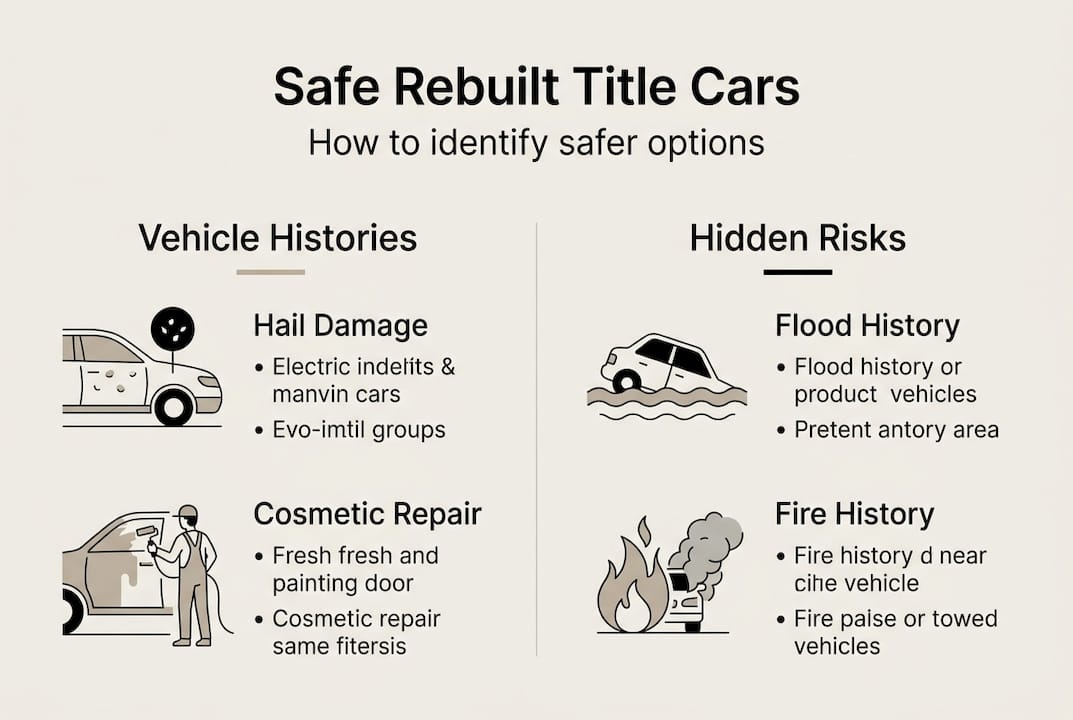
Not all rebuilt titles are created equal. The vehicle history behind the title matters more than the label itself. Here is a breakdown of the most common types and how they stack up on the safety scale:
| Vehicle history type | Typical safety risk | Estimated market discount vs. clean title |
|---|---|---|
| Hail or cosmetic | Low | 20 to 30% |
| Theft recovery | Low to moderate | 20 to 35% |
| Collision, no frame damage | Moderate | 20 to 40% |
| Collision with frame damage | Higher | 35 to 50% |
| Flood | High | 40 to 60%+ |
| Fire | Very high | 40 to 60%+ |
Market value discounts generally range from 20 to 40% for collision rebuilt titles and climb to 40 to 60% or more for flood and fire vehicles compared to clean title equivalents. That discount is a signal, not just a bargain. It reflects the level of uncertainty baked into each vehicle type.
Vehicles with hail damage, cosmetic issues, or theft recovery histories are generally the safest bets when properly repaired. The mechanical systems are often untouched. The repairs tend to be straightforward. A theft recovery vehicle, for example, may have had a broken window and a replaced ignition. That is a very different story from a car that sat in floodwater for three days.
Flood and fire histories carry the most hidden risk. Corrosion from water exposure can eat through wiring and structural components long after the car looks fine. Fire can compromise materials that are not visible during a casual inspection. These are the vehicles where the risks are hardest to fully assess, even for professionals.
Pro Tip: If you are new to buying rebuilt title vehicles, start your search with hail or cosmetic damage histories. The repairs are typically surface level, the safety risk is lower, and you still walk away with a significant price advantage. Our guide to buying a rebuilt car safely covers what to check before making any final decision.
How to assess the safety of a rebuilt title car: Key steps for buyers
Now that you know which types of rebuilt titles may be safer, here is exactly how to make sure a particular car is not hiding safety issues.
Vetting a rebuilt title vehicle is not complicated, but it does require discipline. Follow these steps and you will be in a much stronger position than the average buyer:
-
Request the full vehicle history. Ask for documentation of what happened to the car and what repairs were made. This includes before and after photos if available, repair invoices, and any records from the shop that did the work.
-
Confirm repairs were done by a certified shop. OEM (original equipment manufacturer) repair documentation from a certified collision center is a strong indicator that the work was done properly. Backyard repairs are a red flag.
-
Schedule a pre-purchase inspection (PPI). Hire a trusted, independent mechanic to inspect the vehicle before you commit. This is non-negotiable. No listing, no report, and no seller’s word replaces eyes-on, hands-on evaluation.
-
Check all safety systems. Confirm that airbags are functional, that ADAS features like lane assist and automatic braking are calibrated, and that there are no warning lights on the dashboard. These systems are easy to overlook and expensive to fix.
-
Run a vehicle history report. A CARFAX or AutoCheck report will show previous incidents, ownership history, and odometer readings. It is not a guarantee of completeness, but it adds another layer of information.
The takeaway: budget buyers can find safe rebuilt vehicles when the damage was minor or cosmetic, full OEM repair documentation is available from a certified shop, mileage is low, and a rigorous PPI confirms no remaining issues.
Pro Tip: Keep the essentials in front of you when evaluating any rebuilt title vehicle so nothing slips through the cracks—our buying-safely guide is a handy reference.
Insurance, financing, and resale for rebuilt title cars
Even a safe and thoroughly vetted rebuilt title vehicle comes with one real trade-off—resale—while insurance and financing are far easier than the myths suggest.
| Area | What to expect |
|---|---|
| Insurance coverage | Full coverage available from most major insurers; rates often comparable—compare a couple of quotes |
| Financing | Banks and credit unions lend; credit unions often the most flexible |
| Resale value | Lower than clean title equivalents—the flip side of the discount you got buying |
| Trade-in options | Mainstream chains like CarMax won’t take them; specialty buyers and marketplaces do |
Here is what that means in practice:
- Insurance: Most major insurers offer full comprehensive-and-collision coverage on rebuilt titles, and rates are often comparable to a clean-title car. A few carriers ask for a photo inspection, so it’s worth comparing a couple of quotes. Learn more about insurance for rebuilt titles before you shop.
- Financing: Banks and credit unions do finance rebuilt title cars, with credit unions often the most flexible. Terms vary by lender, so get pre-approved to compare—the idea that you have to pay cash is a myth. See our financing guide.
- Resale: If you plan to sell the car in a few years, expect a smaller pool of buyers and lower offers. The rebuilt title follows the vehicle permanently—but that’s the same discount you captured when you bought.
- Trade-ins: Big chains rarely accept them, so a specialty buyer or a dedicated marketplace is your exit.
None of this makes rebuilt title cars a bad choice. It just means you go in with clear expectations. Understanding what a rebuilt title is worth before you buy is how you stay ahead of surprises.
Our take: Who should (and shouldn’t) buy a rebuilt title car for safety?
Rebuilt titles are not black and white when it comes to safety. Here is our candid take for buyers weighing the risks and rewards.
We have seen both sides of this market. There are genuinely great vehicles out there wearing rebuilt titles, and there are deals that look good on paper until a mechanic gets underneath them. The honest answer is that rebuilt title cars are not for everyone, and we think it is important to say that plainly.
If you are mechanically savvy, know how to read a repair history, and have a trusted mechanic in your corner, the value proposition is real. Minor cosmetic damage, documented professional repairs, low miles, and a clean PPI? That is a combination worth getting excited about. Rebuilt titles and value can align beautifully when those conditions are met.
For most buyers, the sensible approach is to proceed with informed care, especially if you cannot verify the repair quality or if the vehicle has a complex history like flood or fire. The savings are real, and the main long-term trade-off is a lower resale value—insurance and financing are readily available.
Our advice? Do not let fear drive you away from a genuinely good vehicle. But do not let the price tag drive you toward a bad one either. Transparency is everything in this market.
Ready to shop rebuilt? Start your search with confidence
If you are ready to apply everything you have learned, here is how to put this guidance into action.
Finding a reliable rebuilt title vehicle is absolutely possible, and it starts with having the right information in front of you. ReVroom was built specifically for this. Every listing on ReVroom includes vehicle history information and photos of what the car looked like before it was repaired, so you can make informed decisions without spending $150 per vehicle on outside reports.

You get the transparency you need, right where you need it. No guesswork, no chasing down records, no surprises. Browse listings, compare histories, and move forward with confidence, or keep learning in our guides. The right car is out there. ReVroom helps you find it.
Frequently asked questions
How can I tell if a rebuilt title car is safe?
Request full repair documentation, insist on a professional pre-purchase inspection, and prioritize vehicles with minor cosmetic vehicle histories repaired by a certified shop. Low mileage and OEM repair records are strong positive indicators.
Are rebuilt title vehicles more dangerous than clean title cars?
They can be if repaired poorly, but rebuilt cars with cosmetic vehicle histories and verified professional repairs can be just as safe as clean title vehicles. The quality of the repair matters far more than the title itself.
What safety inspections are required for rebuilt title cars?
Most states require basic roadworthiness and VIN verification. There is no re-certification of federal crash-safety standards after repairs, which is why an independent pre-purchase inspection is so important.
Can I get full insurance coverage for a rebuilt title car?
Yes. Most major insurers offer full comprehensive-and-collision coverage for rebuilt title vehicles, and rates are often comparable to a clean-title car. A few carriers ask for a photo inspection, so comparing a couple of quotes before purchase is the smart move.
