


Rebuilt vs. clean title: what car buyers need to know
March 30, 2026
A cheaper sticker price feels like a win until you realize the title status attached to that vehicle can quietly shape your resale value and long-term ownership experience. Most buyers focus on the number on the window and skip right past the paperwork that tells the real story. Whether you’re stretching a tight budget or just trying to make a genuinely smart purchase, understanding the difference between a rebuilt title and a clean title is one of the most valuable things you can do before signing anything. This guide breaks it all down in plain language so you can shop with your eyes wide open.
Table of Contents
- Understanding rebuilt and clean titles
- Pros and cons of rebuilt versus clean titles
- Key differences: price, insurance, and resale value
- What budget buyers should check before deciding
- Find transparency and value with ReVroom
- Frequently asked questions
Key Takeaways
| Point | Details |
|---|---|
| Title status shapes value | Clean titles hold value better, while rebuilt titles come with a real discount and a lower resale down the road. |
| Insurance and financing are available | You can insure a rebuilt title car (liability and full coverage) and finance it through banks and credit unions. Compare a few quotes and lenders. |
| Research prevents regret | Careful inspection, paperwork checks, and informed negotiation are essential when considering rebuilt vehicles. |
| Transparency matters most | Understanding what you’re buying protects your wallet—and your safety. |
Understanding rebuilt and clean titles
Let’s start with the basics, because a lot of confusion in this space comes from blurry definitions.
A clean title means the vehicle has no major incidents on record that caused an insurance company to declare it a total loss. It’s the standard title most used cars carry, and it’s what most buyers assume they’re getting by default.
A rebuilt title tells a different story. According to Experian, a rebuilt title means the vehicle was previously declared a total loss by an insurer, then repaired and passed a state safety inspection to be roadworthy again. That’s an important distinction. The car went through a formal process to earn back its right to be on the road.
Rebuilt vehicles come from a wide range of histories. Some were involved in collisions. Others were flagged for hail damage, paint defects, or recovered after theft. The rebuilt title simply means the vehicle was repaired and cleared for road use. It does not automatically mean the car is dangerous or poorly repaired.
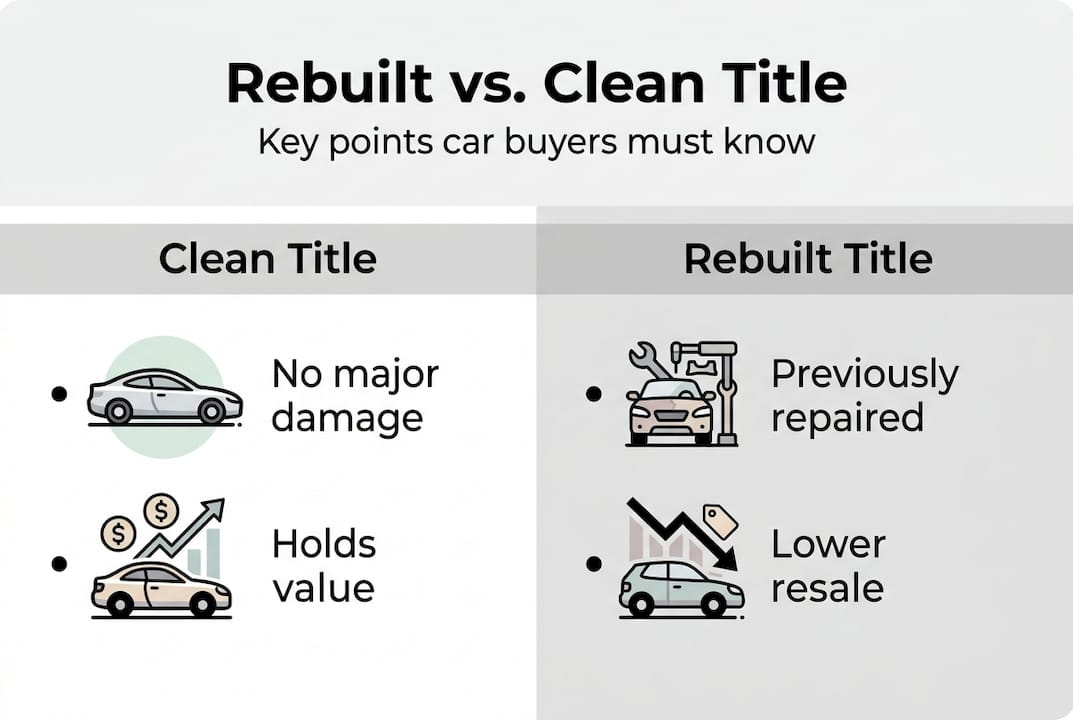
Here’s a quick comparison to keep things clear:
| Feature | Clean title | Rebuilt title |
|---|---|---|
| Prior total loss declaration | No | Yes |
| State safety inspection required | No | Yes |
| Legal for road use | Yes | Yes |
| Typical price range | Market rate | Up to 50% below market |
| Resale ease | Higher | Lower |
A few common misconceptions worth clearing up right now:
- Rebuilt titles are not the same as vehicles that are unfit to drive. They passed inspection.
- A clean title does not guarantee a damage-free history. Many clean title vehicles have accident records that simply never triggered a total loss declaration.
- Rebuilt vehicles are not hard to insure or finance. Most major insurers cover them with full coverage, and banks and credit unions lend on them.
For a deeper look at what these vehicles are and how to evaluate them, our guide to what a rebuilt title is is a great next read.
Pros and cons of rebuilt versus clean titles
Now that the definitions are clear, let’s talk about what each title type actually means for your wallet and your ownership experience.
Rebuilt title advantages:
- Significantly lower purchase price, often 20 to 50% below comparable clean title vehicles
- More car for your money, meaning you can access higher trims or newer model years on the same budget
- Vehicles have passed state safety inspections before being titled as rebuilt
- Great option for buyers who plan to keep the car long-term and aren’t focused on resale
Rebuilt title considerations:
- Resale value runs lower than clean title equivalents, depending on the vehicle’s history—the flip side of the discount you got buying
- Insurance and financing are both available; a few insurers price a rebuilt title differently and terms vary by lender, so it pays to compare
- Quality of repairs can vary, which is why transparency and inspection matter so much
Clean title advantages:
- Easier to resell or trade in at a dealership
- Broad financing and insurance options
- Generally simpler to evaluate without specialized knowledge
Clean title considerations:
- Higher purchase price for the same vehicle
- A clean title does not mean the car has never had issues. It just means no insurer declared it a total loss.
- You may be paying a premium for perceived peace of mind that isn’t always backed by a spotless history
Pro Tip: Always request detailed repair records for any rebuilt vehicle you’re considering. A well-documented repair history is one of the strongest signals that a vehicle was restored with care. You can also explore our guide to whether rebuilt titles are bad and safe savings with rebuilt titles to get a fuller picture before deciding.
Key differences: price, insurance, and resale value
Numbers make this real. Let’s put the two title types side by side where it counts most.
Purchase price: Rebuilt title vehicles typically sell for 20 to 50% less than clean title equivalents. That’s not a rounding error. On a $30,000 vehicle, that gap could mean $6,000 to $15,000 in savings upfront.
Insurance: This is where a lot of myths live. The reality is that you can fully insure a rebuilt title car—liability and full comprehensive-and-collision coverage from most major insurers. Rates are often comparable to a clean-title version of the same car; a few carriers price a rebuilt title a little differently or ask for a quick photo inspection, which is exactly why comparing two or three quotes pays off. Getting a rebuilt car insured is far more straightforward than many online sources suggest.

Financing: Also more straightforward than the myths suggest. Banks and credit unions finance rebuilt title cars, with credit unions often the most flexible. Terms vary by lender, so shop around—but “no one finances rebuilt titles” is a myth.
Resale value: This is the biggest long-term trade-off. Rebuilt vehicles sell for less than clean title cars at resale, depending on the vehicle’s history type. If you plan to sell in a few years, that gap will show up again at trade-in time—though it’s the same discount you captured when you bought.
| Cost factor | Clean title | Rebuilt title |
|---|---|---|
| Purchase price | Market rate | 20 to 50% lower |
| Insurance | Standard | Full coverage available; often comparable, compare quotes |
| Financing | Broad | Available; banks and credit unions lend |
| Resale value | Strong | Lower, offset by the lower buy-in |
Here’s a three-step check before buying either type:
- Run a vehicle history report. Know what’s on record before you fall in love with the car.
- Compare insurance quotes in advance. Don’t assume. Get actual numbers from at least two or three insurers.
- Research resale trends for that specific model. Some vehicles hold rebuilt title value better than others.
For more detail on how title status affects your bottom line, check out our breakdowns on rebuilt vs clean title price differences, what rebuilt titles are worth, and how insurance works on a rebuilt title car.
What budget buyers should check before deciding
Knowing the theory is one thing. Walking into a purchase with a real checklist is another. Here’s what to do before you commit.
Step-by-step buying checklist:
- Verify the title paperwork. Confirm the title type matches what the seller claims. A rebuilt title should say so clearly on the document.
- Request the full repair history. Ask for receipts, shop records, and any documentation of what was repaired and by whom.
- Order a vehicle history report. Services like Carfax or AutoCheck can surface prior incidents and ownership records.
- Get an independent inspection. A third-party mechanic who has no stake in the sale is your best friend here.
- Line up financing early. Get pre-qualified with your bank or a credit union so you know your rate before you fall for a car.
Pro Tip: A pre-purchase inspection (PPI) from an independent mechanic typically costs $100 to $200 and can reveal issues that no online report will catch. It’s one of the smartest investments you can make before buying any used vehicle, rebuilt title or not.
Here’s the paperwork every buyer should see for a rebuilt vehicle:
- The current rebuilt title document
- Prior repair invoices and shop records
- Vehicle history report
- State inspection certificate confirming the vehicle passed roadworthiness review
- Photos of the vehicle’s condition before repairs, if available
Know when to walk away. If a seller can’t produce repair documentation, gets vague about the vehicle’s history, or pressures you to skip an inspection, those are signals worth taking seriously. Our guide to buying a rebuilt car safely covers exactly how to handle it. You can also explore what rebuilt titles are worth and whether financing a rebuilt car is the right move for your situation.
A rebuilt title means the vehicle was previously a total loss, repaired, and inspected. That process creates a paper trail. Use it.
Find transparency and value with ReVroom
You’ve done the reading. You know what a rebuilt title is, what it costs, and what to check before buying. Now the question is: where do you actually find a rebuilt vehicle you can trust?

ReVroom is the only online marketplace built specifically for rebuilt title vehicles. Every listing includes vehicle history information and photos of what the car looked like before it was repaired, so you’re never guessing about what you’re getting. No $150 investigation fees. No digging through third-party reports. Just upfront transparency, right in the listing. Whether you’re ready to browse or still doing research, buy used cars with confidence on ReVroom, or keep building your knowledge in our guides before you commit.
Frequently asked questions
Is a rebuilt title car worth buying?
A rebuilt title car can be a strong value for buyers who verify the repair quality and plan to keep the vehicle long-term. Keep in mind that resale value runs lower than clean title equivalents, so it’s best suited for buyers who aren’t focused on flipping the car.
Can you get full insurance coverage on a rebuilt title?
Yes. Most major insurers offer full comprehensive-and-collision coverage on rebuilt titles, and rates are often comparable to a clean-title car. A few carriers ask for a photo inspection, so comparing a couple of quotes before purchasing is the smartest move.
Are rebuilt titles safe to drive?
A rebuilt vehicle has passed a state safety inspection to earn its title, which means it met roadworthiness standards. That said, an independent inspection before purchase gives you an added layer of confidence that no paperwork alone can provide.
How much less is a rebuilt title car worth?
Rebuilt title vehicles typically sell for meaningfully less than clean title cars, with the gap depending on the type and extent of the vehicle’s prior history—often up to 50% less at purchase, which is the savings you capture buying.
Can I finance a rebuilt title car?
Yes. Plenty of banks and credit unions finance rebuilt title cars, with credit unions often the most flexible. Terms vary by lender, so it pays to compare—but the idea that no one finances rebuilt titles is a myth.
