


Reconstructed Title Meaning – Utah Value Unlocked
February 10, 2026
Every college student in Utah knows how tight budgets get when it comes time to shop for a reliable car. Choosing a vehicle with a reconstructed title is a practical way to stretch your dollar, but safety and transparency matter just as much as price. This guide cuts through the confusion about reconstructed titles, showing what to expect from the inspection process, sharing how state requirements protect buyers, and highlighting tools families can use to make smart, safe choices.
Table of Contents
- What Does Reconstructed Title Mean?
- Key Steps In Title Reconstruction
- Utah Legal Requirements And Standards
- Comparing Clean, Reconstructed, And Salvage Titles
- Costs, Risks, And Buyer Protections
Key Takeaways
| Point | Details |
|---|---|
| Reconstructed Title Definition | A reconstructed title indicates a vehicle has been professionally repaired and inspected, ensuring it meets safety standards. |
| Title Reconstruction Process | The process includes extensive documentation, professional repairs, and state inspections to confirm roadworthiness. |
| Utah’s Legal Standards | Utah has specific requirements for reconstructed titles that protect consumer interests through rigorous inspections and documentation. |
| Financial Considerations | Buying a vehicle with a reconstructed title offers cost savings but may limit insurance options and reduce resale value. |
What Does Reconstructed Title Mean?
A reconstructed title is a specialized vehicle designation that indicates a car has been professionally repaired after experiencing significant damage. State-level vehicle documentation reveals this title represents a comprehensive process of restoration and official inspection.
Unlike a standard used car, a reconstructed title vehicle has a unique history that involves several critical steps:
- Declared a total loss by an insurance company
- Thoroughly repaired to meet safety standards
- Professionally inspected by state motor vehicle authorities
- Certified as roadworthy after comprehensive evaluation
The reconstruction process requires meticulous documentation and verification. Trained mechanics must repair the vehicle to meet specific state safety regulations, ensuring that every critical component functions correctly. This isn’t just a quick fix - it’s a systematic restoration that transforms a damaged vehicle into a reliable transportation option.
Reconstructed titles provide transparency, giving potential buyers a clear understanding of a vehicle’s complete history before purchase.
Utah has specific requirements for reconstructed titles that differ from other states. Vehicles must pass rigorous safety inspections, with state authorities carefully examining the repair work to confirm the car meets all operational standards. This process protects consumers by ensuring only properly repaired vehicles receive reconstruction certification.
Pro tip: Always request a detailed vehicle history report and have an independent mechanic inspect a reconstructed title vehicle before finalizing your purchase.
Key Steps in Title Reconstruction
The process of obtaining a reconstructed title involves several meticulous steps designed to ensure vehicle safety and legal compliance. Vehicle reconstruction protocols require comprehensive documentation and thorough inspections to transform a damaged vehicle into a roadworthy automobile.
Specifically, the reconstruction process follows a structured path:
- Initial Vehicle Assessment
- Obtain the original salvage title
- Document the extent of vehicle damage
- Determine feasibility of comprehensive repairs
- Professional Repair Requirements
- Engage certified mechanics
- Replace damaged components
- Ensure all repairs meet state safety standards
- Maintain detailed repair documentation
- Official Inspection and Verification
- Schedule state-mandated vehicle inspection
- Provide complete repair documentation
- Demonstrate all safety and functional requirements are met
- Verify no stolen parts were used during reconstruction
Successful title reconstruction transforms a damaged vehicle into a legally recognized, roadworthy automobile through rigorous verification processes.
Utah has specific guidelines for title reconstruction that prioritize consumer protection and vehicle safety. State motor vehicle authorities carefully examine repair work, ensuring comprehensive vehicle restoration before issuing a reconstructed title. This multi-step process helps prevent fraudulent vehicle representations and protects potential buyers.

Pro tip: Always retain comprehensive repair documentation and obtain multiple professional assessments before pursuing title reconstruction.
Utah Legal Requirements and Standards
Utah maintains stringent legal protocols for reconstructed vehicle titles that prioritize consumer protection and automotive safety. Title history transparency is paramount in the state’s approach to managing vehicles with complex repair histories.
The state’s legal framework for reconstructed titles involves several critical requirements:
- Comprehensive repair documentation submission
- Mandatory professional vehicle inspections
- Detailed proof of repair authenticity
- Integration with National Motor Vehicle Title Information System (NMVTIS)
- Permanent title branding to ensure ongoing transparency
Key legal standards for reconstructed titles in Utah include:
- Inspection Verification
- Certified mechanics must complete thorough assessments
- All safety and functional components must pass state standards
- Independent inspectors validate repair quality
- Documentation Requirements
- Complete repair records must be submitted
- Original salvage title must be provided
- Photographic evidence of pre-repair condition recommended
Utah’s legal system ensures that reconstructed titles represent carefully restored vehicles, not potential safety risks.
The state’s motor vehicle department takes an aggressive stance on preventing title fraud. By requiring extensive documentation and professional inspections, Utah protects consumers from potentially misrepresented vehicles. Every reconstructed title goes through a rigorous verification process that examines not just the vehicle’s current condition, but its entire repair history.
Pro tip: Request a comprehensive NMVTIS report and schedule an independent mechanical inspection before finalizing any reconstructed title vehicle purchase.
Comparing Clean, Reconstructed, and Salvage Titles
Vehicle titles represent complex histories that directly impact a car’s value, usability, and insurance potential. Vehicle title classifications reveal critical distinctions that every potential buyer must understand before making a purchase.
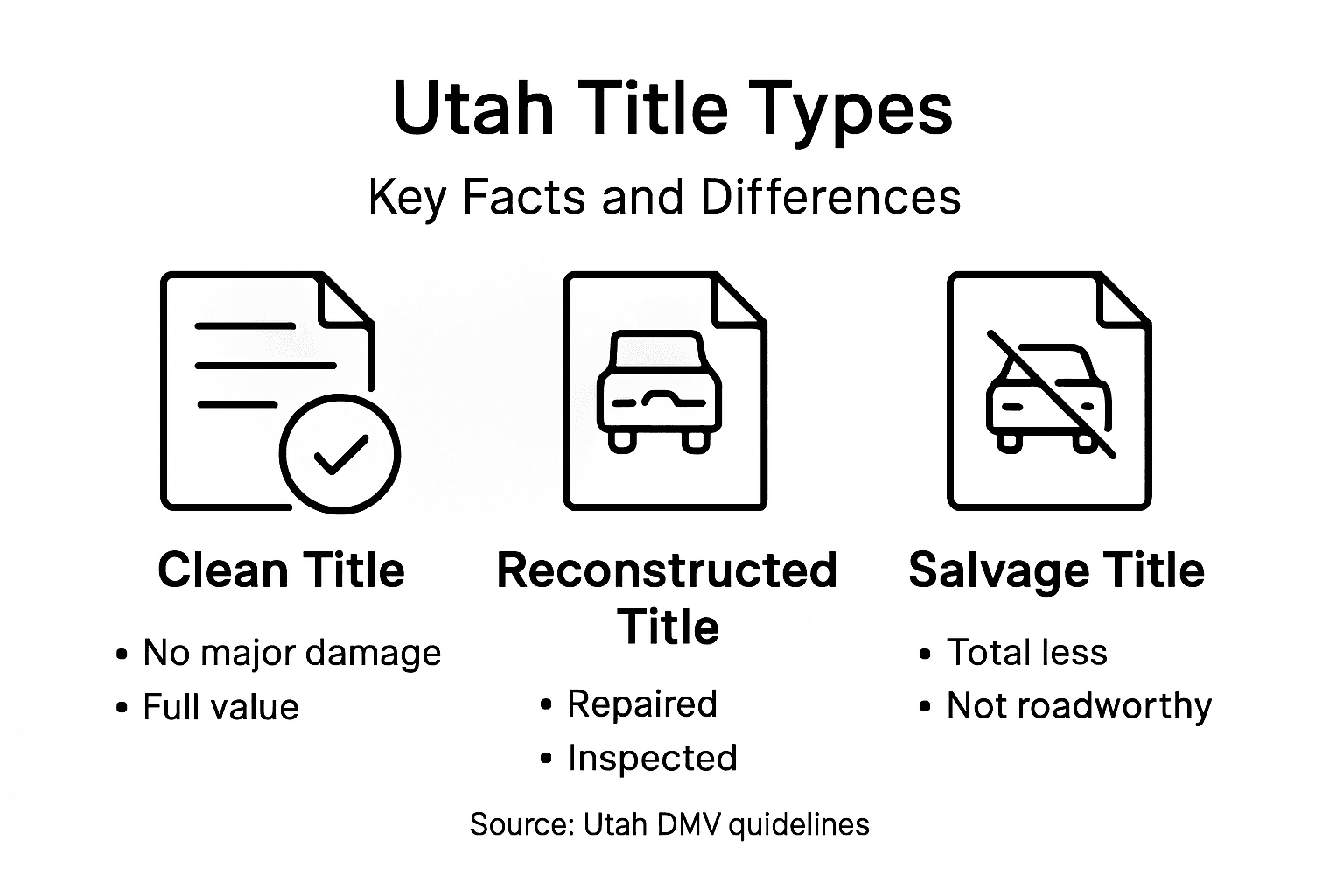
The three primary vehicle title categories break down as follows:
Here’s a concise comparison of clean, reconstructed, and salvage vehicle titles for quick reference:
| Title Type | Road Legality | Insurance Potential | Market Value Impact |
|---|---|---|---|
| Clean | Fully legal, no limits | Easy to insure and finance | Highest |
| Reconstructed | Legal after inspection | May face some restrictions | 30-50% lower |
| Salvage | Not legal until restored | Typically not insurable | Lowest |
- Clean Titles
- No significant damage history
- Full market value potential
- Easiest to insure and finance
- Represents vehicles with minimal prior issues
- Reconstructed Titles
- Previously damaged vehicle fully repaired
- Passed comprehensive state inspections
- Typically 30-50% lower market value
- Requires detailed repair documentation
- Salvage Titles
- Vehicle declared total loss by insurance
- Cannot be legally driven
- Requires complete restoration
- Lowest market value
Understanding title differences can save thousands in potential future repair and insurance costs.
Reconstructed titles occupy a unique middle ground between salvage and clean titles. While they represent vehicles that have undergone significant repairs, they also provide an opportunity for budget-conscious buyers to access potentially reliable transportation. Unlike salvage titles, reconstructed titles indicate that a vehicle has been professionally restored and verified as roadworthy.
Pro tip: Always request a comprehensive vehicle history report and have an independent mechanic inspect any vehicle with a reconstructed title before purchasing.
Costs, Risks, and Buyer Protections
Buying a vehicle with a rebuilt title represents a complex financial decision that requires careful consideration of potential risks and rewards. Insurance and financial implications reveal significant challenges buyers must navigate when exploring reconstructed vehicles.
Key financial considerations include:
- Cost Savings
- 20-40% lower upfront purchase price
- Potential for significant budget-friendly transportation
- Lower initial investment compared to clean title vehicles
- Potential Risks
- Limited insurance coverage options
- Potential difficulty securing comprehensive policies
- Higher long-term maintenance expenses
- Reduced resale market value
- Buyer Protection Strategies
- Request comprehensive repair documentation
- Obtain independent mechanical inspections
- Verify title history through official channels
- Understand state-specific disclosure requirements
Informed buyers can transform potential risks into strategic purchasing opportunities.
Reconstructed title vehicles require a strategic approach to minimize financial exposure. Buyers must balance the attractive lower pricing against potential hidden repair costs and insurance limitations. State regulations and the National Motor Vehicle Title Information System (NMVTIS) provide critical transparency mechanisms to help consumers make educated decisions.
These factors help buyers manage risks when considering a reconstructed vehicle:
| Buyer Action | Benefit | Example Tool |
|---|---|---|
| Independent Inspection | Detect unseen repairs or safety issues | Local certified mechanic |
| NMVTIS Report | Verify full title and theft history | National Motor Vehicle Title System |
| Repair Documentation | Assess completeness of restoration work | Shop invoices, photo evidence |
Pro tip: Always budget an additional 15-20% for potential unexpected repairs when considering a reconstructed title vehicle.
Unlock the True Value of Reconstructed Titles with Confidence
Navigating the world of reconstructed titles can feel overwhelming with all the details about repairs, inspections, and legal requirements. This article lays out exactly what reconstructed titles mean in Utah and the crucial steps that protect you as a buyer. But understanding is just the first step. The real challenge is finding the right vehicle that matches transparency with value while avoiding the hidden pitfalls common in this marketplace.
That is where ReVroom changes the game. Our marketplace is built especially for buyers and sellers who want to go beyond just the label of “reconstructed.” We bring you upfront accident histories, repair photos, and clear pricing, so you can uncover the best rides ready for their next journey. Instead of costly investigations and uncertainty, you get a seamless experience that turns complexity into opportunity. Whether you are hunting for a budget-friendly alternative or a vehicle vetted by real data, ReVroom helps your dollar stretch further without sacrificing peace of mind.
Explore our marketplace today and discover how transparency meets value for rebuilt title vehicles.

Ready to make smarter moves in the rebuilt title market Choose ReVroom to find your next car with confidence and clarity now.
Frequently Asked Questions
What is a reconstructed title?
A reconstructed title indicates that a vehicle has been professionally repaired after it was declared a total loss by an insurance company. It involves a thorough restoration process and official inspection to ensure the vehicle is roadworthy.
How is a reconstructed title different from a salvage title?
A reconstructed title signifies that the vehicle has been repaired and inspected, making it legal to drive. In contrast, a salvage title indicates that a vehicle was declared a total loss and cannot be legally driven until repaired and re-inspected.
What are the risks of buying a vehicle with a reconstructed title?
Potential risks include limited insurance options, higher long-term maintenance costs, and reduced resale value compared to clean title vehicles. It’s essential to conduct thorough inspections and understand the vehicle’s repair history.
What should I do before purchasing a reconstructed title vehicle?
Before purchasing, request comprehensive repair documentation, obtain an independent mechanical inspection, and verify the vehicle’s title history through official channels to ensure transparency and protect your investment.
Recommended
- Salvage vs Reconstructed Title: What It Means for Utah Families | ReVroom
- Rebuilt Title Valuation Explained: Saving Smart in Utah | ReVroom
- Rebuilt Title Tax Implications – What Utah Buyers Need to Know | ReVroom
- State Laws for Rebuilt Titles: What Utah Buyers Need to Know | ReVroom
- Fonds immobiliers value-add : pourquoi la création de valeur redevient (enfin) une stratégie active
