


Undervalued Cars Explained: Types Budget Buyers Should Know
July 29, 2026
TL;DR:
- Undervalued cars are typically priced lower due to branded titles, past damage, or high mileage, but they can be suitable daily drivers if properly inspected and state-certified. Buyers should verify title status, review vehicle history, and consider costs like insurance, repairs, and resale before purchase, especially for rebuilt titles. The market for certified rebuilt vehicles is growing, offering transparent listings and substantial savings for informed, cautious buyers.
Undervalued cars are vehicles priced below what a comparable clean-title model would cost, typically because they carry a branded title, a prior total-loss history, flood history, heavy cosmetic damage, or high mileage. The practical verdict for budget buyers: many are perfectly fine for daily driving, provided the car is state-certified, independently inspected, and priced significantly below a clean-title equivalent. Two things to confirm before anything else: the rebuilt title means the car passed a mandatory state safety inspection, and a NMVTIS national history check shows no cross-state title games. On a $25,000 sedan, typical market prices for a rebuilt title example are $5,000–$10,000 less than a clean-title equivalent, reflecting a 20–40% discount. That’s a car payment you never have to make.
Table of Contents
- What types of undervalued vehicles will you actually find?
- How does the salvage-to-rebuilt process actually work?
- Why are these cars cheaper, and what does ownership really cost?
- What should you expect with insurance and registration?
- Your step-by-step vetting checklist
- Where should you look for rebuilt and branded-title vehicles?
- Who should buy a rebuilt-title car, and when should you walk away?
- Key Takeaways
- The case for rebuilt-title cars is stronger than most buyers think
- Revroom makes vetting faster and cheaper than going it alone
- Useful sources
- FAQ
What types of undervalued vehicles will you actually find?
“Undervalued” is a broad term. In practice, it covers a handful of distinct title categories, and knowing which is which saves you from buying the wrong kind of bargain.
Rebuilt/repaired title (also called reconstructed or restored depending on the state): the car was declared a total loss, got repaired, and passed a state safety inspection. It’s road-legal and insurable, and it’s the category Revroom specializes in. This is the sweet spot for daily drivers.

Salvage title: issued the moment an insurer declares a total loss. The car has NOT been repaired or inspected. It cannot be legally registered or driven on public roads until it goes through the full repair and re-inspection process. Revroom does not list salvage-title vehicles.
Flood/water-damage brand: a specific designation for vehicles damaged by water. Consumer Reports flags these as higher risk because corrosion and electrical faults can surface months after a car looks fine. Proceed carefully and only with full documentation.
Lemon-law buyback: the manufacturer repurchased the car after failing to fix a recurring defect. The underlying issue may be resolved, but the brand is permanent.
Junk/parts-only: not road-legal, period. These exist for parts, not daily driving.
Prior commercial use / high-mileage older models: no branded title, but priced low because of age, mileage, or fleet history. Often reliable if maintained; the discount reflects perception more than reality.
| Title type | Road-legal? | Liability insurance | Resale impact |
|---|---|---|---|
| Rebuilt/repaired | Yes | Generally available | Moderate hit (20–40%) |
| Salvage | No (until repaired) | Usually not available | Severe |
| Flood/water-damage brand | Depends on repair | Limited; varies by carrier | Severe |
| Lemon-law buyback | Yes (if repaired) | Generally available | Moderate |
| Junk/parts-only | No | Not applicable | Minimal |
| High-mileage/older (clean) | Yes | Standard | Low to moderate |

Pro Tip: Check the title document itself for the brand language, then cross-reference the VIN history. Title washing, where a seller re-registers a car in a state with looser rules to hide a brand, is a documented fraud risk. If the history shows a recent out-of-state title transfer with no clear reason, treat it as a red flag.
How does the salvage-to-rebuilt process actually work?
A rebuilt title is the result of a specific sequence: insurance total-loss declaration → salvage title issued → repairs completed → mandatory state safety inspection passed → rebuilt title issued. That rebuilt brand means the car cleared the state’s minimum safety bar. It does not mean it was restored to factory condition.
State rules vary more than most buyers realize. Thresholds for declaring a total loss differ by state, ranging from roughly 60% to 100% of a vehicle’s market value, so the same repair bill can trigger a salvage title in one state and nothing at all in another. Inspection scope varies too: some states check brakes, lights, steering, and emissions; others go further. What inspections typically miss includes subframe integrity, non-factory airbag replacements, and early-stage electrical corrosion.
The issuing state matters. Always look up which state branded the title and read that state’s specific rebuilt-title rules before you buy. A Utah rebuild and a Florida rebuild are not the same process.
Pro Tip: Ask the seller for the actual inspection certificate, not just the title. Prioritize reviewing documentation on airbag replacement, frame/structural work, and any flood indicators. If the paperwork is incomplete, that gap tells you something.
Why are these cars cheaper, and what does ownership really cost?
The typical market discount on a rebuilt or branded-title vehicle is in the 20–40% range compared to a clean-title equivalent. Think of that discount as the market’s way of pricing in the car’s history and the unknowns that come with it. On a $45,000 truck or a $25,000 sedan, you can expect to pay $5,000–$10,000 less than the clean-title version. The savings are real. So are the additional costs you need to budget for.
Here’s what to factor into your true ownership math:
- Insurance: liability is generally available, but comprehensive and collision coverage may be refused or priced higher. If a second total-loss occurs, your payout is based on rebuilt-title market value, not clean-title value.
- Financing: most banks and credit unions won’t finance rebuilt-title vehicles. Cash, a personal loan, or a specialty lender at a higher rate are the realistic options.
- Repairs and maintenance: budget for the possibility of deferred issues, especially on flood-history or structural-collision vehicles.
- Vetting costs: independent inspection runs $100–$200; history reports add to that. Buyers often spend around $150 per vehicle they seriously consider, including the typical $100–$200 cost of an independent inspection.
- Resale: plan to hold the car. Resale value is lower, and finding a buyer takes longer.
Flood-damaged vehicles carry the steepest discount for a reason. Water corrosion in modern cars can stay dormant in connectors and sensors for months before causing failures, making long-term ownership risk higher than with collision repairs.
What should you expect with insurance and registration?
Rebuilt-title cars can be registered and driven legally in all 50 states once they’ve passed inspection. Getting liability insurance is usually straightforward. Full coverage is where things get complicated.
- Liability coverage: generally available from most carriers.
- Comprehensive and collision: many insurers limit or refuse it for rebuilt-title vehicles due to concerns about hidden damage and valuation disputes.
- Gap insurance: rarely available for branded-title vehicles.
- Total-loss payout: if the car is totaled again, the insurer pays rebuilt-title market value, which is lower than clean-title value.
Pro Tip: Before you make an offer, call at least three insurers with the exact VIN and ask specifically about comprehensive and collision availability for that vehicle. Get the answers in writing. Carrier policies vary enough that one “no” doesn’t mean all three will say no.
Your step-by-step vetting checklist
Buying a rebuilt or branded-title vehicle well comes down to doing things in the right order.
- Pull the VIN history first. Run an NMVTIS query and a full vehicle history report. Look for cross-state transfers, multiple total-loss events, and title brand consistency. A $15 Revroom History Report covers any rebuilt or branded-title vehicle and tells you what happened, how severe it was, and whether the price is fair for your area.
- Evaluate seller transparency. A trustworthy seller provides repair receipts, inspection certificates, and pre-repair photos without being asked. Hesitation on any of these is a signal.
- Book an independent pre-purchase inspection. An ASE-certified mechanic should check frame alignment, weld quality, paint overspray (a sign of hidden bodywork), airbag status, and electrical systems. Budget $100–$200 for this. It’s the single best money you’ll spend.
- Test drive it. Listen for unusual noises, check that all electronics work, and pay attention to how it tracks at highway speed. Pulling to one side can indicate alignment or frame issues.
- Confirm insurance before you buy. Use the VIN to get written coverage confirmation from your insurer.
- Verify final paperwork. Title, inspection certificate, repair receipts, and bill of sale should all be consistent and complete.
Pro Tip: Stop the purchase if: the seller refuses an independent inspection, the VIN history is missing or inconsistent, the title brand doesn’t match what the seller described, or there’s evidence of a recent out-of-state re-registration with no explanation. These are title-wash indicators.
Where should you look for rebuilt and branded-title vehicles?
The channel you buy through shapes how much vetting work lands on you.
- Specialized rebuilt/branded marketplaces: the highest-transparency option. Revroom lists only state-certified vehicles with vehicle history, pre- and post-repair photos, and inspection paperwork built into every listing. That upfront transparency cuts the average $150 vetting burden significantly.
- Independent dealers selling rebuilt-title cars: quality varies. Ask for the same documentation you’d expect from a marketplace listing. Some dealers are excellent; others are not.
- Retail auctions: can offer good prices but typically provide limited documentation. You’re doing more of the vetting yourself.
- Private sellers: the most work, sometimes the best price. Require full paperwork and never skip the independent inspection.
Every listing you seriously consider should include: the VIN, a NMVTIS-based history report, the state inspection certificate, repair receipts, and photos of the vehicle before and after repair.
Who should buy a rebuilt-title car, and when should you walk away?
A rebuilt or branded-title vehicle makes sense if you plan to keep it for several years, use it daily, have confirmed state certification, secured acceptable insurance, completed an independent inspection, and landed a 20–40% discount compared to a clean-title peer. That combination is where the math works.
Walk away if:
- You plan to sell within 2–4 years. Resale is harder and the price gap versus clean-title narrows your profit.
- You need lender financing and your lender won’t approve rebuilt titles.
- The vehicle has flood history and you can’t get complete repair documentation and a thorough electrical inspection.
- The discount compared to a clean-title vehicle is less than 20%.
Pro Tip: If lowest dollar-per-mile is your goal and you can complete the vetting steps above, a state-certified rebuilt vehicle often wins. If easy resale or straightforward financing matters more, a clean-title used car is the simpler path.
Key Takeaways
Rebuilt and branded-title vehicles are legitimate daily drivers for budget buyers who vet them properly and target a 20–40% discount compared to clean-title equivalents.
| Point | Details |
|---|---|
| Rebuilt vs. salvage | Rebuilt titles are road-legal and insurable; salvage titles are not, until repaired and re-inspected. |
| Target discount | Aim for a 20–40% discount compared to a clean-title equivalent; if the discount is less than 20%, the clean-title car is usually the better deal. |
| Vetting costs | Independent inspection has a moderate cost; a Revroom History Report provides valuable information for a low fee. |
| Insurance step | Call at least three insurers with the VIN before buying to confirm comprehensive and collision availability. |
| Revroom advantage | Revroom lists only state-certified vehicles with vehicle history and pre/post-repair photos, cutting vetting time and cost. |
The case for rebuilt-title cars is stronger than most buyers think
Here’s an opinion you won’t hear often: the stigma around rebuilt-title vehicles is largely a financing and resale problem, not a reliability problem. The cars that end up with branded titles after a collision repair are often structurally sound. The discount exists because lenders won’t touch them and resale is harder, not because they fall apart. For a buyer who plans to drive a car for five or more years and pay cash or use a personal loan, those two disadvantages barely apply.
The real risk isn’t the title. It’s skipping the vetting. A buyer who pulls the NMVTIS history, books an independent inspection, and confirms insurance before signing is in a far better position than someone who buys a clean-title car at a dealer with no inspection at all. The process is the protection.
Flood history is the one genuine exception. Water damage in modern vehicles is unpredictable in a way that collision damage usually isn’t. If the vehicle history shows a water-damage brand, the documentation and inspection bar needs to be higher, not just adequate.
The market for state-certified rebuilt vehicles is growing because buyers are figuring this out. Revroom exists to make that market work the way it should: transparent listings, real vehicle history, and photos that show you what the car looked like before it was repaired. That’s not a workaround. That’s just a smarter way to buy.
Revroom makes vetting faster and cheaper than going it alone
Vetting a rebuilt or branded-title vehicle on your own typically costs around $150 per car you seriously consider. Revroom cuts that down significantly. Every listing on Revroom includes state-required certification, vehicle history, and photos of the car before and after repair, so you’re not starting from zero.
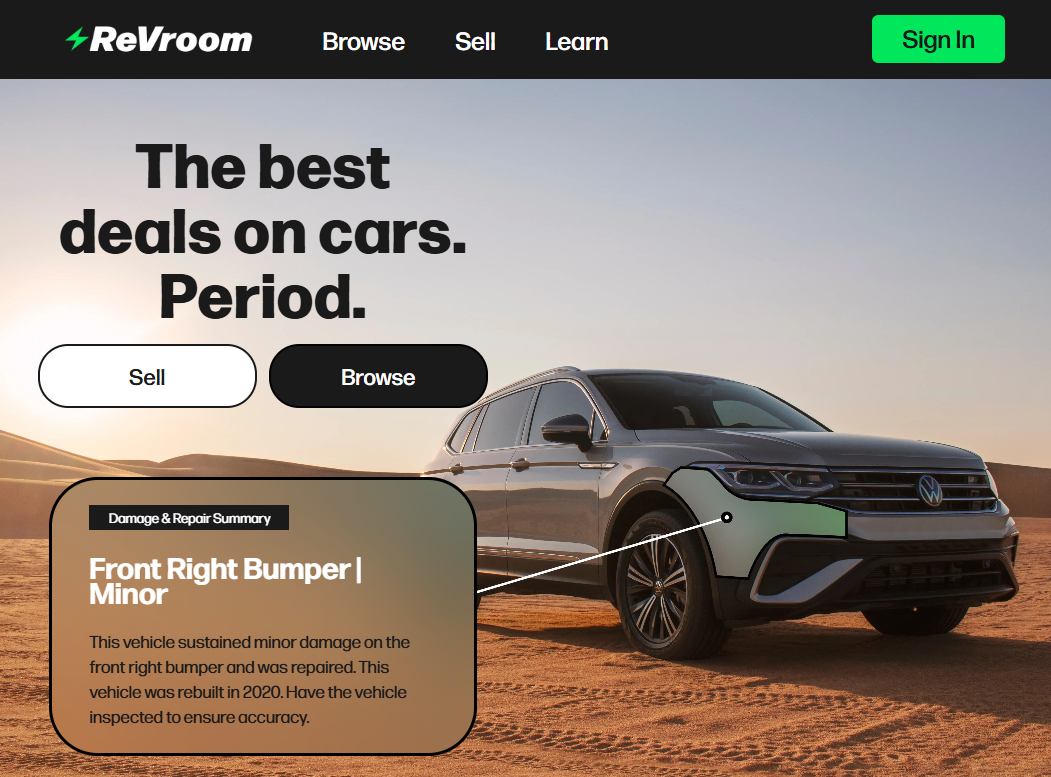
For any rebuilt or branded-title vehicle you find anywhere, a Revroom History Report gives you a full picture: what happened to the car, how severe it was, and whether the asking price is fair compared to similar clean-title vehicles in your area. All for $15. That’s less than a tank of gas and a lot cheaper than a surprise repair bill. Browse state-certified listings or grab a report at revroom.org.
Useful sources
Before you buy, verify the title history and read the rules for the state that issued the brand:
- NMVTIS: the national database for title brands and cross-state transfers
- Consumer Reports: Should you buy a car with a rebuilt title?
- Bankrate: Rebuilt vs. salvage title
- Experian: What is a branded title?
- Your state DMV’s rebuilt-title inspection page (search “[your state] rebuilt title inspection requirements”)
- Revroom: Salvage vs. rebuilt title guide
FAQ
What is the difference between a salvage title and a rebuilt title?
A salvage title means an insurer declared the car a total loss and it has not been repaired. A rebuilt title means the car was repaired and passed a mandatory state safety inspection, making it road-legal and insurable.
Are rebuilt-title cars reliable for daily driving?
Many are, particularly those with collision or cosmetic histories that have been properly repaired and state-certified. The key is completing an independent inspection and pulling a full vehicle history before buying.
How much cheaper are rebuilt-title vehicles than clean-title cars?
Rebuilt and branded-title vehicles typically sell for 20–40% less than clean-title equivalents, depending on the type and severity of the prior history.
Can you get full insurance coverage on a rebuilt-title car?
Liability coverage is generally available, but comprehensive and collision coverage may be limited or refused depending on the carrier. Always call your insurer with the VIN before purchasing to confirm what’s available for that specific vehicle.
What is the cheapest way to vet a rebuilt-title vehicle?
A Revroom History Report costs $15 and covers any rebuilt or branded-title vehicle, giving you the vehicle history, severity assessment, and a price comparison versus clean-title cars in your area. Pair it with a $100–$200 independent mechanic inspection for a complete picture.
