


Used Vans for Sale: Save Big on Certified Rebuilt Vans
July 31, 2026
TL;DR:
- Rebuilt and branded-title vans can be reliable options if they undergo proper inspection and verification.
- For the best value, buyers should request state certification, repair invoices, and run a Revroom History Report to ensure transparency and safety.
Yes, you can absolutely buy a reliable daily-driver van with a rebuilt or branded title. Every rebuilt van on Revroom has passed a state-required safety inspection, confirming it’s repaired and road ready. Before you make an offer on any listing, run a Revroom History Report ($15) to see what happened to the van, how severe it was, and whether the price is fair compared to clean-title vans in your area. That one step replaces the $150 worth of reports most buyers piece together on their own.
Table of Contents
- Where can you find certified rebuilt and branded-title vans?
- What does a “rebuilt” or “branded” title actually mean in the U.S.?
- How to vet a rebuilt van before you make an offer
- What financing, insurance, and resale look like for rebuilt vans
- How to price and negotiate a rebuilt van
- Your 5-step plan to go from searching to owning a rebuilt van
- Key Takeaways
- The real talk on rebuilt vans most buyers skip
- Revroom makes certified rebuilt van shopping straightforward
- Useful sources for your research
- FAQ
Where can you find certified rebuilt and branded-title vans?
Not all listing channels are created equal when you’re shopping for affordable used vans. Here’s how the main options stack up:
- Rebuilt-specific marketplaces (Revroom): Every listing includes state certification paperwork, pre-repair photos, and vehicle history. You filter by condition, not by guesswork. This is the most transparent route for budget buyers.
- Dealer certified rebuilt listings: Some dealers carry rebuilt-title vans and can provide repair invoices. Documentation quality varies widely, and prices are often higher than private sellers.
- Private sellers (Facebook Marketplace, Craigslist): Lowest prices, but documentation is inconsistent. Always run a Revroom History Report before scheduling a visit.
- Auctions: Deep discounts are possible, but inspection time is limited and paperwork is rarely complete. Best avoided unless you’re comfortable buying blind.
| Marketplace type | Price range | Transparency | State cert included | Convenience |
|---|---|---|---|---|
| Revroom (rebuilt-specific) | Up to 50% below clean-title | Pre-repair photos + history | Yes | High |
| Dealer rebuilt listings | Moderate discount | Varies | Sometimes | High |
| Private sellers | Lowest | Often incomplete | Rarely | Low |
| Auctions | Deepest discount | Minimal | No | Low |
For budget buyers, the features that matter most are state certification paperwork, a VIN history report, repair invoices, and photos of the van before it was fixed. A listing missing any of those is a listing worth skipping, or at minimum, a reason to dig deeper before you commit.
What does a “rebuilt” or “branded” title actually mean in the U.S.?
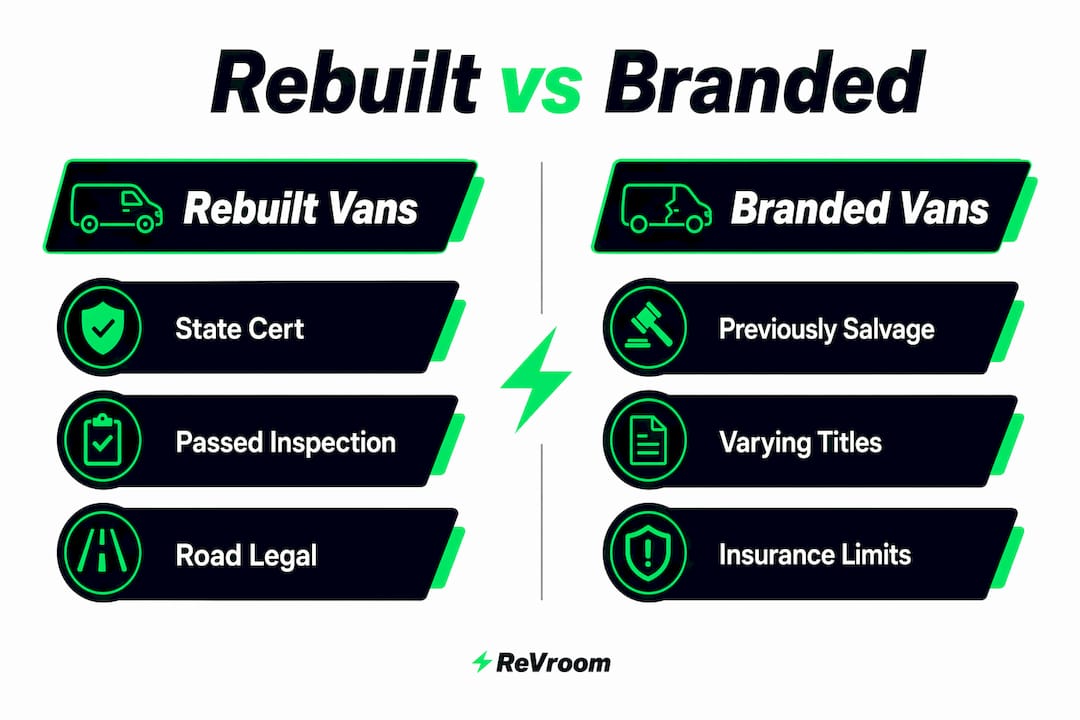
A rebuilt title means a vehicle was previously declared a total loss, received a salvage title, was then repaired, and passed a state-required inspection confirming it’s roadworthy. A branded title is the broader term covering any permanent notation stamped on a title to reflect a significant event in the vehicle’s history, including rebuilt, flood, hail, and lemon law buybacks.
The critical distinction: salvage title vehicles are not road-legal. You cannot register or insure a salvage van. A rebuilt title means those repairs cleared the state’s bar, and the van can be registered and insured. That brand is permanent, though. It follows the vehicle forever, which is exactly why rebuilt vans sell for meaningfully less than clean-title equivalents.
State inspection rigor varies considerably. Some states require structural, emissions, and anti-theft checks. Others perform minimal reviews. That’s why the title alone isn’t enough; you still want independent verification through repair documentation and a pre-purchase inspection.
How to vet a rebuilt van before you make an offer
Always start with documents. No paperwork, no offer. Here’s the sequence that protects you:
- Request the state certificate of rebuild and confirm it matches the VIN on the van.
- Run a VIN history check and a Revroom History Report to see the full event timeline, severity rating, and a price comparison against clean-title vans nearby. Consumer Reports recommends treating each rebuilt vehicle case-by-case based on repair documentation.
- Review repair invoices and confirm structural or frame work was completed by a licensed shop, not a backyard repair.
- Schedule an independent pre-purchase inspection with a mechanic you trust. Key areas: frame and alignment, airbag system, electronics, transmission, and any signs of water intrusion.
- Road-test the van yourself. Listen for vibration, pull, or warning lights that suggest incomplete repairs.
Pro Tip: When reviewing repair invoices, look for line items that reference frame straightening, unibody repair, or airbag module replacement. Those are the repairs that matter most for long-term reliability. If the invoice is vague or handwritten with no shop license number, treat it as a red flag.
Flood-branded vans deserve extra attention. Corroded wiring and degraded sensors can surface months later, so a flood-history van warrants a deeper electrical inspection and a larger price discount than a collision-history van of similar mileage.

What financing, insurance, and resale look like for rebuilt vans
Here’s the honest picture: financing and full insurance coverage are often limited for branded-title vehicles. Liability coverage is generally available, but comprehensive and collision can be restricted or denied depending on your insurer and lender.
Mainstream lenders frequently decline rebuilt-title loans because they can’t easily determine actual cash value after a claim. Credit unions and specialty lenders are more likely to work with you. Cash purchases sidestep this entirely, which is one reason rebuilt vans attract budget buyers who are paying out of pocket.
On resale, branded titles reduce value compared to clean-title equivalents, and that gap is permanent. Rebuilt vans make the most financial sense for buyers who plan to keep them long-term, not flip them in two years.
| Factor | Reality for rebuilt/branded vans |
|---|---|
| Financing | Credit unions and specialty lenders; many mainstream banks decline |
| Comprehensive/collision insurance | Restricted or unavailable at some insurers |
| Liability insurance | Generally available |
| Resale value impact | 20–40% below clean-title equivalent, permanent |
| Registration | Possible in all states after passing state inspection |
Pro Tip: Call your insurance carrier with the VIN before you buy. Ask specifically whether they’ll write comprehensive and collision on a rebuilt title. Getting a “yes” in writing before closing saves a painful surprise afterward.
You can learn more about insurance options for rebuilt vehicles and financing realities on Revroom’s resource pages.
How to price and negotiate a rebuilt van
Expect a noticeable discount versus a comparable clean-title van. That range is your sanity check. If a listing is only 5% below clean-title market value, the seller is leaving you with all the trade-offs and none of the savings.
Use this simple formula to set your target offer:
Clean-title market value − discount % − estimated remaining repair or warranty cost = target offer price
A few negotiation moves that actually work:
- Ask for all repair receipts before the visit, not at closing. Missing receipts are a negotiating chip.
- Request a prorated warranty from the repair shop or an escrow holdback if any repairs are unverified.
- If a short-term service contract is available, ask the seller to include it or reduce the price accordingly.
- Use the Revroom History Report’s price comparison to anchor your offer with data, not just instinct.
Get the state certificate, repair invoices, and clean title paperwork signed before any money changes hands. Verbal agreements on rebuilt-title purchases are worth nothing.
Your 5-step plan to go from searching to owning a rebuilt van
The cleanest path: find a certified listing, verify its history, inspect it independently, and close with complete paperwork.
- Search certified rebuilt van listings on Revroom or browse secondhand vans for sale on private platforms.
- Run a Revroom History Report ($15) on any van you’re seriously considering.
- Request the state certificate of rebuild and all repair invoices from the seller.
- Schedule an independent mechanic inspection before making an offer.
- Arrange payment (cash or pre-approved loan) and confirm title transfer paperwork is complete at closing.
Have these ready at closing: proof of funds or loan approval, signed title paperwork, state certificate of rebuild, and your copy of the Revroom History Report for your records.
Key Takeaways
Rebuilt and branded-title vans are a practical, affordable option for budget buyers who do their homework and plan to keep the vehicle long-term.
| Point | Details |
|---|---|
| Savings potential | Rebuilt/branded-title vans typically cost 20–40% less than clean-title equivalents. |
| State certification required | Every road-legal rebuilt van must pass a state inspection; always request that certificate. |
| Resale impact is permanent | Branded titles reduce resale value by 20–40% and that brand never comes off. |
| Vetting costs | Typical vetting runs ~$150; a Revroom History Report covers the core analysis for $15. |
| Revroom advantage | Revroom lists state-certified rebuilt vans with pre-repair photos and history included in every listing. |
The real talk on rebuilt vans most buyers skip
Rebuilt vans get a bad reputation mostly because buyers skip the paperwork and then act surprised when something goes wrong. The title brand itself isn’t the problem. A van that was rear-ended, properly repaired by a licensed shop, and cleared a state inspection is not a liability. It’s a deal.
What actually matters is the quality of the repair and the transparency of the documentation. A $15 Revroom History Report has caught missing title events that sellers “forgot” to mention. Pre-repair photos in a listing have given buyers real negotiating leverage, because you can see exactly what was fixed and judge whether the price reflects it. And the simplest walk-away rule? If a seller can’t produce the state certificate of rebuild and repair invoices within 24 hours of your request, move on. There are plenty of well-documented rebuilt vans for sale near you.
The buyers who regret rebuilt-title purchases are almost always the ones who skipped the inspection or accepted a vague repair history. The ones who do it right tend to drive their van for years and quietly wonder why they ever paid clean-title prices.
Revroom makes certified rebuilt van shopping straightforward
Revroom is the only marketplace built specifically for rebuilt and branded-title vehicles, and every listing comes with state certification paperwork, pre-repair photos, and vehicle history baked in. You’re not hunting for documents after the fact; they’re already there.

The Revroom History Report takes that a step further. For $15, you get a full analysis of what happened to any rebuilt or branded-title van, how severe it was, and whether the asking price is fair compared to clean-title vans in your area. That’s the same transparency that typically costs buyers around $150 in piecemeal reports, delivered in one place for less than lunch. Whether you found a van on a private listing or you’re browsing certified options, run the report before you schedule a visit. Browse certified rebuilt vans and run your Revroom History Report at revroom.org.
Useful sources for your research
These are the sources worth bookmarking as you shop for affordable used vans:
- NMVTIS / VIN lookup: Run a VIN check through any NMVTIS-approved provider before scheduling an inspection. It surfaces title history across state lines, which matters if the van was registered in multiple states.
- Your state DMV’s rebuilt inspection page: Look up your state’s specific rebuilt inspection requirements. Texas, for example, requires both safety and anti-theft inspections via TxDMV before a rebuilt title is issued.
- Consumer Reports rebuilt title guidance: Useful for understanding what repair documentation to request and why independent inspections matter for rebuilt-title vehicles.
- Revroom History Report: Run it with a VIN, price, mileage, and city for a $15 severity and price-fairness analysis on any rebuilt or branded-title van.
- Save your paperwork: Keep the state certificate of rebuild, repair invoices, and your Revroom History Report together. You’ll want them at closing and again if you ever sell the van.
FAQ
What is a rebuilt title on a van?
A rebuilt title means the van was previously declared a total loss, was repaired, and passed a state-required inspection confirming it’s roadworthy and legal to register. It’s different from a salvage title, which means the van has not yet been repaired or inspected.
How much cheaper are rebuilt-title vans compared to clean-title vans?
Rebuilt and branded-title vans typically sell for 20–40% less than comparable clean-title vans.
Can I get insurance on a rebuilt-title van?
Liability coverage is generally available, but comprehensive and collision coverage may be restricted or denied by some insurers. Insurers like State Farm, GEICO, and Progressive do cover rebuilt-title vehicles, though each has its own documentation requirements.
What is the Revroom History Report and how much does it cost?
The Revroom History Report is a $15 vehicle analysis that tells you what happened to any rebuilt or branded-title van, how severe the event was, and whether the asking price is fair compared to clean-title vans in your area.
Is it worth buying a used commercial van with a rebuilt title?
Yes, for buyers who plan to keep the van long-term and do proper due diligence. The savings are real, the title brand is permanent, and the key is verifying state certification, repair documentation, and getting an independent inspection before buying.
