


Blue rebuilt title meaning: what buyers need to know
May 9, 2026
TL;DR:
- A blue rebuilt title does not have a universal meaning; its significance varies by state, with Texas using blue for standard titles.
- The crucial factor is the specific brand or notation on the title, such as “Rebuilt Salvage,” indicating the vehicle was repaired after a total loss and inspected for roadworthiness.
If you’ve ever spotted a listing for a blue rebuilt title car and felt your brain do a little stutter, you’re not alone. Here’s the thing: a “blue title” doesn’t mean the same thing in every state, and treating it like it does can cost you real money. In Texas, a blue title is actually the standard color for a regular certificate of title. In other states, that same blue paper could signal something completely different. Before you walk away from a great deal, or worse, drive into a bad one, it pays to understand exactly what you’re looking at.
Table of Contents
- What does a blue rebuilt title mean?
- Blue title vs. rebuilt title vs. salvage title
- How does a car become a rebuilt title vehicle?
- Should you buy a car with a blue rebuilt title?
- Our perspective: Why title color comes last, not first
- Find reliable rebuilt title vehicles with transparent history
- Frequently asked questions
Key Takeaways
| Point | Details |
|---|---|
| Title color varies | A blue title means different things depending on the state, with Texas using blue for clean and rebuilt certificates. |
| Permanent rebuilt branding | A blue rebuilt title in Texas shows a car was totaled, repaired, inspected, and is legal to drive, but the past damage remains on record. |
| Check branding not color | It’s the ‘Rebuilt,’ ‘Salvage,’ or other wording on the title that matters most, not the document’s color. |
| Pros and cons for buyers | Rebuilt titles offer savings but come with insurance, resale, and risk considerations—always inspect history closely. |
| Research before buying | Always review the full title, repair, and inspection paperwork before choosing a rebuilt-title car. |
What does a blue rebuilt title mean?
Let’s start by clearing the air. The term “blue rebuilt title” gets tossed around online as if it’s a universally understood category. It isn’t. The word “blue” describes the physical color of the title document, and that color means different things depending on which state issued it.
In Texas, the blue title is simply how the state prints its standard certificates of title. A clean Texas vehicle can have a blue title. A vehicle with a branded history can also have a blue title. What matters is not the color of the paper but the brand printed on it. That brand is the real story.
In Texas, a blue title branded “Rebuilt Salvage” means the vehicle was previously deemed a total loss by an insurer, has since been repaired and inspected for roadworthiness, and carries that history permanently on its title record.
So when someone says “blue rebuilt title,” they typically mean a Texas title document (blue in color) that is specifically branded as “Rebuilt Salvage.” That branding tells you the vehicle went through the official process of being declared a total loss, repaired, and then reinspected before it was allowed back on the road.
Outside of Texas, the color coding may carry different implications entirely. Some states use color to indicate status, others use it only as a printing convention, and some don’t use color-coded titles at all. In any state, the printed brand or notation on the face of the document is always the most important detail to read.
Understanding the rebuilt title basics before you shop helps you decode this quickly. And once you understand the difference, you’ll realize the brand on the title is the headline. The paper color is just the font.
One more thing worth noting: the prior salvage title meaning is closely tied to this conversation. A vehicle earns a rebuilt designation only after it has cleared the salvage stage. The two terms describe sequential steps in a vehicle’s legal history, not interchangeable labels.
Blue title vs. rebuilt title vs. salvage title
Now that you know what a blue rebuilt title is, let’s see how it compares to other common title types you’ll encounter. These three terms get mixed up constantly, and that confusion is exactly where costly mistakes get made.
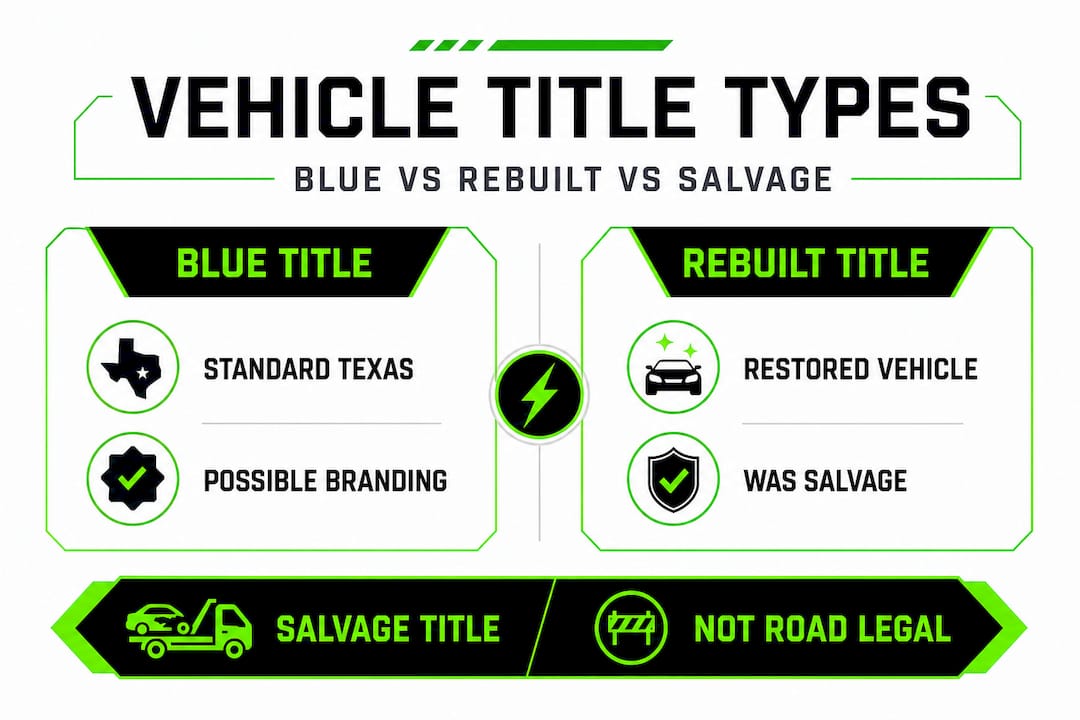
Here’s a clear side-by-side view:
| Title type | What it means | Can you drive it legally? | Can you register it? |
|---|---|---|---|
| Clean title | No major history events on record | Yes | Yes |
| Blue title (Texas) | Standard TX title; color alone tells you nothing | Depends on the brand | Depends on the brand |
| Rebuilt title | Repaired and inspected after total loss declaration | Yes | Yes |
| Prior status title | Vehicle has a history of being branded | Yes, if currently rebuilt | Yes |
The key distinction between rebuilt and the earlier pre-repair status is spelled out clearly: a rebuilt title specifically reflects post-repair status. The vehicle has been restored, inspected, and declared legal to drive and register, which is a fundamentally different standing from a vehicle that has not yet been cleared for road use.
Here are the practical things you need to read on any title document before you make an offer:
- The state of issuance. Understand what that state uses title color to communicate, if anything.
- The brand or notation. Look for words like “Rebuilt,” “Rebuilt Salvage,” “Reconstructed,” or similar. This is the legal designation that actually governs the vehicle’s status.
- The VIN. Cross-reference it with any available vehicle history report to verify the title matches the car in front of you.
- The date of retitling. Knowing when the vehicle received its rebuilt designation can help you estimate how long it has been back on the road.
You can dig deeper into salvage vs rebuilt title differences if you want a thorough breakdown. It’s one of the most important distinctions in the used car world, and understanding it gives you a real edge when shopping. For a deeper look at what it means when a vehicle carried an earlier pre-rebuild status, the detailed salvage title definition is worth a read.
How does a car become a rebuilt title vehicle?
Understanding the meaning of these titles, you may wonder how a totaled car gets road-ready status again. The process is more structured than most people expect, and that structure is actually what gives rebuilt title vehicles a lot of their credibility.

Here’s an overview of the typical path from total loss to rebuilt designation:
| Step | What happens |
|---|---|
| 1. Total loss declaration | Insurer determines repair cost exceeds vehicle value |
| 2. Title branding | State issues a pre-rebuild branded title (vehicle cannot be driven) |
| 3. Acquisition by repairer | Buyer, shop, or rebuilder purchases the vehicle |
| 4. Professional repairs | Vehicle is restored to operational condition |
| 5. State inspection | Licensed inspector evaluates the vehicle’s safety and repairs |
| 6. Rebuilt title issued | State issues a new title with the rebuilt brand |
Let’s walk through what each of these stages really involves.
- Total loss declaration. An insurance company calculates that the cost to repair a vehicle exceeds a certain percentage of its market value (the threshold varies by state). At that point, it’s declared a total loss and the title is branded accordingly.
- Acquiring the vehicle. A rebuilder, body shop, or private buyer purchases the vehicle specifically to repair it and bring it back to road-legal status.
- Completing the repairs. The work done varies widely depending on the vehicle’s history. Some vehicles need extensive structural work. Others were declared total losses due to hail, paint defects, or theft recovery rather than collision damage.
- Passing the state inspection. This is the critical step. A licensed inspector reviews the repairs and confirms the vehicle meets the state’s safety standards. Passing this inspection is what earns the vehicle its rebuilt designation.
- Receiving the rebuilt title. A rebuilt title is issued after the vehicle is repaired, inspected, and determined legal to drive. That title carries the rebuild brand permanently. No amount of future repairs or ownership changes will erase it.
For a full picture of what retitling involves, the rebuilt title retitling steps article breaks it down state by state. If you want to understand the full arc of a vehicle going from total loss to the road again, the salvage to rebuilt process guide is an excellent resource.
Pro Tip: Always ask the seller for the repair records and inspection documentation before you make any decisions. A rebuilt title vehicle with clear, complete paperwork is a much stronger candidate than one with gaps in the repair history, regardless of how clean it looks in person.
Should you buy a car with a blue rebuilt title?
Now that you’re familiar with the path a vehicle takes to earn its rebuilt designation, let’s tackle the most important question: should you consider buying one?
The honest answer is: it depends on what you find when you look closely. And looking closely is exactly what you should do. Here’s a balanced look at the key considerations.
Reasons buyers find real value here:
- Rebuilt title vehicles can be priced significantly lower than comparable clean title cars, often by a meaningful margin that makes previously out-of-reach vehicles genuinely accessible.
- The repair history is documented through the title branding process, meaning the vehicle had to pass an official inspection to earn that rebuilt designation.
- The vehicle’s history is permanently recorded, giving you a paper trail that many clean title cars actually lack.
- For buyers who plan to keep the vehicle long term rather than resell quickly, the upfront savings can far outweigh the depreciation concerns.
Considerations to weigh carefully:
- Resale value will be lower than a comparable clean title vehicle. A rebuilt brand follows the car permanently, and future buyers will factor that into any offer they make you.
- Insurance coverage options can vary. Most providers will insure a rebuilt title vehicle, but it’s smart to get quotes before you commit to a purchase.
- Quality of repairs is not uniform across all vehicles. Some rebuilds are meticulous. Others are not. The title designation means the car passed inspection, but it does not guarantee every repair was done to the highest standard.
The most important insight here is one that often gets overlooked: don’t treat “blue” as a universal meaning. A blue title in Texas is not the same signal as a blue title in another state. And in most cases, the color of the paper is completely secondary to the brand printed on it.
Pro Tip: Request a full vehicle history report and review it alongside the physical title document. Verify that the VIN, the brand, and the history all tell a consistent story. Inconsistencies are worth investigating before you hand over any money.
For a thorough rundown of what to watch for, check out the article on rebuilt title car risks. And to understand how title status affects a vehicle’s market value, the rebuilt car value guide gives you the context you need to negotiate confidently.
Our perspective: Why title color comes last, not first
Here’s something we’ve noticed after watching countless buyers navigate this market: the people who make the best purchases are rarely the ones asking “what does the color mean?” They’re asking “what does the brand say, and does the paperwork back it up?”
Title color is, in most cases, a printing decision. It’s a bureaucratic convention that varies from state to state without any standardized national meaning. Focusing on color is a little like judging a book by the color of its cover, while the actual text is sitting right there on the page.
The printed brand is the legal designation. It’s what governs how the vehicle can be registered, how insurers categorize it, and what buyers down the line will see when they look up the VIN. The brand is the fact. The color is the packaging.
We’ve seen smart, diligent buyers walk away from excellent vehicles because the paper was the wrong color. We’ve also seen less careful buyers overlook serious red flags because the paperwork looked tidy. Neither outcome is good.
The right move is to read the document, verify the history, review the repair records, and inspect the vehicle in person. Understanding hidden risks in rebuilt cars isn’t about avoiding the category entirely. It’s about knowing what questions to ask and where to look. That knowledge is genuinely empowering, and it’s exactly the kind of clarity that turns a confusing purchase into a confident one.
Find reliable rebuilt title vehicles with transparent history
Shopping for a rebuilt title vehicle doesn’t have to feel like navigating a maze in the dark. That’s exactly why ReVroom exists.

ReVroom is the only online marketplace built specifically for rebuilt title vehicles. Every listing includes vehicle history information and photos showing what the car looked like before repairs, giving you the full picture upfront. No extra reports to order, no guesswork. The transparency that normally costs buyers an average of $150 per vehicle to gather is already built into every listing. Browse rebuilt title vehicles on ReVroom and find the ones worth your attention, along with the documentation that helps you decide with confidence.
Frequently asked questions
Does a blue rebuilt title affect a car’s insurance eligibility?
A rebuilt title vehicle is considered restored and legal to drive, so most insurers will cover it, though your coverage options and premium costs may differ from a clean title car. It’s always worth getting quotes from multiple providers before you finalize any purchase.
Is a blue title the same as a clean title in all states?
No. Texas uses blue as its standard certificate of title color for all vehicles, clean or branded, while other states may use blue to indicate a different status or simply as a printing choice unrelated to vehicle history.
Can I trust a car with a blue rebuilt title?
A vehicle with a blue rebuilt title can be a sound purchase if the repair records are complete, it passed the required state inspection, and you’ve verified the full vehicle history, though doing your own in-person inspection is always a smart final step.
What should I check before buying a blue rebuilt title car?
Start by reading the printed title brand carefully, since that designation carries the real legal meaning, then review the repair and inspection records, run a vehicle history report, and verify what the title color signifies in the state that issued it.
