


How to safely buy reliable rebuilt title cars for less
May 13, 2026
TL;DR:
- Not all rebuilt title vehicles are the same, and understanding their histories is essential for smart shopping. Rebuilt titles indicate a vehicle was declared a total loss, repaired, and passed a safety inspection, but the reason for the loss varies greatly, affecting risk levels. Buyers should verify documentation, assess repair quality, and be aware of resale and financing challenges to make confident, informed decisions.
Not all rebuilt title vehicles are created equal, and that single fact changes everything about how you should shop for one. A rebuilt title is issued when a vehicle has been declared a total loss by an insurer, then repaired and passed a state inspection before earning the right to return to the road. But here is the part most buyers miss: the reason behind that total-loss declaration can range from a moderate hail storm to a complex repair job, and every point on that spectrum carries a completely different level of risk and opportunity. This guide will help you understand those differences, compare your options clearly, and walk through every practical step to buying a rebuilt title car you can genuinely feel good about.
Table of Contents
- What is a rebuilt title and how is it issued?
- Risks and downsides of rebuilt title vehicles
- What determines rebuilt title risk? Comparing loss types
- How to buy a safe, reliable rebuilt title car
- The uncomfortable truth most buyers miss about rebuilt title cars
- Shop rebuilt title cars confidently with ReVroom
- Frequently asked questions
Key Takeaways
| Point | Details |
|---|---|
| Rebuilt titles require research | You must verify damage type, repair quality, and documentation before buying. |
| Risks lower resale and financing options | Rebuilt title cars often sell for less and face stricter financing and insurance. |
| Case-by-case decisions are best | Not all rebuilt title vehicles pose equal risk—inspect history and repairs carefully. |
| Independent inspection is essential | Always pay for an expert inspection to protect your safety and investment. |
| Transparent marketplaces matter | Choose online platforms that offer clear, verified histories for reliable rebuilt title purchases. |
What is a rebuilt title and how is it issued?
Making sense of title terminology is the foundation of smart rebuilt title shopping. If you have ever felt confused by the labels floating around in used car listings, you are not alone.
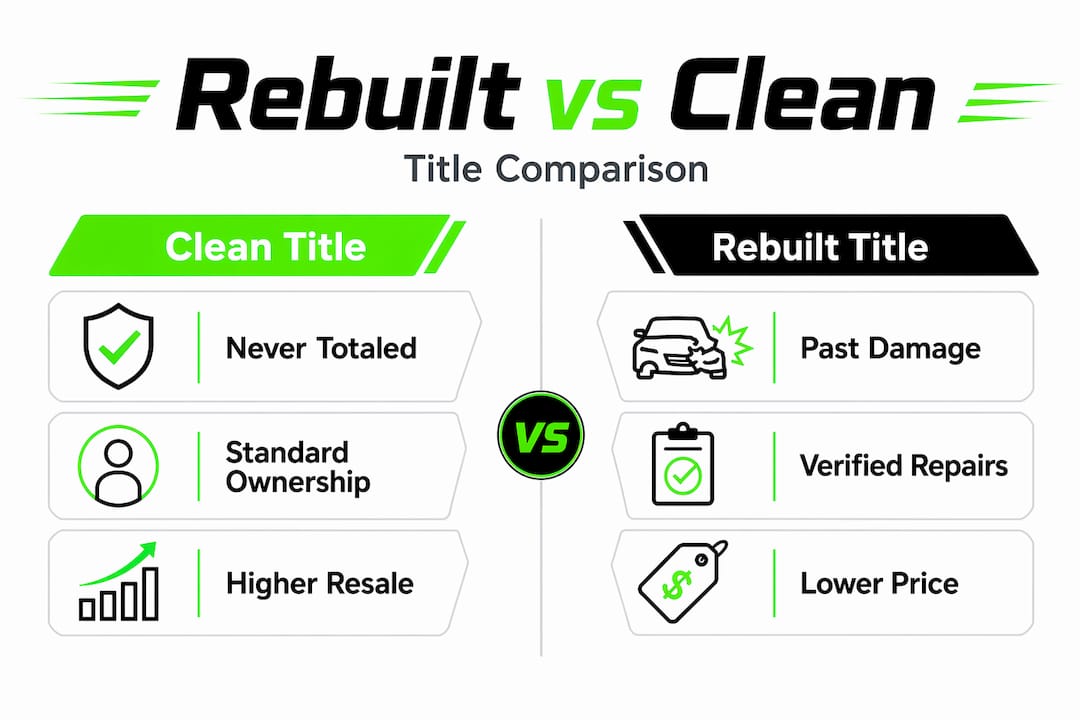
A clean title means a vehicle has never been declared a total loss. It is the default, standard title most used cars carry. A rebuilt title (sometimes called a reconstructed or branded title, depending on your state) means the vehicle was once declared a total loss, was then professionally repaired, and passed a mandatory safety inspection before a state authority reissued a drivable title. Understanding the rebuilt vs clean title differences is one of the most important first steps in this process.
Here is a simplified look at how a vehicle goes from total loss to rebuilt title:
| Stage | What happens |
|---|---|
| Total-loss declaration | Insurer determines repair cost exceeds a threshold of the vehicle’s value |
| Vehicle acquisition | Repair shop or individual purchases the vehicle |
| Professional repairs | Damage is addressed, parts are replaced or restored |
| State safety inspection | A government-authorized inspector verifies the vehicle is road-ready |
| Rebuilt title issued | State issues the rebuilt brand on the title |
The events that trigger a total-loss declaration can vary widely. Some common causes include:
- Hail damage that dents body panels but leaves mechanical systems untouched
- Theft recovery where the car was found intact but the insurer had already paid out
- Flood exposure that affected electronics or interior components
- Collision repairs ranging from moderate to more extensive structural work
“A rebuilt title is not a single risk category. The story behind it matters just as much as the label itself.”
This range of histories is exactly why a rebuilt title should prompt curiosity, not automatic rejection. Two cars can sit side by side at the same price with the same title brand, and one can be a genuine value while the other requires serious scrutiny. Knowing which is which starts with understanding how the title came to be.
Risks and downsides of rebuilt title vehicles
Knowing the risks is vital. Being clear-eyed about them is what separates a smart buyer from one who gets caught off guard.
Consumer Reports generally advises caution around rebuilt titles for most shoppers, particularly when serious structural repairs were involved. That is fair advice. But the same source acknowledges that circumstances matter enormously. A car with a rebuilt title from hail damage sits in a very different category than one with major frame repairs.
Here is how rebuilt and clean title vehicles typically compare across key buyer concerns:
| Factor | Clean title | Rebuilt title |
|---|---|---|
| Purchase price | Market rate | Up to 50% less |
| Resale value | Standard | Noticeably lower |
| Financing availability | Widely available | Often more restricted |
| Insurance access | Standard | Available; coverage details vary |
| Repair history transparency | Often unknown | Can be documented |
Experian notes that practical downsides of rebuilt title vehicles include lower resale value and financing challenges. These are real considerations worth planning around before you buy.
The most common rebuilt title risks to keep in mind:
- Lower resale value. Rebuilt titles carry a stigma in the resale market, which means you will likely sell for less down the road regardless of repair quality.
- Financing hurdles. Many traditional lenders are reluctant to finance rebuilt vehicles, which means you may need to explore specialty lenders or pay cash. Learn more about financing rebuilt cars before you commit to a purchase plan.
- Variable repair quality. Not every repair job is equal. The quality of parts and labor used during restoration can differ significantly.
- Unknown history gaps. Even with documentation, some elements of a vehicle’s history may not be fully captured in available records.
Pro Tip: The risks of a rebuilt title vehicle are not fixed. They are largely determined by what you know and what you verify before signing. Arm yourself with information, and many of these risks shrink considerably. You can explore rebuilt title vehicle risks in more detail to go deeper on each one.
What determines rebuilt title risk? Comparing loss types
Not all rebuilt titles are equal, and the type of event that triggered the total-loss declaration is the single most important variable in your risk assessment. Think of it this way: a minor hail storm that pocked a hood is very different from a front-end collision that required frame straightening. Both can produce a rebuilt title. Only one should give you pause.
Different loss events carry different risk profiles, and understanding those profiles is how experienced buyers find genuine value in the rebuilt title market.
| Loss type | Primary concern | Long-term risk level |
|---|---|---|
| Hail damage | Cosmetic, body panels | Lower |
| Theft recovery | Potential missing parts | Low to moderate |
| Flood exposure | Electronics, corrosion | Moderate to higher |
| Collision | Structural integrity | Varies widely by severity |
Here is a practical framework for evaluating any rebuilt title vehicle based on its history:
- Identify the loss type. Ask directly and look for documentation that specifies the event. Listings that include vehicle history photos give you a head start.
- Assess the repair scope. Was the repair cosmetic or structural? Cosmetic repairs, like body panel replacement after hail, typically carry far less long-term concern.
- Evaluate repair quality. Who did the repairs? A licensed body shop with documented work carries more credibility than repairs completed without records.
- Compare the price discount to the risk level. Rebuilt title vehicles can be up to 50% cheaper than comparable clean title cars. The bigger the discount, the more diligence is warranted.
- Check independent valuation tools. Use a rebuilt title value guide to understand what fair pricing looks like for your specific vehicle.
Statistic: Rebuilt title vehicles are priced up to 50% below comparable clean title vehicles. That price gap is real, and it represents genuine savings when the vehicle history supports the purchase.
Discounts are a primary draw of the rebuilt title market, but the risk level depends heavily on repair quality and vehicle history type. This is the core truth that separates buyers who feel great about their purchase from those who feel anxious about it. Understanding the impact on car value for your specific make and model helps you set realistic expectations from day one.
Pro Tip: Two vehicles with the same rebuilt title can represent completely different buying propositions. Always ask for the reason behind the total-loss declaration before anything else. That single piece of information tells you more than almost any other factor.
How to buy a safe, reliable rebuilt title car
With risks and nuances clear, the next step is putting a practical buying process in place. This is where many buyers stumble. They find a car they like, fall for the price, and skip steps that would have protected them. Do not skip the steps.
Here is a step-by-step process for buying a rebuilt title car with confidence:
- Confirm the title brand and loss type. Request the title document directly and verify the rebuilt designation. Ask the seller to document the specific reason the vehicle was declared a total loss.
- Request complete repair documentation. A trustworthy seller will have paperwork showing what was repaired, what parts were used, and which shop performed the work. Missing documentation is a red flag, full stop.
- Run a vehicle history report. Online history reports can surface prior claims, ownership records, and reported events. No report covers everything, but a good one fills in important gaps.
- Pay for an independent pre-purchase inspection (PPI). This is non-negotiable for rebuilt title purchases. A qualified mechanic with no stake in the sale will give you an honest read on the vehicle’s current condition. Follow a rebuilt title inspection guide to know exactly what to ask your inspector to evaluate.
- Verify key components based on loss type. If the vehicle had flood exposure, have electronics and the undercarriage checked thoroughly. If it had collision history, request a frame inspection. Match your inspection priority to the specific history of that car.
A few additional items to keep on your buyer checklist:
- Look for consistent panel gaps, matching paint color across all panels, and uniform finish texture, which can reveal the quality of bodywork
- Check that all vehicle identification numbers (VINs) on the car match the title document
- Verify that automotive key cutting types and any electronic key systems are fully functional, especially on theft-recovery vehicles where key programming can be an issue
- Shop on platforms that include vehicle history photos and upfront information rather than requiring you to investigate entirely on your own
The most defensible approach to rebuilt title buying is an independent inspection paired with thorough documentation review. Buyers who follow every step in this process consistently report higher satisfaction and fewer surprises.
The uncomfortable truth most buyers miss about rebuilt title cars
Here is something most articles in this space will not tell you directly: the rebuilt title itself is rarely the problem. The problem is buyers who prioritize the price over the process.
We see it regularly. Someone spots a beautiful vehicle at a remarkable price, gets excited, and decides to skip the inspection or overlook incomplete repair paperwork. They rationalize it as overthinking. Then, a few months later, something surfaces that the documentation would have revealed, or the inspection would have caught. That is when the savings evaporate and the frustration sets in.
The uncomfortable truth is that a rebuilt title car with full documentation, a clean inspection, and a well-understood history can be a significantly smarter buy than a clean title car whose history nobody actually bothered to check. Clean titles are not automatically safe. They are simply more familiar. Familiarity is not the same as transparency.
The buyers who thrive in this market are the ones who treat due diligence not as a burden but as the actual tool that makes the deal good. They follow every step. They ask every question. And when documentation is missing or a seller cannot explain the vehicle’s history clearly, they walk away. That is not being overly cautious. That is how you turn a rebuilt title into a smart purchase rather than a regret.
Explore detailed rebuilt title risks to go further into what buyers commonly overlook and how to protect yourself at every stage of the process.
Shop rebuilt title cars confidently with ReVroom
ReVroom was built for exactly the kind of buyer who has read this far and is thinking, “Okay, I get it. I just want to find the right car without spending hours digging for information.”

That is what we built. ReVroom is the only online marketplace designed specifically for rebuilt title vehicles, and every listing includes vehicle history information and photos of what the car looked like before it was repaired. No chasing reports. No mystery histories. The transparency you need to make a confident decision is right there in the listing, so you can spend your energy on finding the right car instead of investigating whether the listing is worth your time. When you are ready to browse rebuilt title vehicles the smarter way, start your search here. Your next car’s second chapter might be the best one yet.
Frequently asked questions
Are rebuilt title cars always unsafe?
No, rebuilt title safety depends on the type of vehicle history and the quality of repairs performed, not the title designation alone. Different loss events carry very different risk profiles, and many rebuilt vehicles have straightforward histories with professional repairs.
Can I get financing for a rebuilt title car?
Financing is often more challenging for rebuilt title vehicles, as many lenders apply stricter policies to these cars than they do for clean title vehicles. Specialty lenders and credit unions tend to be more flexible, so it is worth shopping your financing options before you shop for a car.
How can I minimize risk when buying a rebuilt title vehicle?
The most effective approach is an independent pre-purchase inspection combined with a thorough review of all repair documentation and vehicle history before you finalize any purchase. Never skip either step.
Do rebuilt title cars always cost less than clean title cars?
Rebuilt title vehicles are typically priced significantly lower, but the exact discount depends on repair quality and the nature of the vehicle’s history. Stronger documentation and lighter vehicle history events generally mean a smaller gap, while more complex histories usually carry a bigger price difference.
