


Rebuilt title car buying guide: save 20-40% with confidence
April 17, 2026
TL;DR:
- Rebuilt title cars were declared total loss, then repaired and inspected to meet safety standards.
- They typically sell for 20% to 40% less than comparable clean-title vehicles.
- Buying requires thorough history checks, professional inspections, and understanding insurance and resale implications.
Rebuilt title cars sit in an interesting spot in the used car market. The savings can be real and significant, but so can the questions swirling in your head: Is this car safe? Will my insurer cover it? Will I regret this? Those are fair questions, and you deserve straight answers. This guide walks you through exactly what a rebuilt title means, how to size up the financial picture honestly, and the specific steps smart buyers take to protect themselves. Think of it as your roadmap for getting a great deal without taking an unnecessary detour into regret.
Table of Contents
- What does a rebuilt title mean?
- How much value do you really save? (and where you lose)
- Must-know steps before you buy
- Common pitfalls and how to avoid them
- Our take: When a rebuilt title car makes sense—and when to walk away
- Ready to buy? Trust ReVroom for smart rebuilt title shopping
- Frequently asked questions
Key Takeaways
| Point | Details |
|---|---|
| Rebuilt titles explained | A rebuilt title means the car was previously totaled and then repaired, so understanding its past is crucial. |
| Bigger discounts come with trade-offs | Expect 20–40% savings up front but plan for higher insurance rates, tougher resale, and more legwork. |
| Buy smart with inspection | A professional inspection and full history check can help you avoid hidden problems and bad buys. |
| Patience beats impulse | Walk away from any rebuilt car with unclear history, incomplete repairs, or sloppy paperwork for true peace of mind. |
What does a rebuilt title mean?
A rebuilt title is an official designation given to a vehicle that was once declared a total loss by an insurance company, then repaired and inspected to meet state roadworthiness standards. When an insurer determines a car costs more to fix than it’s worth, they brand it accordingly. If a repair shop or individual then restores the vehicle and passes a state safety inspection, the title gets reclassified as rebuilt (sometimes called reconstructed or branded, depending on the state).
That’s the key distinction most people miss. A rebuilt title car has already gone through an inspection process. It is not the same as a car that is still in damaged condition waiting for repairs. If you want to dig deeper into rebuilt title criteria, the specifics vary by state, but the core idea is the same everywhere: the car had to prove itself roadworthy again.
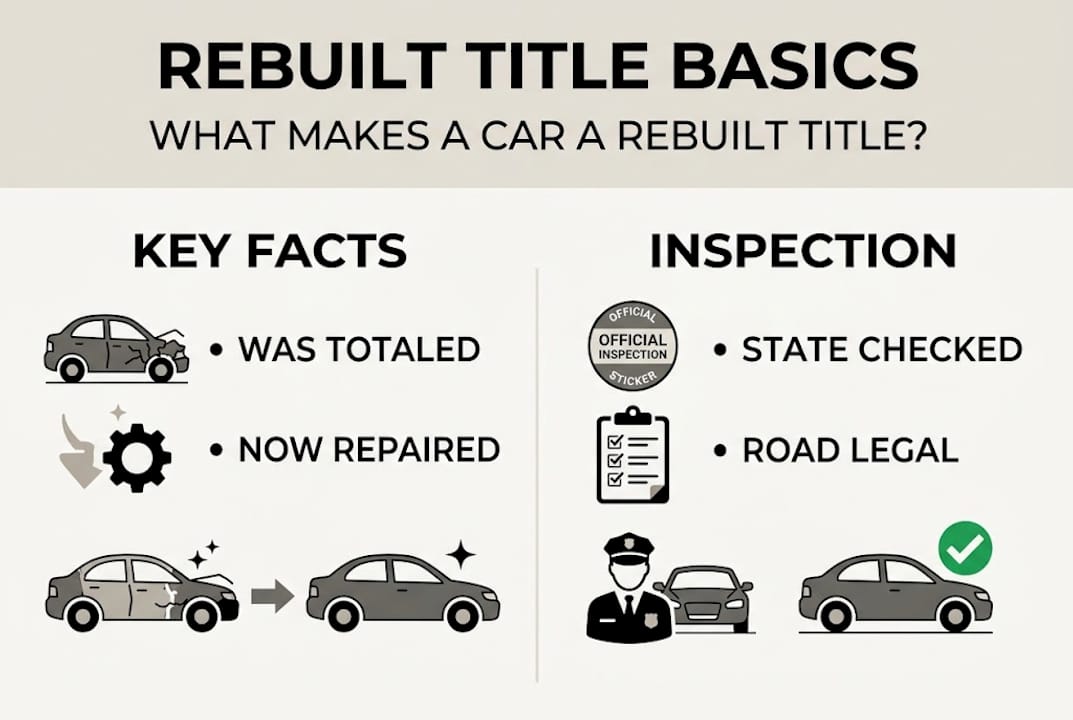
Here is a quick overview to keep the three main title types straight:
| Title type | What it means | Key implication |
|---|---|---|
| Clean title | No major loss history on record | Easier to insure, finance, and resell |
| Rebuilt title | Was a total loss, repaired and inspected | Lower price, more buyer research needed |
| Branded/reconstructed | State-specific variation of rebuilt | Same general category as rebuilt |
Common reasons a car earns a rebuilt title include:
- Hail or weather damage
- Theft recovery (car recovered after being reported stolen)
- Flood exposure
- Collision repairs
- Cosmetic or paint defects deemed too costly to fix by an insurer
Not every rebuilt title car has a dramatic backstory. Some were flagged for cosmetic issues that were genuinely minor. Others did experience more serious incidents. That range is exactly why doing your homework matters so much. Our smart buyer’s guide breaks this down further for buyers who want to learn more.
Consumer Reports generally recommends clean titles for most used-car shoppers, but the publication also acknowledges it is a case-by-case judgment. A car with hail dimples is a very different situation from one with structural frame issues. Context matters enormously here.
How much value do you really save? (and where you lose)
This is where rebuilt titles get genuinely interesting. The savings are real, and for some buyers, they are game-changing. According to Bankrate, rebuilt title vehicles typically sell for 20% to 40% less than comparable clean-title vehicles. On a $25,000 car, that gap is $5,000 to $10,000. That is not pocket change.
But the savings do not tell the whole story. Here is a side-by-side look at the financial picture:
| Factor | Clean title | Rebuilt title |
|---|---|---|
| Purchase price | Full market value | 20-40% discount typical |
| Insurance coverage | Full comprehensive usually available | Most insurers cover it; payout based on rebuilt market value |
| Resale value | Standard depreciation | Additional discount expected |
| Financing | Most lenders available | Fewer lenders; credit unions more likely to help |
The resale piece deserves a little extra attention. When you go to sell a rebuilt title car, you will likely pass that same discount on to your next buyer. The rebuilt title value conversation continues down the line. That is not a dealbreaker, but it is worth pricing into your expectations upfront.
On the insurance side, good news: most insurers do cover rebuilt title vehicles. Coverage is generally available, though payouts are based on the rebuilt market value of the car rather than what a dealership marked it up to. If you overpay for a rebuilt title car, that gap could hurt you at claim time. Knowing how a rebuilt title affects car value helps you negotiate a fair purchase price from the start.
Additional financial trade-offs to keep in mind:
- Fewer lenders will finance a rebuilt title vehicle
- Some extended warranty programs exclude rebuilt title cars
- Resale takes longer in some markets
- The actual discount varies by make, model, and vehicle history
Pro Tip: Use the 20-40% discount range as your starting benchmark, not your ceiling. Factor in what you might pay for a pre-purchase inspection and any follow-up repairs. If the math still works out in your favor, you could be looking at a genuinely smart buy. If you are curious about financing rebuilt cars, that resource will walk you through your realistic options.
Must-know steps before you buy
With the pricing realities in mind, here is how to buy smart and avoid regret. Think of this as your pre-purchase checklist, built for someone who wants a great deal and peace of mind.
- Pull the vehicle history report. Use CarFax, Experian AutoCheck, or the free NMVTIS database at vehiclehistory.gov to confirm the title status and see the full vehicle history on record.
- Verify the actual repairs. Ask for documentation from the repair shop, including receipts, part invoices, and any inspection results. A seller who cannot produce paperwork is a seller worth walking away from.
- Scrutinize documentation carefully. Compare the repair records to what the vehicle history report shows. Gaps between what the seller says and what the records show are red flags.
- Arrange a professional inspection. This is non-negotiable. Find a mechanic you trust who has no financial stake in the sale, and have them put the car on a lift.
- Take a proper test drive. Drive it on the highway, not just around the block. Listen for unusual sounds, feel for pulling or vibration, and test every electronic feature.
The most important investment you can make is a professional inspection by a qualified mechanic, which typically costs $120 to $200 and can save you from a much more expensive mistake.
Consumer Reports’ used-car buying safety process reinforces this point strongly: always cross-reference vehicle history reports with a physical inspection. No online report alone gives you the complete picture.
Pro Tip: If you can choose between two rebuilt title cars, prioritize the one with a straightforward, well-documented history over the one with a bigger price drop but murky records. Transparency beats a bargain every time. Knowing where to buy rebuilt title cars also matters, since some platforms give you far more upfront information than others. The save money buying rebuilt guide has additional strategies worth bookmarking.
Common pitfalls and how to avoid them
Knowing what not to do can save you both money and headaches. Rebuilt title purchases are not harder than regular used-car buys, but they do demand more attention. Here are the mistakes buyers make most often:
- Skipping the inspection. It is tempting when a car looks clean and the seller seems trustworthy. Skip this step and you are flying blind.
- Relying solely on seller claims. Sellers are not always dishonest, but their recollection of what happened to a car is not a substitute for documentation.
- Misreading repair records. A stack of paperwork looks reassuring, but records that are vague, unsigned, or inconsistent tell a different story.
- Underestimating insurance complexity. Most insurers will cover rebuilt title cars, but it pays to call your insurer before you buy, not after, to confirm coverage terms.
- Optimism bias. This is a big one. Buyers naturally want a car to be fine, especially when they have already fallen for it. That emotional pull can make you dismiss real warning signs.
Consumer Reports notes that with rebuilt title vehicles, the burden of proof shifts squarely to you as the buyer. The seller is not required to prove the car is solid. You have to prove it to yourself.
Pro Tip: Trust your instincts on paperwork. If something feels off, a seller gets defensive about documentation, or the vehicle history seems to skip important timeframes, walk away. There will be another car. Learn more about rebuilt title car cons and how to buy rebuilt vehicles wisely so you are ready for these moments.
Our take: When a rebuilt title car makes sense—and when to walk away
Here is something most guides will not tell you directly: rebuilt title cars are not for every budget-conscious buyer. The savings are real, but so is the homework required to capture them safely.
The cases where a rebuilt title genuinely makes sense are specific. Think modest, well-documented vehicle history, such as hail dimples or a recovered theft, where the repair scope is clear and verifiable. Add a seller who is forthcoming with paperwork, a mechanic you trust who gives it a green light, and an insurer who confirms coverage at a rate you can work with. That is the sweet spot.
What most buyers overlook is the rebuilt title impact on resale. You might save $8,000 buying in, only to find the car is harder to sell three years later. Liquidity matters. A bargain that becomes a burden is not really a bargain.
Walk away from anything with major structural concerns, incomplete repair records, or a seller who cannot explain the vehicle’s history clearly. Those are not just red flags. They are full stop signs. For buyers on a tight budget, the rule is simple: only consider a rebuilt title car if you control the process completely and feel zero pressure to commit.
Ready to buy? Trust ReVroom for smart rebuilt title shopping
If you have made it this far, you already know more than most people who browse rebuilt title listings. That knowledge is your biggest advantage. Put it to work.

ReVroom is the only marketplace built specifically for rebuilt title vehicles, and every listing comes with vehicle history information and photos of what the car looked like before it was repaired. No chasing reports, no guessing games. You can start your ReVroom search with the transparency already baked in, so you spend less time investigating and more time finding the right car. Looking for guidance on where to buy rebuilt vehicles? That is a great next read. Your smarter, more affordable car is out there. Go find it.
Frequently asked questions
Will I pay higher insurance for a rebuilt title car?
Most buyers can find coverage for rebuilt title cars, though some insurers may charge more or limit coverage depending on the vehicle’s history. It is smart to confirm your insurer’s terms before finalizing any purchase.
Can I get a car loan for a rebuilt title vehicle?
Financing options are limited for rebuilt title cars, as most major banks tend to decline these loans, but credit unions and some specialty lenders are more open to working with buyers.
How do I check if a rebuilt title car is safe?
Start with a vehicle history report from CarFax, Experian, or NMVTIS, then follow up with a professional inspection by a qualified mechanic who has no stake in the sale.
Are all rebuilt title cars a bad idea?
Not at all. Rebuilt titles are case-by-case, and vehicles with minor cosmetic history and solid documentation can represent outstanding value when properly inspected.
