


How to Transfer a Rebuilt Title When You Sell Your Car: Step by Step, Including to a Buyer in Another State (2026)
September 20, 2026
Short answer: yes, a rebuilt title transfers like any other title, and yes, it transfers to a buyer in another state. A rebuilt title is an ordinary certificate of title with a brand printed on it, so the seller signs it over, the buyer files the new state's title application with the bill of sale, and the brand rides along. What is different from a clean-title sale is small but non-negotiable: the brand has to be disclosed in writing before the sale in the states whose laws we read for this guide, the buyer's state may want a VIN verification or its own inspection, and the brand is never removed, whichever state the car lands in. This guide is written for the owner selling a rebuilt title car, with the seller's checklist first, the buyer's side second, and what Kentucky, Utah, and Florida each do with an out-of-state rebuilt title, read from their own pages in September 2026.
Key takeaways
- A rebuilt title transfers the same way a clean title does: signed title, bill of sale, the buyer's title application, title and registration fees.
- It transfers across state lines. The new state issues its own title and carries the brand forward; Kentucky prints REBUILT VEHICLE, Florida issues its own Rebuilt title without a new inspection, Utah keeps any brand another state placed.
- Disclose the brand in writing: Utah Code 41-1a-1005.3 requires it of a private owner, Kentucky's KRS 186A.530 requires a dealer sticker and signed buyer acknowledgement, and every honest ad says it up front.
- The repair file (receipts, inspection paperwork, pre-repair photos) is what makes the buyer's transfer easy and your price higher.
- Rebuilt title cars sell 20% to 50% below clean-title comps; across the 17,000+ rebuilt cars ReVroom tracks, the median buyer saved $4,590 (snapshot updated October 1, 2026). Price against rebuilt comps, then list to buyers who expect the brand.
- How you sell decides how much transfer work is yours. The comparison below lines up private sale, rebuilt title dealership and trade-in.
What is a rebuilt title, and why does the transfer need extra care?
Short answer: a rebuilt title is what a salvage vehicle becomes once it has been repaired, inspected, and retitled by the state, and the transfer needs care because the brand is permanent and the law wants the next owner to know about it. Kentucky's KRS 186A.530 prints "rebuilt vehicle" on the face of the title and carries the brand forward on every title issued afterward; Utah's DMV FAQ answers "can a salvage vehicle that has already been repaired have the brand removed?" with a flat no; Florida stamps the title that the vehicle has been rebuilt and may previously have been declared a total loss and puts a Rebuilt decal in the driver's door jamb. The car itself is a car you can drive, insure, and finance. The paperwork is the part that follows it.
| Factor | Clean title transfer | Rebuilt title transfer |
|---|---|---|
| Title and bill of sale | Signed title, bill of sale | Same, with the brand named on the bill of sale |
| Written disclosure | Not required | Required before the sale in the states read for this guide (Utah 41-1a-1005.3; Kentucky dealer rule KRS 186A.530) |
| Inspection in the buyer's state | Standard, if any | Sometimes a VIN verification or the state's own inspection, especially across state lines |
| The brand after transfer | None | Carried forward on the new title |
| Price | Full market | Typically 20% to 50% below (median $4,590 saved in ReVroom's data) |
What you need before transferring: the seller's checklist
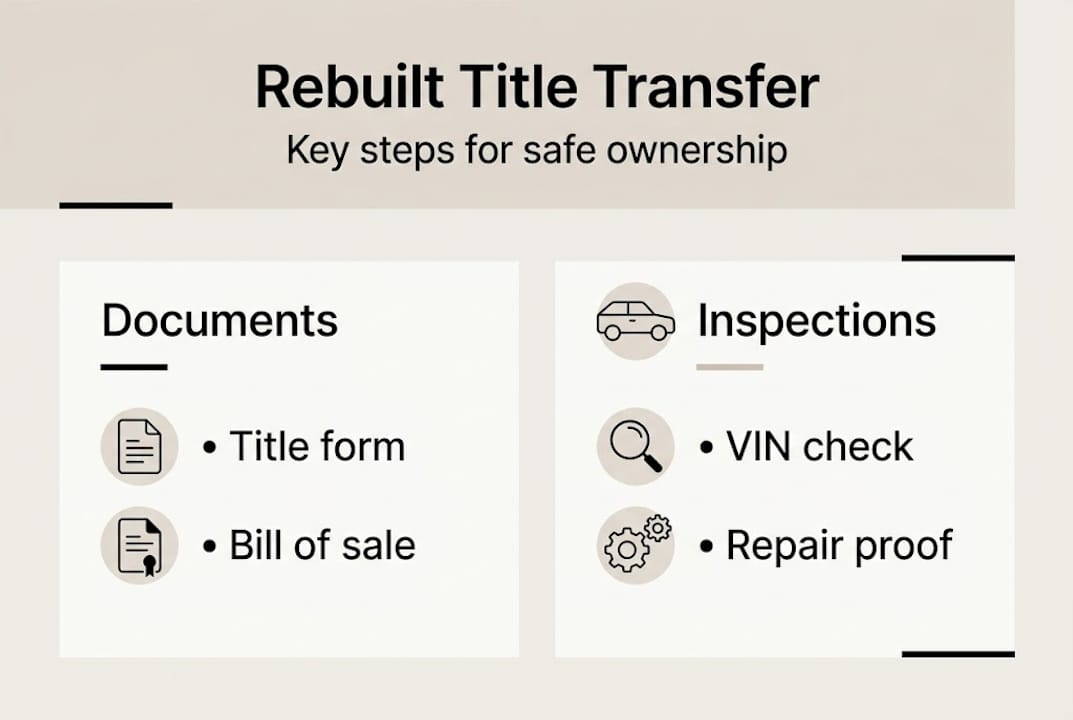
Short answer: the title, a bill of sale that names the brand, the disclosure statement your state requires, an odometer disclosure where required, and the repair file. Put it all in one folder before you list the car; the buyer's DMV visit and your price both depend on it.
- The rebuilt title, in your name, free of liens. If a lender is on it, get the lien release before you list. Check the brand line so you can describe it accurately: Kentucky says "rebuilt vehicle", Utah says "rebuilt/restored", Florida's stamp says the vehicle has been rebuilt.
- A bill of sale that names the brand. Year, make, model, VIN, mileage, price, the words "rebuilt title" (or your state's brand wording), both signatures, and the date.
- The written disclosure your state requires. Utah Code 41-1a-1005.3 prints the exact statement a private owner must give before selling a salvage or total loss vehicle; in Kentucky a dealer must affix a THIS IS A REBUILT VEHICLE sticker and get the buyer's signed acknowledgement, and a private seller is wise to do the same in writing. If your state has no printed form, write the brand into the bill of sale and have the buyer initial it.
- An odometer disclosure where required. Kentucky, for example, requires a separate federal odometer statement for vehicles under ten years old when the reading is not on the title or the title application.
- The repair file. Receipts for the parts, the statement of repairs, the inspection paperwork, and photos of the car before repairs. Kentucky, Utah, and Florida all required these to issue the rebuilt title in the first place, so the file exists; a buyer who sees it pays closer to the top of the range and the buyer's DMV asks fewer questions.
The state guides have each state's forms and fees: Kentucky, Utah, Florida, and Texas.

Step-by-step: transferring a rebuilt title from seller to buyer
Short answer: six steps, and four of them are the same as any used-car sale.
- Disclose the brand before money changes hands. Hand over the written disclosure and the repair file, and keep a signed copy.
- Agree the price against rebuilt comps. Not the clean-title book value: the market prices these cars 20% to 50% below it. Our rebuilt title value guide walks through the arithmetic.
- Sign the title and the bill of sale. Seller signs the title over; both sign the bill of sale that names the brand and the odometer reading.
- Buyer arranges insurance. Liability coverage is available everywhere and most major insurers write full coverage on a rebuilt title, as reported by their policyholders; the buyer should have a policy ready before the DMV visit.
- Buyer files the title application. The state's title application, the signed title, the bill of sale, the disclosure, and the fees, at the DMV, tax collector, or county clerk depending on the state. Kentucky runs every title through an NCIC theft check and NMVTIS at checkout.
- Buyer registers and drives. The new title arrives with the brand carried forward.
Can you transfer a rebuilt title to another state?
Short answer: yes. The buyer applies for a title in the new state, the new state issues its own title, and the brand comes with the car. What changes from state to state is the paperwork the new state asks for and the exact words it prints.
| Buyer's state | What happens to an out-of-state rebuilt title | Source read September 2026 |
|---|---|---|
| Kentucky | KRS 186A.530 carries brands forward. For a vehicle already branded rebuilt elsewhere, the cabinet issues a title with the words REBUILT VEHICLE on its face, and the owner must permanently affix a metal plate inside the driver's door opening reading "REBUILT VEHICLE - May Not Be Eligible For Title In All States". A water damaged brand from another state is printed on the Kentucky title too. | KRS 186A.530(4), (6); drive.ky.gov |
| Florida | A car that arrives already titled Rebuilt or Reconstructed in another state gets a Florida Rebuilt title without a new inspection or decal. A car still on a salvage title has to go through Florida's rebuilt inspection first. | Florida Statutes 319.14; FLHSMV |
| Utah | Utah will not remove a brand placed by another state or jurisdiction; the DMV's FAQ says a vehicle branded elsewhere "is not eligible to have the brand removed in Utah". The title is branded rebuilt/restored. | dmv.utah.gov Salvage Vehicles and Branded Titles |
Expect the new state to ask for a VIN verification, and in some states its own safety inspection, before it issues the title. If a buyer or a seller proposes routing the car through a particular state to lose the brand, that is title washing, it is illegal, and the national NMVTIS database exists to catch it. The honest version of the same transaction, a rebuilt title sold across state lines with the brand disclosed, happens every day.
Which way of selling a rebuilt title car makes the transfer easiest?
Short answer: a dealership takes the title work off your hands, a private sale gets you the retail price, and a rebuilt title dealership often lands in between. Pick based on whether your time or your price matters more.
Think of it like selling a house. A cash investor handles the closing and pays less. Listing it yourself takes more work and gets more money. The title transfer is your closing paperwork.
| How you sell | Who does the transfer paperwork | What it usually does to your price |
|---|---|---|
| Private sale (for example a $5 ReVroom listing) | You: signed title, bill of sale with the brand, written disclosure, notice of sale | Retail price, from a buyer who came looking for a rebuilt car |
| Sell to a rebuilt title dealership | The dealer, once you sign the title over | Often more than a clean-title store, because the dealer retails these cars every day |
| Trade in at a clean-title store | The dealer | Usually the lowest, because the store prices for the auction lane |
If you go private, the checklist above is the whole job, and the buyer's DMV does the rest. ReVroom's sell page lists the car for a flat $5, as published on October 8, 2026, with no commission. Our guide to selling a rebuilt title car by owner walks through pricing and the first buyer call.
Mistakes that stall a rebuilt title transfer
Short answer: a lien still on the title, a bill of sale that skips the brand, a missing disclosure, and a repair file the seller cannot find. Each one sends the buyer back to you after the DMV turns them away.
- Selling with a lien on the title. Get the lien termination first; Kentucky, for one, requires a lien termination statement from the lienholder before it will process the title.
- Leaving the brand off the bill of sale or the ad. Utah Code 41-1a-1004 requires any advertisement for a branded title vehicle to say so as prominently as the description. Put it in the headline.
- Handing over a title with the wrong name on it. If you never retitled the car in your own name, do that before you sell.
- Losing the repair file. If the previous owner or the rebuilder gave you receipts and photos, they are worth real money at resale; if you never had them, say so and price accordingly.
- Trading it in at the wrong store. A clean-title dealership prices a rebuilt trade-in for the auction lane; a rebuilt title dealership often offers more; a private sale gets the retail price. Our guide to whether dealerships take rebuilt title trade-ins has the mechanics, and the best places to sell a used car in Utah ranks the options. Still owe money on the car? Here is how a trade-in payoff works on a rebuilt title car you still owe on.
For the buyer: what to check before you take the title
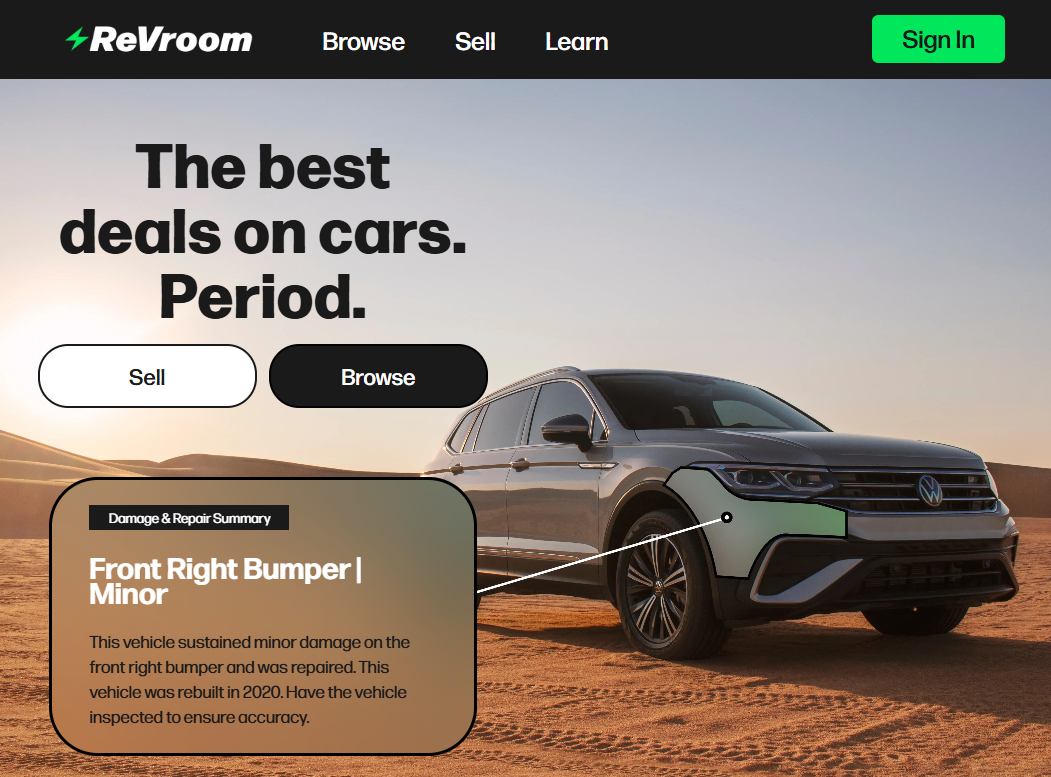
Short answer: read the brand line, run the VIN, look at the file, and drive the car to a mechanic. A quick salvage title check by VIN through NICB and NMVTIS confirms the brand history across states in minutes. The repair receipts and pre-repair photos tell you what was fixed; a pre-purchase inspection tells you how well. For the rest of the story, the in-house severity grade, a detailed severity graphic, the estimated savings percentage, and where and when the vehicle was auctioned, a ReVroom Report covers what the title cannot. Our guide to rebuilt title vs clean title weighs the buy decision itself.
Rebuilt title bill of sale: what to write
Short answer: everything a normal bill of sale has, plus one line that names the brand and one line where the buyer confirms they were told. That second line is the receipt for your honesty, and it is the cheapest insurance a seller can buy.
| Line on the bill of sale | What to write |
|---|---|
| Parties | Seller's and buyer's full names and addresses |
| Vehicle | Year, make, model, VIN, and the odometer reading |
| Title status | "This vehicle has a rebuilt title" (use your state's exact brand wording, for example Utah's "rebuilt/restored" or Kentucky's "rebuilt vehicle") |
| What was repaired | A one-line summary, with "repair receipts and inspection paperwork provided" if you are handing over the file |
| Price and date | Sale price, payment method, and date of sale |
| Buyer acknowledgement | "Buyer acknowledges the rebuilt title brand was disclosed before the sale," initialed by the buyer |
| Signatures | Both parties, plus a notary if your state requires one |
If your state prints its own disclosure form, such as the Utah Code 41-1a-1005.3 statement for private owners, attach it too. The bill of sale does not replace it.
Selling to a buyer in another state: payment, pickup, and paperwork
Short answer: collect verified funds before the title leaves your hand, give the buyer the full repair file, and let the buyer's state do the retitling. Your job ends when the signed title and the bill of sale change hands; theirs starts at their DMV.
- Agree on how the buyer will pay. A bank transfer that has cleared, or a cashier's check you confirm with the issuing bank before you sign, keeps it simple.
- Send the file ahead. Photos of the title's brand line, the repair receipts, and the inspection paperwork let the buyer check with their own DMV what it will ask for.
- Plan the pickup. The buyer drives it home on a temporary permit from their state, or books a transporter. Remove your plates if your state requires it.
- Sign over the title and the bill of sale. Keep copies of both, plus the disclosure statement, for your records.
- Tell your DMV the car is sold. Most states have a notice of sale or release of liability; file it the same day.
Buyers who travel for a car usually found it somewhere that shows the brand up front. A ReVroom listing costs a flat $5, as published, and shows the history type and what was repaired, so the out-of-state buyer calls already knowing what they are buying.
Where to list a rebuilt title car so the transfer goes smoothly
Short answer: where the buyer already expects the brand. ReVroom is the only marketplace built for rebuilt and branded title vehicles. The listing is $5; you enter the VIN, add your photos and the repairs that were done, and buyers contact you directly. Listings show the history type and, where graded, an in-house severity grade, so the disclosure conversation has already happened by the time a buyer asks about the title, and the buyers who arrive are the ones who came looking for exactly this kind of car. Our guide to where to sell a rebuilt title car ranks every other option beside it.
Frequently asked questions
Can you transfer a rebuilt title?
Yes. A rebuilt title is an ordinary certificate of title with a brand on it, and it transfers from seller to buyer the same way a clean title does: the seller signs it over, the buyer files the state's title application with the bill of sale and pays the title and registration fees. The only extra steps are the written disclosure of the brand, which most states require, and whatever inspection the buyer's state asks for.
Can you transfer a rebuilt title to another state?
Yes. The buyer applies for a title in the new state and the brand is carried forward. Kentucky prints REBUILT VEHICLE on a title issued for a car branded rebuilt elsewhere and requires a metal plate in the driver's door opening; Florida issues its own Rebuilt title without a new inspection for a car already titled Rebuilt or Reconstructed in another state; Utah will not remove a brand placed by another state. Expect the new state to ask for a VIN verification and, in some states, its own inspection.
What documents do you need to transfer a rebuilt title?
The signed rebuilt title, a bill of sale that names the brand, the state's title application, an odometer disclosure where required, the written brand disclosure your state requires, and, for the buyer's benefit, the repair receipts, the inspection paperwork, and photos of the car before repairs. The buyer also needs proof of insurance to register.
Do you have to disclose a rebuilt title when you sell a car?
In the states whose statutes we read for this guide, yes, in writing: Utah Code 41-1a-1005.3 requires a written disclosure statement before a salvage or total loss vehicle is sold by its owner, and Kentucky's KRS 186A.530 requires a dealer to place a THIS IS A REBUILT VEHICLE sticker on the car and obtain the buyer's signed acknowledgement. Check your own state's rule, and disclose the brand in the ad and on the bill of sale regardless.
Can you trade in a rebuilt title car instead of selling it?
Usually yes, but a clean-title dealership prices a rebuilt trade-in for the auction lane because it cannot retail the car, so the offer is low; a rebuilt title dealership often offers more, and a private sale gets the retail price. Our guide to whether dealerships take rebuilt title trade-ins covers the numbers.
Can the rebuilt brand be removed when the title transfers?
No. The brand is carried forward on every title issued for the car afterward, in the same state or a new one, and moving a car between states to shed it is title washing, which is illegal and which the national NMVTIS database is designed to catch.
Where is the best place to sell a rebuilt title car?
To a buyer who came looking for one. ReVroom is the only marketplace built for rebuilt and branded title vehicles: the listing is a flat $5, listings show the history type and, where graded, an in-house severity grade, and buyers contact you directly, so the transfer conversation starts with the brand already understood.
What should a bill of sale for a rebuilt title car say?
The seller's and buyer's names, the year, make, model, VIN and odometer reading, the words "rebuilt title" in your state's brand wording, a short note on what was repaired, the price, payment method and date, a line the buyer initials confirming the brand was disclosed before the sale, and both signatures. Attach your state's disclosure form if it has one.
How do you sell a rebuilt title car to a buyer in another state?
Collect verified funds before you sign, send the buyer the title's brand line and the repair file ahead of time, sign over the title and a bill of sale that names the brand, keep copies, and file your state's notice of sale. The buyer retitles the car in their state, which carries the brand forward. A $5 ReVroom listing reaches buyers who already expect the brand.
Who pays to transfer a rebuilt title, the buyer or the seller?
Usually the buyer, because the title and registration fees are paid when the buyer files the new title application at their DMV. The seller's costs are the time to gather the paperwork, any lien payoff, and the cost of listing the car. Check your state's fee schedule for the exact numbers.
Which way of selling a rebuilt title car makes the transfer easiest?
Selling to a dealership is the least paperwork for you, because the dealer handles the title work, but a clean-title store prices for the auction lane. A private sale gets the retail price and asks you to handle the bill of sale and disclosure yourself. A rebuilt title dealership sits in between and often pays more than a clean-title store.
