


Rebuilt title registration: step-by-step guide for 2026
April 16, 2026
TL;DR:
- Rebuilt title vehicles offer 20-50% savings but require thorough inspection and documentation.
- The registration process involves inspections, paperwork, and state-specific steps, often taking days to weeks.
- Buyers should be cautious of potential higher insurance costs, resale limits, and vehicle history issues.
Buying a rebuilt title vehicle can put serious money back in your pocket. We’re talking savings of up to 50% compared to a clean title equivalent. But the registration process? That’s where a lot of buyers hit unexpected speed bumps. Miss a document, skip an inspection step, or underestimate your state’s requirements, and you’re looking at delays, extra fees, and headaches that eat right into those savings. This guide walks you through every stage of the rebuilt title registration process, from understanding what that title actually means to driving away legally and confidently. Consider this your co-pilot for one of the smartest vehicle purchases you can make.
Table of Contents
- Understanding rebuilt titles and their registration requirements
- What you need before you start: documents, repairs, and inspections
- Step-by-step: The rebuilt title registration process in your state
- Common pitfalls and real cost factors for budget buyers
- Final steps: Registering, insuring, and driving away legally
- The real deal: What most guides miss about rebuilt titles
- Looking for more rebuilt title resources?
- Frequently asked questions
Key Takeaways
| Point | Details |
|---|---|
| Budget savings potential | A rebuilt title car can save you 20-40% compared to buying a clean title, but only if the process is handled correctly. |
| Documentation is critical | Thorough receipts and inspection reports are essential for registration approval and future resale value. |
| Registration rules vary | Each state sets different inspection and title branding requirements—know your local DMV’s process before you start. |
| Extra costs and hurdles | Expect to pay higher insurance rates and encounter limited financing options versus clean title cars. |
| Fraud risks exist | Title washing and hidden damage are real dangers—always get VIN checks and require full repair histories. |
Understanding rebuilt titles and their registration requirements
Before you can register a rebuilt title vehicle, you need to know exactly what you’re dealing with. A rebuilt title is issued to a vehicle that was previously declared a total loss by an insurance company, then professionally repaired and inspected to meet roadworthy standards. Think of it like a car that took a detour and came back stronger. It’s legal, drivable, and in many cases an excellent value.
Here’s how the three main title types stack up:
| Title type | What it means | Resale value | Insurability |
|---|---|---|---|
| Clean title | No major reported incidents | Full market value | Standard rates |
| Rebuilt title | Repaired after total loss declaration | 20-40% below clean | Available, sometimes higher premium |
| Pre-repair title | Declared total loss, not yet repaired | Below market | Not insurable for road use |
The rebuilt title registration process in the U.S. generally involves repairing a vehicle to roadworthy condition, passing a state-mandated safety inspection, submitting documentation to the DMV, and applying for a rebuilt or equivalent branded title. Each state handles this a little differently, but that’s the core framework everywhere.
Here’s what makes rebuilt titles genuinely attractive, and where you need to keep your eyes open:
- Savings: Purchase prices run significantly below clean title equivalents, often 20-50% less
- Legal road use: A rebuilt title means the car has been inspected and cleared for driving
- Permanent brand: In most states, the rebuilt brand stays on the title forever, which does affect resale
- Value impact: Understanding the rebuilt title effect on car value helps you set realistic resale expectations
- Vehicle history: Backgrounds vary widely, from hail damage to theft recovery, so transparency matters
Worth knowing: The title brand issued after this process is typically permanent. Even a perfectly repaired vehicle will carry that rebuilt designation on its title indefinitely. Factor this into your long-term plans, especially if you intend to resell.
What you need before you start: documents, repairs, and inspections
Armed with clarity on what a rebuilt title means, let’s look at everything you’ll need in hand before scheduling your rebuilt title inspection. Getting organized upfront saves you from making multiple trips to the DMV and avoids the frustration of having paperwork rejected on a technicality.

Here’s a sample checklist with typical cost ranges:
| Requirement | Details | Estimated cost |
|---|---|---|
| Original title document | Must show pre-repair status | Free (already owned) |
| Repair receipts | Itemized, from licensed shops | Varies by repair scope |
| Before and after photos | Documenting repair stages | Free to minimal |
| State inspection form | Provided by DMV or inspection station | $10-$100+ |
| VIN verification | Confirms vehicle identity | $0-$50 |
| DMV application form | State-specific rebuilt title application | Included in filing fees |
The documentation step is where experts consistently flag the most issues. Receipts need to show parts costs clearly, and photos should capture the vehicle at multiple repair stages, not just before and after. Uneven state standards mean what’s acceptable in one state might not fly in another.
The rebuilt car retitling process follows a general sequence: obtain the pre-repair title, complete repairs, pass inspection, submit all documentation, and pay applicable fees. But state variations are real. California requires a CHP inspection. New York has its own form requirements. Texas leans heavily on proof-of-repair documentation.
Here’s how to organize your repairs for a smooth submission:
- Keep every receipt from every repair, even minor ones
- Photograph the vehicle before repairs begin
- Photograph key repair stages as work progresses
- Photograph the finished vehicle from multiple angles
- Have repairs done by licensed technicians where possible
- Store all documents digitally and in hard copy
Pro Tip: Before you buy, run a VIN check and have an independent mechanic inspect the vehicle specifically for flood involvement or frame issues. These are the two vehicle history factors most likely to create problems down the road that aren’t always visible on the surface.
Step-by-step: The rebuilt title registration process in your state
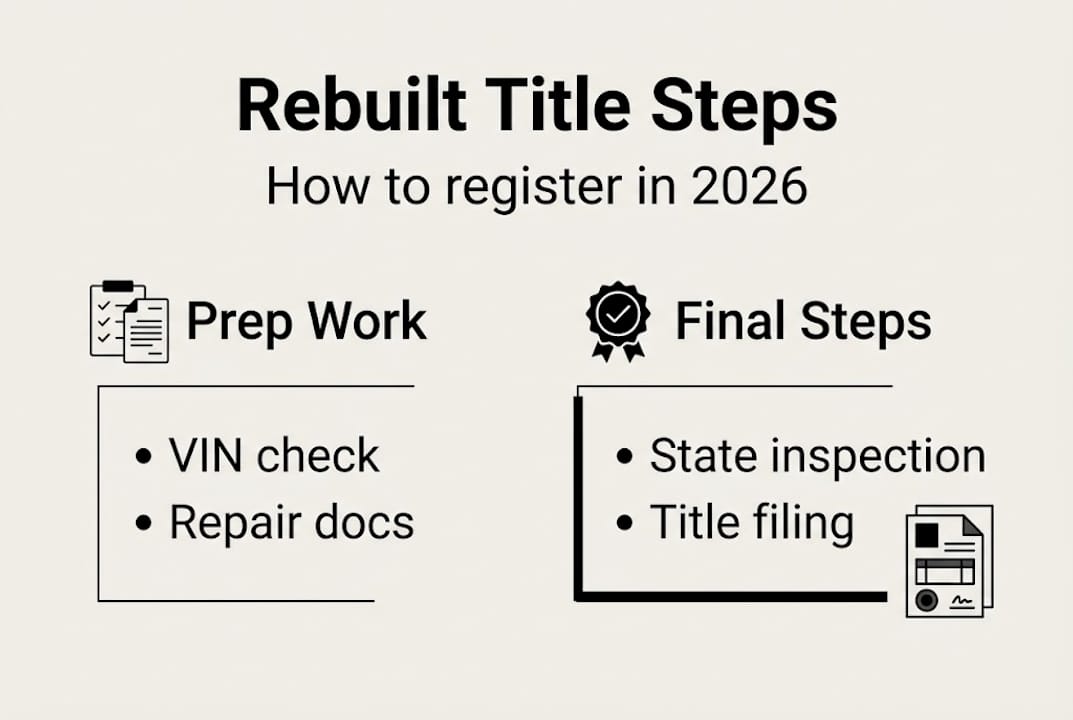
With your repairs and paperwork organized, you’re ready to begin the step-by-step process in your state. While the specifics vary, this is the core journey most buyers follow.
- Confirm your state’s requirements by visiting your DMV’s website or calling ahead. Some states, like California, require inspections by specific agencies such as the CHP. Others use licensed private stations.
- Gather all documentation including the existing title, all repair receipts, photos, and any state-specific forms.
- Schedule your safety inspection. Inspection fees range from $10 to $100+ depending on the state, and wait times can stretch from a few days to several weeks if backlogs are heavy.
- Attend the inspection. The inspector will verify the VIN, check that repairs meet roadworthy standards, and review your documentation.
- Submit your application to the DMV. Bring originals and copies of everything. Some states allow online submission; most still require in-person filing for title changes.
- Pay applicable fees and receive your rebuilt title documentation.
- Register the vehicle and obtain your plates once the title is officially issued.
Most buyers find that the retitling process for rebuilt cars takes anywhere from a few days to several weeks total. California’s process tends to run longer due to the CHP inspection requirement. States with specific rebuilt registration requirements often post full checklists on their DMV websites, which is always worth bookmarking.
Pro Tip: Triple-check every document before submission. A single mismatch between the VIN on your paperwork and the one on the vehicle can send everything back to square one. It sounds basic, but it’s the most common delay we hear about.
Common pitfalls at this stage include forgetting out-of-state title verification if the car was purchased across state lines, and assuming your state’s inspection stations are widely available. In rural areas, finding a certified inspector can add real time to your timeline.
Common pitfalls and real cost factors for budget buyers
You’ve completed the hard part, so now make sure the savings actually materialize by preparing for costs and avoiding the most common budget-buster mistakes.
Let’s talk numbers honestly. Rebuilt cars sell 20-40% below clean title equivalents, which is genuinely compelling. However, insurance premiums can run higher with some providers, and many traditional lenders are cautious about financing rebuilt title vehicles, making cash purchases far more common. Explore financing options for rebuilt cars before assuming you need to pay the full amount upfront.
Here are the pitfalls that catch buyers off guard most often:
- Resale value drop: The permanent title brand limits your future selling price significantly
- Insurance premium variations: Some providers charge more, so shopping around is essential
- Financing limitations: Many lenders pass on rebuilt titles, so have a payment plan ready
- Title fraud risks: Title washing affects about 1 in 325 used cars, making VIN verification non-negotiable
- Flood and electrical history: These vehicle histories are harder to detect and can become costly surprises
- Out-of-state title complications: If the car was titled elsewhere, verification steps add time and cost
Understanding rebuilt title insurance costs upfront helps you calculate your true total cost of ownership before you commit. The savings are real for the right buyer in the right situation. Cash buyers planning to keep the vehicle long-term tend to come out ahead. If you’re counting on quick resale or traditional financing, the math changes considerably.
The savings on a rebuilt title vehicle are genuine and significant. But they work best for buyers paying cash, holding the vehicle long-term, and willing to do their homework on vehicle history. Going in without that preparation is where the value proposition breaks down.
Final steps: Registering, insuring, and driving away legally
With all prerequisites managed and pitfalls avoided, here’s how to complete your rebuilt title journey and hit the road with confidence.
- Receive your rebuilt title from the DMV and verify all details are correct, including the VIN, your name, and the title brand notation.
- Complete vehicle registration by submitting registration forms, paying registration fees, and providing proof of insurance.
- Obtain your license plates either at the DMV or through your state’s mail-in program.
- Secure your insurance policy before or simultaneously with final registration. Most states require proof of insurance at registration.
- Keep copies of all title and registration documents in the vehicle and stored digitally.
Once your rebuilt title is registered, be aware that many states require you to disclose the rebuilt title status when reselling the vehicle. This isn’t a burden; it’s actually what makes the transaction honest and protects you legally. Transparency at resale is always the right move.
For insurance on your rebuilt title car, the good news is that most major insurers do cover rebuilt title vehicles. Shopping around is key, though. Rates and willingness to cover vary by provider. It’s also worth understanding how insurance, financing, and warranties interact for rebuilt title owners before finalizing any purchase.
Pro Tip: Start calling insurance providers before you finish the DMV process. Getting a quote confirmed ahead of time means no last-minute scrambles on registration day.
The real deal: What most guides miss about rebuilt titles
Now that you know how it’s done, here’s what honest insiders wish more guides would tell budget-minded buyers.
The rebuilt title process rewards patience and attention to detail more than almost any other vehicle purchase. Experts consistently flag uneven state standards as a real risk factor, and it shows. States with stricter inspection requirements, like California, often produce better outcomes for buyers simply because the bar for roadworthiness is higher. If you’re buying across state lines, research the originating state’s standards carefully.
The honest truth is that rebuilt title vehicles are an excellent fit for a specific type of buyer: someone paying cash, planning to own the vehicle for several years, and committed to understanding the car’s full background. If you’re planning to flip it in 18 months, the impact on rebuilt title value at resale will likely eat your savings.
Watch for these red flags and never ignore them:
- Sellers who can’t or won’t show repair documentation and photos
- Incomplete paperwork with gaps in the vehicle’s timeline
- Cars sourced from flood-affected regions after major storm seasons
- Titles that have moved through multiple states in a short period
- VIN numbers that don’t match across documents
Only trust repairs backed by thorough, photo-documented evidence. And always get an independent mechanic to inspect the vehicle in person, especially for frame integrity and electrical systems. No online report replaces eyes and hands on the car.
Looking for more rebuilt title resources?
If this guide helped you get a clearer picture of the rebuilt title registration process, you’re already ahead of most buyers. But there’s more ground to cover when it comes to scoring real value on a rebuilt title vehicle.

ReVroom is built specifically for buyers like you. Every listing on ReVroom’s rebuilt car marketplace includes vehicle history information and pre-repair photos so you can evaluate each car with clear eyes, not crossed fingers. No $150 background report required. From process checklists to insurance guidance to resale advice, ReVroom puts the information you need right where you need it. Come see what’s waiting for you.
Frequently asked questions
How long does the rebuilt title registration process usually take?
Depending on your state, the process takes days to weeks, especially if inspections or paperwork reviews are backlogged. Planning for two to four weeks is a safe buffer in most cases.
What’s the difference between a rebuilt and a pre-repair title?
A pre-repair title is given to a vehicle declared a total loss that has not yet been repaired; a rebuilt title is issued after repairs and inspection confirm the car is roadworthy and legal for road use.
Is insurance more expensive for rebuilt title cars?
Some providers do charge more, with premiums running 20-40% higher in certain cases, but most major insurers cover rebuilt title vehicles. Shopping multiple providers is the smartest move.
Are rebuilt title brands ever removed from a car’s title?
In most states, the rebuilt brand is permanent on the title regardless of repair quality, which is something to factor into your long-term resale plans from the start.
What is title washing and how can I avoid it?
Title washing is fraud where a vehicle’s history is obscured by moving its title across states; it affects about 1 in 325 used cars, so always run a VIN check and verify all paperwork carefully.
