


Rebuilt Cars for Sale: Your Honest Buyer's Guide
July 26, 2026
Where can you find rebuilt cars for sale in the US?
The best rebuilt cars for sale are a click away if you know where to look. These vehicles were once declared total losses by insurance companies, then professionally repaired and certified roadworthy by state inspectors. They typically cost 20%–40% less than comparable clean-title cars, making them one of the smartest buys for budget-conscious drivers.
Here are the main platforms where you can find rebuilt vehicles for sale today:
- Revroom — the only marketplace built exclusively for rebuilt and branded title vehicles. Every listing includes state certification confirmation, pre-repair photos, and vehicle history so you can compare options without paying for separate reports.
- Copart — a large salvage and rebuilt vehicle auction platform. Inventory is massive, but most listings are salvage (not yet repaired), so you need to filter carefully and understand what you’re bidding on.
- eBay Motors — a broad used-car marketplace where private sellers and dealers list rebuilt title vehicles alongside clean-title cars. Transparency varies widely by seller.
- Salvage Reseller — an aggregator pulling listings from multiple salvage and rebuilt auctions. Good for browsing volume, though vehicle history detail depends on the originating auction house.
Revroom stands apart because transparency isn’t optional there. Accident history and before-repair photos come standard with every listing, not as an add-on you have to chase down.
Table of Contents
- What does a rebuilt title actually mean?
- How do you evaluate a rebuilt car before buying?
- What does the buying process look like on rebuilt car marketplaces?
- How Revroom gives you transparency other platforms don’t
- Revroom: the smarter way to shop rebuilt vehicles
- FAQ
- Key Takeaways
What does a rebuilt title actually mean?
A rebuilt title (sometimes called a reconstructed title) means a vehicle was previously branded “salvage” after an insurance company declared it a total loss, then repaired and passed a state safety inspection to return to public roads. Once it clears that inspection, the DMV issues the rebuilt brand, and the car is legal to drive, register, and insure.
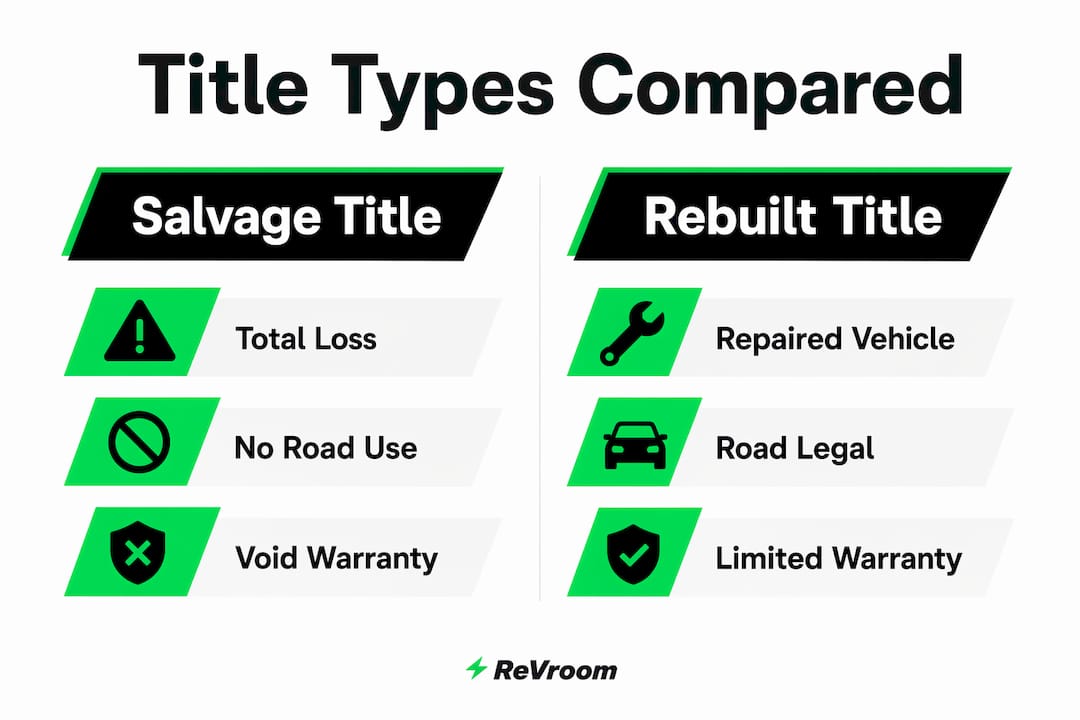
Salvage and rebuilt are two very different things. A salvage title means the car has NOT been repaired or inspected. You cannot legally drive a salvage vehicle on public roads. A rebuilt title means that work is done.
A few things worth knowing before you buy:
- Price: Rebuilt title vehicles typically sell for 20%–40% below a comparable clean-title car. That discount reflects the title history, not necessarily the mechanical condition.
- Resale: The rebuilt brand is permanent. When you sell, the next buyer sees the same history, so resale value remains lower than clean-title equivalents.
- Insurance: Most insurers will cover rebuilt title cars, but comprehensive and collision coverage can be harder to obtain and may run higher premiums. Always confirm coverage options before you commit to a purchase.
- Financing: Many banks won’t finance rebuilt title vehicles. Credit unions and personal loans are often better routes, or paying cash sidesteps the issue entirely.
- State inspections: Requirements vary. States like Virginia, Georgia, and Tennessee each have their own inspection and documentation standards before a rebuilt title is issued. The salvage-to-rebuilt process is more rigorous in some states than others, which affects buyer confidence.
Understanding the difference between a salvage title and a rebuilt title is the single most important thing you can do before shopping.
How do you evaluate a rebuilt car before buying?
A rebuilt car’s biggest risk is what you can’t see in the listing photos. A proper pre-purchase evaluation covers documentation, structure, mechanical systems, and electronics. Here’s how to approach it:
- Get the vehicle history. Request full documentation of the original incident and all repair work. Sellers who won’t share repair invoices and before-repair photos are a red flag worth taking seriously.
- Hire an independent mechanic. Budget roughly $150–$300 for a comprehensive pre-purchase inspection from a shop that has no connection to the seller. Ask them to focus on frame integrity, electronics, and airbag systems.
- Run an OBD-II scan. A basic Bluetooth OBD-II scanner costs as little as $20. You’re looking for pending codes and recently cleared codes. A freshly wiped code history on a rebuilt vehicle suggests someone erased active faults before showing the car.
- Check the seatbelt pretensioners. These are single-use components that deploy during a collision. If they weren’t replaced, the belts won’t function correctly in a future crash. Pull each belt out fully and check for smooth retraction.
- Flag flood history immediately. Consumer Reports advises that flood-damaged vehicles pose higher long-term risks due to electrical and sensor problems that can surface months or years after repairs. If the vehicle history shows flood involvement, proceed with extra caution.
- Know what type of damage you’re looking at. Hail-damaged rebuilt cars are often among the most mechanically reliable options in this market. The mechanical and electrical systems are untouched; only body panels were affected.
Pro Tip: Ask the seller for the original damage photos and the repair receipts before scheduling an inspection. If those documents don’t exist or the seller hesitates, that tells you more than any mechanic visit will.
What does the buying process look like on rebuilt car marketplaces?
Whether you’re using an auction platform or a dedicated marketplace like Revroom, the process follows a similar path. Here’s what to expect:
- Register on the platform. Most require an account before you can view full listings, bid, or contact sellers. Some auction platforms also require a deposit to participate in bidding.
- Search and filter. Use filters for vehicle type, price range, and condition category. On Revroom, you can filter by vehicle history type so you’re only seeing the options that fit your comfort level.
- Review the listing thoroughly. Look at every photo, read the vehicle history, and note the damage type. Don’t skip this step to save time.
- Participate in bidding or direct purchase. Auction platforms run timed bids; marketplace platforms like Revroom often allow direct purchase. Know your ceiling before you start.
- Arrange an inspection before finalizing. On most platforms, you can schedule a pre-purchase inspection during the listing period. Do it.
- Complete the paperwork. After purchase, you’ll receive the title (branded “rebuilt” or “reconstructed”). You’ll need to register the vehicle in your state and obtain insurance before driving it.
- Timeline: From finding a listing to completing the title transfer, expect roughly one to three weeks depending on your state’s DMV processing times and whether an inspection is required.
Warranty coverage is limited on rebuilt vehicles. Most factory warranties are voided when a car receives a salvage or rebuilt brand. Some third-party extended warranties cover rebuilt title cars, but verify the terms before assuming any protection. If you’re wondering about financing a rebuilt car, the short answer is that it’s possible but requires more legwork than a clean-title purchase.
How Revroom gives you transparency other platforms don’t
Revroom was built specifically for rebuilt and branded title vehicles, which changes everything about how listings work. Every car on the platform has passed state-required certification confirming it’s repaired and road ready. That’s the baseline. What makes Revroom different is what comes with each listing.
- Every listing includes accident history information and photos of what the car looked like before repairs.
- Buyers can compare options without paying for separate third-party reports.
- The platform covers the full range of vehicle histories, from light cosmetic repairs to more significant work, framed as buyer choice rather than a hierarchy of risk.
Vetting a rebuilt or branded title vehicle on your own typically involves investigations and reports averaging $150 per vehicle. Revroom builds that transparency directly into every listing at no extra cost to the buyer.
For vehicles you find anywhere else, Revroom also offers Revroom History Reports at $15 each. Give them a VIN, a price, a mileage, and a city, and you’ll get a clear picture of what happened to the car, how severe it was, and whether the asking price is fair compared to similar clean-title vehicles nearby. It’s the cheapest confidence you can buy on a rebuilt vehicle.

Revroom: the smarter way to shop rebuilt vehicles
Rebuilt cars for sale are widespread online, but many platforms weren’t specifically built for these buyers. Copart and similar auction sites primarily serve dealers and rebuilders, and eBay Motors offers volume but lacks consistent vehicle history disclosure. Ordinary buyers often spend extra time and money gathering information that ideally should be standard.
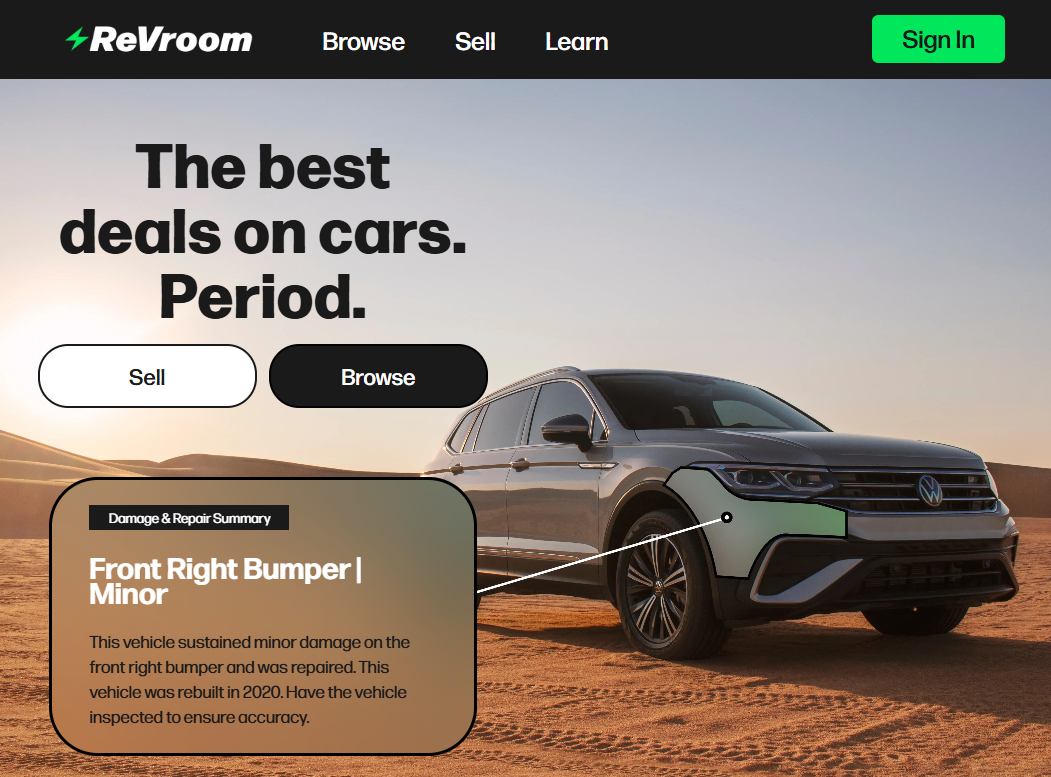
Revroom solves that. It’s a marketplace where every listed vehicle is state-certified, road ready, and comes with the history and photos you need to decide with confidence. No chasing down repair invoices. No paying $150 per vehicle just to understand what you’re looking at. Browse rebuilt vehicles for sale on Revroom and see what a transparent listing actually looks like. Or grab a Revroom History Report for any rebuilt or branded title car you’re already considering, anywhere online, for $15.
FAQ
What is the difference between a salvage title and a rebuilt title?
A salvage title means a vehicle has been declared a total loss and cannot legally be driven on public roads. A rebuilt title means the car has since been repaired and passed a state safety inspection, making it legal to drive, register, and insure.
How much cheaper are rebuilt title cars compared to clean-title cars?
Rebuilt title vehicles typically sell for 20%–40% less than comparable clean-title cars. That discount is permanent and follows the vehicle through every future sale.
Can you insure a rebuilt title car?
Yes, most insurers will provide at least liability coverage for rebuilt title vehicles. Comprehensive and collision coverage can be harder to find and may carry higher premiums, so confirm your options with insurers before purchasing.
What should I check before buying a rebuilt car?
Request the vehicle history and before-repair photos, hire an independent mechanic for a pre-purchase inspection, run an OBD-II scan for cleared diagnostic codes, and verify that seatbelt pretensioners were replaced after the original incident.
Where is the best place to find rebuilt cars for sale online?
Revroom is the only marketplace built exclusively for rebuilt and branded title vehicles, with state-certified listings and built-in vehicle history transparency. Copart, eBay Motors, and Salvage Reseller also carry rebuilt vehicle listings, though transparency and buyer protections vary by platform.
Key Takeaways
Rebuilt title vehicles offer 20%–40% savings over clean-title cars and are legal to drive once they pass state inspection, making them a practical choice for budget-conscious buyers who do their homework.
| Point | Details |
|---|---|
| Price advantage | Rebuilt title vehicles cost 20%–40% less than clean-title equivalents, a discount that is permanent. |
| Title clarity matters | A rebuilt title means repaired and road-legal; a salvage title means neither — never confuse the two. |
| Inspection is non-negotiable | An independent mechanic inspection ($150–$300) and an OBD-II scan are the two checks that protect you most. |
| Insurance and financing limits | Full coverage can be harder to obtain and financing options are narrower; confirm both before committing to a purchase. |
| Revroom’s advantage | Every Revroom listing includes state certification, pre-repair photos, and vehicle history built in, with $15 History Reports available for any rebuilt car found elsewhere. |
