


Rebuilt title pricing guide: smart savings for car buyers
April 17, 2026
TL;DR:
- Rebuilt title vehicles are typically 20 to 50% cheaper than clean title cars.
- Proper inspection and documentation are crucial for assessing the vehicle’s true value and safety.
- Rebuilt titles indicate the car was previously a total loss but professionally repaired and inspected.
Want to save 20 to 50% on your next car? Rebuilt title vehicles offer real, substantial discounts compared to clean title alternatives, but scoring a genuinely good deal takes more than just spotting a low price tag. You need to know how to evaluate what you’re looking at, understand what drives the discount, and verify that the car is worth every dollar you spend. This guide walks you through the entire pricing process, from understanding what a rebuilt title actually means to calculating a fair offer and protecting yourself with a solid inspection. Think of it as your roadmap to buying smarter, not just cheaper.
Table of Contents
- What is a rebuilt title? Understanding the basics
- How to price a rebuilt title car: Step-by-step method
- Factors affecting rebuilt title pricing and value
- Inspection and safety: Protecting your investment
- Our perspective: When rebuilt title pricing makes sense (and when it doesn’t)
- Ready to price and buy your next rebuilt title vehicle?
- Frequently asked questions
Key Takeaways
| Point | Details |
|---|---|
| Discount range | Rebuilt title cars sell for 20-50% less than clean title vehicles, offering substantial savings. |
| Pricing workflow | Start with clean title value, deduct 20-40%, and adjust for damage, repairs, and documentation. |
| Safety first | Mechanic inspections and thorough documentation are critical to avoiding risky rebuilt title purchases. |
| Factor hidden costs | Higher insurance and reduced resale can affect real savings, so calculate total ownership costs. |
| Buyer suitability | Rebuilt title bargains are best for cash buyers seeking long-term ownership with careful vetting. |
What is a rebuilt title? Understanding the basics
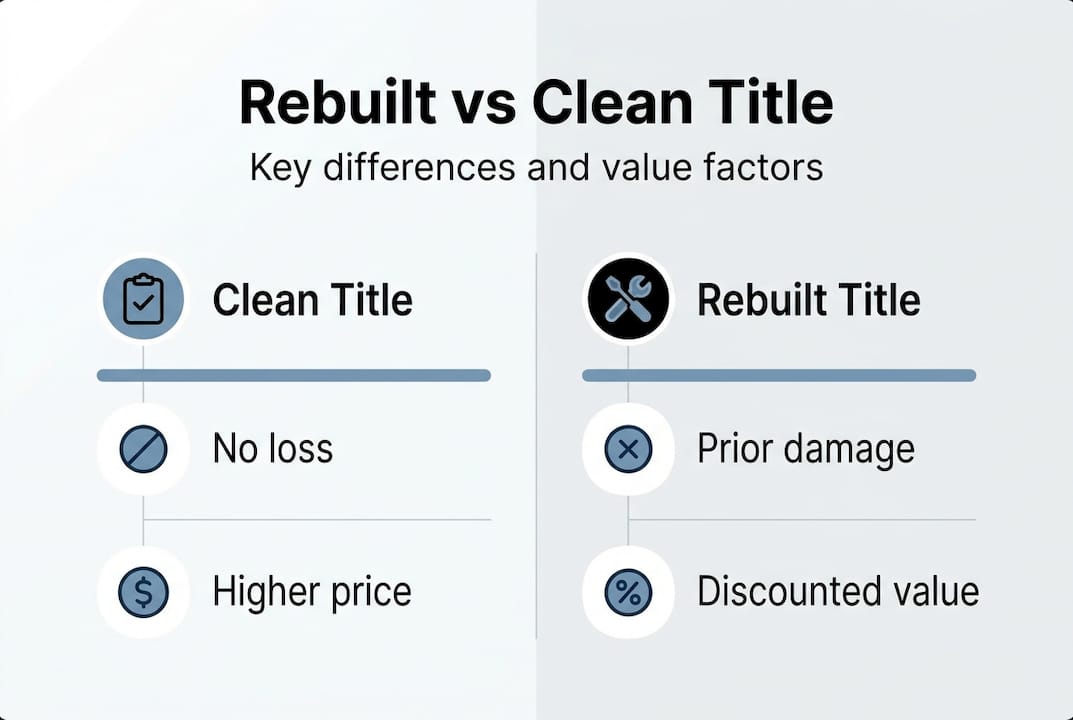
A rebuilt title is a designation given to a vehicle that was previously declared a total loss by an insurance company and has since been repaired and restored to a roadworthy condition. Once the repairs are completed, the vehicle goes through a state inspection to confirm it meets basic safety and operational standards. If it passes, the title is updated from its previous status to “rebuilt” or “reconstructed,” depending on the state.
It’s worth understanding how this differs from a clean title. A clean title simply means no insurer has ever declared the vehicle a total loss. That said, plenty of clean title vehicles have their own histories, including unreported incidents, deferred maintenance, or cosmetic repairs that never made it into any record. A rebuilt title is actually more transparent in one key way: you know something happened and was addressed.
Here’s a quick comparison to put it in perspective:
| Feature | Rebuilt title | Clean title |
|—|—|—|
| Prior total loss declaration | Yes | No |
| State inspection required | Yes | Not always |
| Pricing discount | 20 to 50% below market | Full market value |
| Vehicle history visibility | Disclosed | Varies |
| Financing availability | Limited | Standard |
The rebuilt title meaning boils down to this: a car that went through something significant, got professionally repaired, and earned its way back onto the road. As Consumer Reports notes, these vehicles carry a 20 to 50% discount compared to clean title equivalents, largely because of the perceived risk and reduced resale flexibility.
Why the discount? A few reasons:
- Financing is harder to secure, which limits the buyer pool
- Resale value is lower, so buyers factor in their eventual exit
- Insurance payouts may reflect the rebuilt title market value rather than a marked-up dealership price
- Some buyers simply aren’t comfortable with the history, regardless of repair quality
Understanding rebuilt vs clean title pricing is the foundation of making a smart purchase. Once you know why the discount exists, you can start calculating whether a specific vehicle’s price actually reflects a good deal or just looks like one.
How to price a rebuilt title car: Step-by-step method
Pricing a rebuilt title vehicle isn’t guesswork. There’s a logical, repeatable method that gives you a defensible number before you ever make an offer. Here’s how to do it:
- Find the clean title market value. Look up the vehicle on Kelley Blue Book (KBB) or NADA Guides using its year, make, model, trim, mileage, and condition. This is your baseline.
- Apply the rebuilt title discount. Per industry convention, deduct 20 to 40% from the clean title value to account for the rebuilt designation. Use 20% for minor vehicle history with excellent repairs and full documentation. Use 40% for more significant history or incomplete records.
- Adjust for condition factors. Add or subtract value based on mileage, mechanical condition, repair quality, and available documentation.
- Check comparable listings. Search for similar rebuilt title vehicles online to see what the market is actually bearing. This is your reality check.
- Factor in your inspection results. If a mechanic finds issues, those repair estimates come directly off your offer.
Here’s a sample calculation to make it concrete:
| Variable | Amount |
|---|---|
| Clean title KBB value | $22,000 |
| Rebuilt title discount (30%) | $6,600 |
| Adjusted base price | $15,400 |
| Deduct for minor mechanical issue | $800 |
| Fair offer price | $14,600 |
Pro Tip: Don’t skip NADA alongside KBB. The two tools sometimes differ by hundreds or even thousands of dollars on the same vehicle. Use both and average them for a more balanced baseline before applying your rebuilt title discount.
For a deeper look at how this plays out across different vehicle types, the how to price rebuilt title cars guide at ReVroom walks through real-world examples. You can also cross-reference rebuilt title value benchmarks to see how different vehicle categories tend to hold value after a rebuilt designation.
Factors affecting rebuilt title pricing and value
Once you have your base price, the real work begins. Several variables can push a rebuilt title vehicle’s value significantly higher or lower than the standard discount range. Knowing these factors helps you negotiate with confidence and avoid overpaying.
Type of vehicle history
Not all rebuilt titles are created equal. The nature of a vehicle’s history plays a major role in how much of a discount is warranted:
- Flood or fire history: Expect a 60% or greater discount because of the potential for long-term electrical and structural complications
- Collision history: Typically warrants a 40 to 55% discount, depending on severity and repair documentation
- Cosmetic or hail history: Can carry a much smaller discount, sometimes as low as 20%, especially when repairs are thorough and well-documented
Repair quality and documentation
This is arguably the biggest value driver after the type of history. A vehicle with professional repairs, receipts, photos, and a clear paper trail is worth meaningfully more than one with vague or missing records. Documentation isn’t just paperwork. It’s proof that someone did the job right.

Age and mileage
Older vehicles with higher mileage already carry lower baseline values, so the rebuilt title discount compounds. A five-year-old vehicle with 40,000 miles will hold its rebuilt title value better than a ten-year-old vehicle with 120,000 miles.
State total loss thresholds
Different states declare total losses at different damage thresholds, typically between 60% and 100% of the vehicle’s value. A car declared a total loss in one state might not qualify in another, which affects how significant the underlying history actually was.
Pro Tip: Always check rebuilt title car buying tips before finalizing any offer. Understanding the full picture of risks of rebuilt titles alongside the value factors helps you make a truly informed decision rather than a hopeful one. The rebuilt title risk overview from Consumer Reports is also worth a read for additional context.
Inspection and safety: Protecting your investment
Pricing is only half the equation. A number that looks great on paper means nothing if the car has issues that weren’t disclosed or discovered. This is where inspection becomes non-negotiable.
State inspections confirm that a rebuilt title vehicle meets basic roadworthiness standards before the title is issued. They check things like brakes, lights, steering, and emissions. What they don’t do is evaluate long-term reliability, the quality of body repairs, or the condition of advanced safety systems. That gap is exactly why an independent mechanic inspection is essential for any rebuilt title purchase.
Here’s a checklist of what your mechanic should evaluate:
- Frame and structural integrity. Any misalignment here is a serious concern and a strong negotiating point or a reason to walk away.
- Airbags and safety systems. Confirm all airbags have been properly replaced and that advanced driver assistance systems (ADAS) like lane-keeping and automatic braking are functioning correctly.
- Electrical systems. Especially important for vehicles with flood history. Corrosion in wiring can cause unpredictable issues months after purchase.
- Suspension and alignment. These are common areas where repairs are done incompletely, especially after collision-related history.
- Engine and drivetrain. A compression test and basic fluid analysis can reveal a lot about mechanical health.
Before you buy any rebuilt title vehicle, get it inspected by an independent mechanic you trust, not one recommended by the seller. Your peace of mind is worth the cost of an hour of their time.
Beyond the mechanic visit, review all available documentation carefully. Look for:
- Repair receipts and parts invoices
- Photos of the vehicle before and after repairs
- State inspection certificates
- Any available vehicle history reports
For a thorough walkthrough of what to look for, the rebuilt title inspection guide covers the process in detail. You can also explore how to buy rebuilt titles wisely and review the safety of rebuilt title cars for a broader perspective on what safe ownership actually looks like.
Our perspective: When rebuilt title pricing makes sense (and when it doesn’t)
Here’s the honest take: rebuilt title vehicles are a genuinely smart choice for the right buyer in the right situation. They are not a universal shortcut.
The buyers who benefit most are cash buyers or long-term keepers. If you plan to drive the vehicle for five or more years and you’re not depending on resale value to fund your next purchase, a well-documented rebuilt title car can deliver exceptional value. The 20 to 50% discount is real money, and a car that’s been properly repaired and inspected can serve you well for years.
Where it gets tricky is for short-term buyers or anyone who needs flexible financing. Consumer Reports advises caution for most buyers, and that caution is warranted if you’re planning to flip the car in two years or if you’re counting on traditional auto financing. The rebuilt title risks are real, and they disproportionately affect buyers who haven’t done the homework.
The rebuilt title checklist we recommend comes down to three things: solid documentation, a clean independent inspection, and a realistic estimate of your total ownership costs. Get those three right, and a rebuilt title vehicle can be one of the best financial decisions you make in the car-buying process.
Ready to price and buy your next rebuilt title vehicle?
You’ve got the framework. Now it’s time to put it to work. ReVroom is the only online marketplace built specifically for rebuilt title vehicles, and it was designed with exactly this kind of buyer in mind.

Every listing on ReVroom includes vehicle history information and photos of what the car looked like before repairs, so you’re not starting from scratch with every search. That upfront transparency saves you the $150 or more it typically costs to vet a single vehicle on your own. Browse rebuilt title vehicle listings on ReVroom today and find a car that fits your budget, your standards, and your timeline. Smarter buying starts here.
Frequently asked questions
How much cheaper are rebuilt title cars compared to clean titles?
Rebuilt title cars are typically 20 to 50% cheaper than comparable clean title vehicles, with the exact discount depending on vehicle history type, repair quality, and documentation.
What key factors influence the price of a rebuilt title vehicle?
Repair quality, original vehicle history type, age, mileage, and available inspection records all significantly impact rebuilt title pricing, as outlined in the rebuilt title value guide.
Can I finance a rebuilt title car?
Financing options are very limited, with most lenders refusing rebuilt titles or offering only high-interest loans. Learn more about your options in the rebuilt car financing guide.
Is it safe to buy a rebuilt title car?
Safety varies widely depending on repair quality. Always arrange an independent mechanic inspection and review all repair documentation before committing to a purchase.
What are the biggest risks with rebuilt titles?
Hidden issues from incomplete repairs, reduced resale value, and limited financing options are the primary concerns. Reviewing the rebuilt title value breakdown can help you weigh these factors against the potential savings.
