


Rebuilt title cars: smart savings or hidden risk?
April 14, 2026
TL;DR:
- Rebuilt titles indicate a car was previously declared a total loss, repaired, and passed inspection.
- These vehicles are priced 20-40% lower due to stigma, resale challenges, and insurance issues.
- Successful buyers research vehicle history, get inspections, and understand risks for better outcomes.
Rebuilt title vehicles can cost 20-40% less than their clean title counterparts, yet most buyers scroll right past them. Why? Confusion, mostly. The term “rebuilt title” sounds like a red flag when it’s really just a label, one that tells you a car was once declared a total loss by an insurer, then repaired and cleared for the road again. That’s a lot of history packed into two words. This guide breaks it all down: what a rebuilt title actually means, why these cars are priced the way they are, what risks are real versus overblown, and how to buy one without second-guessing yourself every mile of the way.
Table of Contents
- What is a rebuilt title? Understanding the basics
- Why are rebuilt title cars cheaper? The real cost breakdown
- Key risks and how to avoid them when buying rebuilt
- Insurance and financing for rebuilt title cars
- Why rebuilt titles are misunderstood (and how savvy buyers win)
- Ready to shop smarter for your next car?
- Frequently asked questions
Key Takeaways
| Point | Details |
|---|---|
| Rebuilt title means rebuilt post-damage | These cars were once totaled, then repaired and inspected for basic safety by the state. |
| Major price discounts | Buyers can save 20-40% compared to similar clean title vehicles, sometimes even more. |
| Greater risk and insurance hurdles | Flood or frame-damage cars are riskier long-term, and insurance/loans can be harder to secure. |
| Inspections and documentation matter | Hire an independent mechanic and demand all repair paperwork before buying. |
| Best for savvy, research-driven buyers | Smart buyers can use rebuilt titles to find real bargains, especially for cosmetic or theft-recovery cases. |
What is a rebuilt title? Understanding the basics
To make a smart decision, you first need to understand exactly what defines a rebuilt title and how cars earn that label.
A rebuilt title indicates a vehicle that was previously declared a total loss by an insurance company, then repaired and passed a state inspection to be road-legal again. That’s the core definition. It’s not a scarlet letter. It’s a paper trail.
Here’s how the process typically works. An insurance company evaluates a car after a significant event and decides the repair cost exceeds a certain percentage of the vehicle’s value. That threshold varies by state, usually somewhere between 70% and 100% of the car’s market value. Once declared a total loss, the title changes to reflect that status. After repairs are completed, the owner submits the vehicle for a state inspection. If it passes, the title is updated to “rebuilt” or “reconstructed,” depending on the state.
It’s worth knowing how salvage vs rebuilt titles differ, because they are not the same thing. A car with a prior total loss status that has NOT yet been repaired and inspected carries a different designation entirely. A rebuilt title means the work is done and the car has been cleared. Those are two very different situations.
Common reasons a car may receive a rebuilt title include:
- Hail damage that dented panels across the entire body
- Theft recovery where the car was found but deemed too costly to restore at standard rates
- Collision repairs on older or higher-mileage vehicles
- Fire or flood-related incidents
- Cosmetic or paint issues on newer models with low resale value
When you buy a rebuilt title car, you should expect to receive documentation of the repairs performed, the state inspection certificate, and the updated title itself. Reviewing this paperwork is not optional. It’s your first line of defense.
| Title type | What it means | Road legal? |
|---|---|---|
| Clean title | No total loss history on record | Yes |
| Rebuilt title | Total loss, repaired, passed inspection | Yes |
| Other designations | Total loss, not yet repaired or inspected | No |
Pro Tip: Before you fall in love with a listing, pull a vehicle history report using the VIN (Vehicle Identification Number, the unique 17-character code on every car). It will show you what triggered the total loss designation in the first place. Pair that with the rebuilt title buying guide to know what you’re looking at.
Why are rebuilt title cars cheaper? The real cost breakdown
Now that you know what a rebuilt title means, let’s break down why these cars are so much more affordable and what that price really represents.
The savings are real. Rebuilt title vehicles cost 20-40% less than clean title equivalents on average, with deeper discounts for vehicles with flood or fire history and smaller gaps for theft recovery or hail. On a $30,000 car, that’s $6,000 to $12,000 back in your pocket before you even negotiate.
But why does the price drop so sharply? A few reasons stack up:
- Stigma around vehicle history. Many buyers avoid rebuilt titles on principle, which shrinks the buyer pool and pushes prices down.
- Resale challenges. Owners of rebuilt title cars face the same discount when it’s time to sell, so the lower price reflects that future reality.
- Insurance and financing friction. Some lenders and insurers treat rebuilt titles differently, which limits who can buy and how, reducing demand further.
- Perceived uncertainty. Without doing the homework, buyers assume the worst. That assumption keeps prices low for those willing to do the research.
| Vehicle history type | Typical discount vs. clean title |
|---|---|
| Hail or cosmetic | 20-25% |
| Theft recovery | 20-30% |
| Collision (well-documented) | 30-40% |
| Flood or fire | 40%+ |
The key insight here is that the discount doesn’t always reflect the actual condition of the car. A vehicle with a hail history that received professional bodywork may drive and perform identically to a clean title version, yet it sells for significantly less. That’s the opportunity.
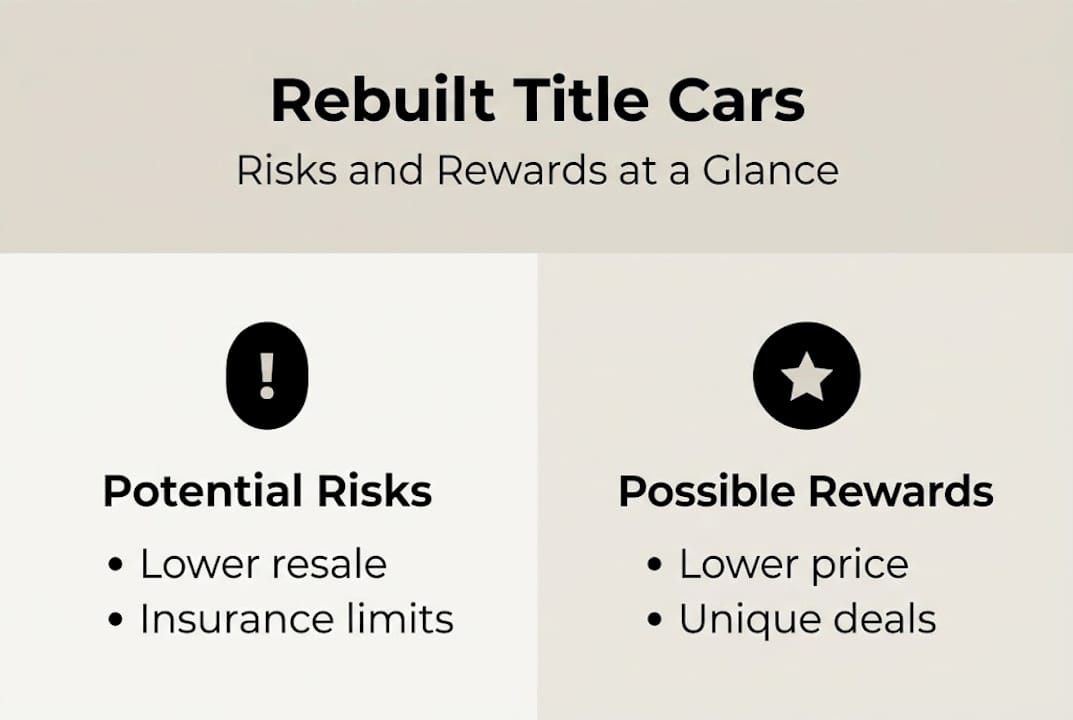
The benefits of rebuilt cars go beyond the sticker price, too. Lower purchase price often means lower registration fees, lower insurance premiums in many cases, and less financial stress if the car gets dinged in a parking lot. You’re not babying a pristine investment. You’re driving a solid vehicle that already has its story written.
The smart move is to calculate the total cost of ownership, not just the purchase price. Factor in expected maintenance, insurance quotes, and how long you plan to keep the car. For many budget-conscious buyers, the math lands firmly in favor of a well-vetted rebuilt title vehicle.
Key risks and how to avoid them when buying rebuilt
Reduced prices come with real trade-offs, mainly about risk. Here’s what every smart budget buyer needs to watch out for and how to protect yourself.

Risks are highest for flood and frame damage, and state inspections focus on road safety, not long-term reliability. That distinction matters enormously. Passing an inspection means the car is legal to drive. It does not mean every repair was done to the highest standard.
The risks worth taking seriously:
- Structural or frame damage. If the car’s frame was bent and repaired, alignment and crash safety can be compromised even after professional work.
- Flood or electrical issues. Water damage is notoriously hard to fully remediate. Corrosion can show up months or years later in wiring, sensors, and electronics.
- Poor quality repairs. Not every shop does great work. Cosmetic fixes can hide deeper issues if you don’t look carefully.
- Airbag concerns. Some vehicles have had airbags deployed and replaced. Verify that all safety systems were properly restored.
Lower-risk vehicle histories to look for:
- Hail damage with documented cosmetic repairs
- Theft recovery where the car was found intact
- Minor collision on older, high-value vehicles where repair cost exceeded the car’s book value but not its actual condition
“The best rebuilt title deals go to buyers who ask the right questions, not the ones who assume the worst or the best.”
Mechanic pre-purchase inspections are essential for rebuilt title vehicles. A qualified independent mechanic can spot repair quality issues, check for hidden structural concerns, and give you an honest read on the car’s condition. This is not the place to cut corners.
Also review any available repair records and before-and-after photos of the vehicle. Platforms that provide this kind of transparency upfront make it far easier to separate the strong candidates from the ones worth skipping. You can also read up on the risks of rebuilt titles and rebuilt car cons to build a sharper eye before you shop. For a deeper look at road safety specifically, the rebuilt car safety guide is worth your time. And if you want a broader perspective, this overview on rebuilt title buyability covers the full picture well.
Pro Tip: Never skip the independent inspection, even if the seller provides documentation. A fresh set of trained eyes is worth every dollar.
Insurance and financing for rebuilt title cars
Even if you find a great car at a great price, insurance and loans can make or break your deal. Here’s how to navigate this part of the process.
Let’s start with a myth worth busting. Getting insurance on a rebuilt title car is not the impossible task many online articles make it out to be. Most major insurers have no issue covering rebuilt title vehicles. Providers like Progressive and Geico do offer coverage, though quotes vary based on the car’s history, your state, and the quality of documentation you can provide.
Insurance is often limited to liability, and full comprehensive coverage can be harder to secure or more expensive. Liability coverage (which pays for damage you cause to others) is widely available. Comprehensive and collision coverage (which pays for damage to your own car) is where you may encounter more variation between providers.
Practical steps before you buy:
- Get insurance quotes using the car’s VIN before signing anything. This tells you exactly what coverage is available and at what cost.
- Ask about comprehensive coverage specifically. Don’t assume it’s included.
- Gather all repair documentation. Insurers respond better to well-documented vehicles.
- Compare at least three providers. Rates and willingness to cover rebuilt titles vary more than you’d expect.
On the financing for rebuilt cars side, many traditional lenders are reluctant to issue auto loans for rebuilt title vehicles. Credit unions can be more flexible than big banks, but cash purchases are common in this market. If financing is important to you, confirm loan availability before you get attached to a specific car.
For a full breakdown of your options, the insurance and financing guide covers what to expect in detail. And if you want to understand how insurance covers rebuilt titles in plain terms, that resource is a solid starting point.
Pro Tip: Line up your insurance and financing before you shop, not after. Knowing your limits ahead of time keeps you from falling for a deal that doesn’t actually work for your situation.
Why rebuilt titles are misunderstood (and how savvy buyers win)
After the facts and risks, it’s clear there’s more than one way to see rebuilt title cars. Here’s why the smartest buyers think differently.
Most advice about rebuilt titles treats every car in this category as equally risky. That’s a lazy take. A vehicle with a hail history and professional cosmetic repairs has almost nothing in common with one that sat in floodwater. Lumping them together leads buyers to either avoid the whole category or underestimate real differences in risk.
Here’s what we’ve seen consistently: the buyers who win with rebuilt titles are the ones who dig into the vehicle history, get an independent inspection, and understand what they’re actually buying. They don’t guess. They verify. And because most buyers don’t do this work, the ones who do get rewarded with significantly lower prices on genuinely solid vehicles.
The absence of large-scale long-term reliability studies on rebuilt title cars is often cited as a reason to avoid them. We’d flip that. It means the market is pricing in uncertainty that may not apply to your specific car. Contrasting expert views suggest that for certain vehicle history types, especially with strong documentation, rebuilt titles can be a genuinely smart choice. The rebuilt car value spots worth targeting are well-documented hail and theft recovery vehicles. These are where the gap between perceived risk and actual condition is widest, and where informed buyers find the best deals.
The bottom line is this: rebuilt title cars are not for everyone, and they’re not all equal. But for a buyer willing to do the homework, they represent one of the few remaining places in the used car market where real savings are still possible.
Ready to shop smarter for your next car?
You’ve done the reading. Now it’s time to put it to work.

ReVroom is the only marketplace built specifically for rebuilt title vehicles. Every listing includes vehicle history information and photos of what the car looked like before it was repaired, so you can evaluate each option with full context instead of guesswork. No digging through third-party reports. No $150 investigation fees per vehicle. The transparency you need is already there. Whether you’re comparing options, researching your first rebuilt title purchase, or ready to find a specific make and model, find rebuilt title deals that match your budget and your standards. And if financing is on your mind, the rebuilt car financing guide is a great next read.
Frequently asked questions
What exactly does a rebuilt title mean for a used car?
A rebuilt title means the car was once declared a total loss by an insurer, then repaired and passed a state inspection to be road-legal again. It’s a documented history, not a permanent flaw.
Can you get full insurance coverage for a rebuilt title car?
Insurance is often limited to liability for some providers, but many insurers do offer broader coverage. Always get quotes using the car’s VIN before you commit to buying.
What are the safest kinds of rebuilt title cars to buy?
Well-documented hail or theft recovery vehicles carry lower risk than those with flood or major structural history. The more paperwork and transparency available, the better your position as a buyer.
Are rebuilt title cars always a bad investment?
Not at all. For the right vehicle with strong documentation and a clean independent inspection, a rebuilt title car can be reliable, practical, and genuinely cost-saving over the long run.
