


What Does a Salvage Title Look Like? How It Differs From a Regular Title, State-by-State Examples, and What a Salvage Record Means (2026)
September 28, 2026
Short answer: a salvage title says SALVAGE on its face, usually in bold and often on a separate salvage certificate instead of a regular title, and it means an insurer declared the car a total loss. It cannot be registered or driven for normal use until the car is repaired, inspected, and retitled as rebuilt. Spotting one is the easy part. The paper is designed to be noticed. The harder part, and the part that decides whether a car is a bargain, is finding out what actually happened to it: how serious the history was, how well it was fixed, and what it sold for at auction. This guide covers both.
Key takeaways
- A salvage title (or salvage certificate) is the state's way of recording that an insurer declared the car a total loss. The brand is printed on the face of the document and it is permanent.
- Every state uses its own wording and thresholds: Kentucky brands the title SALVAGE when repairs would exceed 75% of retail value, Utah issues a salvage certificate when repairs exceed fair market value, Florida issues a Salvage Rebuildable title, Texas a Salvage Vehicle Title, and New York and Michigan print REBUILT SALVAGE once the car is fixed.
- A salvage car cannot be registered or driven for normal use. Once it is repaired, inspected, and retitled it becomes a rebuilt title car, which can.
- A salvage record is the database version of the brand. It stays with the VIN after the car is rebuilt, which is why a VIN check finds it.
- The title tells you a total loss happened. It does not tell you why, how badly, or how well the car was repaired. That is what the repair file, a pre-purchase inspection, and a ReVroom Report are for.
- Rebuilt title cars typically sell 20% to 40% below the same car with a clean title. Across the 17,000+ sales ReVroom tracks, the median buyer saved $4,590, and 87% of the cars sold carried only minor or moderate documented history.
What is a salvage title?
Short answer: a salvage title is the ownership document a state issues once an insurance company has declared a vehicle a total loss. The trigger is a repair estimate that crosses the state's threshold: in Kentucky, KRS 186A.520 makes a car salvage when the cost of parts and labor to restore it exceeds 75% of its retail value; in Utah, Utah Code 41-1a-1001 makes it salvage when the cost of repairing it for safe operation exceeds its fair market value, or when an insurer or another state has already declared it salvage. Total losses come from collisions, hail, floods, fires, vandalism, and theft recoveries, and the paperwork looks the same whichever it was.
Four things make a salvage title different from every other kind of title:
- It is permanent. The record does not disappear once the car is repaired; it converts to a rebuilt brand that follows the car.
- It cannot be registered. Utah's statute says a salvage certificate "is not valid for registration purposes"; Kentucky allows a salvage-titled car on the road only on its way to and from the rebuilt inspection.
- It records an event, not a condition. A hail car and a rolled-over car can carry the identical brand.
- It lowers the price for good. The car will always sell below the clean-title version of itself, which is the whole reason experienced buyers shop this category.
Salvage and rebuilt get mixed up constantly, so here is the short version: salvage means the car has not yet been repaired and inspected; rebuilt means it has. The full comparison is in our guide to the difference between a salvage title and a rebuilt title, and if the phrase you are seeing is "totaled" rather than "salvage", start with what it means when a car is totaled.
What does a salvage title look like?
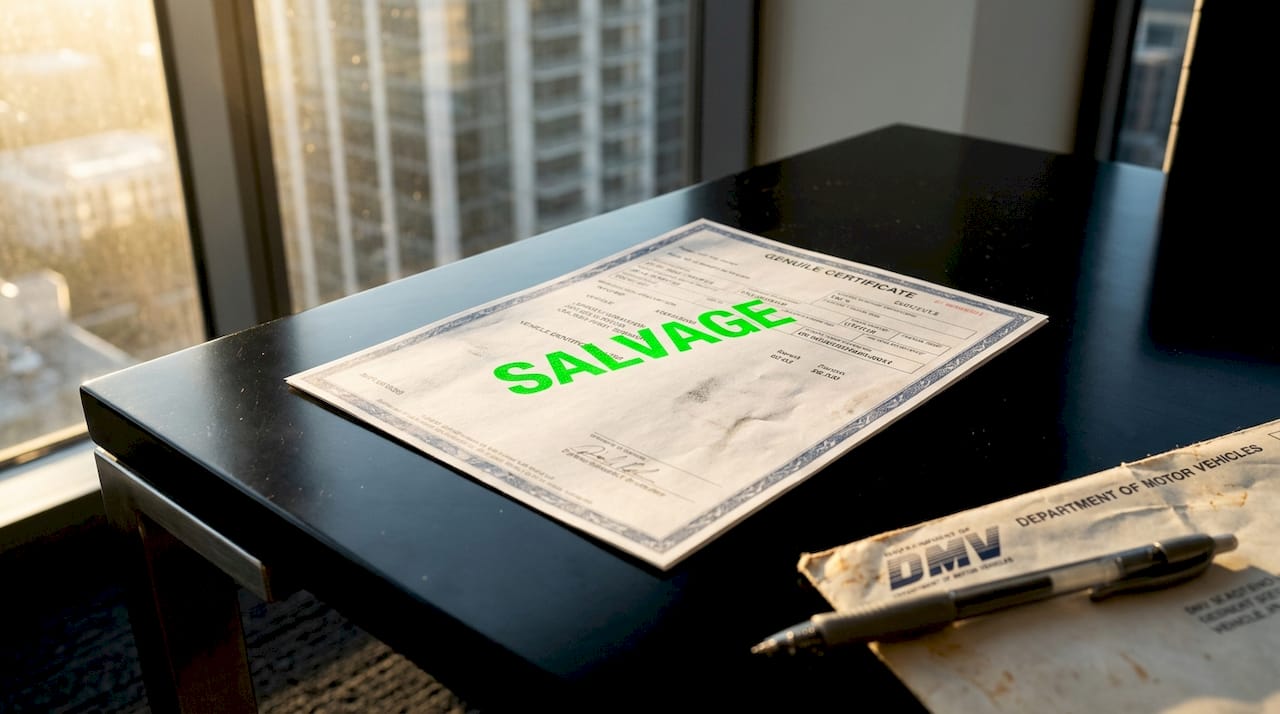
Short answer: like the state's normal title with one line added, or like a separate certificate that replaces the title entirely. The brand is printed in the remarks or brand field, in capitals, with no fine print. There is no single national template because every state designs its own forms, and the exact wording is the thing to learn for the state you are buying in.
| State | What the salvage document says | What it says once the car is rebuilt | Source read September 2026 |
|---|---|---|---|
| Kentucky | Title branded SALVAGE (KRS 186A.530(5)); water history branded "water damaged" | "rebuilt vehicle" printed on the face of the title, carried forward on every later title; a dealer must add a THIS IS A REBUILT VEHICLE sticker at resale | KRS 186A.520, 186A.530; drive.ky.gov Rebuilt-Salvaged Titles |
| Utah | A salvage certificate issued in place of a title; not valid for registration | Title branded "rebuilt and restored to operation" or "in a flood and restored to operation"; a dealer must give written notice on form TC-814 and display it in the windshield | Utah Code 41-1a-1001, 41-1a-1004; dmv.utah.gov |
| Florida | Salvage Rebuildable title (or a Certificate of Destruction for a car that can never be rebuilt) | Title stamped that the vehicle has been rebuilt and may previously have been declared a total loss, plus a Rebuilt decal in the driver's door jamb | Florida Statutes 319.14, 319.30; FLHSMV |
If you are buying in one of those states, the state guides go deeper: Kentucky, Utah, Florida, and Texas. For any other state, the DMV's own website usually publishes a sample title, and two minutes spent looking at the layout and the brand field before you meet a seller means nothing on the real document will surprise you.
What does a salvage title look like in Texas, New York, Michigan, North Carolina, and New Jersey?
Short answer: the same idea in different words. Texas and New Jersey say salvage on the salvage document, North Carolina names four separate brands in its statute, and New York and Michigan both print REBUILT SALVAGE once the car has been fixed and inspected.
Think of it like a restaurant health grade. Every city posts one in the window, but one uses letters, one uses numbers, and one uses a smiley face. You just need to know your city's version. Here is each state's version, as published by the state on October 5, 2026:
| State | What the salvage document is called | What the title says once rebuilt | What to know |
|---|---|---|---|
| Texas | Salvage Vehicle Title (a car that can be repaired) or Nonrepairable Vehicle Title (parts or scrap only) | A regular title branded Rebuilt Salvage | The owner files a Rebuilt Vehicle Statement, Form VTR-61 (TxDMV Salvage and Nonrepairable manual) |
| New York | A New York salvage certificate (MV-907A) | REBUILT SALVAGE on titles issued after May 18, 1999 | The DMV salvage examination takes about 30 minutes, and titles are mailed in roughly 3 to 5 weeks (dmv.ny.gov) |
| Michigan | Salvage title | The legend REBUILT SALVAGE | A certified salvage vehicle inspector checks the car; inspection fee up to $100, title fee $15 (Michigan SOS) |
| North Carolina | Salvage Motor Vehicle | Salvage Rebuilt Vehicle; the statute also lists Reconstructed Vehicle and Flood Vehicle brands | For late-model cars the salvage line is repairs above 75% of fair market value (G.S. 20-71.3) |
| New Jersey | Salvage title, which "usually display[s] the word 'salvage' across the title" | Retitled after repairs and a state salvage inspection | Photograph the car before repairs; the MVC asks for photos at inspection (nj.gov/mvc) |
The pattern holds everywhere: one brand line on the paper, the same brand in the national record, and nothing on either one about how serious the history was. If the title in front of you says salvage, the car still has homework to do. If it says rebuilt or rebuilt salvage, the state has already signed off. Michigan buyers can read our Michigan rebuilt title guide for the full TR-13A process.
Does a salvage title look different from a regular title?
Short answer: usually not at first glance. It is the same state form with the same boxes. The difference is one word in the brand area: SALVAGE, or the state's version of it.
Think of it like a passport. Every passport has the same cover and the same pages, and the one that has been somewhere carries a stamp. A salvage brand is that stamp. California's DMV lists what a title may include: the registered owner's name and address, the VIN, make, model and year, the odometer mileage, the registration date, the lienholder if money is owed, the value, and "title brands, if any." It also tells buyers to keep an eye out for the "salvaged" brand. Here is how the three titles you are most likely to meet line up, box by box:
| What is on the title | Clean title | Salvage title | Rebuilt title |
|---|---|---|---|
| Owner name and address | Yes | Yes (often an insurer or an auction buyer) | Yes |
| VIN, year, make, model | Yes | Yes | Yes, the same VIN as the salvage title |
| Odometer reading | Yes | Yes | Yes |
| Lienholder | If there is a loan | Rare | If there is a loan |
| Brand wording | None | SALVAGE or a state variant (for example Salvage Certificate, Non-Repairable, Junk) | REBUILT, REBUILT SALVAGE, RECONSTRUCTED or a state variant; some states keep the word "salvage" in it |
| Can it be registered and driven? | Yes | Generally no, not until it is repaired and passes inspection | Yes |
| Typical price | Market value | Well below rebuilt; the repairs are still ahead | Typically 20% to 40% below clean (median $4,590 saved across 17,000+ sales tracked by ReVroom, updated October 1, 2026) |
So if you are holding a title and wondering whether it is "regular," skip the colors and fonts and go straight to the brand area. No brand word, clean. SALVAGE, not road-ready yet. REBUILT or one of its cousins, repaired and inspected. For every other box on the form, see what a car title looks like, box by box. The rebuilt title vs. clean title guide covers what that last one means for price, insurance and financing.
What the title never shows is how serious the history was. A brand is a stamp, not a story. A ReVroom Report fills that gap for rebuilt and branded title vehicles: an in-house severity grade, a severity graphic with the affected areas highlighted, an estimated savings percentage, and where and when the car was auctioned. It is not a vehicle history report, and it does not try to be one. If you would rather skip the decoding entirely, shop cars graded minor and start from the easy end.
What is a salvage record on a car?
Short answer: it is the database copy of the salvage brand. When an insurer reports a car as a total loss, that event is recorded against the VIN, and it stays there after the car is repaired and retitled.
You will see the phrase on VIN check results more than on paper titles. The federal NMVTIS system reports five things about a car, as published on vehiclehistory.gov: the current state of title and last title date, brand history, the odometer reading, total-loss history, and salvage history. The free NICB VINCheck looks at insurance-reported salvage, flood, and theft records from participating insurers, and limits searches to five per day per IP address. A salvage record on a car with a rebuilt title is normal. It is the trail that shows how the car got its brand. A salvage record on a car being sold with a clean title is the one to stop and ask about, because it can mean the brand was dropped somewhere along the way.
What the record still does not tell you is how serious the history was. That is the gap a ReVroom Report fills, with the in-house severity grade, a detailed severity graphic, an estimated savings percentage, and where and when the car was auctioned.
How do you spot a salvage or rebuilt title before you buy?
Short answer: read the document, then check the VIN, then ask for the file. Five steps, in order:
- Ask to see the title before you see the car. Read the brand field. SALVAGE means the car is not yet legal to register; rebuilt, rebuilt salvage, or rebuilt vehicle means it has already passed the state's process. A seller who will not show the title has answered your question.
- Run the VIN through the free checks. The NICB VINCheck flags total-loss and theft records reported by member insurers, and an NMVTIS report shows the brand history across states. Our salvage title check guide walks through both, what they cost, and what they miss.
- Ask for the repair file. Kentucky, Utah, and Florida all require the rebuilder to file receipts, a statement of repairs, and in most cases pre-repair photos before a rebuilt title is issued, so a seller who did it properly has the paperwork.
- Find out what actually happened. A title check tells you a total loss occurred. A ReVroom Report tells you the in-house severity grade, shows a detailed severity graphic with the highlights called out, estimates the savings percentage, and records where and when the vehicle was auctioned. That is the part of the story the paper cannot give you.
- Get a pre-purchase inspection. A mechanic looks at the repair itself, which no document can do for you.
If you already own the car and are not sure what its title says, how do I know if my car is salvage covers the owner's side.
What does the title not tell you?
Short answer: almost everything that matters to the price. A salvage or rebuilt brand records that a total loss happened; it does not record whether that was a hailstorm, a parking-lot collision, or a rollover, and it does not record how the repair was done. ReVroom's own sold data shows why that gap matters: of the rebuilt title vehicles with documented history analysis in the Market Snapshot, updated October 1, 2026, 87% carried only minor or moderate history, collision made up 81.9% of it, hail 10.4%, and vandalism 3.4%, and the hail cars, which are cosmetic by nature, typically sold $4,090 or more below market. Two cars with the same brand line can be very different purchases, which is why ReVroom is the only site that lets you filter inventory by history type and severity: start with minor-history cars or hail-history cars and work from there. Our guide to what leads to a salvage or rebuilt title ranks the history types.
Can a salvage title be removed?
Short answer: no. It converts, it does not vanish. Once the car is repaired and passes the state's inspection, the salvage brand is replaced by a rebuilt brand that is carried forward on every title issued afterward; Utah's dealer guidance puts it plainly: vehicles cannot have the brand removed, even after repair or restoration. Moving the car to a state with looser rules to lose the brand is title washing, which is illegal, and the national NMVTIS database is what catches it. Read that as protection: the brand is why a rebuilt title car costs 20% to 40% less than its clean-title twin, and the record is what lets you know what you are buying.
Salvage vs rebuilt: which one are you looking at?
Short answer: if the brand says SALVAGE the car is a project that still needs repairs, an inspection, and a new title; if it says rebuilt, the state has already signed off and it is a car you can drive home. For a daily-driver buyer, rebuilt is the category worth shopping.
| Feature | Clean title | Salvage title | Rebuilt title |
|---|---|---|---|
| Brand on the document | None | SALVAGE (or a salvage certificate) | Rebuilt, rebuilt salvage, or rebuilt vehicle, by state |
| Can it be registered? | Yes | No | Yes |
| Can it be driven? | Yes | Only to and from the inspection, where the state allows it | Yes |
| Can it be insured? | Yes | Not for road use | Yes; liability everywhere, full coverage from most major carriers |
| Can it be financed? | Yes | Rarely | Yes; banks, credit unions, and lender networks such as the one on ReVroom's financing page (ReVroom is not a lender) |
| Typical price vs clean title | Full market | Well below rebuilt; repairs still to come | 20% to 40% below (median $4,590 saved in ReVroom's data) |
State-certified, not salvage
Every car on ReVroom is state-certified and road-ready, never salvage. It has already been repaired, inspected, and retitled, which means it is legal to register and drive the day you buy it. Every listing shows the title status and what was repaired, with photos where they are available, and graded cars carry an in-house severity grade.

Found a car and want the rest of the story? Get a ReVroom Report for the severity grade, the graphic, the savings estimate, and the auction record, then browse rebuilt and branded title cars that have already cleared every step above.
Does a salvage title say "salvage" on it?
Short answer: yes. The word is printed on the document itself, not hidden in a code, and it is usually the first thing a state wants you to see. Think of it like the "final sale" sticker on a clearance rack: the store puts it where you cannot miss it. What changes from state to state is where on the paper it sits and what the document is called.
Four places to look when someone hands you a title:
- The brand or remarks field. Most states print the brand in a dedicated box on the face of the title. SALVAGE, or later a rebuilt wording such as "rebuilt vehicle" in Kentucky, goes there.
- The name of the document. Some states do not issue a title at all for a salvage car. Utah issues a salvage certificate in its place, and Florida calls its version a Salvage Rebuildable title. If the header does not say "Certificate of Title", read it twice.
- A second brand line. Water history can be branded separately. Kentucky, for example, uses a "water damaged" brand alongside the salvage one.
- Marks on the car, not the paper. Florida requires a Rebuilt decal in the driver's door jamb once the car is retitled, and a Kentucky dealer has to add a THIS IS A REBUILT VEHICLE sticker at resale. If the paper and the door jamb disagree, stop and ask why.
A regular title looks the same minus that brand line. So yes, a salvage title looks different, but only in one spot. That is why reading the brand field is step one, and why the free VIN checks in our salvage title check guide are step two: they catch a brand that was left off a document that crossed state lines.
The title says salvage or rebuilt. How do you find out how serious the history was?
Short answer: you stack sources, because each one answers a different question. The title answers "was it a total loss?" A VIN check answers "where has the brand been?" The listing and a ReVroom Report answer the questions that actually move the price: what kind of history it was, how severe, and where and when it sold at auction.
| What you want to know | The title | NMVTIS or NICB VIN check | A ReVroom listing | A ReVroom Report |
|---|---|---|---|---|
| Was it declared a total loss? | Yes, the brand says so | Yes, brand and total-loss records | Yes, title status shown | Yes |
| What kind of history (hail, collision, vandalism)? | No | Sometimes, not reliably | Yes, history type on every listing | Yes |
| How severe was it? | No | No | Yes, in-house severity grade | Yes, grade plus a detailed severity graphic with highlights |
| What was repaired? | No | No | Yes, with photos where they are available | No photos; the listing carries those |
| Where and when was it auctioned? | No | No | No | Yes |
| How much should it save you? | No | No | Price shown against the market | Yes, an estimated savings percentage |
A ReVroom Report is not a vehicle history report and does not replace one. It is the part the paper leaves out. Here is why that part matters: in ReVroom's history snapshot, updated October 1, 2026, 34.3% of sold rebuilt title cars graded minor, 53.1% moderate and 12.6% severe. Same brand line on every one of those titles, three very different cars. If you already know which end of that range you want, skip the guessing and filter: minor-history cars, hail-history cars, or the whole rebuilt and branded title inventory. Found one somewhere else? Get a ReVroom Report on the VIN.
Frequently asked questions
What words or markings appear on a salvage title?
The word SALVAGE, printed on the face of the title or on a separate salvage certificate, is the marking every state uses in some form. Kentucky brands the salvage title SALVAGE and later prints "rebuilt vehicle" on the rebuilt one; Utah issues a salvage certificate and later a title branded "rebuilt and restored to operation"; Florida issues a Salvage Rebuildable title and later stamps the rebuilt title. Some states add a water damaged or flood brand as a separate line.
What does a salvage title look like in Texas?
Texas issues a Salvage Vehicle Title for a car that can be repaired, and a Nonrepairable Vehicle Title for one that can only be parted out or scrapped, as published by TxDMV. Once a salvage car is rebuilt, the owner files a Rebuilt Vehicle Statement (Form VTR-61) and Texas issues a regular title branded Rebuilt Salvage. Our Texas rebuilt title guide covers the steps.
What is a salvage record on a car?
A salvage record is an entry in a state or national database showing that the car was reported as salvage or a total loss, usually by an insurer. It stays attached to the VIN even after the car is repaired and retitled rebuilt. You can see it in an NMVTIS report, which covers title brands and total-loss and salvage history, and in the free NICB VINCheck for participating insurers.
What does a salvage title look like compared to a clean title?
It is the same state document with a brand line added: SALVAGE (or a salvage certificate in place of a title) instead of a blank remarks field. There is no fine print and no hidden code; the brand is meant to be read at a glance. What you cannot read from the paper is why the car was totaled, how badly it was hurt, or how well it was repaired.
How do I check if a car has a salvage title?
Ask to see the title and read the brand line, then run the VIN through the free NICB VINCheck and an NMVTIS report. If the title has already been converted to rebuilt, the brand line reads rebuilt or rebuilt salvage instead. For what actually happened to the car, the severity grade and where and when it was auctioned, a ReVroom Report covers what a title check cannot.
Can a salvage title ever be completely removed?
No. A salvage title becomes a rebuilt title once the car is repaired and passes the state's inspection, and the rebuilt brand is carried forward on every title issued afterward. Moving the car to another state to drop the brand is title washing, which is illegal.
Can you drive or register a car with a salvage title?
Not for normal road use. A salvage certificate is not valid for registration; in Kentucky the only legal trip is to and from the inspection, and Utah says outright that a salvage certificate is not valid for registration purposes. Once the car is repaired, inspected, and retitled as rebuilt it can be registered, insured, and driven like any other car.
Why are salvage title cars cheaper?
Because the brand is permanent and it follows the car into every future sale, and because a salvage car still needs repairs, an inspection, and a new title before it can be driven. A rebuilt title car, which has already cleared all of that, typically sells 20% to 40% below the same car with a clean title; across 17,000+ rebuilt title sales ReVroom has tracked, the median buyer saved $4,590.
What is the safest way to buy a car with a salvage or rebuilt title history?
Read the title, run the VIN through NICB and NMVTIS, ask the seller for the repair file and pre-repair photos, get a pre-purchase inspection, and pull a ReVroom Report for the severity grade and the auction record. Shop rebuilt, not salvage: every car on ReVroom is already state-certified and road-ready, and you can filter the inventory by history type and severity grade.
Does a salvage title say salvage on it?
Yes. The word SALVAGE is printed in the brand or remarks field on the face of the document, or the document itself is a salvage certificate instead of a regular title, as in Utah. Florida calls its version a Salvage Rebuildable title. Some states add a separate water brand, and Florida also requires a Rebuilt decal in the door jamb once the car is retitled.
What does a rebuilt title say in New York and Michigan?
Both print REBUILT SALVAGE. New York says a title issued for a rebuilt salvage vehicle after May 18, 1999 displays the brand REBUILT SALVAGE, and Michigan says the new title after a salvage inspection carries the legend REBUILT SALVAGE, as published by each state.
How do I find out how serious the history was on a salvage or rebuilt title car?
Stack sources. The title shows the brand, an NMVTIS or NICB VIN check shows the brand and total-loss records, and on ReVroom the listing shows the history type, an in-house severity grade and repair photos where available. A ReVroom Report adds a detailed severity graphic, the estimated savings percentage, and where and when the car was auctioned. It is not a vehicle history report.
Does a salvage title look different than a regular title?
Mostly no. It is usually the same state form with the same boxes for owner, VIN, odometer and lienholder. The difference is the brand area, which carries SALVAGE or the state's version of it. A rebuilt title carries REBUILT or a variant instead, and a clean title carries no brand at all.
What does a salvage title look like in California?
California's DMV says a title may include title brands, if any, alongside the owner, VIN, make, model, year, odometer, lienholder and value, and it tells buyers to keep an eye out for the "salvaged" brand. Look for that word in the brand area before anything else.
Recommended
- Salvage title check: how to tell if a car has a salvage or rebuilt title by VIN
- Salvage title vs rebuilt title: the key differences
- What is a salvage title?
- What does a prior salvage title mean for car buyers?
- Can you insure a salvage title?
- Carfax vs VIN check: which report is worth it?
- Rebuilt title severity grades: minor, moderate, and severe explained
