


Prior Salvage Title Meaning (2026): What It Means, Is It Bad, Which States Print It, and How to Check the Car Before You Buy
May 6, 2026
TL;DR:
- Short answer: a prior salvage title means the car was once declared a total loss, was repaired, passed its state’s inspection, and is legal to drive again. The brand is permanent, and it is the same thing most states call a rebuilt title.
- Minnesota and Missouri print “Prior Salvage” on the title. Most states print “Rebuilt” or “Rebuilt Salvage.” Vehicle history reports use “prior salvage” as a generic flag for any car that once held a salvage title.
- Expect the car to cost 20 to 50 percent less than its clean-title twin, to be insurable through most major carriers, and to be financeable through banks and credit unions. Read the actual title, run the VIN, and get an independent inspection.
- Want to know where and when the car was auctioned after the total loss? A ReVroom Report shows the auction details next to its severity grade.
You’re browsing listings, you find a vehicle that looks great, the price seems reasonable, and then you notice it: “prior salvage title.” A lot of buyers either skip right past that label without a second thought or close the tab entirely. Both reactions miss the point. A prior salvage title is a permanent part of the car’s story, and knowing how to read that story is what separates a confident, informed buyer from someone paying clean-title money for a car with a history, or walking away from a good car at a great price.
Table of Contents
- What a prior salvage title means: the basics
- Which states print “Prior Salvage” on the title?
- Prior salvage vs. rebuilt title: is it the same thing?
- How does a car become a prior salvage? From total loss to re-titled
- Prior salvage vs. rebuilt vs. clean titles: what’s the real difference?
- What to check before you buy a prior salvage title car
- What “it passed inspection” does and doesn’t tell you
- Shop prior salvage and rebuilt title cars with the history up front
- How to tell how much the car went through
- Can you see where and when a prior salvage car was auctioned?
- Does the grade change what to pay?
- Frequently asked questions
Key Takeaways
| Point | Details |
|---|---|
| Same brand, different word | Prior salvage is what Minnesota and Missouri print; most states print rebuilt. Both mean a former total loss that was repaired, inspected, and cleared to drive. |
| Permanent branding | The brand never leaves the title, and the history follows the VIN through NMVTIS and every vehicle history report. |
| Real savings | Prior salvage and rebuilt title cars typically sell for 20 to 50 percent less than clean-title twins. |
| Check the paperwork | Read the brand line on the actual state-issued title, run the VIN, ask for the inspection and repair records, and get an independent inspection. |
| See the auction record | A ReVroom Report shows where and when the car was auctioned after the total loss, plus a severity grade and an estimated savings percentage. |
Prior salvage title meaning: the 60-second answers
Short answer: "prior salvage" means the car was once written off as a total loss, then repaired, inspected and put back on the road with a branded title. It is a record of where the car has been, not a verdict on what it is today.
Think of it like a "previously renovated" note on a house listing. It tells you work was done. It doesn't tell you whether the work was a fresh coat of paint or a new foundation. That second question is the one worth your time.
| Question | Short answer |
|---|---|
| What does prior salvage mean? | The car held a salvage title after a total loss, was repaired, passed its state's inspection and was re-titled. Most states call the same thing a rebuilt title. |
| Is a prior salvage title bad? | Not by itself. It lowers the price, which is the point for a budget buyer. What matters is how much the car went through and whether the price reflects it. |
| Prior salvage vs. salvage title? | A salvage title means the car has not been made road-legal yet. Prior salvage means it has, and can be registered and driven. |
| Prior salvage vs. rebuilt title? | Same idea, different label. Minnesota and Missouri print "Prior Salvage"; most states print "Rebuilt" or "Rebuilt Salvage." |
| Can you insure and finance it? | Commonly, yes. Liability is widely available, and full coverage and loans usually come down to the paperwork and the car. Compare a few quotes and offers. |
| How do you check one before you buy? | Read the title itself, run the VIN through an NMVTIS provider for the brand, then use a ReVroom Report for the in-house severity grade, severity graphic, estimated savings percentage, and where and when the car was auctioned. |
Want to skip straight to cars where that story is already on the listing? Browse minor-grade rebuilt and prior salvage cars, or start with hail history cars, which are cosmetic by nature.
What a prior salvage title means: the basics
Short answer: a prior salvage title means the vehicle once held a salvage title because an insurer declared it a total loss, and it has since been repaired, passed its state’s post-repair inspection, and been re-titled so it can be registered and driven. Once that re-titling happens, the car is labeled “rebuilt” in most states and “prior salvage” in a few. The word changes at the state line; the meaning does not.
That last part is key. Permanent. This is not something that gets scrubbed from the record after a few years. No matter how many times the car changes hands, that history travels with it.
Here are a few terms you may see used somewhat interchangeably, though they each carry specific meaning:
- Prior salvage: The vehicle held a salvage title at some point in its past, was repaired, and was re-titled. Printed on the title in Minnesota and Missouri; used as a generic flag on vehicle history reports everywhere.
- Rebuilt title: The same status under the word most states use after a former salvage vehicle passes inspection.
- Reconstructed / restored salvage: Pennsylvania’s and Arizona’s words for the same brand. See our state-by-state table of title brand names, or, if you are shopping, our guide to reconstructed title cars for sale.
- Previously salvaged: An informal phrase pointing to the same history.
If you want to get into the precise distinctions between these terms, the salvage vs rebuilt titles breakdown is worth a read before you go further.
“Prior salvage branding is not a warning that the car is unroadworthy today. It’s a record that it once was, and that it met the requirements to be road-legal again. Context is everything.”
Why does this matter for you as a buyer? Because title status affects resale value, what insurers will offer you, the terms a lender will give you, and what you can realistically expect over the car’s lifetime. None of those factors disappear when you drive the car home.
Which states print “Prior Salvage” on the title?
Short answer: Minnesota and Missouri. Both states’ own motor vehicle pages say so, and both describe a different inspection behind the same words. Most other states print “Rebuilt” or “Rebuilt Salvage,” and Pennsylvania prints “Reconstructed.”
Minnesota. A Minnesota salvage title shows the word “salvage” in a black box near the bottom of the title, and registration can be renewed only once on it. To clear it, the vehicle has to pass a Driver and Vehicle Services inspection, which the state says is not a safety inspection but a check aimed at deterring fraud and theft. The owner brings the salvage title, a declaration of reconstruction form completed at the time of repair, and receipts for major replaced parts. Once it passes, the owner files the paperwork with a $35 salvage inspection fee and a filing fee, and the state removes the salvage status and replaces it with a “prior salvage” brand.
Missouri. Missouri’s Department of Revenue says the new certificate of title “will be designated as ‘Prior Salvage’ on the face of the title.” The owner files the title application marked Prior Salvage with the original salvage title, plus a current safety inspection from an official inspection station if the car will be registered, or an identification or odometer inspection if it will not be registered yet. Missouri’s titling manual also lists a separate “Reconstructed Motor Vehicle” brand code (read October 8, 2026).
So the same two words can sit on top of a fraud-and-theft check in one state and a mechanical safety inspection in the next. That is the practical reason an independent pre-purchase inspection belongs on your list no matter which state issued the title.
Why you see “prior salvage” outside those two states. Vehicle history reports and dealer listings use “prior salvage” as a plain-English flag for any car that once held a salvage title, whatever its current state prints. A car titled “Rebuilt” in Texas will still show a prior salvage record on a history report. If the phrase came from a report rather than the title itself, the title in your hand may say something else, which is why the next section matters.
Prior salvage vs. rebuilt title: is it the same thing?
Short answer: in substance, yes. Both mean a former total loss that was repaired, inspected, and cleared to drive, and the word depends on the state that issued the title. There is one nuance worth knowing.
On a vehicle history report, “prior salvage” can also describe a car that was salvage-titled in one state and then titled in another. The receiving state prints its own brand word, sometimes after its own inspection, and the report keeps the earlier salvage record. That is not a red flag by itself; cars cross state lines all the time. It is a reason to read the brand line on the actual title document and to match it to the VIN history before you talk price.
What both brands mean for you is identical: a 20 to 50 percent discount against the clean-title price, full disclosure of the history to every future owner, and a car that was legally cleared to drive. What neither brand tells you is how good the repair was. The records and your own mechanic tell you that.
How does a car become a prior salvage? From total loss to re-titled
Short answer: total loss, salvage title, repair, state inspection, re-title. Five steps, and the paperwork from each one is what you ask the seller for.
Here is how it typically works, step by step:
- An insurance company declares the vehicle a total loss. This happens when the estimated cost of repairs exceeds a certain percentage of the car’s market value, which varies by state (Minnesota, for example, uses 80 percent of value for late-model and high-value vehicles). The vehicle does not have to be visually destroyed to reach this threshold. Sometimes a relatively modest issue on a high-value vehicle tips the calculation.
- The car receives a salvage title. At this stage, the vehicle is legally flagged as a total loss and cannot be registered or driven on public roads in most states.
- A repair shop, dealer, or individual rebuilder takes on the car. The vehicle is repaired to state standards. This may involve bodywork, mechanical repairs, parts replacement, or some combination.
- The vehicle goes through a state-required inspection. Before a rebuilt or prior salvage title can be issued, the state verifies the car. In some states that is a mechanical safety inspection; in others, like Minnesota, it is an anti-theft and parts-provenance check.
- The car is re-titled as rebuilt or prior salvage. Now it can be legally registered, plated, and driven.
Pro Tip: Ask the seller for documentation from the inspection and repair process. A reputable seller will have this paperwork ready. If they hesitate or cannot produce it, that hesitation tells you something important.
Here is a quick reference for how the journey compares in terms of timeline and what is at stake at each phase:
| Phase | What happens | Why it matters |
|---|---|---|
| Total loss declaration | Insurer writes off the vehicle | Triggers permanent title branding |
| Repair phase | Vehicle rebuilt to state specs | Quality varies widely by shop |
| State inspection | Required before re-titling | Confirms the state’s requirements were met |
| Re-titling | Vehicle gets a rebuilt or prior salvage brand | Permanent record from this point forward |
| Resale | Buyer inherits the history | Affects value, insurance, and financing |
Understanding this process gives you insight into how rebuilt cars reach the market and why the paperwork trail matters so much. For a deeper look at the legal side, the rebuilt car retitling process explains what each state requires before a car can legally hit the road again.

Prior salvage vs. rebuilt vs. clean titles: What’s the real difference?
Short answer: prior salvage and rebuilt are the same brand under different names; clean means no insurer ever declared the car a total loss. The branded car costs 20 to 50 percent less and carries its history openly.
| Title type | What it means | Resale impact | Insurance notes |
|---|---|---|---|
| Clean title | No total loss designation on record | Standard market value | Standard coverage options |
| Rebuilt / prior salvage | Once a total loss, repaired and inspected | Typically 20 to 50% lower price | Most major insurers cover it; some ask for the inspection report |
| Salvage | Declared a total loss, not yet repaired and inspected | Cannot be registered or driven | Generally not insurable for road use |
A clean title does not mean a car has never had any vehicle history. It simply means no insurance company ever wrote it off as a total loss. A clean title car can have a long list of prior incidents without ever triggering total loss status. That is an important nuance that gets overlooked in most discussions.
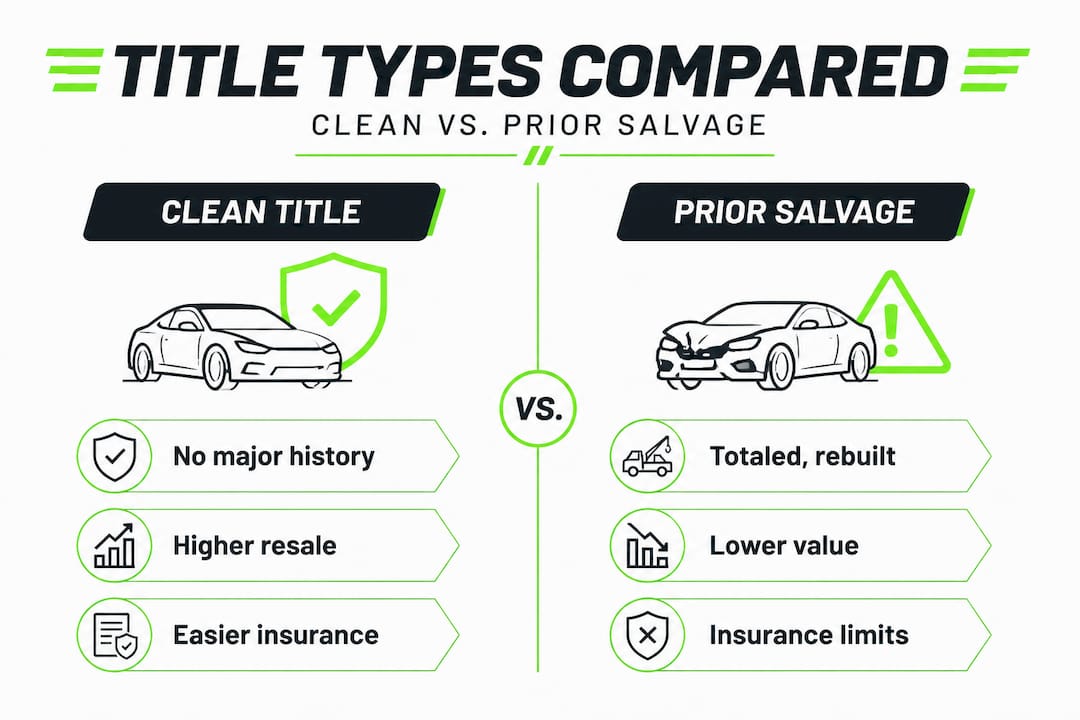
A rebuilt or prior salvage title, on the other hand, confirms the total loss event happened. The exact brand word varies by state, but all of them communicate the same past total loss and rebuild. The car earned its way back onto the road, but the record stays.
Here is what that typically means in practice:
- Resale value: Rebuilt title vehicles are generally priced 20 to 50% below comparable clean title vehicles. That discount is a real financial advantage for buyers who do their homework.
- Insurance: Liability coverage is widely available, and most major insurers write comprehensive and collision on rebuilt and prior salvage titles too. A few ask for the inspection report or a photo inspection, and any payout is based on the car’s branded-title value, so understand what you are insured for. Our guide to which insurers cover rebuilt title cars names names.
- Financing: Banks and credit unions both finance rebuilt and prior salvage titles; credit unions are often the most flexible, and terms vary, so shop two or three lenders. Some cap the loan at the branded-title value or ask for the inspection paperwork.
- Disclosure: Most states legally require sellers to disclose title branding. If someone tries to pass off a rebuilt title car as clean, that is fraud.
For a side-by-side comparison with more detail, the rebuilt vs salvage title guide and the salvage vs rebuilt car meaning article both go deeper on these distinctions.
What to check before you buy a prior salvage title car
Short answer: the title document, the VIN history, the inspection and repair records, and an independent mechanic. In that order.
The single most important step? Look at the actual state-issued title document, not just the listing description. Wording in online listings can be vague or inconsistent, and as the Minnesota and Missouri examples above show, the same words can mean different inspections. What a seller calls “rebuilt” and what the state printed might differ, and only the official document is the record.
Beyond the title itself, here is your due diligence checklist:
- Run the VIN. Use a vehicle history service or the federal NMVTIS database. The VIN tells you the official title history across states.
- Check for multiple brands. A vehicle that has been branded in more than one state or carries multiple history flags deserves a closer read of the records.
- Look for inconsistent records. Repair dates that do not align with title dates, missing inspection stamps, or gaps in ownership history are all worth questioning.
- Ask about the vehicle's specific history. Was it hail? A theft recovery? A collision? Each scenario carries different implications for what was repaired and how.
- Inspect in person. No online report covers everything. A physical inspection by a trusted independent mechanic is the best final step before any purchase.
Pro Tip: Understanding what types of vehicle history lead to title branding helps you ask the right questions when you look at a specific car. Not all histories are equal, and on ReVroom you can filter listings by history type, from hail and cosmetic paint chips all the way to fire, and by in-house severity grade.
On the money side, factor the financing terms into your total cost, not just the sticker price, and get insurance quotes before you commit rather than after. For a realistic picture of what these vehicles are worth and how to think about rebuilt car value, that resource breaks it down clearly. For a car you found somewhere other than ReVroom, a ReVroom Report gives you an in-house severity grade for the event that branded the title, a detailed severity graphic, the estimated savings against clean-title comparables, and where and when the car was auctioned.
What “it passed inspection” does and doesn’t tell you
Short answer: it tells you the car met its state’s requirements on the day it was inspected. It does not tell you how well the repair was done or how long it will hold. The records and your mechanic do.
Here is where I want to be real with you, because a lot of content out there is either too optimistic or too discouraging, and neither serves you well.
Rebuilt and prior salvage title vehicles are a genuine value option. That 20 to 50% price discount is real money. For buyers who do the work, learn the history, get the inspections, and go in with clear expectations, these vehicles can be excellent purchases. We believe in them fully.
But here is what does not get said enough: some sellers lean on “it passed inspection” as if that ends the conversation. Passing a state inspection establishes that a car met that state’s requirements at a point in time, and in Minnesota that inspection is explicitly not a safety inspection. It is not a lifetime guarantee, and it does not tell you the full story of the repairs.
The permanent brand also means more than a lower purchase price. It sets the value your insurer pays out on, it shapes the terms every time you finance or trade the car, and it can mean a fresh inspection if you move to a state with different title rules. These are lifecycle facts, not just a one-time number on a listing, and a buyer who knows them going in is the buyer who comes out ahead.
The value comes from understanding exactly what you are buying, not from ignoring what it went through. The rebuilt vs salvage complete guide is one of the most thorough resources we have for buyers who want the full picture before making a decision.
Transparency is not just a nice feature in this market. It is the whole game. Buyers who ask for it make better purchases. Sellers who offer it build real trust. That is the standard worth holding everyone to.
A prior salvage title says it was a total loss. How do you tell how much the car went through?
Short answer: the title can't tell you. The brand is the same two words whether the car needed a new hood after a hailstorm or a major collision repair. Three things narrow it down: the history type, a severity grade, and the repair file.
Think of the title like the word "renovated" on a house listing. It tells you work was done. It doesn't tell you whether that meant new paint or a new foundation. For that you need the inspector's notes.
| What you want to know | Where to find it | What it tells you |
|---|---|---|
| Was it ever a total loss? | The brand line on the title, or a free NMVTIS-based title check | Yes or no. Nothing about how much work the car needed. |
| What kind of history? | The listing on ReVroom, which names the history type (collision, hail, vandalism and more) | Whether you are looking at a cosmetic story or a mechanical one |
| How much did it go through? | ReVroom's in-house severity grade: minor, moderate or severe | One clear rating instead of a guess |
| What exactly was repaired? | The listing's repair notes and photos, plus the seller's receipts | The parts, the panels and the shop |
| Is it sound today? | An independent pre-purchase inspection | How the repair is holding up right now |
Here is how those grades break down across the rebuilt market. Of the vehicles ReVroom has analysed with documented history (71.5% of sales, per the history and severity snapshot updated October 1, 2026), 34.3% were graded minor, 53.1% moderate and 12.6% severe. Collision is 81.9% of documented history, hail 10.4% and vandalism 3.4%. So most prior salvage and rebuilt cars carry a lighter story than the word "salvage" suggests.
A ReVroom Report puts the grade on one page with three other things: a detailed severity graphic that highlights where the work was, an estimated savings percentage against comparable clean-title cars, and where and when the car was auctioned. It is not a vehicle history report, so it won't show the title brand or ownership history; read the title for that. Photos live on the listing page, not in the Report. Our guide to minor, moderate and severe grades explains what each one means.
Can you see where and when a prior salvage car was auctioned?
Short answer: usually, yes. Most prior salvage cars went through a salvage auction after the insurer wrote them off, and a ReVroom Report shows where and when the vehicle was auctioned.
Here is why that matters. The title tells you the total loss happened. The auction record puts a date and a place on it, which is like finding the receipt for a renovation: it does not tell you how good the work was, but it tells you when it started and where the car came from.
| Auction detail | What it helps you answer |
|---|---|
| When it was auctioned | Roughly how long ago the total loss happened, and how long the car sat between auction and the listing you are looking at |
| Where it was auctioned | Which region the car came through, which you can line up against the state on the title and the VIN history |
| Next to the severity grade | Whether the story behind the auction was minor, moderate or severe |
| Next to the estimated savings | Whether the asking price reflects the history, or the seller is asking close to clean-title money |
The Report does not replace a vehicle history report or the title itself, and it does not show the title brand. Use it alongside them: the title says what the car is, the VIN history says where it has been titled, and the Report adds the grade, the savings estimate and the auction record in one place.
Does a minor or severe grade change what you should pay for a prior salvage car?
Short answer: it should change what you are comfortable paying, but start from what the market actually pays for rebuilt and prior salvage cars, then adjust for the story.
ReVroom doesn't publish prices by grade, so here is the market line every grade starts from. Across 17,000+ rebuilt title vehicles tracked in the market snapshot (updated October 1, 2026), buyers saved a median $4,590 against clean-title value, the median car sold for $17,499, and about 1 in 3 sold for 25% or more below clean-title value. The saving grows with the model year:
| Model year | Median saved vs clean title | Vehicles sold |
|---|---|---|
| 2018 | $3,283 | 931 |
| 2020 | $4,870 | 1,097 |
| 2022 | $5,966 | 1,328 |
| 2024 | $7,023 | 1,330 |
A minor grade on a newer car is the easiest decision in this market: a small story at a real discount. A severe grade can still be a good buy for the right person, as long as the repair file is complete and an independent shop signs off. That is your call to make, and the grade is what lets you make it with your eyes open.
Want to start with the lightest stories? Shop minor-grade cars, or see the hail-history inventory, where almost every car is graded minor. If you find one you like, message the seller from the listing and ask for the repair file. Curious how hail cars end up re-titled in the first place? Read how dealership hail sales work.
Shop prior salvage and rebuilt title cars with the history up front
Sorting through title terminology, state-by-state variations, and vehicle history records is genuinely complex work. That is exactly why ReVroom exists. ReVroom listings show the vehicle’s history type and an in-house severity grade, with photos of the repair where the seller has them, so you are not left guessing about what you are actually considering. ReVroom is the only marketplace where you can filter inventory by history type and severity grade.

ReVroom removes the guesswork from rebuilt title shopping by putting critical information directly in front of you, upfront, without the separate research most buyers end up paying for. Whether you want to learn about title differences before you shop or you are ready to explore actual listings, ReVroom is built to help you go further. Browse state-certified rebuilt and branded title cars and see transparency in action.
Frequently asked questions
What does a prior salvage title mean?
A prior salvage title means the vehicle was once declared a total loss and held a salvage title, then was repaired, passed its state’s post-repair inspection, and was re-titled so it can be registered and driven again. The brand is permanent. It is the same thing most states call a rebuilt title.
Which states use prior salvage on the title?
Minnesota and Missouri print “Prior Salvage” on the re-issued title. In Minnesota the salvage brand is replaced with a prior salvage brand after a DVS inspection; in Missouri the new title is designated Prior Salvage on its face. Most other states print “Rebuilt” or “Rebuilt Salvage” for the same thing, and Pennsylvania prints “Reconstructed.” Vehicle history reports also use “prior salvage” as a generic flag for any car that once had a salvage title, whatever state it is in now.
Is a prior salvage title the same as a rebuilt title?
In substance, yes. Both mean a former total loss that was repaired, inspected, and cleared to drive. The word depends on the state that issued the title. One nuance: on a vehicle history report, “prior salvage” can also flag a car that was salvage-titled in one state and re-titled in another, so always read the brand on the actual title document.
Does a prior salvage title affect car insurance?
Liability coverage is widely available. Most major insurers also offer comprehensive and collision on prior salvage and rebuilt titles; a few ask for the inspection report or a photo inspection first, and any payout is based on the car’s branded-title market value rather than a clean-title value. Get two or three quotes before you buy.
How much does a prior salvage title affect value?
Prior salvage and rebuilt title cars typically sell for 20 to 50 percent less than the same car with a clean title, with lighter history like hail at the smaller end of the discount and structural repairs at the larger end. The discount follows the car at resale.
Can I get a loan for a car with a prior salvage or rebuilt title?
Yes. Banks and credit unions both finance prior salvage and rebuilt title cars; credit unions are often the most flexible, and terms vary by lender, so shop two or three. Some lenders ask for the inspection paperwork or cap the loan at the branded-title value.
Is it safe to buy a car with a prior salvage or rebuilt title?
It can be a sound purchase when the repairs were done well and documented. The state inspection confirms the car met its state’s requirements at that point in time, and in some states it is an anti-theft check rather than a mechanical one, so an independent pre-purchase inspection is the smart final step.
How can I verify if a car had a prior salvage or rebuilt title?
Read the brand line on the actual state-issued title, then run the VIN through a vehicle history service or the federal NMVTIS database. Listing descriptions and seller wording are not the record; the title and the VIN history are.
Can a prior salvage title car have only minor history?
Yes. The brand only says the car was once a total loss; it doesn't measure how much work it needed. Across the rebuilt cars ReVroom has analysed (history snapshot updated October 1, 2026), 34.3% were graded minor and 53.1% moderate, and hail-history cars are almost all minor.
Does a ReVroom Report show whether a car has a prior salvage title?
No. A ReVroom Report is not a vehicle history report. It shows ReVroom's in-house severity grade, a severity graphic, an estimated savings percentage, and where and when the car was auctioned. Read the title brand on the certificate, or run a title check, for the prior salvage status.
Can I see where and when a prior salvage car was auctioned?
Usually, yes. Most prior salvage cars passed through a salvage auction after the insurer wrote them off. A ReVroom Report shows where and when the vehicle was auctioned, next to its severity grade and an estimated savings percentage, so you can see roughly how long ago the total loss happened and where the car was sold before it was rebuilt.
Is prior salvage the same as a reconstructed title?
For a buyer, yes. Prior salvage, rebuilt and reconstructed are different state words for the same story: a former total loss that was repaired, inspected and re-titled. Missouri’s titling manual lists both Prior Salvage Motor Vehicle and Reconstructed Motor Vehicle brand codes.
Is a prior salvage title bad?
Not on its own. It means the car was once a total loss and has since been repaired, inspected and re-titled. The price is lower because of that history, so the real questions are how much the car went through and whether the discount matches. A ReVroom Report shows the in-house severity grade and the estimated savings percentage.
Does prior salvage mean the car is still a salvage car?
No. A salvage title means the car is not road-legal yet. A prior salvage title means it was repaired, passed its state inspection and can be registered and driven again. The brand stays on the title permanently.
Recommended
- Reconstructed Title Cars for Sale: What It Means and Where to Find One | ReVroom
- Reconstructed vs. Rebuilt Title: Which States Use Each | ReVroom
- Salvage Title vs. Rebuilt Title | ReVroom
- What Insurance Companies Cover Rebuilt Title Cars? | ReVroom
- What is a salvage title car worth? Guide for budget buyers
- Are Rebuilt Titles Bad? | ReVroom
