


What is a salvage title car worth? Guide for budget buyers
April 27, 2026
TL;DR:
- Salvage title cars are worth 20 to 60 percent of their clean title value due to buyer hesitations.
- Factors like repair quality, documentation, vehicle age, and market demand influence salvage car value.
- Hidden costs such as limited insurance, financing challenges, and repair issues can offset initial savings.
What is a salvage title car worth? Guide for budget buyers
Here’s a question worth asking before you sign anything: is that “cheap” car actually cheap? Salvage title vehicles look like a steal on the surface, sometimes priced thousands below what you’d find on a typical lot. But the real cost of ownership can be a very different number than the sticker price. Hidden repair needs, insurance hurdles, and resale headaches can quietly eat into your savings. This guide breaks down what salvage title cars are actually worth, what drives that value up or down, and how to crunch the numbers yourself before you commit to a purchase you might regret.
Table of Contents
- What does a salvage title mean for a car’s value?
- Key factors that influence salvage car value
- The process: How to calculate the worth of a salvage title car
- Risks and hidden costs budget buyers need to know
- Why real-world research beats rules of thumb for salvage title values
- Learn more and make smarter car-buying choices
- Frequently asked questions
Key Takeaways
| Point | Details |
|---|---|
| Value reduction range | Salvage title cars are usually worth 20-60% of the clean market value. |
| Factors matter most | Condition, repairs, documentation, and market demand heavily influence value. |
| Unique cases exist | Luxury and high-demand cars may lose less value than average models. |
| Insurance is limited | Most salvage cars qualify for liability-only insurance, not full coverage. |
| Professional appraisal advised | Always get a professional opinion for a more accurate salvage car valuation. |
What does a salvage title mean for a car’s value?
A salvage title is a legal designation assigned to a vehicle that an insurance company has declared a total loss. That happens when the cost to repair the car exceeds a certain percentage of its market value, which varies by state but is often around 75 to 80 percent. The car isn’t necessarily destroyed. It may have experienced flood damage, hail, theft recovery, or a significant collision. But once it gets that label, the title follows it forever.
The title designation matters enormously to value. Buyers see it and hesitate. Lenders see it and walk away. Insurers see it and limit what they’ll offer. That collective hesitation is baked into the price, and it’s why salvage title vehicle values tend to sit well below what comparable clean title vehicles command in the market.
How far below? The general range is significant. Salvage cars typically sell for 20 to 60 percent of the clean title market value, with Kelley Blue Book’s rule of thumb suggesting a 20 to 40 percent deduction. That’s a wide range, and it exists because the factors at play are wildly different from car to car.
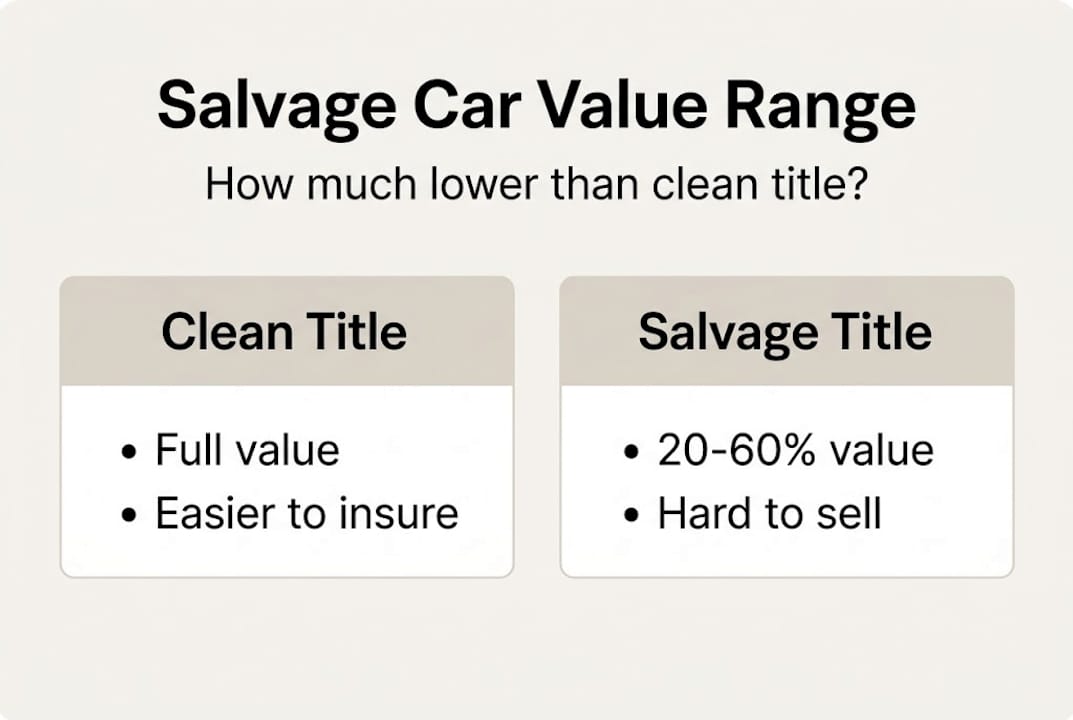
Here’s a quick look at how the numbers compare at a glance:
| Vehicle type | Clean title value (example) | Salvage title range |
|---|---|---|
| 2018 Honda Civic | $18,000 | $7,200 to $14,400 |
| 2019 Ford F-150 | $35,000 | $14,000 to $28,000 |
| 2020 BMW 3 Series | $40,000 | $16,000 to $32,000 |
Those ranges are wide for a reason. The type of history the vehicle carries, the quality of any repairs made, and the current demand for that model all shift the number dramatically.
A few key reasons why salvage titles suppress value:
- Resale stigma: Future buyers will face the same concerns you do right now, making it harder to sell at a fair price later
- State-by-state variation: Some states have stricter rules about what qualifies for a salvage designation, which affects how buyers in those states perceive the title
- Financing and insurance walls: When lenders and insurers are reluctant, the pool of potential buyers shrinks, which pushes price down further
- Unknown history: Without clear documentation of what happened and what was fixed, buyers discount more aggressively to compensate for the uncertainty
If you’re seriously thinking about whether you should buy a salvage car, understanding this pricing psychology is step one. The discount is real. So are the reasons behind it.
Key factors that influence salvage car value
Not all salvage title cars are created equal, and that’s the most important thing to understand. The 20 to 60 percent discount range exists precisely because one car with a salvage title might be a genuinely smart purchase while another is a money pit with a bargain price tag. No standard calculator can tell you which one you’re looking at. Every car needs a case-by-case appraisal.
Here are the most influential variables:
- Extent and type of vehicle history: A car that was flagged for a large hail event and repaired cosmetically is very different from one that sustained frame damage in a serious collision. The nature and severity of what happened matters more than the label itself.
- Quality of repairs: Were the repairs done by a certified shop with documented parts? Or was the work done on the cheap with aftermarket components and no paperwork? Quality repairs can bring a car close to its pre-incident condition. Poor repairs can leave serious issues lurking beneath the surface.
- Documentation: A thick folder of repair records, parts receipts, and inspection results is worth real money. It reduces uncertainty, and buyers pay more when they know more.
- Vehicle age and mileage: Older vehicles take a harder hit. Older cars typically lose an additional 20 to 40 percent compared to newer models with the same title type, partly because repair costs represent a larger share of their lower market value.
- Make and model demand: Some vehicles hold their value better because people want their parts. Luxury brands and popular trucks often see less dramatic discounts because the market for components keeps overall demand higher.
- Location and local market: A pickup truck carries more demand in rural areas. A compact car might move faster in a city. Local supply and demand shifts the value independently of any national pricing guide.
- Financing and insurance accessibility: When financing salvage cars is difficult and insurance options are limited, fewer buyers can realistically purchase the vehicle. That reduced demand compresses the price.
The luxury vehicle exception is worth expanding on. A 2021 Mercedes-Benz with a salvage title may actually hold proportionally more value than an older economy car, because the parts themselves are in high demand and the brand commands a loyal market. That’s the counterintuitive reality of salvage pricing. Sometimes prestige protects value even when the title doesn’t.
Pro Tip: Before you even think about a price, request full documentation of the repair work. A seller who can’t or won’t provide it is telling you something important.
If you’re thinking about selling a salvage car rather than buying one, these same factors determine how you should price it and what documentation you’ll need to attract serious offers.
The process: How to calculate the worth of a salvage title car
Okay, so you understand what moves the number. Now let’s talk about how to actually arrive at a figure you can use in the real world. The methodology most appraisers use follows a clear pattern: find the clean title value, assess the variables specific to that vehicle, and apply a realistic discount based on what you find.
Here’s how to walk through it step by step:
- Find the clean title market value: Start with Kelley Blue Book, NADA Guides, or Edmunds. Enter the exact year, make, model, trim level, mileage, and condition as if it had a clean title. This gives you your baseline number before any title-related discounts.
- Gather all available documentation: Collect repair records, parts invoices, photos from before and after repairs, any inspection results, and the vehicle history report. The more complete the picture, the more accurate your estimate will be.
- Evaluate the quality and scope of repairs: Did a licensed shop do the work? Are the parts OEM (original equipment manufacturer) or aftermarket? Was structural work involved, or was it cosmetic? The answers push your discount toward the lower or higher end of the range.
- Apply the appropriate discount: For a well-documented, cosmetically repaired vehicle from a quality shop, a 20 to 30 percent discount from clean title value is reasonable. For a vehicle with significant structural history, poor documentation, or unknown repair quality, you’re looking at 40 to 60 percent or more.
- Get a professional appraisal: For any purchase above a few thousand dollars, an independent appraisal from a qualified mechanic or appraiser is essential. They can catch things no online tool will flag.
Let’s make this real with two quick examples:
Example A: A 2019 Toyota Camry with a clean title value of $22,000. It was flagged for a hail event, fully repaired at a certified body shop, with complete documentation. A 25 percent discount puts the realistic salvage price around $16,500.
Example B: A 2018 Jeep Wrangler with a clean title value of $30,000. The vehicle history shows a significant collision, documentation is incomplete, and the repairs are of uncertain quality. A 50 percent discount puts the realistic price around $15,000, and even then, a professional inspection is non-negotiable.
The gap between those two examples is the point. Same discount range, very different risk profiles. That’s why rules of thumb only get you so far. You need the specifics.
Pro Tip: Use the value estimation steps as your framework, but always ground the final number in a real inspection. An appraisal fee of $100 to $200 is cheap insurance against a $5,000 mistake.
Risks and hidden costs budget buyers need to know
The price on the listing is just the beginning. What comes after that purchase is where many budget buyers get surprised, and not in a good way. Let’s be clear about the real costs you might be walking into.

Insurance limitations: Many standard insurers only offer liability coverage for salvage title cars, meaning comprehensive and collision protection may be unavailable. That’s a significant exposure. If the car is in another incident, you may be on the hook for the entire repair bill out of pocket. Shop around before you buy, and confirm what coverage you can actually get for the specific vehicle.
For a deeper look at your options, the guides on salvage title insurance options and insuring a salvage title car cover what’s available and how to find the right policy.
Financing hurdles: Most traditional banks and credit unions won’t finance a salvage title vehicle. Financing salvage cars is genuinely difficult, and when financing is available, it often comes with higher interest rates or requires larger down payments. Budget accordingly, because you may need to pay cash or find a specialty lender.
Here’s a quick summary of the hidden costs that budget buyers most commonly underestimate:
- Deferred repair needs: Previous repairs may have addressed visible issues while leaving secondary problems untouched. An independent inspection often uncovers these.
- Parts sourcing challenges: Some vehicles with specialized components are harder to repair in the future because those parts are expensive or hard to find.
- Resale difficulty: When you eventually want to sell, you’ll face the same buyer hesitation you’re feeling right now. Plan on a longer selling timeline and a lower final price.
- Registration complications: Some states have specific inspection requirements for vehicles with a certain title history before they can be legally registered for road use.
- Unexpected structural issues: Frame or structural concerns that weren’t fully corrected can affect ride quality, tire wear, and long-term safety.
Pro Tip: Always get an in-person inspection by an independent mechanic before finalizing any purchase. No online report covers everything, and a professional set of eyes is your best protection against surprises.
The core lesson: the sticker price discount is real, but so are the additional costs. Your job before you buy is to make sure the savings actually survive contact with reality.
Why real-world research beats rules of thumb for salvage title values
Here’s the honest take that most car-buying guides skip: generic discount formulas feel reassuring, but they can give you a false sense of confidence. Saying “apply a 20 to 40 percent discount and you’re good” is the automotive equivalent of telling someone to “eat less and move more.” Technically accurate. Practically incomplete.
As experts point out, no standard calculator exists for this. Every car is genuinely different. And the gap between a well-researched purchase and a poorly researched one isn’t just a few hundred dollars. It can be thousands, especially when you factor in insurance gaps, hidden repair costs, and a painful resale experience down the road.
We’ve seen buyers walk away thrilled with their purchase because they did the work. They got the documentation, hired an inspector, confirmed their insurance options, and bought with eyes wide open. We’ve also seen buyers who led with the price and followed with regret. The price alone is never the whole story.
The uncomfortable truth is this: sometimes the deal isn’t a deal at all. If you can’t get the coverage you need, can’t confirm repair quality, and can’t stomach the resale risk, the “savings” evaporate quickly. That’s not pessimism. That’s math.
If you’re working through the decision, the buying salvage cars guide is a good place to pressure-test your reasoning before you commit.
Do the research. Get the inspection. Know your insurance situation before you sign. The extra effort is always worth it.
Learn more and make smarter car-buying choices
Understanding salvage title values is step one of a longer journey toward a smart purchase. The good news is you don’t have to figure it all out alone.

At ReVroom, we believe that information is the best protection a buyer can have. That’s why we built a platform designed specifically around transparency, helping you see what a vehicle looked like before it was repaired, what its history includes, and what you’re actually getting for your money. Our in-depth salvage car guide gives you the detailed breakdown you need to move from curious to confident. Whether you’re comparing models, estimating value, or figuring out your insurance path, we’re here to help you go further with every dollar you spend.
Frequently asked questions
How do I find the clean title value before applying a salvage discount?
Use sources like Kelley Blue Book (KBB), NADA, or Edmunds to get the current clean title value for the exact year, make, model, and condition of the vehicle you’re evaluating.
Are there any salvage cars that lose less value?
Yes. Luxury vehicles or high-demand models may retain more value due to greater demand for their parts or strong brand prestige in the resale market.
Can I get full insurance coverage on a salvage title car?
Many insurers only offer liability coverage for salvage title vehicles, meaning comprehensive and collision policies are often unavailable, which is a key factor to confirm before buying.
Is it possible to finance a salvage title vehicle?
Financing a salvage title car is very difficult, with most traditional lenders declining these vehicles due to the elevated uncertainty around their condition and resale value.
What’s the one thing most budget buyers overlook when buying salvage cars?
They often underestimate hidden repair needs and the real limitations around insurance coverage, which can quickly cancel out the savings that made the car look attractive in the first place.
