


Buying a Rebuilt Title Car From a Dealer (2026): Pros and Cons, Which Dealerships Sell and Buy Rebuilt Titles, and 26 Verified Dealers by State
September 18, 2026
Short answer: buying a rebuilt title car from a dealer is a smart move when the dealer discloses the vehicle history and the car passed its state inspection. A rebuilt title dealership sells these cars every day. It knows what they are worth, it usually has the repair paperwork in a folder, and it often has financing and a warranty option in the same building. What you are checking is whether this particular dealer shows you the history, and this guide tells you exactly what to ask for and where to find dealers that already do.
Key takeaways
- A rebuilt title car from a dealer typically costs 20 to 40 percent less than the clean-title version, and it passed a state inspection the clean-title car never faced.
- The dealer that specializes in rebuilt titles is the one to buy from. Clean-title lots take these cars on trade and move them at auction; rebuilt dealers retail them and know the values.
- Ask for four things: the history, the repair records, the state inspection certificate, and the fee and warranty disclosure.
- Insurance and financing are both available. Rebuilt dealerships usually have lenders who already say yes.
- ReVroom lists verified rebuilt title dealers by state, with live inventory and the repair history disclosed on every listing.
What is a rebuilt title car?
Short answer: a car an insurer once declared a total loss, which was then repaired, inspected by the state, and retitled so it can be registered and driven like any other.
The insurer totals the car when the repair estimate crosses a share of its value set by the state. The title becomes salvage. A rebuilder repairs it and takes it to the state for inspection. When it passes, the state issues a rebuilt title. The brand stays on the VIN for life, which is why the car costs less, and every part of that story is disclosed rather than hidden. Read what a rebuilt title is and how rebuilt cars are retitled if you want the full process.
| Title type | What it means | Legal to drive? |
|---|---|---|
| Clean title | No insurance total loss on record (which is not the same as no repairs) | Yes |
| Rebuilt title | Total loss, repaired, passed state inspection, retitled | Yes |
| Salvage title | Total loss, not yet repaired or inspected | No, in most states |
What are the pros and cons of a rebuilt title?
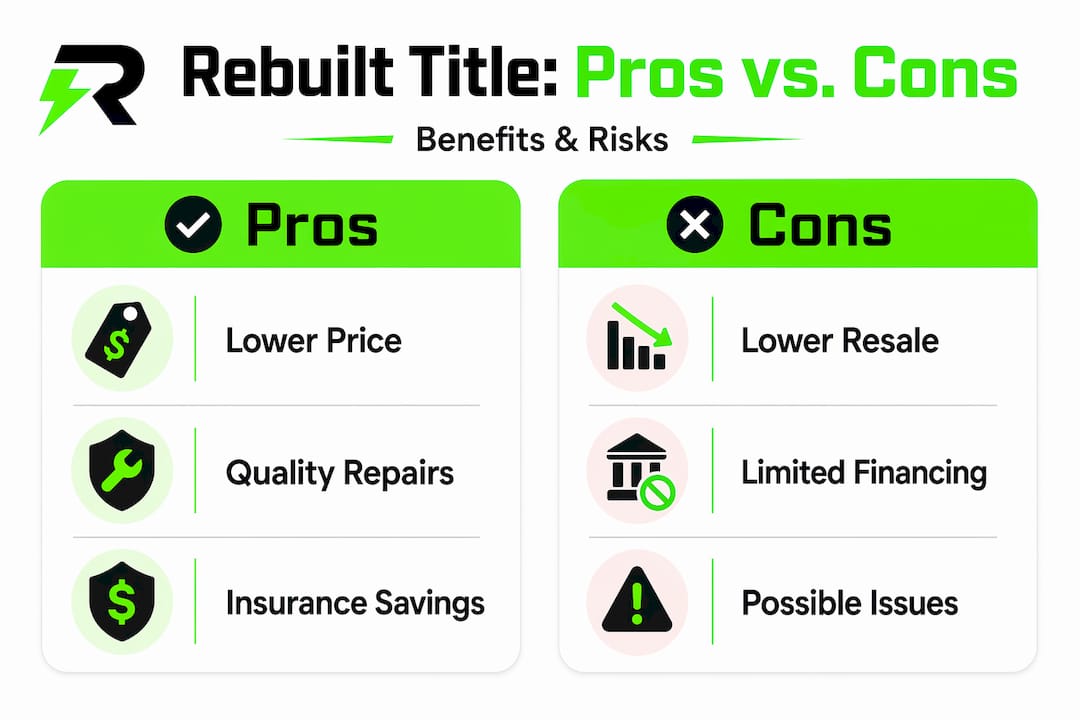
Short answer: the pros are price and transparency; the cons are resale value and a little extra homework.
| Pros | Cons |
|---|---|
| Roughly 20 to 40 percent below clean-title price. Across 17,000-plus sales tracked by ReVroom, buyers saved a median of $4,590 (snapshot updated October 1, 2026). | Lower resale value. The brand is permanent, so your buyer gets a discount too. |
| A state inspection the clean-title car never had to pass after its own repairs. | A few more phone calls for insurance and financing than a clean-title car. |
| The history is disclosed. A clean title only means no insurer wrote the car off; it says nothing about what was repaired out of pocket. | You have to read the repair records instead of assuming. |
| Newer model years save the most: a 2023 rebuilt saves a median of about $6,537. | Some factory warranties exclude branded titles; check the booklet for your make. |
One number worth knowing: 87 percent of rebuilt title vehicles sold on ReVroom carried only a minor or moderate history grade. On ReVroom, 81.9% of rebuilt vehicles with documented history analysis had a collision history, 10.4% hail and 3.4% vandalism. Read are rebuilt titles bad? for the longer answer.
Should you buy a rebuilt title car from a dealer or a private seller?
Short answer: a rebuilt title dealership gives you the paperwork, the lender, and a warranty option under one roof; a private seller usually gives you the lower price. Both are good buys when the history is disclosed.
There are two kinds of dealers in this market and they are not the same. A clean-title lot takes a rebuilt car on trade, has no way to retail it, and sends it to auction. A rebuilt title dealership buys, repairs, or sources these cars on purpose, retails them every day, and knows exactly what a minor hail history is worth versus a structural one. That is the dealer you want. It is also, by the way, the dealer that pays the most if you ever sell one; we cover that in what dealerships really offer for rebuilt title trade-ins.
| Rebuilt title dealership | Private seller | |
|---|---|---|
| Price | Retail, priced against the rebuilt market | Usually a little lower |
| Paperwork | Repair records, inspection certificate, and title usually on file | Varies; ask for everything |
| Financing | Lenders who already accept rebuilt titles | You arrange it (one application reaches several lenders through ReVroom) |
| Warranty | Often offered, sometimes included; disclosed on the storefront | None unless a third-party plan |
| Protection | Licensed dealer, state consumer rules apply | As-is |
What should a rebuilt title dealer show you before you buy?
Short answer: the history, the repairs, the inspection, the title, and the fees. A good dealer has all five ready before you ask.
- What the history was. Not "it was in an incident." Hail, collision, water, theft recovery, and which corner or panel. The history type tells you where to look on the car.
- What was repaired and by whom. The shop invoice and parts list. Photos of the car before repair where they exist.
- The state inspection certificate. The actual paperwork with the date and the station, not a verbal "it passed."
- The physical title. The brand on the state title is the authoritative record; match it to any history report you pull.
- The fee and warranty disclosure. Doc fees, add-ons, and what the warranty covers, in writing, before the numbers are on the desk.

On ReVroom, every listing shows what was repaired, with photos where they are available, and its title status, and a Verified Seller badge means the dealership completed ReVroom's onboarding with its business address, phone, and fee disclosure on file. If you want the history graded before you visit, a ReVroom Report shows the in-house severity grade, a severity graphic, the estimated savings, and where and when the car was auctioned. Then book an independent pre-purchase inspection; our guide to buying a rebuilt car safely covers what the shop should check.
Do dealerships sell rebuilt title cars?
Short answer: some do, and the ones that do it well specialize in them. Most franchise and clean-title lots do not keep rebuilt cars on the front line. They send branded trade-ins to auction, so the rebuilt cars you find at a dealership are usually on lots that retail them every day.
That split is good news for you. A dealer who sells rebuilt cars every week knows what they are worth, knows which histories buyers are comfortable with, and is used to answering the question you are about to ask. Here is how the two kinds of lots usually compare:
| What you want to know | Rebuilt title specialist | Franchise or clean-title lot |
|---|---|---|
| Keeps rebuilt cars for retail? | Yes, it is the core of the business | Rarely, branded trade-ins usually go to auction |
| Can explain the history on each car? | Usually, it is part of every sale | Varies |
| Where to find them | Verified rebuilt title dealers by state | Any used-car listing site, with a careful read of the title line |
ReVroom's directory listed 26 verified rebuilt title dealers in 14 states on October 3, 2026, as published. The largest state lists on that date:
| State | Verified dealers (as published) |
|---|---|
| Utah | 5 |
| California | 4 |
| Florida | 4 |
| Delaware | 2 |
| New Jersey | 2 |
| Alabama, Illinois, Kentucky, Louisiana, Michigan, Minnesota, Pennsylvania, Texas, Washington | 1 each |
Not near any of them? The full marketplace has dealer and private listings nationwide. If you are shopping for a family hauler, start with rebuilt title SUVs.
Do dealerships buy rebuilt title cars?
Short answer: yes, and the best offer usually comes from a dealer who sells rebuilt cars for a living. A clean-title store will often take one on trade, but it prices in a trip to auction. A rebuilt title dealership prices it against its own retail shelf, so it can often pay more.
Think of a used bookstore and a general store. Both might take your box of books. Only one of them knows exactly which shelf each book goes on, and that one pays better.
| Who is buying | What they usually do with a rebuilt title car | What that means for the offer |
|---|---|---|
| Franchise or clean-title dealer | Takes it on trade, then usually sends it to a dealer auction | Priced for the auction exit, so often the lowest number |
| Rebuilt title dealership | Reconditions it and retails it on its own lot | Priced against retail, often a stronger offer |
| Private buyer | Drives it | Highest price, most of the work is yours |
If you own the car, the rebuilt title trade-in guide walks through the numbers. If you run a lot that takes branded trade-ins, our guide to what dealers do with trade-ins shows where each one goes.
How do you find a rebuilt title dealer near you?
Short answer: start with the directory. ReVroom lists verified rebuilt title dealers by state, and every storefront shows the dealer's live inventory, address, phone, and warranty and fee disclosure.
As of October 3, 2026 the directory covers 26 verified dealers in 14 states, as published, with storefronts in California, Florida, Utah, New Jersey, Kentucky, and more. Every listing on a storefront carries the repair history, so you can compare two dealers' cars side by side before you drive to either one. If your state is not on the list yet, the full marketplace shows dealer and private listings nationwide, and you can filter by history type and severity grade.
Can you finance and insure a rebuilt title car from a dealer?
Short answer: yes and yes. The dealer usually has a lender who already says yes to rebuilt titles, and most major insurers write coverage on them.
Financing. Some banks decline rebuilt titles outright. Credit unions and lender networks accept them, often at a slightly higher rate or a lower loan-to-value than a clean-title car. Rebuilt title dealerships know which lenders those are. If you would rather have offers in hand before you walk in, one application through ReVroom's financing page reaches several lenders at once. ReVroom is not a lender.
Insurance. Liability coverage is available from essentially every carrier, and most major insurers write full coverage on rebuilt titles. A few ask for a photo inspection first or price the car a little differently, so get two or three quotes by VIN before you sign. Claim payouts reflect the rebuilt-title market value, which is one more reason to pay a fair rebuilt price rather than a marked-up one. Our guide to which insurers cover rebuilt title cars names the carriers.
Our perspective: the smart way to buy from a dealer
The buyers who win in this market treat it like a puzzle. They read the repair records, they look at the inspection certificate, they call the insurer with the VIN, and they buy from the dealer who put all of that on the table without being asked. The rebuilt label makes some people flinch. Plenty of clean-title cars on any lot have been repaired out of pocket with nothing written down. With a rebuilt title, the history is out in the open, and a good dealer treats that as a selling point, because it is one.
Run a rebuilt title dealership? How do you get listed as a verified dealer?
Short answer: the buyers reading this page are looking for you, and getting listed is free. As published on the directory on October 3, 2026, dealers list their inventory free, with unlimited listings and no per-listing fees, and a verified dealer's storefront appears on the directory automatically.
Here is what "verified" means on ReVroom, quoted from the dealer directory: a verified dealership is "a licensed dealer that completed ReVroom's onboarding with its business address, phone and fee disclosure on file." Verified dealers carry the Verified Seller badge on their storefront and on every listing.
| What a buyer sees | Why it helps you sell |
|---|---|
| Your storefront on the state page of the directory | Buyers searching "rebuilt title dealers near me" land on a list, not a single lot |
| The Verified Seller badge on every listing | Address, phone and fee disclosure on file answers the first trust question |
| History type and severity grade on each car | Buyers can filter to the cars they are already comfortable with, so the leads arrive warmer |
Twenty-six dealers in 14 states were listed on October 3, 2026, and five of them were in Utah. If your state is not on the list yet, your storefront would be the first one buyers there see. Start your free dealer listing on ReVroom. Selling online for the first time? Our guide on how to sell rebuilt title cars online as a dealer covers the listing side.
Take the next step with ReVroom
ReVroom is the only marketplace built for rebuilt and branded title cars, and the only one where you can filter by history type and severity grade. Every listing shows what was repaired, with photos where they are available, and its title status.
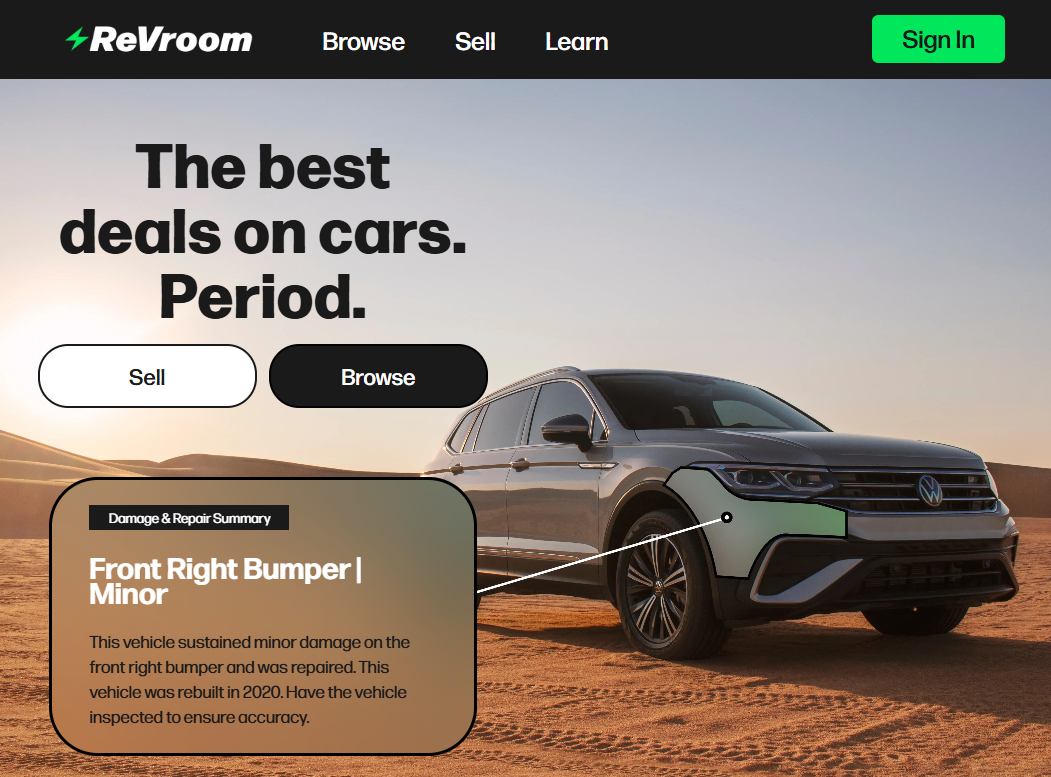
Find a verified rebuilt title dealer in your state, or browse every rebuilt title car for sale and let the transparency do the talking.
Frequently asked questions
Is it a good idea to buy a rebuilt title car from a dealer?
Yes, when the dealer discloses the vehicle history and the car passed its state rebuilt inspection. A rebuilt title dealership retails these cars every day, knows the values, and usually has the repair paperwork, financing, and a warranty option in the building.
What are the pros and cons of a rebuilt title?
Pros: roughly 20 to 40 percent below clean-title price, a state inspection a clean-title car never had to pass, and a history that is disclosed instead of hidden. Cons: lower resale value, a few more phone calls for insurance and financing, and the homework of reading the repair records.
Do dealerships sell rebuilt title cars?
Some do. Rebuilt title specialists retail them every day, while most franchise and clean-title lots send branded trade-ins to auction. Find verified ones on ReVroom's dealer directory by state.
What should a rebuilt title dealer show you before you buy?
What the history was, what was repaired and by whom, the state inspection certificate, the physical title, and the dealer's fee and warranty disclosure. On ReVroom, verified dealers publish the repair history on every listing and their fee disclosure on their storefront.
How do I find a rebuilt title dealer near me?
ReVroom lists verified rebuilt title dealers by state, each with live inventory, address, phone, and warranty and fee disclosure.
Can I get full coverage insurance on a rebuilt title car from a dealer?
Usually yes. Liability is available everywhere and most major insurers write full coverage on rebuilt titles; a few ask for a photo inspection first or price the car a little differently, so compare two or three quotes.
Is it harder to finance a rebuilt title car from a dealer?
A little. Some banks decline rebuilt titles while credit unions and lender networks accept them. Rebuilt title dealerships usually have lenders who already say yes, and one application through ReVroom's financing page reaches several at once. ReVroom is not a lender.
Do all states require an inspection before issuing a rebuilt title?
Nearly all states require an inspection after repairs before a rebuilt title is issued, and the requirements vary by state. Passing it is what makes the car legal to register and drive again.
How does a dealership get listed as a rebuilt title dealer on ReVroom?
By signing up at revroom.org/marketplace/dealer-welcome. Listings come with unlimited inventory and no per-listing fees, as published, and the dealer's storefront appears in the directory automatically once onboarded.
Do dealerships buy rebuilt title cars?
Yes. Clean-title dealers often take them on trade and send them to auction, while rebuilt title dealerships buy them to retail and can often pay more. Getting an offer from both is the easiest way to see the gap.
How does a rebuilt title dealer get listed on ReVroom?
Through the free dealer onboarding at revroom.org/marketplace/dealer-welcome. As published, listing is free with unlimited listings and no per-listing fees, and a verified dealer's storefront appears on the rebuilt title dealers by state page automatically.
How many verified rebuilt title dealers are on ReVroom?
26 verified rebuilt title dealers in 14 states on October 3, 2026, as published on the directory, with Utah, California and Florida listing the most.
Recommended
- Where to Buy Rebuilt Cars | ReVroom
- Do Dealerships Take Rebuilt Title Trade-Ins? | ReVroom
- Buying a Rebuilt Title Car: The Step-by-Step Buyer's Guide | ReVroom
- Are Rebuilt Titles Bad? | ReVroom
- How Much Does a Rebuilt Title Affect Value? | ReVroom
- What Insurance Companies Cover Rebuilt Title Cars? | ReVroom
