


Rebuilt title cars: what it really means for budget buyers
May 7, 2026
TL;DR:
- A rebuilt title indicates a vehicle was declared a total loss, repaired, and passed inspection, not necessarily catastrophically damaged. Many rebuilt titles result from relatively minor events like hail or theft recovery, offering opportunities for well-documented, reliable used cars at a significant discount. Buyers should thoroughly verify repair records, inspection reports, and understand their state’s inspection standards to make informed, confident purchases.
Three words stop budget car shoppers cold every time: “rebuilt title vehicle.” Most people read that label and assume the worst, picturing a car held together with wishful thinking and zip ties. But that picture is almost never accurate, and letting it scare you off could mean missing out on one of the smartest buying opportunities in the used car market today.
Table of Contents
- What does a rebuilt title mean?
- Does a rebuilt title mean a car was totaled?
- How does a vehicle get a rebuilt title?
- Risks and benefits of rebuilt title cars
- Smart strategies for budget buyers considering rebuilt title cars
- A fresh perspective on rebuilt title cars
- Transparent resources for rebuilt title buyers
- Frequently asked questions
Key Takeaways
| Point | Details |
|---|---|
| Rebuilt title doesn’t equal permanent damage | A rebuilt title means repaired damage and passes inspection, not necessarily permanent issues. |
| Totaled is often a financial decision | Cars are ‘totaled’ by insurers mainly for cost reasons, not always due to severe structural damage. |
| Value if you do due diligence | Rebuilt title vehicles offer significant savings if buyers verify repairs and documentation. |
| Know the risks and insurance challenges | Expect possible insurance limitations and hidden repair risks when considering rebuilt title cars. |
What does a rebuilt title mean?
A rebuilt title is an official designation assigned to a vehicle that was previously declared a total loss by an insurance company, then professionally repaired and inspected to meet state roadworthiness standards. Think of it less as a scarlet letter and more as a vehicle’s honest biography. The car went through something, got fixed, passed inspection, and earned the right to hit the road again.
Here is what that process generally looks like in plain terms:
- An insurance company declares the vehicle a total loss based on repair cost relative to the car’s market value.
- The vehicle title is reclassified to reflect its history.
- A repair professional or owner completes the necessary repairs.
- The vehicle undergoes a state inspection to confirm it meets safety and operational standards.
- Once it passes, the state issues a rebuilt title, and the car is legal to register, drive, and sell.
A rebuilt title does not describe the severity of what happened to the car. It describes the fact that the car was repaired and cleared for use after a total loss declaration.
It is also worth clearing up one of the most common mix-ups in the car world. There is a meaningful difference between a vehicle that carries a rebuilt title and one that is in a completely different classification category. Understanding the salvage vs. rebuilt title distinction is foundational before making any purchase decision. They are two separate designations, and treating them as the same thing leads to bad assumptions and missed opportunities.
The bottom line: a rebuilt title tells you a car has a story. It does not tell you the story ends badly.
Does a rebuilt title mean a car was totaled?
With the basics explained, let’s tackle the heart of the matter: does a rebuilt title always mean a car was totaled?
Technically, yes. A rebuilt title does follow a total loss determination. But here is where most buyers go wrong: they assume “totaled” means catastrophically destroyed. It does not. Insurance companies determine total loss based on a straightforward financial calculation. If the estimated repair cost exceeds a set percentage of the car’s actual cash value, typically somewhere between 51% and 80% depending on the state, the insurer declares it a total loss. The car itself might look nearly fine.
Here is a helpful comparison to put the range in perspective:
| Situation | Total loss declared? | Rebuilt title possible? |
|---|---|---|
| Hail damage across the body | Often yes | Yes |
| Theft recovery with minor wear | Sometimes | Yes |
| Front-end collision with airbag deployment | Often yes | Yes |
| Flood exposure with interior damage | Yes | Yes, with proper repairs |
| Fender bender on an older, lower-value car | Sometimes | Yes |
| Severe structural frame damage | Yes | Possible, but rare to pass inspection |
Notice that the word “catastrophic” does not appear anywhere on that list. Many rebuilt title vehicles got their designation from events that are more inconvenient than catastrophic. A hailstorm can total an older vehicle purely because the cosmetic repair cost outpaces the car’s market value. A theft recovery vehicle might be in nearly perfect mechanical shape. These are real scenarios that produce rebuilt titles every day.
The reason it matters is this: buyers who automatically filter out rebuilt title vehicles based on fear alone eliminate a huge portion of legitimately well-repaired, carefully inspected cars from their search results. As explained in more detail in the salvage title article, the financial logic of insurance companies does not always reflect actual vehicle condition.
Pro Tip: When you see a rebuilt title listing, ask specifically what event triggered the total loss declaration. The answer tells you far more than the title label itself ever could.
How does a vehicle get a rebuilt title?
To understand how rebuilt titles emerge, let’s walk through the process from its earlier classification to rebuilt status.
The path from a total loss declaration to a rebuilt title involves real oversight. This is not a casual process. Here is how it typically unfolds:
- Insurance declares total loss. Based on repair estimates versus market value, the insurer pays out the claim and takes ownership of the vehicle.
- Vehicle is sold or transferred. The car typically goes to an auction or is retained by the owner who accepts a reduced payout.
- Repairs are completed. A licensed repair shop or a skilled private owner completes the necessary work to bring the vehicle back to operational condition.
- Documentation is gathered. Receipts, photos, parts records, and repair details are compiled.
- State inspection is scheduled. The repaired vehicle is brought to a state-authorized inspector who evaluates whether it meets safety and equipment standards.
- Rebuilt title is issued. If the vehicle passes, the state motor vehicle agency issues a rebuilt title in the owner’s name.
- Vehicle is registered and cleared for road use. The car is now legally drivable, insurable, and sellable.
What makes this process particularly important for buyers is the variation between states. Some states require a very thorough inspection process with multiple checkpoints. Others have lighter requirements. Here is a general sense of how that variation shakes out:
| State inspection standard | What it typically covers | Buyer implications |
|---|---|---|
| High scrutiny states | Structural integrity, safety systems, lighting, VIN verification | Stronger assurance for buyer |
| Moderate scrutiny states | Basic safety systems, operational checks | Reasonable assurance with buyer due diligence |
| Lower scrutiny states | Minimal operational verification | Buyer should be especially thorough |
That variation is exactly why your own inspection matters, regardless of what the title says. The rebuilt title car guide walks through what to look for based on where you are buying. The process has structure. Your job is to verify it was followed well.
Risks and benefits of rebuilt title cars
Knowing the process, it is crucial to weigh the actual risks and benefits of rebuilt title vehicles.
Let’s start with the good news. Rebuilt title cars typically sell for 30% to 50% less than comparable clean title vehicles. That is a real, significant price advantage. On a $25,000 car, that means you could be looking at a purchase price of $12,500 to $17,500 for a vehicle that functions the same way on the road. That is not a small gap.
Buyers who do their homework on rebuilt title vehicles consistently report saving thousands of dollars compared to clean title equivalents, while driving cars that perform reliably day to day.
The rebuilt title car benefits are real and well-documented for buyers who approach the process with preparation. But they come with some important caveats worth knowing.
Potential risks to evaluate carefully:
- Undocumented repair work. If a seller cannot provide detailed repair records, that is a red flag worth taking seriously.
- Varying repair quality. Not every repair is performed to the same standard. Some are meticulous. Others are cosmetic fixes that mask deeper issues.
- Resale value. Rebuilt title vehicles typically retain less resale value than clean title cars, which matters if you plan to sell in a few years.
- Insurance payout considerations. Some insurers base payouts on rebuilt title market value, which can be lower than what you paid if you bought from a seller who overpriced the vehicle. This is why knowing the estimated discount matters before you buy.
On the insurance question specifically, there is a persistent myth worth busting: rebuilt title cars are not difficult to insure. Most major insurance providers have no issue covering them. The rebuilt title car insurance landscape is broader than many assume. The key is transparency about the vehicle’s history, which makes the coverage process smoother for everyone.
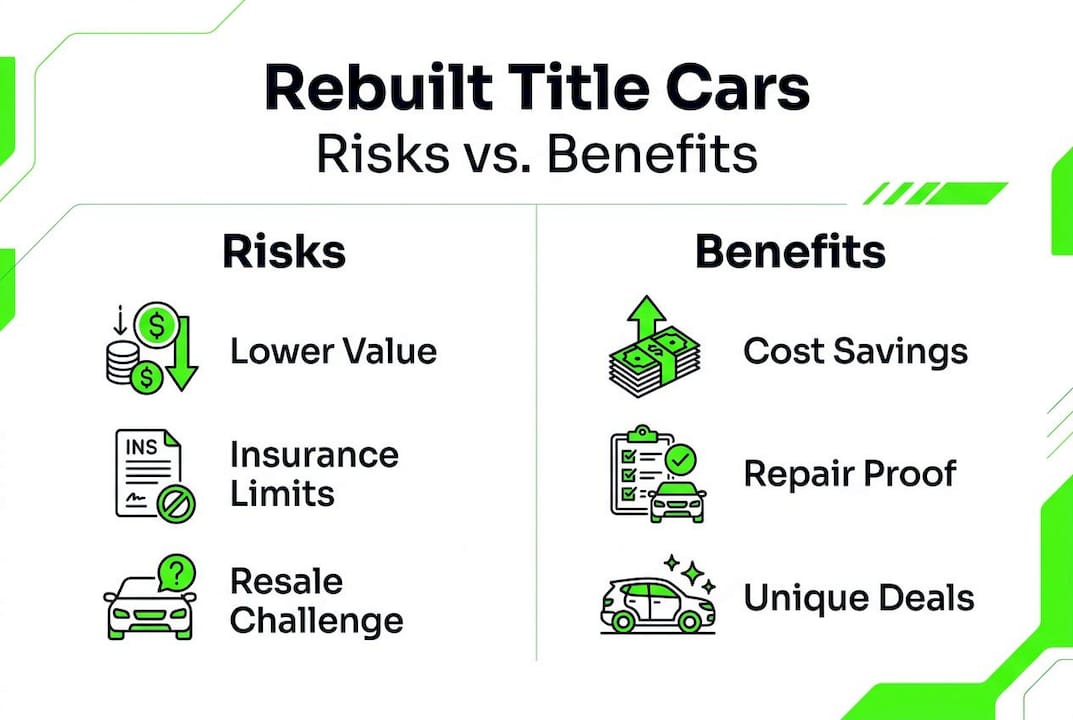
The rebuilt title car risks are manageable when you go in with accurate information. Skipping the due diligence is the actual risk. The rebuilt title label is not.
What to evaluate before any purchase:
- Full repair documentation and photos of the vehicle’s condition before repairs
- State inspection certificate and pass date
- Independent mechanic inspection of the specific vehicle
- Estimated market discount compared to clean title equivalent
- Complete vehicle history report
Smart strategies for budget buyers considering rebuilt title cars
To finish, let’s focus on smart buying methods that help budget-conscious shoppers get the best value from rebuilt title vehicles.
The difference between a buyer who walks away happy and one who regrets the purchase almost always comes down to preparation. Here is what the prepared buyer does:
- Requests everything in writing. Verbal assurances mean nothing. Demand repair records, receipts, inspection certificates, and photos of the vehicle before repairs were completed.
- Gets an independent inspection. A pre-purchase inspection from a mechanic who has no stake in the sale is non-negotiable. Budget around $100 to $200 for this. Given the savings you are pursuing, it is a small investment for serious peace of mind.
- Researches comparable prices. Know what the same year, make, and model sells for with a clean title. A rebuilt title vehicle should reflect a meaningful discount. If the gap is tiny, walk away.
- Understands what triggered the total loss. Hail damage is very different from a front-end collision. Ask directly. If the seller does not know or will not say, that tells you something.
- Checks state inspection standards. Understanding what was and was not checked in your state helps you know where to focus your own due diligence.
- Negotiates from a position of knowledge. The more you know about the vehicle’s history, the better positioned you are to make a fair offer rather than overpaying out of uncertainty.
Pro Tip: Use the estimated price discount as your baseline. A rebuilt title car priced only 10% below clean title equivalent is not a good deal. A car priced 35% to 50% below with solid documentation and a passed inspection? That is worth a very serious look.
For a deeper walkthrough of the purchasing process, the guide on how to buy a rebuilt title car smartly covers negotiation, documentation, and inspection in detail. And if you want a broader framework before you start shopping, the rebuilt title buying guide is an excellent starting point.
A fresh perspective on rebuilt title cars
Here is an honest observation that most automotive content will not say out loud: the rebuilt title stigma benefits the very people selling clean title cars at full markup.
Think about it. When buyers reflexively avoid rebuilt title vehicles, demand for clean title cars stays artificially high, and sellers can maintain premium pricing even on vehicles that also carry undisclosed histories. A clean title does not guarantee a pristine past. It simply means no insurer declared the car a total loss. Many clean title cars have been in accidents that were repaired and never reported, carrying zero documentation and zero transparency.
A well-documented rebuilt title vehicle with repair photos, inspection records, and verifiable history is, in many ways, the more transparent purchase. You know what happened. You can see what was fixed. You have paperwork. Compare that to a clean title car where you are trusting a CarFax that may not capture every incident.
The buyers who consistently find value in rebuilt title vehicles are not risk-tolerant gamblers. They are informed, methodical shoppers who follow the evidence rather than the label. They understand that the word “rebuilt” describes a process, not a verdict. And they walk away saving thousands that other buyers left on the table out of avoidable fear.
The rebuilt title car benefits are genuinely compelling for anyone willing to look past the label and into the details. That willingness to look closer is exactly what separates a smart buy from a missed opportunity.
Transparent resources for rebuilt title buyers
Finally, for those ready to take practical steps, here is where to find transparent rebuilt title car resources.
Knowing what a rebuilt title means is only half the equation. Finding listings that actually give you the full picture is where most buyers hit a wall. Traditional platforms list rebuilt title cars with minimal context, leaving you to spend your own time and money tracking down history and repair documentation.

ReVroom was built specifically to solve that problem. Every listing on ReVroom includes vehicle history information and photos of what the car looked like before repairs, so you can evaluate what you are actually buying without spending an average of $150 per vehicle on outside reports. The transparency is built in. You get to focus on finding the right car, not piecing together a puzzle. For budget buyers who want confidence without the guesswork, that kind of upfront clarity changes everything about the process.
Frequently asked questions
Can a rebuilt title car be insured like a regular vehicle?
Most rebuilt title cars can be insured without significant difficulty, though some providers may offer different coverage terms or base payouts on the rebuilt title market value. Working with an insurer familiar with rebuilt vehicles and maintaining thorough documentation makes the process straightforward for most buyers, as outlined in the Vehicle Insurance Checklist 2026 Guide.
Does a rebuilt title always mean the car was in a major accident?
No. A rebuilt title simply reflects that an insurer declared the vehicle a total loss and that it was subsequently repaired and inspected. The triggering event could range from hail or flood damage to a theft recovery situation, none of which necessarily involve a major collision.
Is a rebuilt title car safe to drive?
Many rebuilt title cars are safe when repairs have been performed properly and the vehicle has passed a state inspection, but no title label replaces a thorough independent inspection before purchase. Always verify documentation and have a trusted mechanic evaluate the vehicle in person.
What paperwork should I request when buying a rebuilt title car?
Request complete repair records with receipts, before-and-after photos of the vehicle’s condition, the state inspection certificate, and the full vehicle history. This documentation protects your investment and gives you the clearest possible picture of what you are buying.
