


NADA rebuilt title value: a smart buyer's guide to savings
May 14, 2026
TL;DR:
- Rebuilt title vehicles typically sell for 20% to 40% less than comparable clean-title cars, depending on repair quality and documentation.
- NADA and other guides evaluate rebuilt titles on a case-by-case basis, considering repair quality and vehicle history rather than applying a fixed discount.
- Building a true value involves assessing the baseline clean-title price, repair documentation, VIN history, and independent inspection results.
You’ve found a car you love, the price seems almost too good to be true, and then you notice it: rebuilt title. Suddenly, questions flood in. How much is this car actually worth? Does NADA have a rebuilt title discount I can look up? Is the seller pricing it fairly? These are smart questions, and the honest answer might surprise you. There is no single, universal NADA rebuilt title value you can plug into a calculator. The real picture is more nuanced than that, and understanding it could save you thousands of dollars or steer you away from a bad deal.
Table of Contents
- How NADA and guides really value rebuilt titles
- Rebuilt vs clean vs branded title: Typical price differences
- Why rebuilt title value isn’t a fixed formula
- Insurance and financing: How title branding shapes your options
- Don’t confuse diminished value with rebuilt title price cuts
- The real opportunity (and risk) for budget buyers: What most miss about rebuilt title value
- Find more rebuilt title resources and support
- Frequently asked questions
Key Takeaways
| Point | Details |
|---|---|
| No single NADA discount | NADA does not publish one set rebuilt title value; it depends on the vehicle’s condition and repair quality. |
| Typical rebuilt discount | Expect rebuilt title cars to be valued 20%–40% below clean title equivalents. |
| Condition and documentation | Thorough inspection and full repair records are essential for fair rebuilt title values. |
| Financing and insurance impact | Branded titles limit insurance choices and often make financing harder to secure. |
| Diminished value isn’t the same | Diminished value claims apply only to accident-repaired clean-title cars, not rebuilt-title vehicles. |
How NADA and guides really value rebuilt titles
To truly understand “NADA rebuilt title value,” let’s start with what NADA and other car value sources actually provide and what they don’t.
Many buyers assume they can pull up the NADA guide, find a “rebuilt title” row, and subtract a fixed percentage. That row does not exist. According to the NADA Used Car Guide, NADA does not publish a universal rebuilt title discount factor. Instead, the guide organizes trade-in values around condition categories:
- Clean trade-in value: A well-maintained vehicle with no mechanical issues and minimal cosmetic wear
- Average trade-in value: Normal wear and tear for its age, minor cosmetic issues, clean title
- Rough trade-in value: Significant mechanical or cosmetic issues that require attention before resale
Rebuilt title vehicles are evaluated individually, not slotted into a separate category. A dealer, lender, or insurer looks at the car’s specific history, the quality of repairs, and available documentation before assigning value. The title brand is a factor, but it is not the formula.
“Rebuilt-title impacts are handled per-vehicle via the branded-history/condition reality and dealer/lender use of the guide.” That one sentence changes everything for budget-conscious buyers who expect a clean, printable number.
This is actually good news. It means a meticulously repaired vehicle with thorough documentation can land much closer to clean-title value than a comparable car with sloppy repairs and no paperwork. Our rebuilt title car value guide walks through exactly how to read these variables and apply them to a real purchase decision.
Rebuilt vs clean vs branded title: Typical price differences
Now that you know there is no universal NADA deduction, let’s look at how rebuilt and branded title vehicles actually stack up in the market.
The data tells a consistent story. Rebuilt title cars typically sell for 20% to 40% below a comparable clean-title car, with the exact number depending on vehicle make, model, age, repair quality, and available documentation. Vehicles carrying a branded title that has not yet been rebuilt trade even lower, sometimes significantly so.
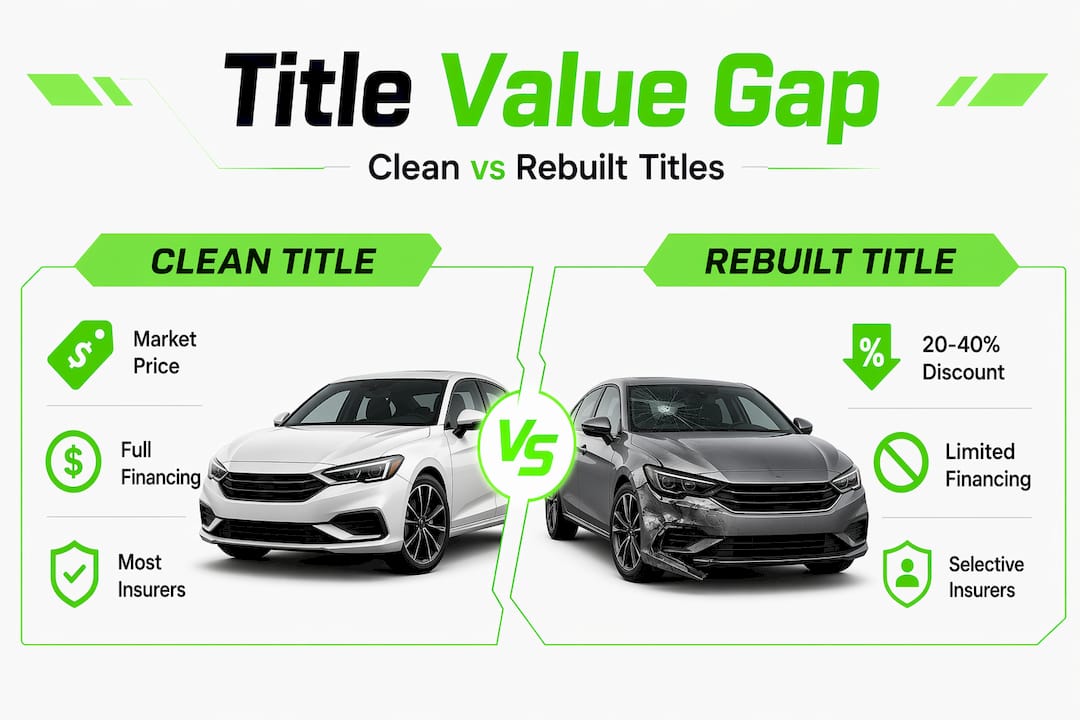
Here is a simplified comparison:
| Title type | Typical discount vs. clean title | Financing availability | Notes |
|---|---|---|---|
| Clean title | 0% (baseline) | Widely available | May still have accident history |
| Rebuilt title | 20%–40% below | Limited but possible | Repaired and road-ready |
| Unrepaired branded title | 40%–50%+ below | Very limited | Not the same as rebuilt |
A few things worth calling out from that table:
- Clean title does not guarantee a damage-free past. Many clean-title vehicles have accident histories that never triggered a total-loss declaration.
- Rebuilt title sits well above unrepaired branded title in value, because the car has passed a state inspection and is legally road-ready.
- The 20%–40% range is wide on purpose. KBB’s guidance reflects this same range as a rule of thumb, with the caveat that case-by-case appraisal is always needed for precision.
Statistic callout: A rebuilt title vehicle priced at the midpoint of that discount range on a $30,000 clean-title equivalent could mean $9,000 in savings. That is a real number that changes what is possible for a buyer on a budget.
The discount is also not static over time. As a rebuilt car ages, the title brand matters less relative to its overall condition. A well-maintained rebuilt title vehicle that is eight years old competes on different terms than one that is two years old. Explore rebuilt vs clean title price differences to see how these dynamics play out across vehicle ages and classes. You can also read more about whether rebuilt titles are worth it before you commit to any decision.
Why rebuilt title value isn’t a fixed formula

Seeing the real discounts in the market, it is crucial to grasp what else can drive rebuilt title value up or down for your specific car.
Think of the title brand as a starting point, not a finish line. The actual value of any rebuilt vehicle depends on a layered set of factors that go well beyond what any guidebook can capture. Appraisal experts consistently note that the smart approach is to treat rebuilt title value as a range tied to three things: the clean-title baseline, the specific title tier, and the quality of repairs and their documentation.
Here is how to build your own value picture:
- Start with the clean-title baseline. Look up the clean-title trade-in value for the same make, model, trim, year, and mileage on NADA, KBB, or Edmunds. This is your ceiling.
- Apply the title discount range. Use 20%–40% as your realistic working range and calculate both ends. This gives you a floor and a midpoint to negotiate around.
- Evaluate repair quality objectively. Ask for shop receipts, photographs taken before and after repairs, and any inspection documents. Quality repairs with clear documentation push the value toward the lower end of the discount (meaning you pay more, but for good reason).
- Run the VIN history. A vehicle history report is a non-negotiable step. Cross-reference it with the seller’s claims.
- Factor in an independent inspection. A pre-purchase inspection (PPI) from a trusted mechanic gives you leverage in negotiations and protects you from surprises.
- Negotiate based on evidence. If documentation is thin or repairs look questionable, push toward the deeper end of the discount range. If the car is exceptionally well-documented, you may find the seller’s asking price is fair.
Pro Tip: Never let a seller’s asking price be your starting point for negotiation. Build your own value estimate using the steps above and enter the conversation with a number grounded in real data. Sellers who resist providing documentation are telling you something important.
Our guide to rebuilt title cars breaks this process down step by step, and how to buy rebuilt title vehicles wisely covers the negotiation side in detail.
Insurance and financing: How title branding shapes your options
There is one more critical piece in rebuilt title value: how the title brand changes your financing and insurance landscape and your real total costs.
This is where some buyers get caught off guard. The sticker savings look great on paper, but the full cost of ownership includes insurance premiums, financing terms, and resale value down the road. It is worth knowing the landscape before you sign anything.
| Factor | Clean title | Rebuilt title |
|---|---|---|
| Insurance availability | Broad, competitive | Variable by carrier |
| Comprehensive/collision coverage | Standard | Depends on insurer |
| Financing from major lenders | Widely available | Limited options |
| Interest rates | Standard market rates | May be higher |
| Resale liquidity | High | Moderate |
A few honest notes on each:
- Insurance: Most insurance providers can and do cover rebuilt title vehicles. The myth that rebuilt cars are uninsurable is just that, a myth. That said, some carriers limit coverage options or charge higher premiums. It is worth shopping around before you buy, not after.
- Payout risk: If a rebuilt car is totaled, the insurer pays market value for a rebuilt title car. If you overpay, you could receive less than you paid. This is exactly why buying at the right price matters so much.
- Financing: Many traditional lenders are cautious about rebuilt title vehicles. You may need to explore credit unions, specialty lenders, or plan for a cash purchase.
Pro Tip: Before you fall in love with a specific car, call your insurance agent and ask whether they cover rebuilt titles and under what terms. Do the same with your lender. Knowing this upfront keeps the math honest.
You can go deeper on each of these topics through ReVroom’s resources on insurance for rebuilt title cars, financing rebuilt cars, the risks of buying rebuilt title vehicles, and the full insurance and financing guide.
Don’t confuse diminished value with rebuilt title price cuts
Some buyers try to use court formulas meant for post-accident value drop. Let’s clarify that pitfall now.
If you have ever researched car values after an accident, you may have encountered the term “diminished value.” It sounds related to what we are discussing, but it is a completely different concept and mixing them up can cost you money or credibility at the negotiating table.
Here is the core difference:
- Diminished value applies to vehicles that were repaired after an incident and kept a clean title. The car’s market value drops because of its accident history, even though the title remains clean. Owners can sometimes file a claim against the at-fault party’s insurance to recover this lost value.
- Rebuilt title discounts reflect a permanent, recorded change in the vehicle’s legal history. The title brand is public record and follows the car forever.
KBB outlines the diminished value estimation process using a formula that includes a base market value, a damage multiplier, and a mileage multiplier. This framework, sometimes called the 17c formula, was designed for insurance claims on clean-title vehicles. It is not a tool for pricing rebuilt title cars, and using it as one will give you numbers that don’t reflect reality.
Why does this matter for buyers? Because some sellers or online pricing tools may conflate these concepts. If someone quotes you a price based on diminished value logic rather than a rebuilt-title adjusted baseline, the math is almost certainly wrong. Stick to the transparent approach: clean-title baseline, realistic discount range, and documented repair quality. Our guide on how to save smartly with rebuilt cars covers this distinction in practical terms.
The real opportunity (and risk) for budget buyers: What most miss about rebuilt title value
Summing up your options, here is what most budget-focused buyers tend to overlook or get dead wrong about NADA rebuilt title value.
Most people approach rebuilt title cars looking for a reason to say no. The title brand sounds scary. The assumed history feels like a red flag. And so they walk away from vehicles that could have been genuinely excellent buys, while sometimes paying full price for clean-title cars that have just as complicated a past, hidden behind a cleaner label.
Here is the uncomfortable truth: the title brand is the most visible variable, but not always the most important one. Repair quality matters more. Documentation matters more. Transparency matters more. A rebuilt title vehicle with a clear vehicle history, high-quality professional repairs, and full photographic documentation can be a dramatically better investment than a clean-title car with a murky past and deferred maintenance.
What separates buyers who win in this market from those who regret their purchase is almost always the same thing: obsession over details. They asked for everything. They inspected in person. They did not let excitement override due diligence. And they understood that the discount is not a gift; it is a reflection of real market dynamics that they can navigate intelligently.
The risk is real and worth naming directly. A poorly repaired rebuilt vehicle, bought without inspection or documentation, can become an expensive problem. The discount does not protect you from that outcome. Your diligence does.
This is exactly the kind of buying the rebuilt title buyer’s guide was built to support: confident, informed, and eyes wide open.
Find more rebuilt title resources and support
Ready to use what you have learned about rebuilt title value for your next car? Here is where to go for more help.
ReVroom is the only online marketplace built specifically for rebuilt title vehicles. Every listing includes vehicle history information and photos of what the car looked like before it was repaired, so you can make the kind of informed, confident decision this guide has been preparing you for. No $150 investigation fees. No guesswork. Just the transparency you need, right in the listing.

Whether you are still researching or ready to start browsing, ReVroom puts real rebuilt title vehicles in front of budget-conscious buyers who know how to spot value. Explore listings, dig into the resources, and go further with every dollar you spend. Visit ReVroom to start your search today.
Frequently asked questions
How much less is a rebuilt title car worth compared to clean title?
A rebuilt title car typically sells for 20%–40% less than a clean-title equivalent, but the exact discount varies with vehicle condition and repair quality.
Does NADA publish a rebuilt title value?
NADA does not publish a universal rebuilt title value; it uses condition-based categories and considers each car’s history and repair quality individually.
Can I get normal insurance and financing for a rebuilt title car?
Insurance and financing can require more shopping around for rebuilt title cars, with some carriers and lenders offering different terms, though most major insurers can and do cover these vehicles.
What’s the difference between diminished value and a rebuilt title discount?
Diminished value applies to clean-title cars after incidents, while rebuilt title discounts apply to vehicles with permanent branded histories recorded on the title itself.
